

NEET Physics Previous Year Questions: Chapter-Wise Weightage Guide
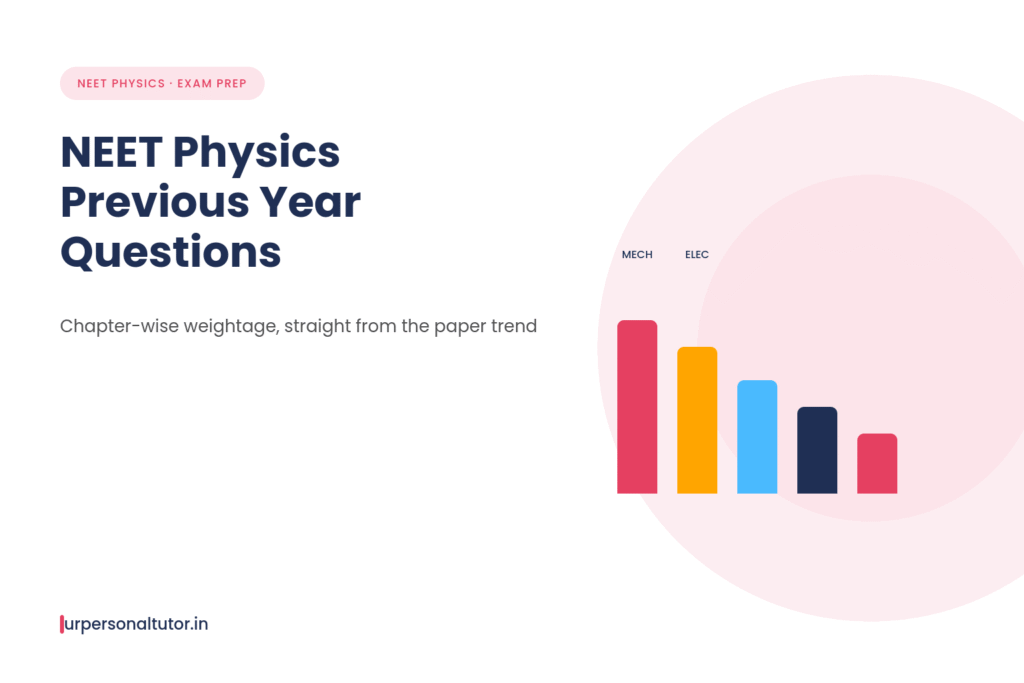
Mechanics and Electrodynamics Dominate NEET Physics Previous Year Questions If you go through a decade of NEET physics previous year questions, one pattern jumps out fast: Mechanics and Electrodynamics together account for roughly 45 to 50 percent of the paper most years. Modern Physics and Optics follow next, usually contributing another 20 to 25 percent combined. The remaining questions spread across Thermodynamics, Waves, Electrostatics-adjacent topics, and a handful of questions from Units and Measurements. That’s the direct answer. The rest of this guide breaks down exactly which chapters carry that weight, why the pattern holds year after year, and how to actually use it while you revise. How We Looked at the Physics Previous Year Question Paper NEET Trend Rather than guessing at what “feels” important, this breakdown comes from mapping every physics previous year question paper NEET has released and tagging each question by chapter. Patterns that repeat across five or more years get treated as reliable trends. A single unusual year gets discounted, since papers do shift occasionally to test different sub-topics within the same chapter. Class 11 and Class 12 physics are usually weighted close to 50-50 in NEET, though Class 12 chapters like Current Electricity, Electromagnetic Induction, and Semiconductor Devices tend to edge slightly ahead in recent years. Chapter-Wise Weightage From NEET Physics Previous Year Questions Here’s how the marks typically distribute across major units, based on multiple years of physics neet previous year questions chapter wise analysis. Mechanics (Class 11) Mechanics alone usually accounts for 10 to 12 questions. Laws of Motion, Work Energy and Power, and Rotational Motion appear almost every single year. Gravitation and System of Particles show up slightly less often but still contribute reliably. This unit rewards conceptual clarity over rote formula recall, since NEET tends to twist standard problems with small variations. Electrodynamics (Class 12) Electrodynamics is the single heaviest unit. Current Electricity and Magnetic Effects of Current are near-guaranteed every year, often worth 8 to 10 marks combined. Electromagnetic Induction and Alternating Current questions appear slightly less frequently but still show up in most recent papers. Anyone serious about scoring well needs this unit locked down cold. Modern Physics Modern Physics questions are shorter and more formula-driven, which makes them efficient to prepare. Dual Nature of Matter, Atoms, and Nuclei together typically contribute 6 to 8 questions. These topics reward students who practise numerical-heavy problems, since the concepts themselves are relatively narrow. Optics and Wave Phenomena Ray Optics and Wave Optics combined usually deliver 5 to 7 questions. Interference and diffraction concepts show up regularly, and NEET has a habit of pairing optics questions with real-world instrument-based scenarios like microscopes and telescopes. Thermodynamics and Kinetic Theory This unit is smaller, contributing around 4 to 5 questions most years, but the questions tend to be predictable. First Law of Thermodynamics and specific heat capacity problems recur often enough that a focused week of practice covers most of what’s needed. Electrostatics Despite being conceptually dense, Electrostatics usually contributes only 3 to 5 questions directly, though its formulas underpin several Current Electricity problems too. Gauss’s Law and capacitor combinations are the recurring favourites. High-Weightage Chapters You Cannot Afford to Skip Based on this pattern, five chapters consistently deliver the most marks: Current Electricity, Laws of Motion, Magnetic Effects of Current, Modern Physics, and Rotational Motion. Together they can account for close to 25 percent of the entire paper. If revision time is limited, these chapters should sit at the top of the list, not the bottom. A closer look at which NEET physics topics and concepts matter most makes it easier to rank these five against everything else on the syllabus. Low-Weightage Chapters Still Worth a Look Some chapters, like Communication Systems or Semiconductor Devices, contribute only 1 to 2 questions in most years. It’s tempting to skip these entirely, but a single well-prepared low-weightage chapter can still be the difference between two ranks in a close finish. The smarter move is to spend just enough time to cover the basics rather than ignoring these sections outright. Using NEET Physics Previous Year Questions Chapter Wise in Your Revision Knowing the weightage only helps if it changes how you study. A few practical ways to apply it: Sort your revision calendar so high-weightage chapters get revisited at least twice before the exam, while low-weightage chapters get one focused pass. Track which chapters keep tripping you up across multiple years of papers rather than just the most recent one, since a mistake that repeats across years points to a genuine gap rather than a one-off slip. Solving previous year questions in isolation only tells half the story though. Sitting timed, full-length papers matters just as much, and this is where regular mock test for neet prep earn their place in a revision plan, since they show how chapter-wise weightage actually plays out under exam pressure rather than in a relaxed practice session. Common Mistakes With Physics Previous Year Question Paper NEET Analysis The biggest mistake is treating one year’s paper as the full picture. NEET occasionally shifts emphasis, so a chapter that was light three years ago can suddenly carry more weight. Relying on a single year’s physics previous year question paper NEET released most recently, instead of the full multi-year pattern, leads to uneven preparation. Another common error is solving previous year questions without reviewing why wrong answers were wrong. Simply working through neet physics previous year questions in bulk without analysing mistakes wastes a lot of the value this practice offers. Every incorrect answer deserves a short note on whether the gap was conceptual, calculation-based, or a misread question. A third mistake shows up early, often in Class 11, when students skip past building a strong foundation in physics and try to jump straight into previous year papers before the basics are solid. That approach usually backfires, since previous year questions assume a baseline understanding that needs to be built first. Ready to Turn This Into a Study Plan? Knowing the