

How to Revise the CBSE Class 12 Syllabus in 90 Days
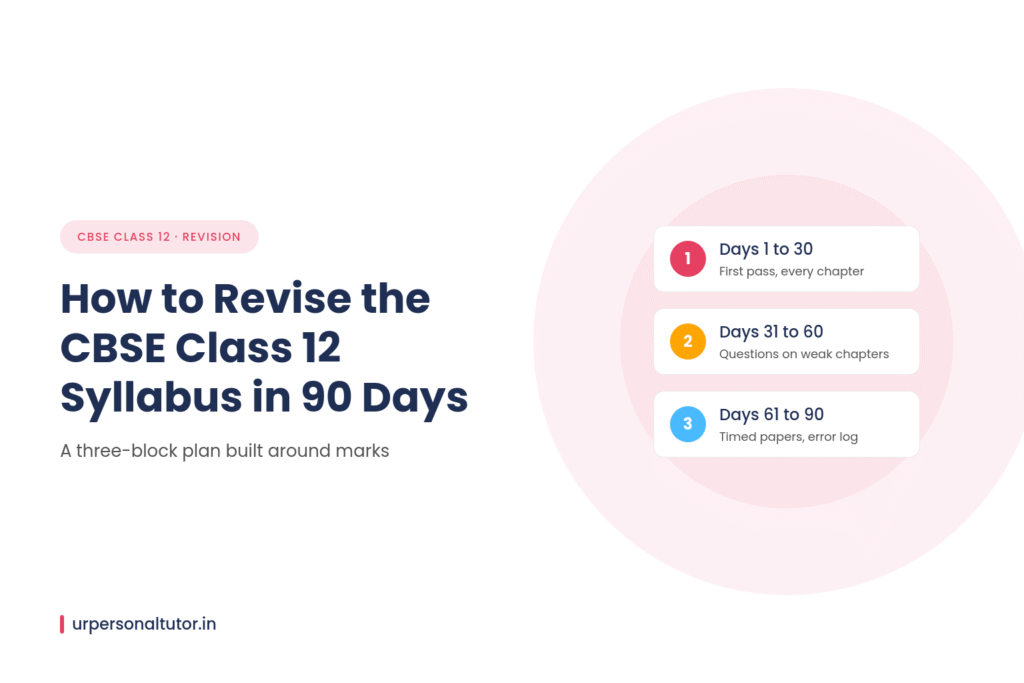
CBSE Class 12 Syllabus: Can You Really Revise It All in 90 Days? Yes, but only if you stop treating every chapter as equal. Ninety days is enough to revise the full CBSE Class 12 syllabus once, properly, and the high-scoring parts a second time. It is not enough to reread every textbook page in order, which is what most students attempt and why most of them finish one subject well and rush the rest. The timing works better than it sounds. CBSE theory papers have started in mid-February in recent years, and the 2027 date sheet is still awaited, so a plan that begins in the second half of October finishes with roughly four weeks in hand. Those weeks are not spare. They absorb practicals, pre-board exams and the bad week that every student has. What follows is the version of the plan that works for students who are still attending school. It assumes five or six subjects, a printed syllabus, and roughly five focused hours on an ordinary day. If your load is lighter or heavier, the proportions still hold. Only the pace changes. What the Revised Syllabus of Class 12 CBSE Actually Changes CBSE published the 2026-27 syllabus on 1 April 2026, and it keeps the shape of recent years: a single annual exam with no term split, internal assessment sitting beside theory, and a clear lean toward application and competency-based questions instead of plain recall. The CBSE Class 12 curriculum is revised every session, so “new” usually means small edits to a familiar course. That is also why sources disagree. Some coaching sites publish long tables of deleted chapters while others report no cuts at all. If a page promises the CBSE new syllabus Class 12 with a neat list of removed topics, cross-check it against the subject PDF on the board’s academic website before dropping anything. Download that PDF and print it. A printed checklist you tick off will still be useful on day 70, when a mental one has long since blurred. Sort the CBSE Class 12 Syllabus by Marks Before You Revise Anything Marks decide where your hours go. Most theory papers carry 80 marks with 20 for internal assessment, while science subjects with practicals usually split 70 for theory and 30 for practicals. Those internal and practical marks come from files, projects and viva preparation, so confirm that record work is under control before day one. Nothing in a 90-day plan can recover it later. Treat the Class 12 CBSE board syllabus as a marking map instead of a reading list. Sort each subject’s chapters into three piles: heavy chapters that appear in every paper and take real effort to relearn, medium ones you mostly remember, and short low-mark chapters you can finish in one sitting. Give the heavy pile about half your hours and the medium pile about a third. The short chapters share what is left. A quick example shows how this plays out. In Physics, Current Electricity is a heavy chapter for most students because it mixes theory with long numericals, while a short chapter such as Communication Systems can be revised in an evening. In Maths, Integrals is a heavy pile on its own, since every later application depends on it. Your piles will differ, and that is the point. Two students with the same marks target can have completely different heavy chapters. The 90-Day Plan for the CBSE Class 12 Syllabus The plan runs in three blocks of thirty days. Each block has one job, and the job changes as the exam gets closer. Days 1 to 30: One Honest Pass Through the CBSE Class 12 Syllabus Read the NCERT chapter, solve its examples and exercise questions, and write a half-page summary of formulas, reactions, dates or key terms. Do not stop to perfect anything. The point is to find out which chapters actually feel shaky, because that list steers the next sixty days. Rotate two subjects a day so none goes cold for more than a couple of days. By the end of this block, colour each chapter on your printed checklist: red if you could not solve its basic questions without the book, amber if you needed hints, green if it came back easily. Be strict. Most students rate themselves one shade too kind. Days 31 to 60: Question Practice on the Weak Chapters Revision without questions is recognition, and recognition fails under exam pressure. Work red chapters first, then amber, using exam-style questions instead of rereading. For Physics, solving chapter-wise important questions in short daily sets shows quickly which derivations and numericals you can reproduce cold. Maths and Chemistry respond to the same treatment: fifteen to twenty questions per chapter, checked against the solution the same day. Give case-based and assertion-reason questions their own weekly session, because the paper now rewards application. Do this even for subjects you feel safe in. Safe subjects are where students lose marks to unfamiliar question styles. Days 61 to 90: Full Papers and an Error Log Move to timed three-hour papers, one per subject each week, written in exam conditions. After every paper, log each lost mark with a one-line cause: concept gap, calculation slip, misread question or unfinished paper. By the third week, the same two or three causes keep reappearing. Those are the last targets. Keep the final five days free of new material. Reread summary sheets and the error log, and sleep properly. Fitting the CBSE Class 12 Syllabus Into a Normal School Week A plan only survives if it fits a week that already has school, tuition and the occasional family function in it. Use six study days and keep one flexible. On weekdays, give the first and longest session to the heaviest subject of the day while your head is clear, and keep a lighter subject for the evening. Saturdays work well for catching up on whatever slipped, and Sundays for one timed paper or a block of mixed questions. The flexible