

CBSE 12 Physics Syllabus at a Glance: 70 Theory Marks and 30 Practical Marks
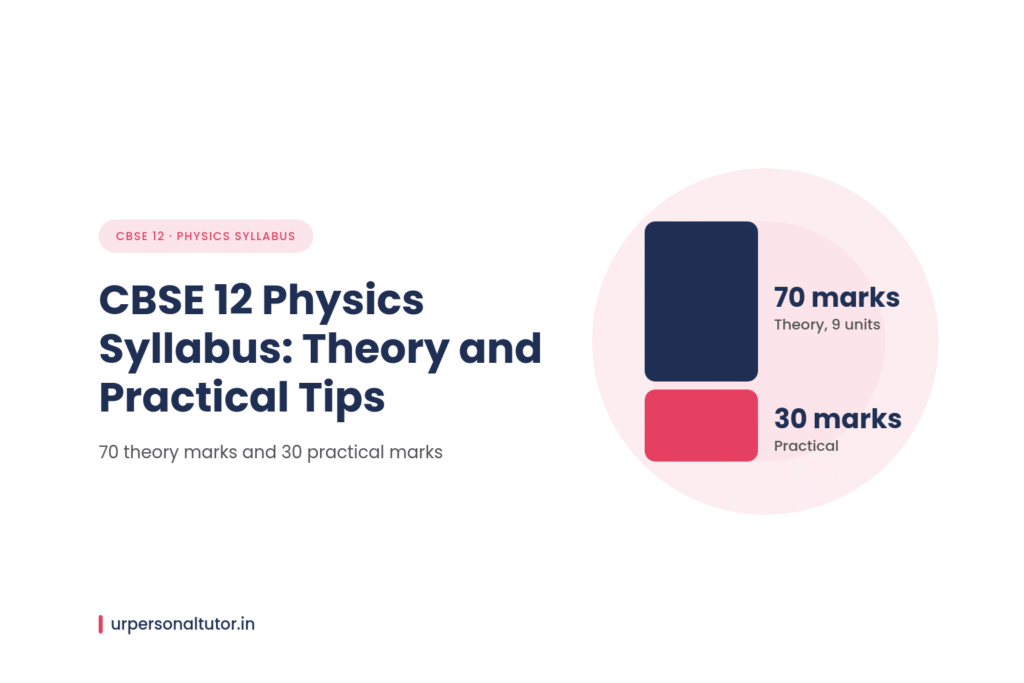
The CBSE 12 physics syllabus (subject code 042) divides 100 marks into a 70-mark theory paper and a 30-mark practical. Theory runs for three hours across nine units. Practicals happen in school, with an external examiner sitting alongside your own teacher. That split shapes everything else. Students who treat the practical as a formality hand away marks that are easier to earn than almost anything in the theory paper. Students who only skim the unit titles never learn which chapters actually move their total. Both problems are fixable, and the sections below show how. Unit-Wise Weightage in the CBSE 12 Physics Syllabus CBSE publishes theory marks in blocks, not chapter by chapter. For the 2026-27 session the blocks look like this. Units Topics Marks I and II Electrostatics, Current Electricity 16 III and IV Magnetic Effects of Current and Magnetism, Electromagnetic Induction and Alternating Currents 17 V and VI Electromagnetic Waves, Optics 18 VII and VIII Dual Nature of Radiation and Matter, Atoms and Nuclei 12 IX Electronic Devices 7 Total 70 Optics and waves hold the single biggest block. Even so, electricity and magnetism taken together are worth 33 of the 70 marks, close to half the paper. Electrostatics and Current Electricity (16 Marks) Three NCERT chapters sit here: Electric Charges and Fields, Electrostatic Potential and Capacitance, and Current Electricity. Gauss’s theorem, capacitors with dielectrics and Kirchhoff’s rules deserve the most practice, since they feed short numericals and five-mark derivations alike. Magnetism and Electromagnetic Induction (17 Marks) Moving Charges and Magnetism, Magnetism and Matter, Electromagnetic Induction and Alternating Current make up this block. The Biot-Savart law, Ampere’s law and the moving coil galvanometer come first. Faraday’s and Lenz’s laws follow, then LCR circuits and resonance, which tend to produce the longest calculations in the paper. Optics and Electromagnetic Waves (18 Marks) Ray Optics and Optical Instruments, Wave Optics and Electromagnetic Waves share this block. Ray diagrams for lenses, prisms and telescopes pay off here, along with Young’s double slit and single-slit diffraction. Optics also overlaps with the practical, so time spent here earns marks twice. Modern Physics and Electronic Devices (19 Marks) Dual Nature, Atoms and Nuclei together carry 12 marks, and Electronic Devices adds 7 more. This is the most formula-driven part of the syllabus, which makes it the cheapest place to gain marks per hour of study. Unit IX alone is 10 percent of the paper, so skipping it is an expensive shortcut. How to Prepare for the Theory Paper in the CBSE 12 Physics Syllabus The paper has 33 questions. Section A holds 16 one-mark questions, 12 of them multiple choice and 4 assertion-reason. Section B has five two-markers and Section C seven three-markers. Section D adds two case-based questions of four marks each, and Section E closes with three five-markers. CBSE has kept this design unchanged for 2026-27. Derivations and Diagrams Five-mark questions reward a labelled diagram, a clear starting formula and a boxed final result. Reading a derivation feels like understanding it, but only writing it out by hand proves the point. Rehearse the important derivations until the sequence of steps comes without looking, then time yourself at under eight minutes each. Numericals and Units Most lost marks in numericals come from small slips: a missing unit, a wrong power of ten, an answer carried to the wrong significant figures. Solve each NCERT example before touching the exercises, then redo any problem you got wrong a week later. Writing the formula before substituting costs five seconds and protects a method mark. Case-Based and Assertion-Reason Questions Together these two types account for 12 marks, and neither can be memorised. They test whether you actually understand the concept behind a formula. After finishing each chapter, solve four or five of each so the format feels familiar well before the exam. Practical Preparation for the CBSE 12 Physics Syllabus (30 Marks) Practical marks break down neatly. You perform two experiments, one from each section, worth 7 marks apiece. The practical record carries 5 marks, one activity adds 3, the investigatory project adds another 3, and the viva takes the last 5. Experiments: Where the Marks Hide Examiners award marks for procedure and presentation, not only for hitting the expected value. A neat circuit or ray diagram, an observation table with least count and units, a graph where needed and a short list of precautions all count. Revisit every experiment from the lab manual, including the sources of error, because those questions turn up in the viva too. Record File, Activity and Project Keep the practical record updated weekly instead of rebuilding it the night before submission. Choose one activity you can perform confidently from start to finish. For the investigatory project, a modest topic you can explain in two minutes beats an ambitious one you cannot defend. Viva Voce Five marks ride on questions drawn from your own experiments, activities and project. Reading silently hides gaps that speaking out loud exposes immediately, so ask a teacher or a CBSE physics tutor to quiz you in the final fortnight. Expect questions on why you chose a particular apparatus, what happens if a reading changes, and where the main error enters. Revising the CBSE 12 Physics Syllabus in the Final 60 Days Finish the first full pass through all nine units before the end of December if you can. After that, switch from reading to testing. Work through important questions block by block, matching the 16, 17, 18, 12 and 7-mark groupings above, so your practice mirrors how the paper is built. In the last three weeks, sit one full three-hour paper every few days under exam conditions. Mark it strictly against the CBSE marking scheme, then list every lost mark and its cause: concept, calculation, diagram or time. Patterns show up quickly. A student who keeps losing marks in LCR circuits knows exactly where the next two days belong. Common Mistakes with the CBSE 12 Physics Syllabus Some errors repeat year after year. Leaving Electronic Devices for