

Why You Cannot Crack NEET Without Physics: The 540/720 Math Nobody Tells You
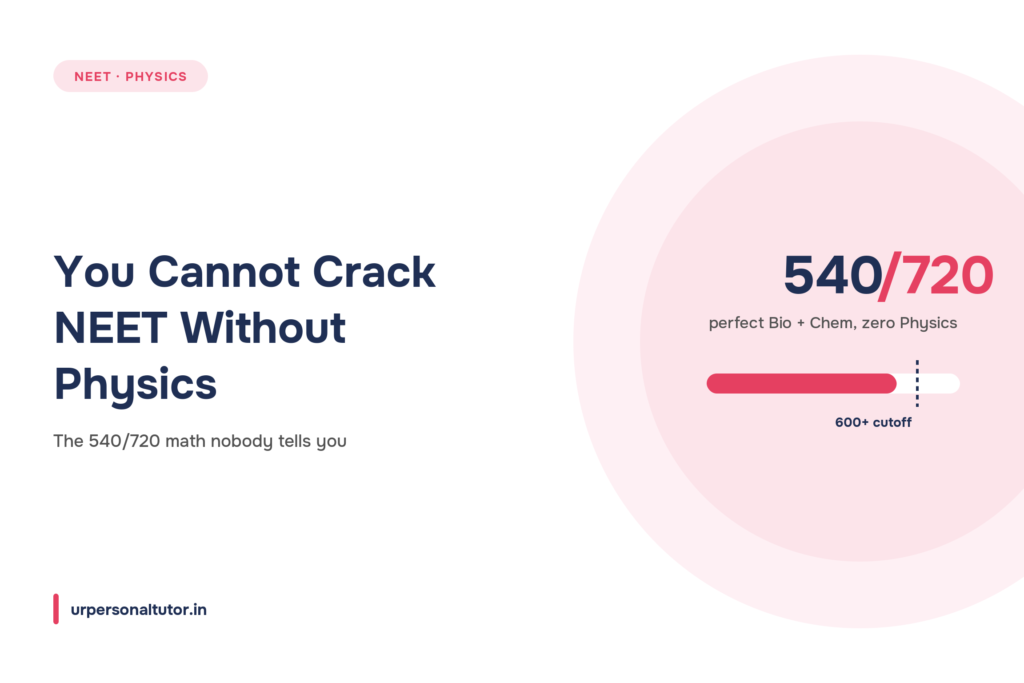
You cannot crack NEET by studying only Biology and Chemistry, and the arithmetic proves it in one line: a perfect 360/360 in Biology plus a perfect 180/180 in Chemistry gives you 540 out of 720, and in most years 540 is not enough for a government MBBS seat in the general category. Recent cutoffs for government college admission have hovered well above that range. In other words, even the impossible best-case scenario of 100 percent in Bio and Chem can leave you without the seat you worked two years for. That single calculation should end the most common NEET mistake I see: treating Physics as an optional subject you will “manage somehow.” The Most Common NEET Mistake: Neglecting Physics Walk into any NEET batch and you will find the same pattern. Students love Biology because it rewards the reading and memorising they are already good at. Chemistry gets decent attention because half of it is also memory-friendly. Physics gets pushed to “later” because it involves calculation, formulas, and conceptual thinking that feels alien to a biology-inclined mind. Then the mock tests arrive. Bio: 320 plus. Chemistry: 150 plus. Physics: 70. And the student concludes “I am just not a physics person,” studies even less physics, and the gap widens. Here is the reframe: NEET Physics is not harder than Biology. It is differently hard. Biology demands volume of memory. Physics demands depth of understanding on a much smaller set of ideas. The entire NEET Physics syllabus runs on maybe 60 to 70 core concepts. Compare that with the thousands of facts Biology expects. You are already doing the harder memory task. Physics asks for less material, understood better. Why 540/720 Is Not Enough: The Real Cutoff Math Let’s put the numbers in one place: Government MBBS seats in the general category typically demand scores in the 600 plus territory, and the safest zone is higher still. Now see what Physics contributes at different levels, assuming a strong 320 in Biology and 150 in Chemistry (realistic for a hardworking student): Physics is not one-fourth of your NEET marks. It is the deciding fourth. Bio and Chem scores cluster tightly among serious aspirants because everyone studies them. Physics is where ranks separate. How to Actually Study NEET Physics: Core Principles and Diagrams The students who turn their Physics score around all make the same two changes. 1. Understand the core principle before touching formulas Do not start a chapter by listing formulas. Start by asking what the chapter is fundamentally about. Newton’s laws are about how forces change motion. Thermodynamics is about energy bookkeeping. When you understand the principle, formulas become obvious consequences instead of random symbols to memorise. Memorised formulas fail the moment a question is phrased differently. Understood principles never do. 2. Draw a diagram for every single question This is the highest-impact habit in NEET Physics, and biology students skip it the most. Before solving, draw the situation: the block, the forces as arrows, the circuit, the ray of light. A drawn diagram converts a scary word problem into a simple visual you can reason about. Most Physics errors are not calculation errors. They are visualisation errors, where the student solved a different problem than the one asked. The diagram prevents exactly that. 3. Follow the right sequence Build in this order: NCERT theory, NCERT examples, previous year NEET questions for that chapter, then coaching material. NEET Physics leans heavily on NCERT-level concepts asked cleverly. Previous year questions teach you the exam’s actual taste faster than any thick book. 4. Give Physics prime time daily Physics gets your freshest hour of the day, every day, no exceptions. One daily hour of fresh-mind Physics beats four hours of tired-mind Physics on Sunday. Consistency dissolves fear. Most “physics phobia” is just unfamiliarity that was never given a fair chance. A 90-Day Physics Recovery Plan for Bio-Strong Students If Physics is currently your weakest subject, run this: Students who complete this honestly usually move from the 60 to 80 range into the 120 to 140 range, which by the math above is often the difference between no seat and a government seat. I specialise in fixing Physics for NEET aspirants who are strong in Biology but stuck below 100 in Physics mocks. If that sounds like you or your child, the 540/720 math says we should talk sooner rather than later. Frequently Asked Questions Can I crack NEET without studying Physics? No. Even a perfect score in Biology and Chemistry totals only 540/720, which is generally below the score needed for a government MBBS seat in the general category. Physics marks are mathematically necessary, not optional. How many marks should I target in NEET Physics? Target at least 130 to 140 out of 180. Combined with strong Biology and Chemistry scores, this puts your total in the 600 plus range where government college seats become realistic. Why is NEET Physics considered so difficult? Because it tests conceptual application and calculation rather than memory, which feels unfamiliar to biology-inclined students. In reality it has far less material than Biology. It only requires a different method: understanding core principles and drawing diagrams for every question. Is NCERT enough for NEET Physics? NCERT is the essential base and covers the concepts NEET tests, but you must add previous year questions and sufficient practice volume on top of it. NCERT theory plus 250 to 300 solved questions per chapter is a reliable combination. How can I improve NEET Physics in 3 months? Focus on mechanics for the first month, electricity and magnetism the next, then the formula-light scoring chapters like modern physics. Study Physics daily during your freshest hour, and draw a diagram before solving every question. Most students add 40 to 60 marks with this approach.
The 300 Questions Rule: How Many Problems Should You Solve Per Chapter to Crack Competitive Exams?

You should solve a minimum of 300 questions per chapter if you are serious about JEE, NEET, or any competitive exam. Not because 300 is a magic number, but because that is roughly the volume at which you stop meeting new question patterns and start recognising old ones in new costumes. Below that number, every test question feels unfamiliar. Above it, you walk into a test having already met most questions’ cousins. And here is the second truth that goes with it: your early test scores at your coaching institute will be low, and that is completely normal. Competitive exam preparation is a process. Nobody scores well in the beginning, including the students who eventually get top ranks. Let me explain both, because misunderstanding either one is how good students quit. Why Your Early Institute Test Scores Are Low (And Why That’s Normal) In school exams, you knew the question paper’s personality. Ten marks of definitions, a numerical from the solved examples, a diagram question. Preparation meant covering a known pattern. Competitive exams have no such courtesy. Each question is unique and demands its own approach. Two questions from the same chapter can require completely different lines of thinking. A student who “completed” the chapter by reading it thoroughly still scores 40 percent on an institute test and wonders what went wrong. Nothing went wrong. Reading a chapter teaches you the concepts. Only solving questions teaches you how concepts get twisted, combined, and disguised in exams. There is no shortcut through this. Colourful scores in institute tests come months into the process, not weeks. If you are scoring low right now, you are not failing. You are in the unavoidable early stage that every ranker went through and most quitters gave up in. Why 300 Questions Per Chapter Is the Benchmark Think of the 300 questions as a ladder: By the time you cross 300 well-chosen questions, something shifts. You look at a new question and think “this is that pulley type with friction added” instead of “I have never seen this before.” That recognition is the entire difference between a 60 percentile student and a 95 percentile student. How to Solve 300 Questions Without Wasting Time Volume without method is just tired hands. Follow these rules: 1. Attempt before you peek Give every question an honest 5 to 10 minutes before touching the solution. The struggle is the workout. Reading solutions directly builds recognition without ability, which collapses in the exam hall. 2. Maintain a mistake notebook Every wrong answer goes into a notebook with one line: what trap did I fall into? Re-solve these questions after a week. Your mistake notebook is worth more than any reference book, because it is a book written specifically about your weaknesses. 3. Mix timed and untimed practice Untimed practice builds depth. Timed practice builds exam temperament. Do both. Around 70 percent untimed learning and 30 percent timed testing works well in Class 11. 4. Quality sources only NCERT, your coaching modules, previous year papers, and one good reference book per subject. Five books solved shallowly lose to two books solved completely. It’s Okay to Be Called a Nerd One more thing, and I say this to every batch. Somewhere in the next two years, someone will call you a nerd for solving questions on a Saturday night. Wear it. The friends calling you boring in Class 11 will be asking which coaching you took when your result comes. It is far better to be called a nerd for two years than to spend the years after that wishing you had been one. Being cool has never gotten anyone a rank. Being consistent has gotten every ranker theirs. I track every student’s per-chapter question count and mistake patterns, so practice is targeted instead of random. If your child is stuck at the same test score for months, the fix is usually in how they practise. Get in touch. Frequently Asked Questions How many questions should I solve per chapter for JEE or NEET? A minimum of 300 questions per chapter, spread across NCERT-level basics, coaching material, previous year questions, and advanced mixed problems. This volume ensures you have seen nearly every question pattern the exam can throw at you. Why are my coaching institute test scores so low? Because competitive exam questions are unique and application-based, and early in preparation you have not yet seen enough patterns. Low early scores are a normal, universal stage. Scores improve steadily as your solved-question count per chapter grows. Is solving previous year questions enough for JEE and NEET? Previous year questions are essential but not sufficient on their own. They work best as the third stage of practice, after basics and standard material, and should be followed by mixed-concept advanced problems. Together this naturally crosses the 300 question mark. How long does it take to see improvement in mock test scores? Most students see meaningful improvement in 2 to 3 months of consistent daily problem solving. Students who only read theory without solving see little improvement regardless of time spent. Should I solve questions daily or in weekend batches? Daily. Problem solving is a skill like sport, and 25 questions a day for six days beats 150 questions on Sunday. Daily practice also keeps older chapters alive in memory