

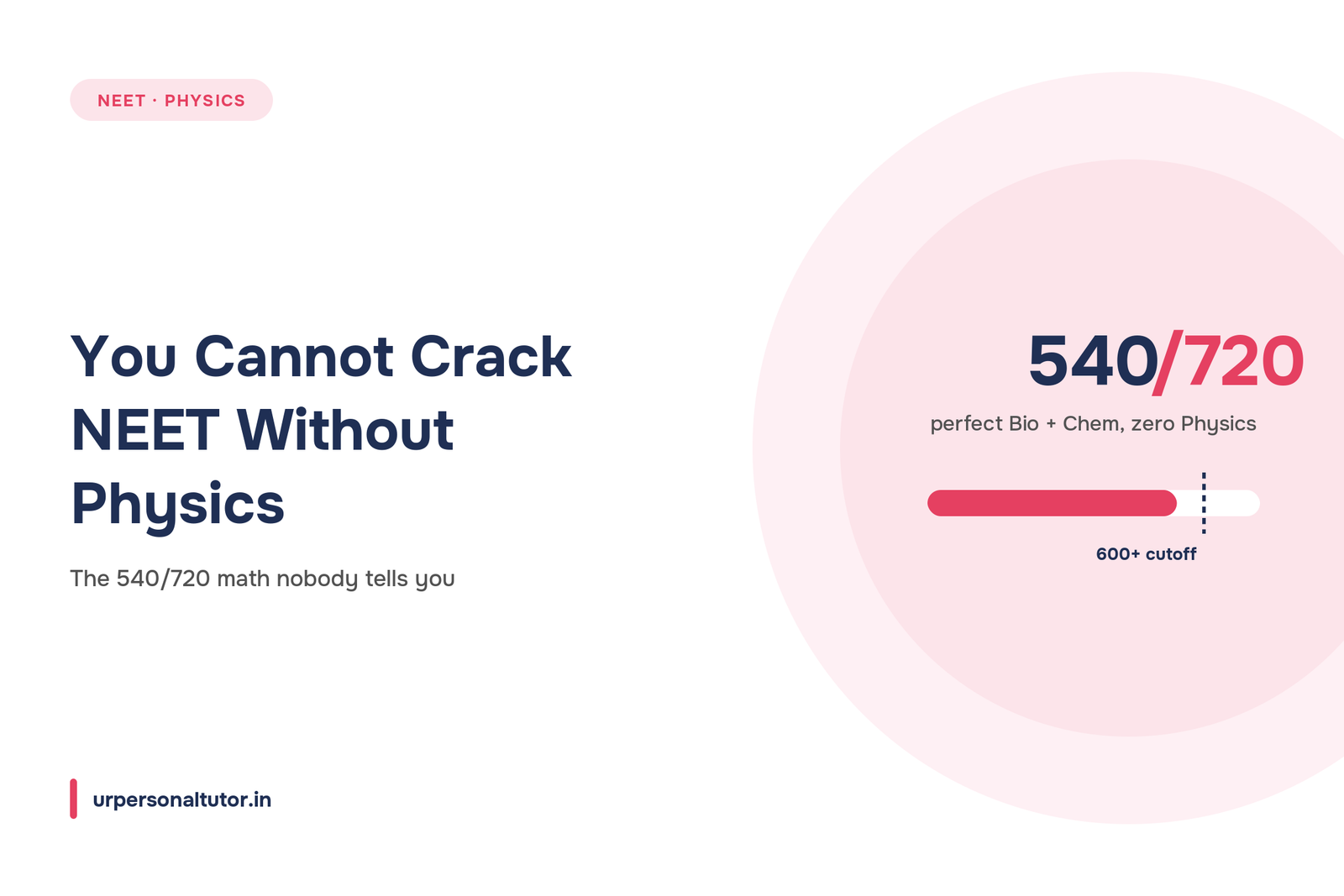
You cannot crack NEET by studying only Biology and Chemistry, and the arithmetic proves it in one line: a perfect 360/360 in Biology plus a perfect 180/180 in Chemistry gives you 540 out of 720, and in most years 540 is not enough for a government MBBS seat in the general category. Recent cutoffs for government college admission have hovered well above that range. In other words, even the impossible best-case scenario of 100 percent in Bio and Chem can leave you without the seat you worked two years for.
That single calculation should end the most common NEET mistake I see: treating Physics as an optional subject you will “manage somehow.”
The Most Common NEET Mistake: Neglecting Physics
Walk into any NEET batch and you will find the same pattern. Students love Biology because it rewards the reading and memorising they are already good at. Chemistry gets decent attention because half of it is also memory-friendly. Physics gets pushed to “later” because it involves calculation, formulas, and conceptual thinking that feels alien to a biology-inclined mind.
Then the mock tests arrive. Bio: 320 plus. Chemistry: 150 plus. Physics: 70. And the student concludes “I am just not a physics person,” studies even less physics, and the gap widens.
Here is the reframe: NEET Physics is not harder than Biology. It is differently hard. Biology demands volume of memory. Physics demands depth of understanding on a much smaller set of ideas. The entire NEET Physics syllabus runs on maybe 60 to 70 core concepts. Compare that with the thousands of facts Biology expects. You are already doing the harder memory task. Physics asks for less material, understood better.

Why 540/720 Is Not Enough: The Real Cutoff Math
Let’s put the numbers in one place:
- NEET total: 720 marks
- Biology: 360 marks (90 questions)
- Chemistry: 180 marks (45 questions)
- Physics: 180 marks (45 questions)
Government MBBS seats in the general category typically demand scores in the 600 plus territory, and the safest zone is higher still. Now see what Physics contributes at different levels, assuming a strong 320 in Biology and 150 in Chemistry (realistic for a hardworking student):
- Physics 60/180: total 530. Out of the race for government seats.
- Physics 100/180: total 570. Still short.
- Physics 140/180: total 610. Now you are in the conversation.
- Physics 160/180: total 630. Comfortable territory.
Physics is not one-fourth of your NEET marks. It is the deciding fourth. Bio and Chem scores cluster tightly among serious aspirants because everyone studies them. Physics is where ranks separate.
How to Actually Study NEET Physics: Core Principles and Diagrams
The students who turn their Physics score around all make the same two changes.
1. Understand the core principle before touching formulas
Do not start a chapter by listing formulas. Start by asking what the chapter is fundamentally about. Newton’s laws are about how forces change motion. Thermodynamics is about energy bookkeeping. When you understand the principle, formulas become obvious consequences instead of random symbols to memorise. Memorised formulas fail the moment a question is phrased differently. Understood principles never do.
2. Draw a diagram for every single question
This is the highest-impact habit in NEET Physics, and biology students skip it the most. Before solving, draw the situation: the block, the forces as arrows, the circuit, the ray of light. A drawn diagram converts a scary word problem into a simple visual you can reason about. Most Physics errors are not calculation errors. They are visualisation errors, where the student solved a different problem than the one asked. The diagram prevents exactly that.
3. Follow the right sequence
Build in this order: NCERT theory, NCERT examples, previous year NEET questions for that chapter, then coaching material. NEET Physics leans heavily on NCERT-level concepts asked cleverly. Previous year questions teach you the exam’s actual taste faster than any thick book.
4. Give Physics prime time daily
Physics gets your freshest hour of the day, every day, no exceptions. One daily hour of fresh-mind Physics beats four hours of tired-mind Physics on Sunday. Consistency dissolves fear. Most “physics phobia” is just unfamiliarity that was never given a fair chance.
A 90-Day Physics Recovery Plan for Bio-Strong Students
If Physics is currently your weakest subject, run this:
- Days 1 to 30: Mechanics only. It underlies half the syllabus. NCERT plus previous year questions, with a drawn diagram for every problem.
- Days 31 to 60: Electricity and magnetism, the second-biggest scoring block, same method.
- Days 61 to 90: Modern physics, optics, thermodynamics: the high-return, formula-light chapters where NEET is generous.
Students who complete this honestly usually move from the 60 to 80 range into the 120 to 140 range, which by the math above is often the difference between no seat and a government seat.
I specialise in fixing Physics for NEET aspirants who are strong in Biology but stuck below 100 in Physics mocks. If that sounds like you or your child, the 540/720 math says we should talk sooner rather than later.
Frequently Asked Questions
Can I crack NEET without studying Physics?
No. Even a perfect score in Biology and Chemistry totals only 540/720, which is generally below the score needed for a government MBBS seat in the general category. Physics marks are mathematically necessary, not optional.
How many marks should I target in NEET Physics?
Target at least 130 to 140 out of 180. Combined with strong Biology and Chemistry scores, this puts your total in the 600 plus range where government college seats become realistic.
Why is NEET Physics considered so difficult?
Because it tests conceptual application and calculation rather than memory, which feels unfamiliar to biology-inclined students. In reality it has far less material than Biology. It only requires a different method: understanding core principles and drawing diagrams for every question.
Is NCERT enough for NEET Physics?
NCERT is the essential base and covers the concepts NEET tests, but you must add previous year questions and sufficient practice volume on top of it. NCERT theory plus 250 to 300 solved questions per chapter is a reliable combination.
How can I improve NEET Physics in 3 months?
Focus on mechanics for the first month, electricity and magnetism the next, then the formula-light scoring chapters like modern physics. Study Physics daily during your freshest hour, and draw a diagram before solving every question. Most students add 40 to 60 marks with this approach.