
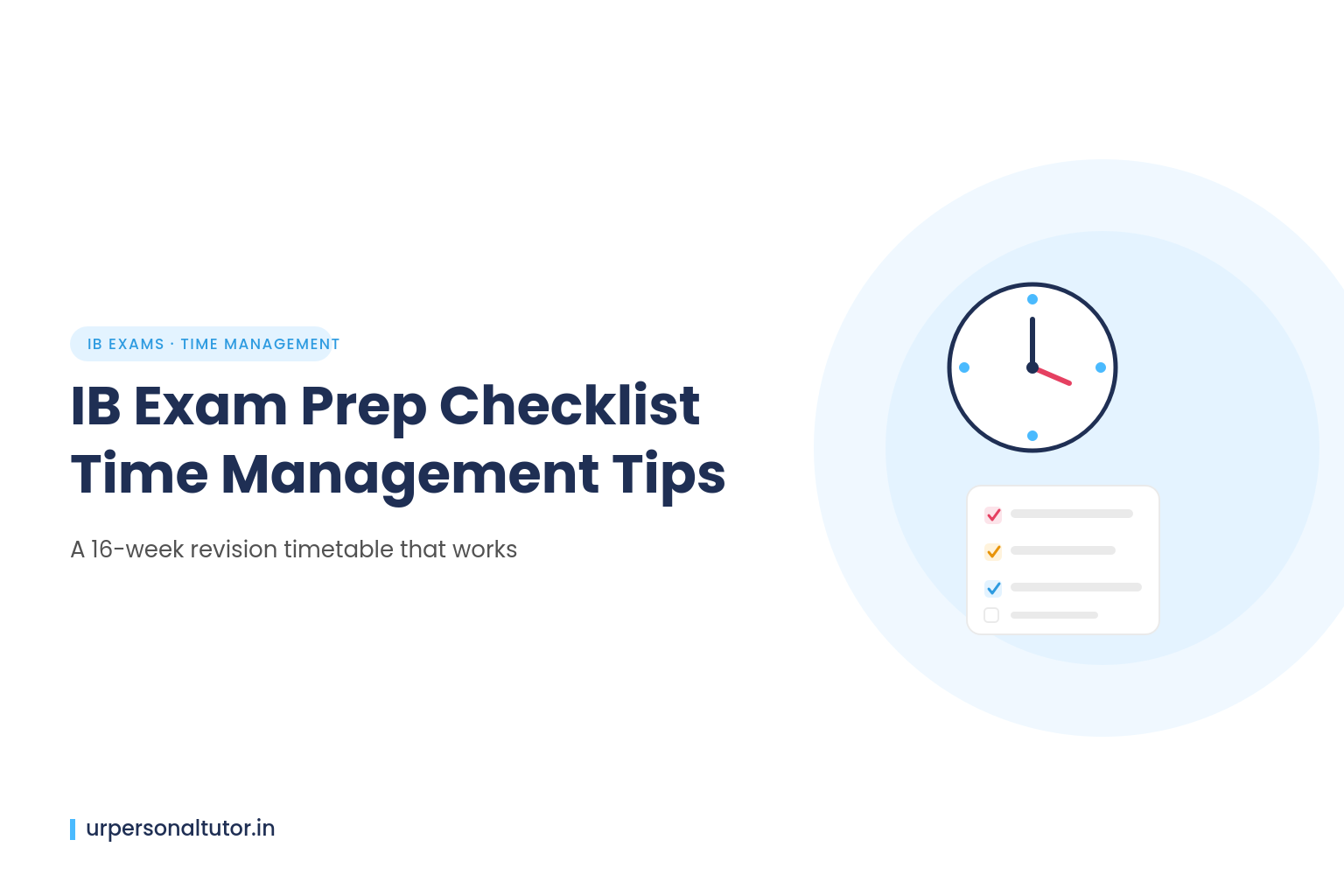
The fastest way to build a working IB exam preparation checklist is to work backwards from your exam dates, block out revision hours by subject difficulty rather than personal preference, and protect at least one full rest day every week. Students who plan this way consistently report less panic in the final month, because the heaviest content gets tackled while there’s still room to fix gaps. The rest of this guide breaks down exactly how to structure that timetable, subject by subject, without burning out before results day.
What an IB Exam Preparation Checklist Should Cover
A proper IB exam preparation checklist isn’t just a to-do list of topics. It has four moving parts: content coverage, past paper practice, IA and EE deadlines, and rest scheduling. Miss any one of these and the other three suffer. Students who focus purely on rereading notes tend to freeze on exam day because they’ve never timed a Paper 2 under real conditions. Students who only grind past papers sometimes skip foundational topics they assumed they knew.
A checklist that actually works has three columns running side by side: what to revise, how you’ll test that revision, and when the IA or EE deadline sits in relation to exam crunch. Six subjects, TOK, the extended essay, and CAS hours all compete for the same 24 hours in a day. Writing them down in one place, rather than juggling them in your head, is what separates a calm April from a chaotic one.
Building Your IB Revision Timetable Months Before Exams
Most schools hand out the exam timetable around January for a May session. That gives you roughly sixteen weeks, and the mistake almost every student makes is treating those weeks as equal. They aren’t. The first eight weeks should be about closing content gaps and rebuilding weak topics from scratch. The last four weeks should be almost entirely past papers, timed and marked against the actual IB grade boundaries.
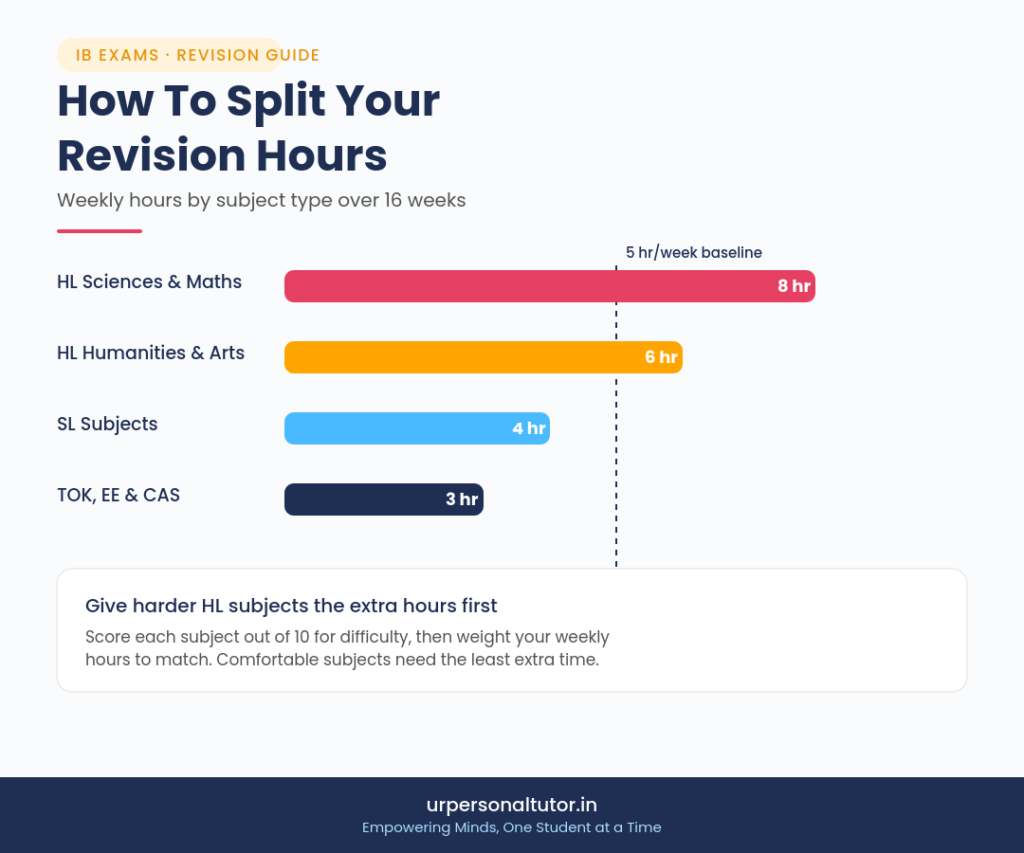
Start your IB revision timetable by listing every subject and giving each one a rough difficulty score out of ten, based on your current grades and your gut feeling about which papers scare you. Higher Level Maths or IB Physics exam prep usually eats more hours than Standard Level Spanish, so don’t split your sixteen weeks evenly across six subjects. Give the harder HL subjects two extra hours a week from week one.
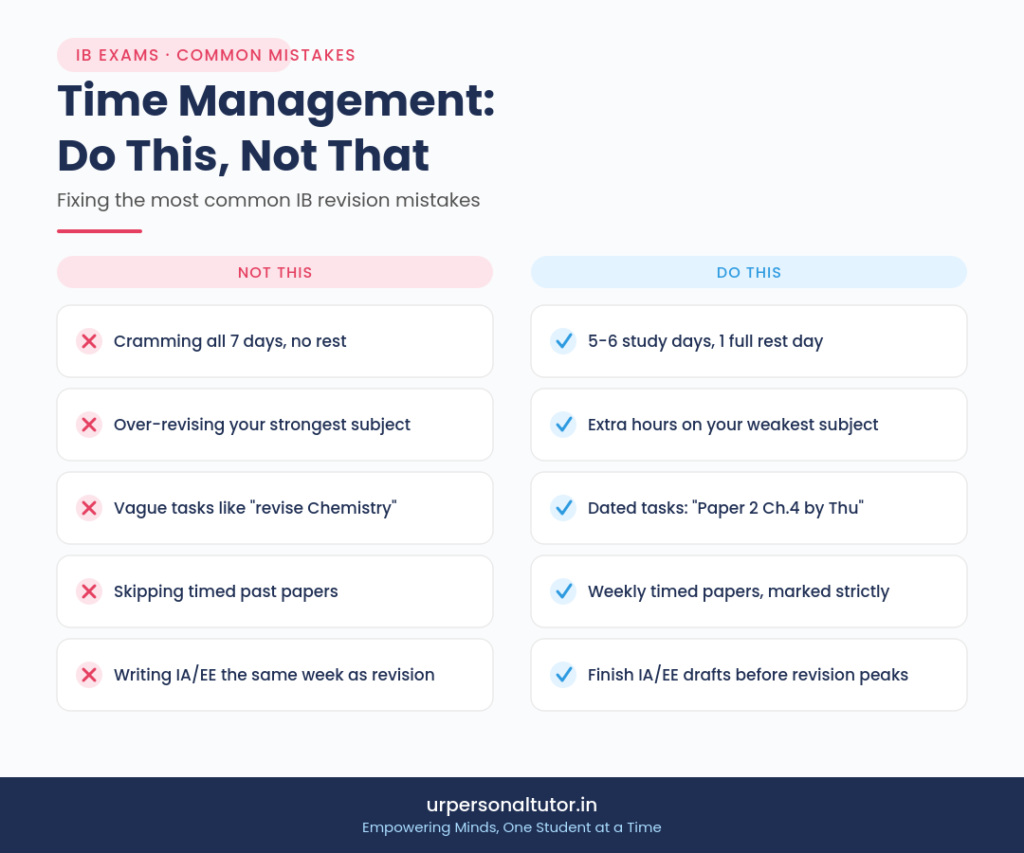
A realistic weekly structure for someone taking three HL and three SL subjects looks like eighteen to twenty-two hours of focused revision, spread across five or six days, not seven. Cramming every evening including Sundays is how motivation collapses by week six. Build the rest day in from day one instead of adding it later as damage control.
How to Prepare for IB Exams Subject by Subject
Knowing how to prepare for IB exams changes depending on the subject, and treating Biology revision the same way you’d revise Maths is a common time sink. Sciences and Maths reward repetition through problem sets; you genuinely improve by doing more questions, not by rereading the syllabus guide a fourth time. Humanities and languages reward structured recall, meaning flashcards, timed essay outlines, and vocabulary drilling matter more than passive rereading.
For HL Maths, spend the bulk of your hours on past paper questions sorted by topic, then move to full timed papers once you’re scoring consistently above 60% on individual topic sets. For English or History, build a bank of ten to fifteen practice essay plans rather than writing full essays every single time. A plan takes twenty minutes and teaches you structure; a full essay takes ninety minutes and often just repeats what the plan already proved you know.
Sciences with a practical component need lab report review folded into the schedule too, since IA marks carry weight independent of the written exam. Don’t let internal assessments quietly vanish from your checklist just because they feel less urgent than the exam itself.
Time Management Tips for an IB Exam Preparation Checklist
Good time management for IB exams starts with knowing your actual working speed, not your ideal one. Time yourself on a single Paper 1 section before you build your full schedule. If a 45-minute paper genuinely takes you 65 minutes including checking, your revision plan needs to include speed drills, not just content review.
Break each revision session into 50-minute blocks with a 10-minute gap, and cap total daily study at around six hours on weekdays and eight on weekends during peak revision weeks. Beyond that, retention drops sharply and mistakes creep into practice papers that would never happen in the real exam. Keep a physical or digital tracker where you tick off completed topics; the visual progress matters more for motivation than most students expect.
Protect sleep even during the final fortnight. Seven hours a night sounds obvious, but it’s the first thing students sacrifice, and it’s also the thing most strongly linked to recall performance in the exam hall itself. A tired brain forgets formulas it knew perfectly well two days earlier.
Common Time Management Mistakes During IB Exam Preparation
The single biggest mistake is starting an IB exam preparation checklist without dates attached to each task. “Revise Chemistry” sitting on a list with no deadline gets pushed indefinitely. Every task needs a specific day and a specific outcome, such as “complete Paper 2 Chemistry, Section A, by Thursday.”
Another frequent error is over-revising strong subjects because they feel comfortable, while avoiding the subject that actually needs the most work. If Economics HL terrifies you, that’s exactly where your extra hours belong, not in the SL subject where you’re already predicted a 6.
Students also underestimate how long past paper marking takes. Marking a Paper 2 essay properly against IB criteria can take longer than writing it. Budget that time in the checklist rather than assuming the paper is “done” the moment the writing stops.
IB Exam Study Guide: Balancing IA, EE, and Exam Revision
A working IB exam study guide has to account for the extended essay and internal assessments, because these deadlines rarely align neatly with revision season. Most EE final drafts are due in the term before exams, which means the heaviest EE writing period often overlaps with the start of your revision timetable.
The fix is sequencing, not multitasking. Finish EE and IA drafts in the first six to eight weeks of your sixteen-week window, and shift almost entirely to pure exam content once those are submitted. Trying to write an EE chapter and revise Physics topic 6 on the same evening usually means neither gets done well. Separate the weeks instead of splitting every day between the two.
Final Two Weeks: Fine-Tuning Your IB Exam Preparation Checklist
The last fortnight should look noticeably different from the rest of your schedule. Drop new content entirely unless there’s a genuine gap you’ve only just discovered. Spend these days on full timed past papers under exam conditions, ideally at the same time of day your real exam is scheduled, so your body clock is already used to performing at that hour.
Review your checklist one final time and mark anything still incomplete in red. Those red items get the first two hours of each remaining day. Everything else becomes light review: flashcards, formula sheets, quick recall drills. This is not the stage to attempt a subject overhaul.
A Quick Word Before You Start
If your checklist keeps slipping, that’s usually a sign the plan was built around an ideal version of your week rather than your actual one. An IB Exam tutor who knows the IB syllabus can help you build a realistic timetable and spot the weak topics faster than trial and error will. If you’d like a second pair of eyes on your revision plan, get in touch through Ur Personal Tutor and we can map out a schedule that fits your actual subjects and timeline. You can also browse more exam prep guides on our blog.
Frequently Asked Questions
How many hours a day should I study for IB exams?
Most students do best with four to six focused hours on weekdays and six to eight on weekends during peak revision, split into 50-minute blocks. More than that tends to reduce retention rather than improve it.
When should I start my IB exam preparation checklist?
Ideally sixteen weeks before your exam session, once the official timetable is released. Starting earlier without a timetable often leads to unfocused, low-yield revision.
Should I revise all six subjects equally?
No. Weight your hours toward subjects with lower predicted grades or higher difficulty, particularly HL subjects, rather than splitting time evenly across all six.
How do I fit EE and IA work into exam revision?
Sequence rather than combine them. Finish EE and IA drafts in the early weeks of your revision window, then shift almost fully to exam content once they’re submitted.
What should the final two weeks before IB exams look like?
Mostly timed past papers under real exam conditions, with light review of weak topics. Avoid introducing new content this close to the exam.
Is a digital or paper revision timetable better?
Whichever you’ll actually check daily. A detailed digital tracker is useless if you forget to open the app, while a paper checklist pinned above your desk gets seen every day almost by accident.