
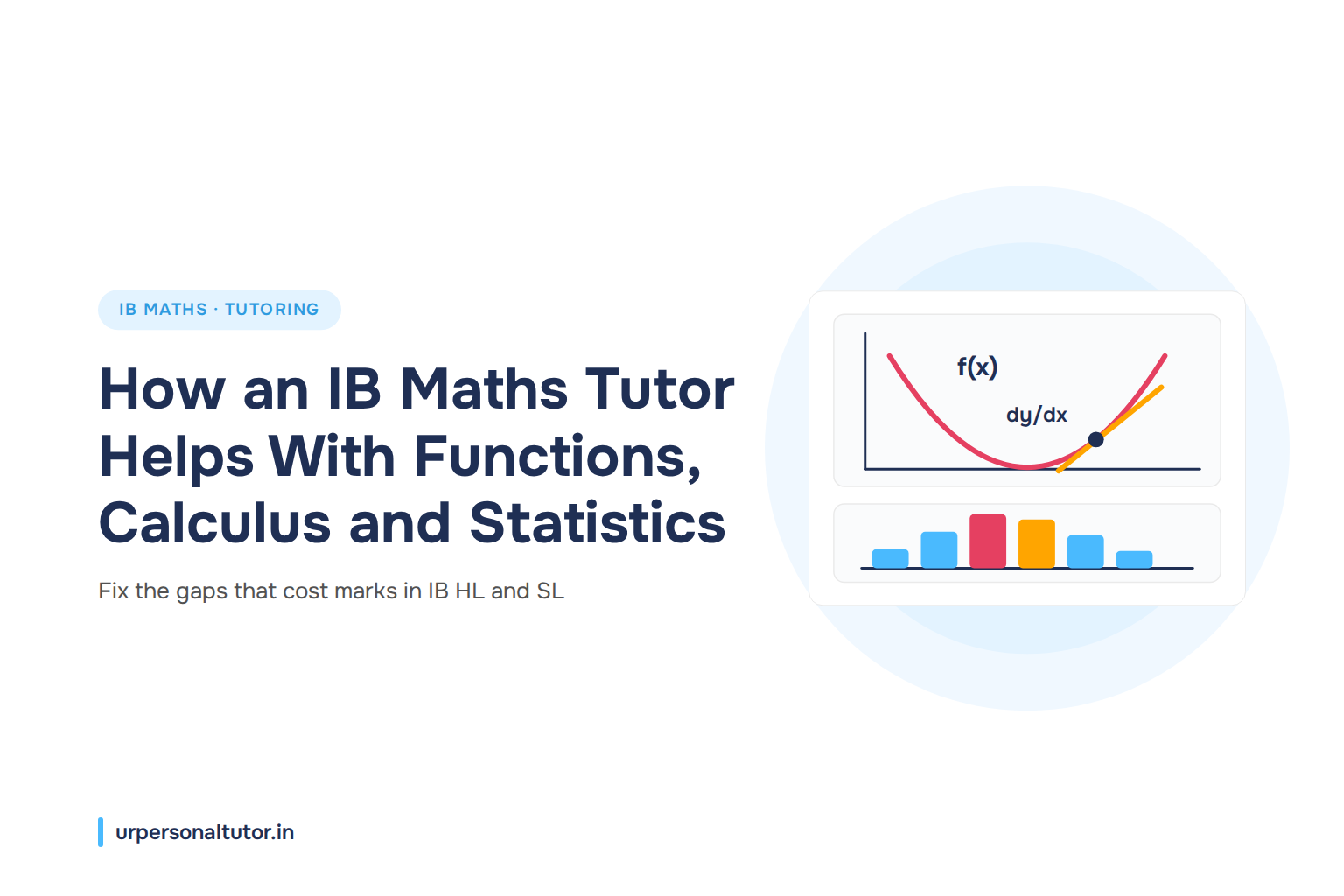
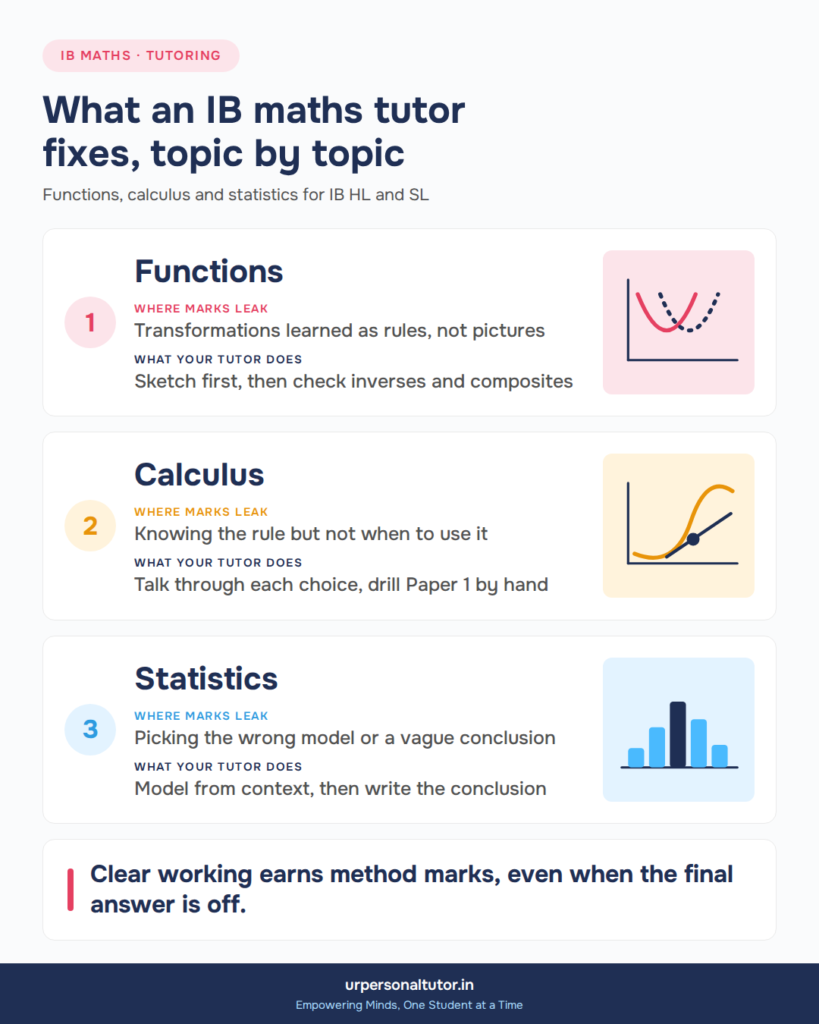
An IB maths tutor helps most where students lose the most marks: building a solid grip on functions, making calculus feel logical rather than mechanical, and turning statistics into something you can reason about instead of guess at. A good tutor does not re-teach the whole course. They find the two or three gaps that are quietly costing you grades, fix those first, and then train you to write answers the way IB examiners want to read them.
What an IB Maths Tutor Actually Does
Many students picture a tutor as someone who repeats the lesson from school. That is rarely what works. A strong IB maths tutor starts by asking which course you are on (Analysis and Approaches or Applications and Interpretation, at SL or HL) and then looks at your recent paper attempts. The pattern of mistakes matters more than the score.
Say you lost 14 marks on a Paper 1 and 11 of them came from algebra slips inside calculus questions. You do not have a calculus problem. You have an algebra problem wearing a calculus costume. Spotting that difference is the whole job, and it is hard to do alone.
Marks in IB maths also depend on method. Examiners award method marks for correct working even when the final answer is wrong, so a tutor teaches you how to lay out a solution that earns those marks. That habit alone can lift a 5 to a 6.
How an IB Maths Tutor Helps With Functions
Functions are the spine of the course. Transformations, inverses, composites, rational functions and exponentials all return in later topics, so a weak base here quietly drags down everything else.
The usual trouble is that students memorise rules without seeing them. They know that f(x + 3) shifts a graph, but they cannot say which way without sketching it twice. A tutor builds the picture first. Once you can see why the shift goes left, you stop second-guessing it under exam pressure.
Domain and range questions are another repeat offender. They look simple and punish vague thinking. Working through ten or fifteen of them with live feedback, rather than reading a worked solution, is far more effective. If you are also working on structuring your wider revision, the guide on IB exam preparation pairs well with a function-heavy study block.
How an IB Maths Tutor Helps With Calculus
Calculus is where students either click or freeze. Differentiation rules are quick to learn. Knowing which rule to use, and when a question is secretly asking for optimisation or a related rate, is the part that takes practice.
A tutor slows this down deliberately. You work through a chain rule question aloud, explaining each choice, and the tutor interrupts the moment your reasoning drifts. That kind of correction is difficult to get from a textbook.
For HL students, integration techniques, differential equations and Maclaurin series add real weight. These topics reward repetition and pattern recognition. Ten well-chosen problems with a tutor who explains why your substitution failed will teach you more than forty solved alone and never checked.
Paper 1 has no calculator, so calculus fluency also means clean arithmetic. A tutor will often make you do the algebra by hand for weeks, because speed there is what frees up time for harder questions later.
How an IB Maths Tutor Helps With Statistics and Probability
Statistics trips up students who are strong at algebra, because it asks for interpretation rather than manipulation. Choosing between a normal and a binomial model, setting up a hypothesis test, or explaining what a correlation coefficient actually says about the data all need judgement.
Here a tutor works through real contexts. You might take a dataset about exam scores or delivery times and decide together what the question is really asking before touching a formula. Students on Applications and Interpretation lean on this skill heavily, since the paper rewards clear written conclusions as much as correct numbers.
Calculator technique matters too. Entering distribution commands, reading regression output and checking your result against what is plausible are all trainable skills. A tutor who knows the exact model you are using can save you hours of fumbling.
IB Maths Tutor Online: Does It Work as Well as In Person?
For most students, yes. Good online sessions use a shared digital whiteboard, so you and the tutor write and sketch on the same screen. You can photograph your handwritten working and get annotated feedback within minutes. There is no commute, and sessions can fit around school hours and time zones.
Online also widens your choice. Students in Bangalore, or anywhere else in India, are not limited to whoever lives nearby and can pick a tutor who specialises in their exact course and level. If you are weighing formats, this comparison of online private tutor options against group classes lays out the trade-offs clearly.
The one real requirement is a quiet space and a stable connection. Beyond that, an online IB maths tutor can do everything an in-person one can.
Signs You Should Look for an IB Maths Tutor
Not everyone needs one. But a few signals suggest extra support will pay off.
Your predicted grade sits one band below your target. You understand lessons in class but freeze on unseen questions. Your Internal Assessment topic feels stuck, or you keep losing marks on communication and notation rather than on the maths itself. Any one of these is a reasonable reason to try a few sessions.
Timing is the other factor. Starting in Year 12 gives you room to fix foundations calmly. Starting six weeks before finals still helps, but the plan has to be narrower and more ruthless about priorities.
Choosing the Best Tutoring for IB Maths HL and SL
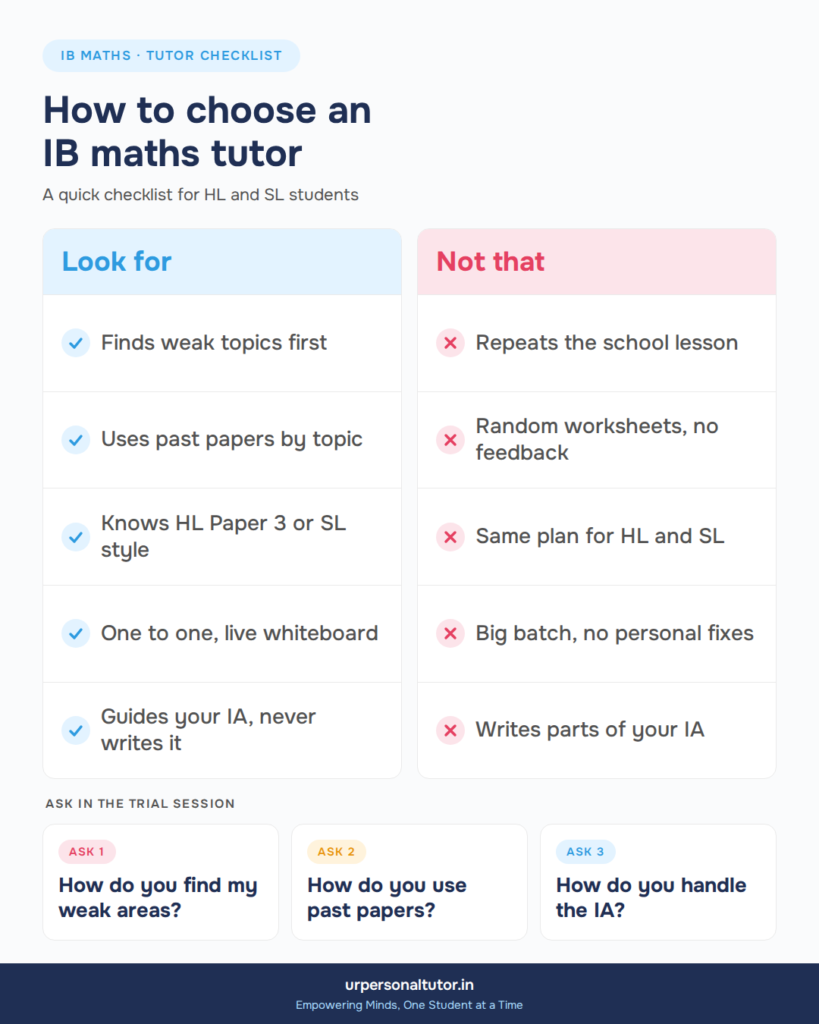
The best tutoring for IB Maths HL looks different from SL support, and a tutor should be able to explain how. HL has Paper 3, a longer problem-solving paper, and covers extra content such as complex numbers and proof. A tutor who has taught HL will know which questions recur and where students typically stall.
Ask a prospective tutor three things in a trial session: how they diagnose weak areas, how they use past papers, and how they handle the IA. A vague answer to any of these is a warning. A good one is specific, such as “we will sort your last three papers by topic and fix the weakest two first.”
Look for one-to-one attention rather than a large batch. Maths is personal, because two students can make the same error for completely different reasons. Our IBDP tuition is built around exactly that kind of individual diagnosis.
Ready to Work With an IB Maths Tutor?
If functions, calculus or statistics are holding your grade back, a few focused sessions can show you where the marks are leaking and how to recover them. Book a consultation with UrPersonalTutor, and we will look at your course, your recent results and your target grade, then suggest a plan that fits the time you have left.
FAQs
Should I choose Analysis and Approaches or Applications and Interpretation?
Pick based on where you are heading. Analysis and Approaches suits students aiming for engineering, physical sciences or pure maths, since it is more algebraic and proof oriented. Applications and Interpretation fits economics, psychology and business, with more technology and data work. Check your university course requirements before deciding, as some programmes name one route specifically.
Can an IB maths tutor help with the Internal Assessment?
Yes, mainly with choosing a manageable topic, structuring the write-up and checking that your mathematical communication meets the criteria. The work must remain yours, so a good tutor guides and questions rather than writing sections. Starting the IA conversation early prevents the common last-minute scramble.
Is it too late to get a tutor in the final months?
Not at all. Three months is enough to lift a grade if the plan is targeted. You will focus on the highest-yield topics and timed past paper practice rather than revisiting the full syllabus.
Can I move from HL to SL if I am struggling?
Schools usually allow a change early in the course, but deadlines vary, so ask your IB coordinator soon. Before switching, a short diagnostic with a tutor can show whether the difficulty is HL content itself or a fixable gap in earlier topics.
How often should I meet an IB maths tutor?
Most students do well with one or two sessions a week, with homework set between them. Increase frequency in the weeks before mock exams, then taper once your practice scores stabilise