
One-to-one physics tuition works because it removes the biggest weakness of the classroom: pace. A tutor sitting across from one student can slow down on Newton’s third law until it actually clicks, then speed through momentum because the student already gets it. That flexibility is the whole argument for hiring a physics tutor in the first place, and it’s worth understanding before you start comparing names and price lists.
This guide walks through what actually matters when choosing between GCSE, IGCSE, A Level, IB, CBSE, NEET, and JEE physics tutors, what one to one physics tuition should look like in practice, and which claims about tutoring are worth ignoring.
Why One to One Physics Tuition Works Better Than Group Classes
A physics classroom with 25 students has one teacher and one pace. If a student is still stuck on resolving forces on an inclined plane, the class has usually already moved on to circular motion. Nobody stops. Nobody can, not with that ratio.
One to one physics tuition flips that. The lesson bends around the student instead of the other way round. A tutor can spend forty minutes on one sticky concept if that’s what’s needed, or blitz through three topics in twenty minutes if the student already has the groundwork. Mistakes get caught in real time, not three weeks later on a marked test paper.
There’s also the question of what a student is comfortable admitting out loud. In a group, few students want to say “I don’t actually understand momentum conservation” in front of classmates. In personal physics coaching, that admission costs nothing. It’s just the starting point for the lesson.
Physics Tuition for Exam Preparation: GCSE, IGCSE, A Level, IB
Exam boards differ enough that tutoring approaches shouldn’t be identical across them. Good physics tuition for exam preparation adjusts to the specific syllabus, command words, and mark scheme style of whichever board a student is sitting.
GCSE and IGCSE Physics Tutoring
GCSE and IGCSE physics reward precision in short-answer questions. Students lose marks not because they don’t understand physics but because they write “the speed goes up” instead of “the speed increases because resultant force acts in the direction of motion.” A tutor working on GCSE or IGCSE content should be drilling exact terminology and mark-scheme phrasing alongside the concepts themselves, since examiners are marking against specific keywords.
A Level Physics Tuition
A Level physics tuition needs a different gear. The maths content jumps sharply, calculus-based mechanics shows up, and questions start layering two or three concepts into a single problem. A tutor here should be pushing past “what is the formula” toward “why does this formula apply in this scenario and not that one.” Past paper practice matters enormously at this stage, more than it did at GCSE, because A Level questions are unpredictable in structure even when the content is familiar.
IB Physics Tuition
IB physics tuition has its own quirks: internal assessments, the extended essay if a student picks physics, and a syllabus that moves between Higher Level and Standard Level content depending on the paper. A tutor supporting IB students needs to understand how IA marking criteria work, not just the physics itself, because a strong lab write-up can matter as much as strong exam technique come final grades.
What to Look for in Personal Physics Coaching
Not every physics tutor is the right fit for every student, and price is a poor way to judge that. A few things matter more.
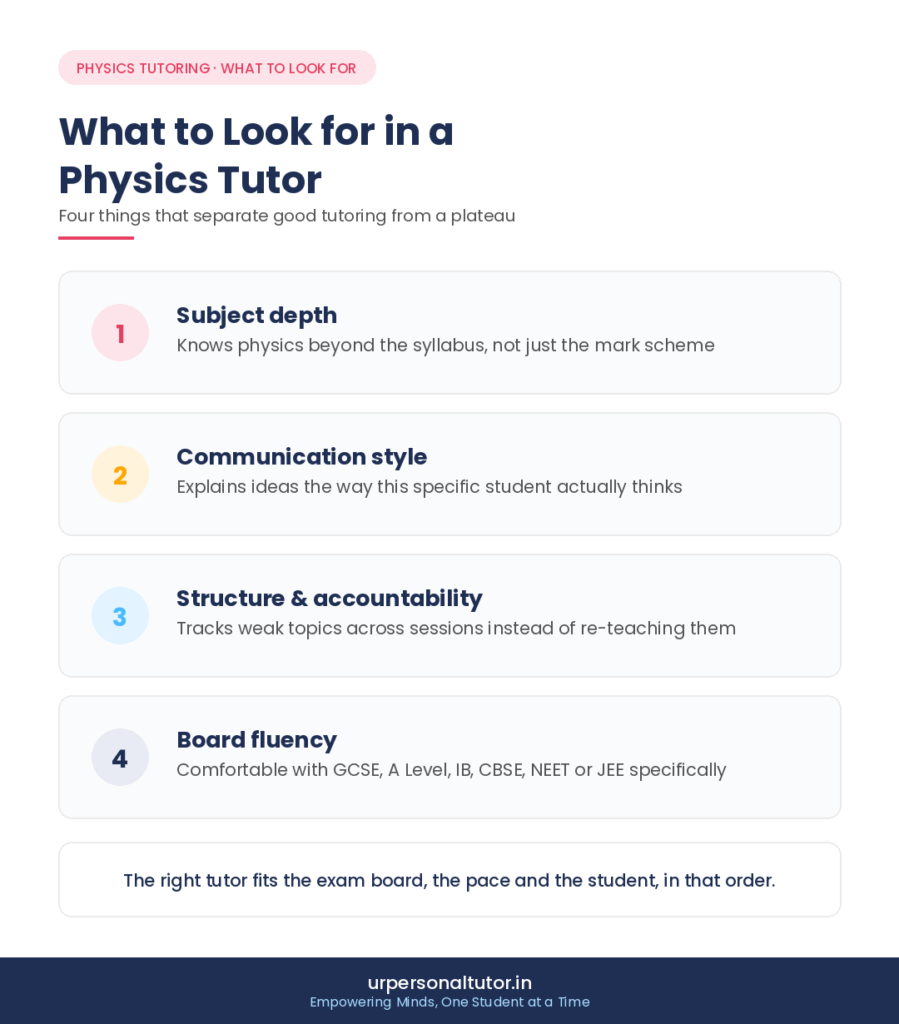
Subject depth beyond the syllabus helps. A tutor who only knows the specification as written tends to teach to the test and struggles the moment a student asks “but why” about something slightly outside the mark scheme. Someone with a physics degree or teaching background usually has that extra depth in reserve.
Communication style matters just as much as knowledge. A brilliant physicist who explains everything in dense technical language isn’t much use to a 15-year-old struggling with circuits. The best personal physics coaching adapts explanations to how a specific student actually thinks, sometimes with analogies, sometimes with diagrams, sometimes just by working through more examples than the textbook offers.
Structure and accountability round it out. One to one physics tuition without any homework, tracked progress, or clear sense of what’s improving over six weeks tends to plateau. A tutor should be able to point to specific weak topics from three sessions ago and show that they’ve been addressed.
CBSE, NEET, and JEE Physics Tutors: Choosing for Competitive Exams
Students preparing for Indian board and entrance exams face a different kind of pressure, and the tutor selection criteria shift accordingly.
CBSE Physics Tutor
A CBSE physics tutor needs to be fluent in the NCERT curriculum specifically, since board exam questions lean heavily on NCERT phrasing and diagram conventions. Numerical problem-solving speed matters here too, since CBSE physics papers reward students who can work through calculations quickly and cleanly under time pressure.
NEET Physics Tutor
NEET physics carries less weight proportionally than biology in the overall exam, but it’s often where students lose the marks that separate a good rank from a great one. A NEET physics tutor should be relentless about formula recall under pressure and fast elimination of wrong options in multiple-choice questions, since NEET rewards speed as much as accuracy.
JEE Physics Tutor
JEE physics concepts are a different animal again. Questions are deliberately layered and often require combining two or three physics principles in one problem, sometimes with a maths trick buried inside. A JEE physics tutor worth hiring should be setting problems that mimic that layered difficulty regularly, not just working through standard textbook questions, because JEE rarely asks anything in its standard form.
Common Myths About Physics Tutoring
A few beliefs about tutoring circulate that are worth correcting honestly, since believing them can lead to picking the wrong tutor or the wrong format.
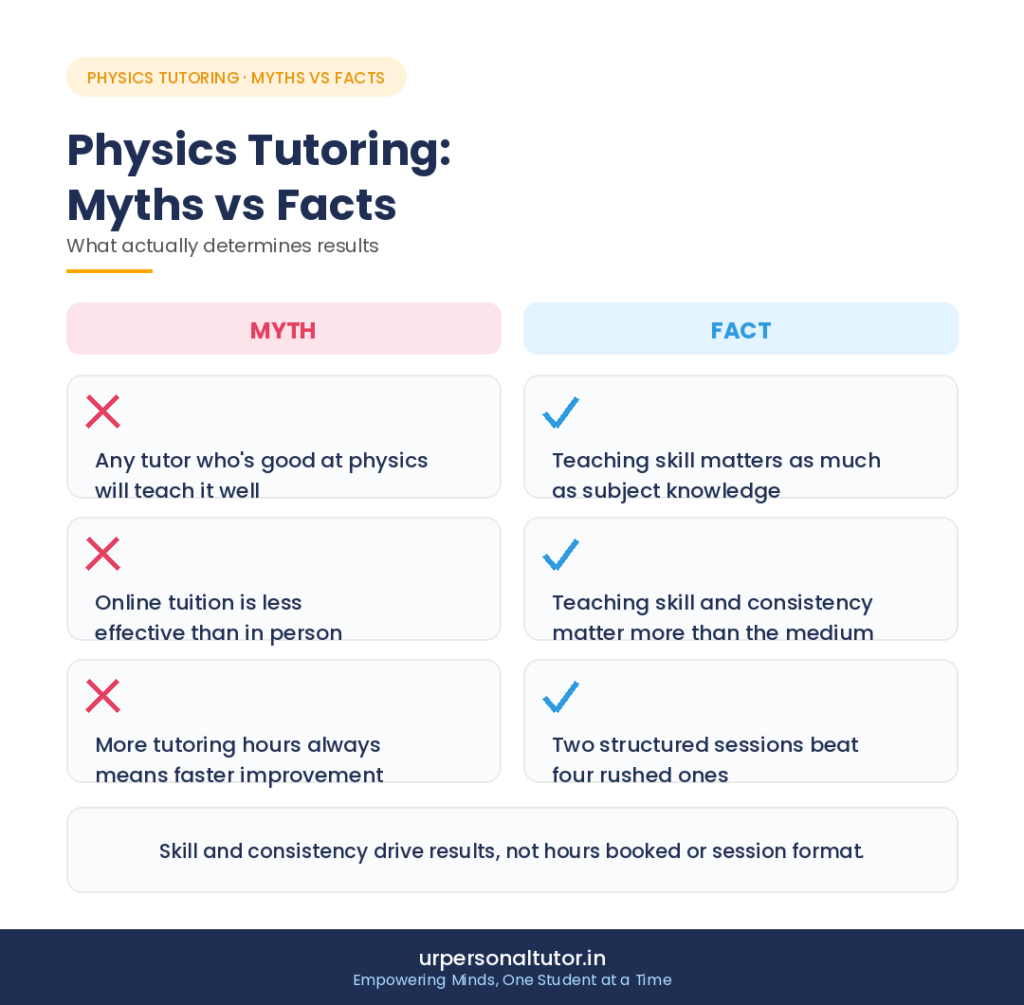
Myth: any tutor who is good at physics will be good at teaching it. Subject knowledge and teaching ability are separate skills. Plenty of physics graduates struggle to explain concepts clearly to a confused 16-year-old, because they’ve never had to break the ideas down from scratch. A tutor’s own exam results matter far less than their ability to diagnose why a specific student is stuck.
Myth: online one to one physics tuition is automatically less effective than in-person. This isn’t true and hasn’t been for years. A shared digital whiteboard, screen sharing for past papers, and video call clarity mean online tuition can match in-person sessions closely, and it opens up access to specialist tutors who aren’t local. What actually determines effectiveness is the tutor’s teaching skill and the consistency of sessions, not the medium.
Myth: more hours of tutoring means faster improvement. Beyond a certain point, cramming extra tutoring hours into a week produces diminishing returns, especially if a student isn’t reviewing material between sessions. Two well-structured sessions a week with proper practice in between usually outperform four rushed ones.
Questions to Ask Before Booking a Tutor
Before committing to a physics tutor, it’s worth asking direct questions rather than relying on a glossy profile page. Ask what board or exam experience they have with students at a similar level. Ask how they track progress across sessions rather than reteaching the same weak topics repeatedly. Ask whether they set homework and review it, since tutoring without follow-through between sessions leaks most of its value. A tutor who answers these clearly and specifically, with real examples, is usually a safer bet than one who answers in generalities.
Ready to work with a physics tutor who adjusts to your exam board, your pace, and your weak spots specifically? Book a free consultation to talk through what one to one physics tuition would look like for your situation, or browse the blog for more exam-specific guides.
Frequently Asked Questions
How many hours of one to one physics tuition does a GCSE student need per week?
Most GCSE students see solid improvement with one to two hours of one to one physics tuition per week, provided they’re also working through practice questions independently between sessions. Students closer to exams or catching up on a specific weak topic sometimes benefit from a short-term increase, but that’s usually temporary rather than a permanent weekly commitment.
Is one to one physics tuition worth it if a student is already getting decent grades?
Yes, often for a different reason than for struggling students. A student already scoring well can use personal physics coaching to close the gap between a good grade and a top grade, since those last few marks usually come from exam technique and precision rather than raw understanding.
Can one physics tutor cover both the theory and the practical or lab components?
A capable tutor can support both, but practical components like IB internal assessments or CBSE lab-based questions benefit from a tutor who has specifically supervised or marked that kind of work before, not just taught the theory content.
How is A Level physics tuition different from tutoring for JEE or NEET physics?
A Level physics tuition tends to focus on depth of understanding and structured written answers, while JEE and NEET physics tutoring focuses heavily on speed, formula recall under time pressure, and rapid multiple-choice problem-solving. The underlying physics overlaps, but the exam skills being trained are quite different.