

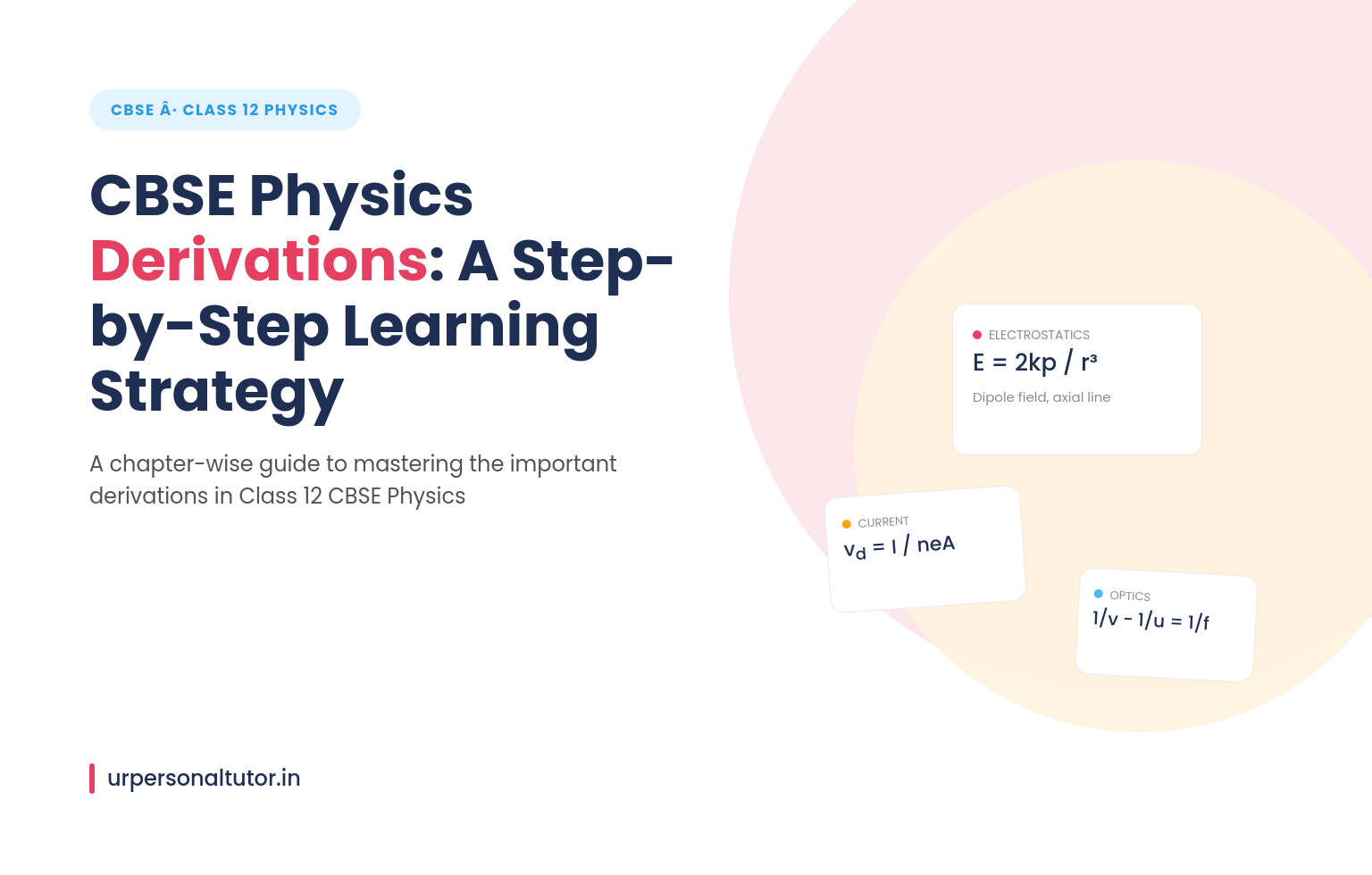
Derivations decide a bigger chunk of the Class 12 CBSE Physics board exam than most students realise. If you’re looking for the important derivations physics class 12 CBSE syllabus actually asks for, the short answer is: they’re concentrated in five chapters — Electrostatics, Current Electricity, Magnetic Effects of Current, Electromagnetic Induction, and Optics — and they’re worth anywhere from 3 to 5 marks each, sometimes appearing twice in a single paper in slightly different forms. The rest of this guide breaks down exactly which ones matter, why they trip students up, and how to actually get them into long-term memory instead of forgetting them the week after a test.
What Are Important Derivations in Physics Class 12 CBSE?
A derivation, in the context of CBSE Physics, is a step-by-step mathematical proof that connects a physical principle to a usable formula. Think of the derivation for electric field due to a dipole, or the expression for drift velocity in a conductor. These aren’t formulas you memorise in isolation. They’re logical chains, and the board specifically rewards students who can reproduce that chain, not just the final equation.
Out of the full Class 12 syllabus, roughly 15 to 18 derivations show up repeatedly across sample papers and previous years’ boards. That’s the real, working list of important derivations physics class 12 CBSE students should prioritise if time is tight. A handful of these are near-guaranteed appearances every year, and a good tutor will usually flag those in the first week of a term rather than waiting until revision season.
Are Derivations Included in the Physics 11th Syllabus CBSE?
Yes, and this catches a lot of students off guard. Are derivations included in physics 11th syllabus CBSE? They are, and skipping them in Class 11 creates a real problem a year later. Concepts like rotational motion, gravitation, and thermodynamics in Class 11 lay the mathematical groundwork for Class 12 topics such as electromagnetic induction and AC circuits. A student who never properly derived the expression for escape velocity in Class 11 will often struggle with the orbital velocity derivation in Class 12, simply because the underlying calculus habits were never built.
Part of this comes down to how sudden the jump from Class 10 to Class 11 actually is, with two dense textbooks landing at once and far less hand-holding than before. If your Class 11 foundation feels shaky, it’s worth going back and redoing a handful of those derivations before diving into the Class 12 list. It takes a weekend, not a semester, and it removes a lot of friction later.
Chapter-Wise List of Important Derivations Physics Class 12 CBSE
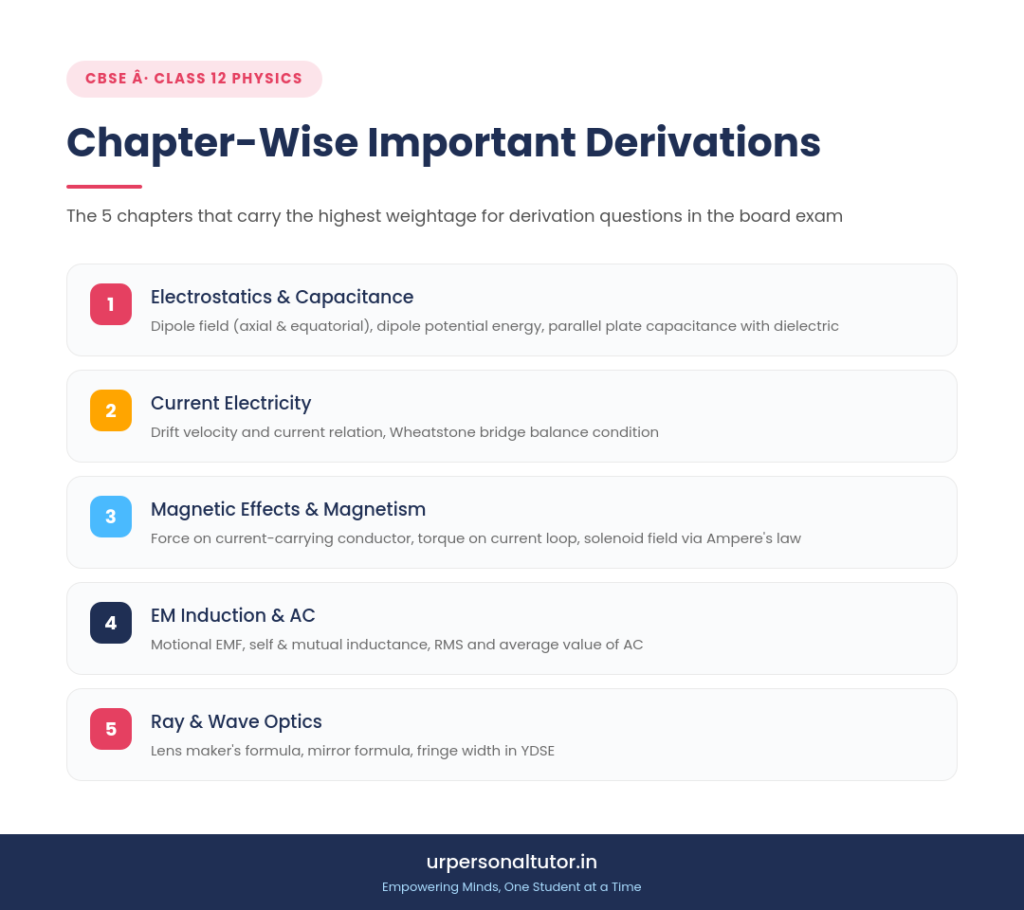
Here’s where most study guides go wrong — they list every derivation in the textbook without any sense of priority. A more useful approach is grouping by chapter and marking which ones appear most consistently in board papers.
Electrostatics and Capacitance
Electric field due to a dipole on axial and equatorial lines, potential energy of a dipole in a uniform field, and capacitance of a parallel plate capacitor with and without a dielectric. These three alone have appeared in some form in nearly every recent board paper.
Current Electricity
Derivation of drift velocity and its relation to current, and the condition for balance in a Wheatstone bridge. Students often memorise the final formula here without understanding why the bridge balances, which becomes obvious the moment an examiner tweaks the question slightly.
Magnetic Effects of Current and Magnetism
Force on a current-carrying conductor in a magnetic field, torque on a current loop, and the magnetic field due to a solenoid using Ampere’s Circuital Law. This last one is dense, and it’s one students consistently underprepare for.
Electromagnetic Induction and Alternating Current
Motional EMF, self and mutual inductance of coils, and the expression for average and RMS values of AC. These build directly on Class 11 rotational and oscillatory motion, which is exactly why weak Class 11 fundamentals resurface here.
Ray Optics and Wave Optics
Lens maker’s formula, mirror formula using the sign convention, and the derivation for fringe width in Young’s double slit experiment. Optics derivations tend to be shorter but require careful geometry, which is a different skill from the algebra-heavy electricity derivations.
Together, this chapter-wise breakdown covers the bulk of the important derivations physics class 12 CBSE examiners return to year after year. Printing this list and ticking off each one as it’s mastered is a small habit that makes revision measurably faster closer to exams.
How to Practice CBSE Physics Derivations Effectively
How to practice CBSE physics derivations without it turning into rote copying is the real question. Rewriting a derivation from the textbook five times in a row feels productive, but it mostly builds short-term recognition, not recall. A better method:
Write the derivation once while looking at the book, understanding every substitution as you go. Then close the book and attempt it from memory. Wherever you get stuck, that’s the exact point you don’t understand yet — not a gap to paper over with more copying, but a signal to go back to the underlying concept.
Spacing this out matters more than most students expect. A derivation revisited after one day, then again after four days, then again after ten, sticks far better than the same derivation practised five times in one sitting. This is standard spaced repetition, and it works particularly well for physics because each derivation has a logical sequence your brain can reconstruct rather than just recall.
Diagrams deserve separate attention. In derivations involving fields, forces, or optics, the diagram often carries half the marks. Practising the diagram alongside the algebra, not as an afterthought, is one of the fastest ways to pick up easy marks that get left on the table.
How to Tackle Derivations CBSE Physics During Exams
How to tackle derivations CBSE physics under actual exam pressure is a different skill from practising them at home. Time is tighter, and a blank moment feels much bigger than it actually is. A few things help.
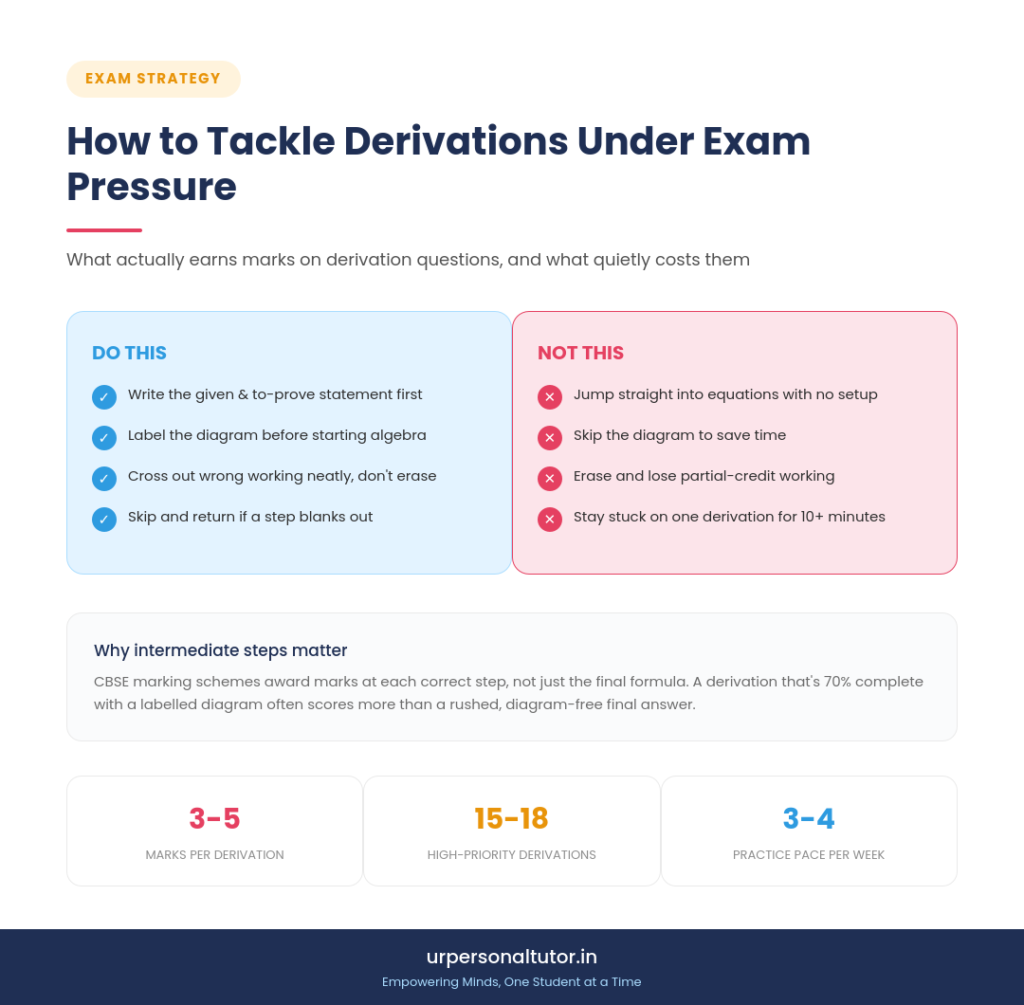
Start with the given and to-prove statement, written clearly, before touching any algebra. Examiners award marks at intermediate steps, so even a partially completed derivation with the right starting point and a labelled diagram earns something. Don’t erase working that seems wrong; cross it out neatly instead, since a partially correct approach visible to the examiner sometimes earns method marks even if the final answer is off.
If a derivation genuinely blanks out mid-exam, move on and come back. Physics papers are long, and the brain often supplies the missing step once the pressure of that specific question is removed. Students who stay stuck on one derivation for ten minutes usually lose more marks elsewhere than they would have lost by skipping and returning.
Common Mistakes Students Make With Physics Derivations
A few patterns show up again and again, and most of the recurring errors in CBSE physics trace back to just a handful of habits rather than a lack of understanding. Students memorise the final formula and skip the intermediate algebra, which works until the examiner asks for a slightly modified version of the same derivation. Others neglect units and sign conventions, particularly in optics and electrostatics, where a missing negative sign changes the entire physical meaning of the result. And a large number of students treat derivations as a Class 12-only task, forgetting that half the groundwork was supposed to happen in Class 11.
The fix for all three is the same: understand the physics behind each step rather than treating the derivation as a sequence to memorise. It takes longer upfront and saves considerably more time later.
A Simple Weekly Plan to Master Derivations
Spread across a term rather than crammed into the final month, three to four derivations a week is a sustainable pace. Pick two from a chapter currently being taught and one revision derivation from a chapter covered earlier. Rotate through chapters this way, and by the time board exams approach, every derivation on the list has been touched at least three or four times through natural spacing rather than a last-minute cramming push.
This is really a scheduling problem more than a physics problem, and it’s usually where students lose the most ground even when they know the material, which is exactly what a properly structured CBSE physics timetable is meant to solve.
Frequently Asked Questions
How many derivations are asked in the CBSE Class 12 Physics board exam?
Board papers typically include two to three derivation-based questions worth 3 to 5 marks each, drawn from the higher-weightage chapters like Electrostatics, Current Electricity, and Electromagnetic Induction.
Do I need to memorise derivations word-for-word or just the steps?
Examiners follow a marking scheme built around key steps and the final result, not exact wording. Understanding why each substitution happens matters more than reproducing identical phrasing.
Can NCERT alone cover all the important derivations for Class 12 Physics?
NCERT covers every derivation required by the CBSE syllabus, but it doesn’t flag which ones repeat most often in board papers. Cross-referencing with previous years’ papers helps prioritise study time.
Is it necessary to draw diagrams for every derivation?
Not every derivation needs one, but for topics like optics, electrostatics, and magnetism, the diagram usually carries dedicated marks in the scheme and is worth practising as carefully as the algebra.
A Note Before You Go
Derivations reward consistency far more than last-minute effort. A student who works through three or four a week across the term, with proper spacing and diagram practice, walks into the board exam with far less anxiety than one attempting to memorise fifteen derivations in the final ten days.
If you’d like a structured, tutor-guided approach to working through the important derivations physics class 12 CBSE syllabus covers, get in touch through urpersonaltutor.in