
IBDP Maths Past Papers Work Best in Three Stages
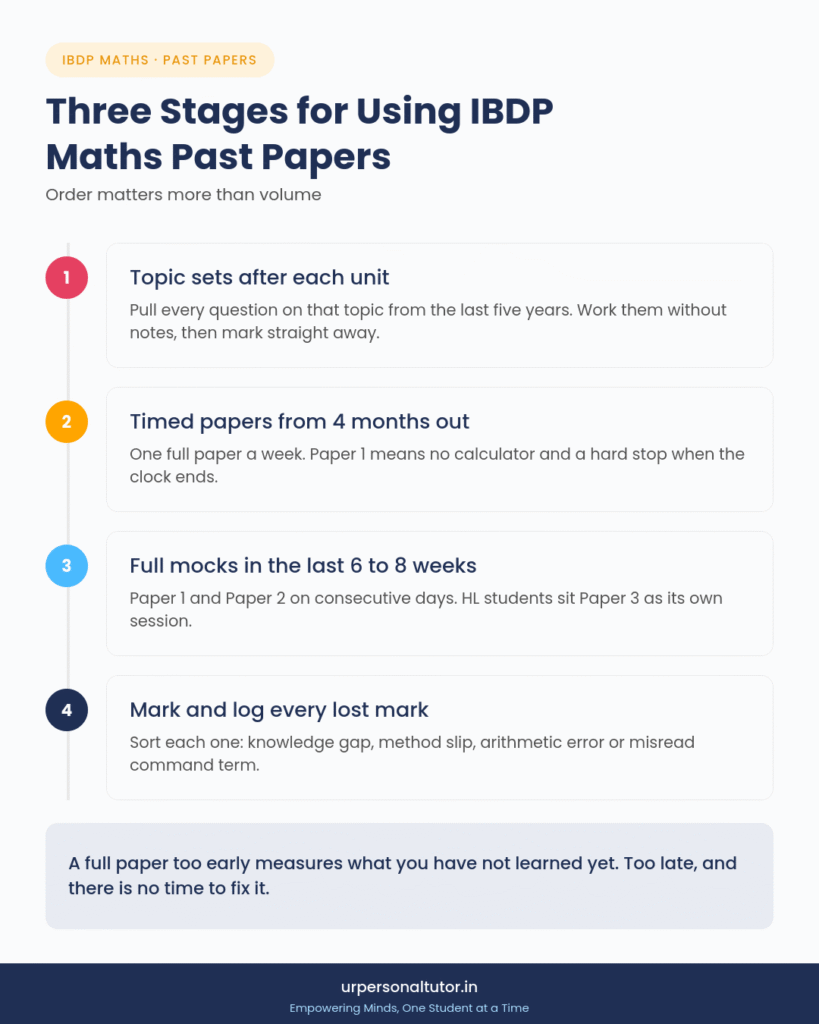
Use IBDP maths past papers in three stages. Start with topic-by-topic questions right after you finish each unit. Move to timed single papers about four months before the exams. Then sit full mock sessions in the final six to eight weeks.
The order matters. A full paper attempted too early mostly measures what you have not learned yet, and that is demoralising rather than useful. A full paper attempted too late leaves no time to repair what it exposes.
Why IB Maths Past Papers Beat Extra Textbook Questions
Textbook exercises teach a method. IB maths past papers show how examiners reward that method. Take a “show that” question: marks go to each justified line of working, and the final value is already printed for you. Practising on textbook questions never trains that habit.
Past papers also expose the command terms (“hence,” “write down,” “find”) and the way marks are split across a multi-part question. That is exam skill, and it only comes from real papers.
Know Which Papers You Are Actually Sitting
Before you download anything, match the papers to your course. The structure differs by level.
| Level | Papers | Calculator |
|---|---|---|
| SL | Paper 1 (90 min, 80 marks) | Not allowed |
| SL | Paper 2 (90 min, 80 marks) | Allowed |
| HL | Paper 1 (120 min, 110 marks) | Not allowed |
| HL | Paper 2 (120 min, 110 marks) | Allowed |
| HL | Paper 3 (60 min, 55 marks) | Allowed |
Analysis and Approaches and Applications and Interpretation papers are not interchangeable. Papers from before the 2021 first exams belong to the old syllabus, so using them by mistake is one of the easiest ways to waste a practice session.
Where to Find IBDP Math SL Past Papers Online
The official route is the IB store, and most schools also give students access to the IB Questionbank, which sorts questions by topic and includes mark schemes. If you are searching for IBDP math SL past papers online, be careful with free sites. Many host copies of unclear origin, and the year or course label is sometimes wrong.
The same applies to IBDP maths HL past papers. Check that Paper 3 is included and that the course matches yours before you start. Ask your teacher which source your school trusts.
Stage One: Topic-Wise IBDP Maths Past Papers After Each Unit
When you finish a unit such as functions or calculus, pull every question on that topic from the last five years. Work them in one sitting without notes, then mark them straight away.
This stage is about patterns. You will notice that examiners love certain setups, like optimisation in calculus or a sequence hidden inside a word problem. Spotting those early makes later timed papers feel familiar rather than random.
Stage Two: Timed Single Papers From Four Months Out
Around four months before the exams, switch to one full paper at a time under real timing. Do Paper 1 with no calculator, for the full 90 or 120 minutes, and stop when the clock stops. Finishing “just the last two questions” afterwards hides how you really perform under pressure.
Fit this into a wider IB exam preparation timetable so maths does not crowd out your other subjects. One timed paper a week is plenty for most students.
Stage Three: Full Mock Sessions in the Final Weeks
In the last six to eight weeks, recreate exam conditions properly. Sit Paper 1 and Paper 2 on consecutive days, at the same time of day as the real exam. HL students should treat Paper 3 as its own session, since its problem-solving style feels different from the other two.
Keep a record of timing too. If you regularly run out of minutes on the last third of Paper 2, no amount of extra content revision will fix that.
How to Mark Your Own Work With the Mark Scheme
IB maths mark schemes use a few codes that are worth learning. M marks reward a correct method, A marks reward an accurate answer that follows from it, and R marks reward a stated reason. AG means the answer was given, so the marks sit entirely in the working. Follow-through marks (FT) let you earn credit after an earlier slip.
Once marked, sort every lost mark into one of four buckets: knowledge gap, method slip, arithmetic error, or misread command term. After two or three papers, the pattern is usually obvious. Students who score a 7 tend to keep exactly this kind of log, because it tells them what to fix instead of what to repeat.
A Simple Weekly Rhythm
Early in the week, do two short topic sets on whatever you studied in class. Midweek, redo three or four questions you lost marks on the previous week. At the weekend, sit one timed paper and mark it on Sunday while the working is still fresh. Close to the exams, replace a topic set with a second timed paper.
Common Mistakes When Using IBDP Maths Past Papers
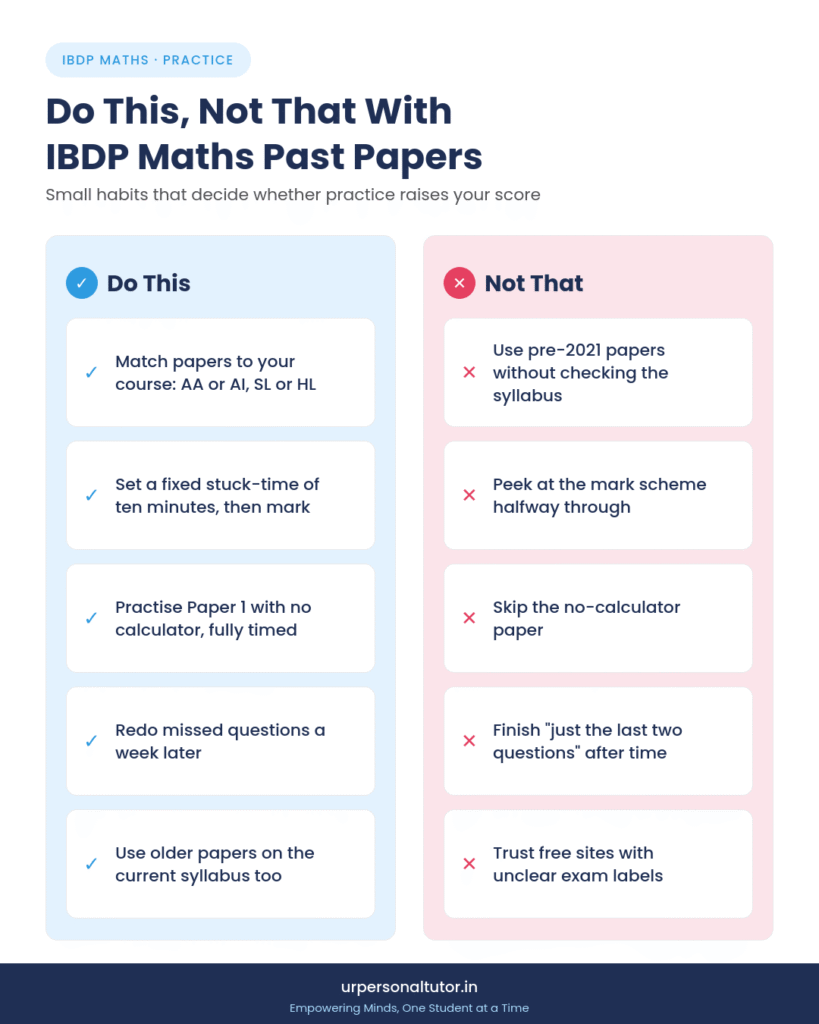
The biggest mistake is opening the mark scheme too soon. If you peek halfway through a stuck question, you learn the answer but not the thinking that leads to it. Give yourself a fixed stuck-time, say ten minutes, and then mark.
Another common mistake is using only recent IBDP maths past papers because they feel more relevant. Older papers on the current syllabus are just as useful, and they stop you running out of material in March. A third is neglecting the no-calculator paper, where arithmetic fluency and algebra speed decide the result.
Finally, many students never redo missed questions. Solving a question again a week later is what proves the fix actually worked.
When Past Papers Alone Are Not Enough
If the same topic keeps costing marks after two rounds of practice, another stack of papers rarely helps. The gap is usually conceptual, and a short session with a tutor finds it faster. That is where targeted IBDP tuition earns its place, because the tutor can watch how you work a problem and not just check the final answer.
Ready to Turn Practice Into Marks?
Past papers work when they sit inside a plan built around your actual weak spots. If you would like help building that plan, book a session with Ur Personal Tutor or browse more study guides on the blog.
Frequently Asked Questions
Are free IBDP maths past papers online reliable?
Some are, but many are copies of unclear origin with wrong year or course labels. Cross-check against what your school provides, and avoid any paper that does not state the exam session and course.
Can I use old syllabus papers for revision?
Only selectively. Questions on shared topics like algebra or trigonometry can still help, but papers from before 2021 include content and a structure that no longer match Analysis and Approaches or Applications and Interpretation.
Should SL students try HL questions?
Occasionally, and only for stretch. If your SL papers are already close to full marks, a few HL-style questions build flexibility. Otherwise, polishing accuracy on SL material gains more.
How should I handle Paper 3 in HL?
Treat it as a separate skill. Paper 3 asks for extended, structured problem solving, so practise it in a dedicated 60-minute block rather than folding its questions into other papers.
What if my score does not rise after many papers?
Count the lost marks by type rather than by topic. If most are arithmetic or misread command terms, more content study will not help. Slow down on those habits first.