
CBSE 11 Syllabus: What It Covers in 2026-27
The CBSE 11 syllabus is a single full-year course with no term split. Every student studies English Core plus a stream of elective subjects, and science students usually add Physics and Chemistry alongside Maths, Biology or both. Physics and Chemistry carry 70 marks of theory and 30 of practical, while Maths is typically 80 marks of theory and 20 of internal assessment.
That structure sounds simple until the textbooks arrive. Four demanding subjects, each with its own long list of chapters, can’t all be studied at once. The smarter question is which topics to learn first, because some chapters hold up half of Class 12 and others can safely wait until the second half of the year.
Is There a CBSE Class 11 Term 1 Syllabus and Term 2 Syllabus?
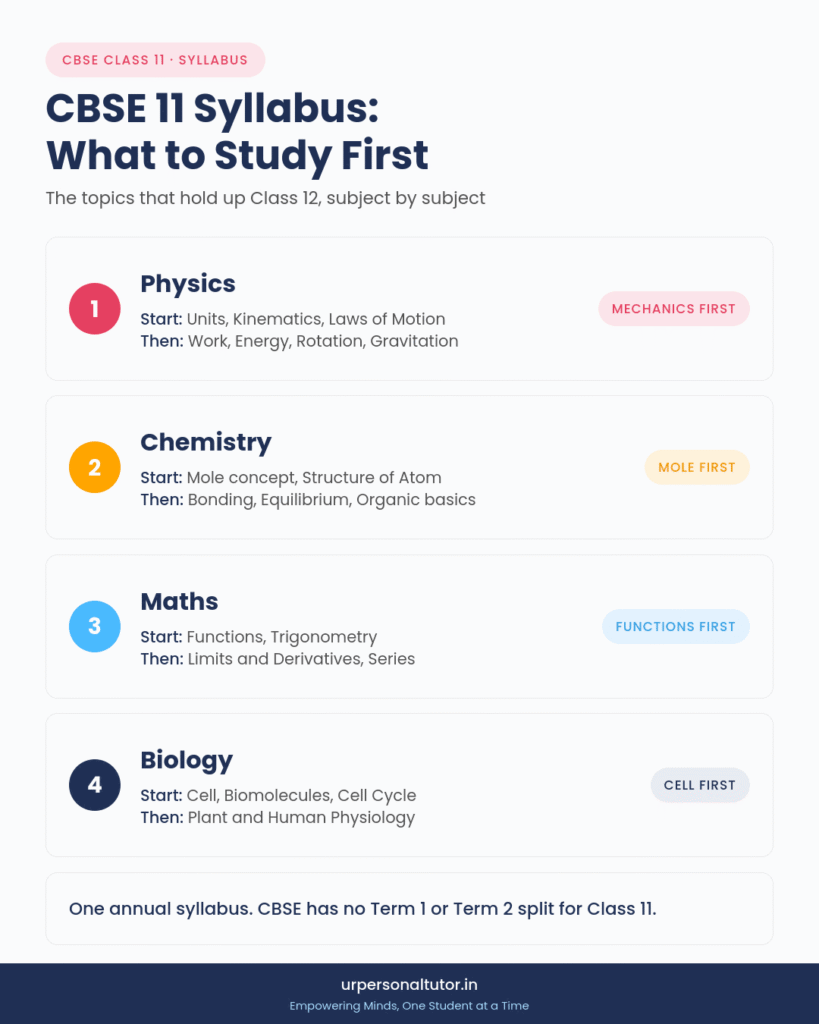
No. CBSE split the syllabus into two terms only for the 2021-22 session and went back to a single annual syllabus afterwards, so an official class 11 cbse term 1 syllabus or cbse class 11 term 2 syllabus does not exist today. What your school calls “Term 1” is its own plan. Usually it means the chapters assigned to a half-yearly exam in September or October, with the rest saved for the final exam.
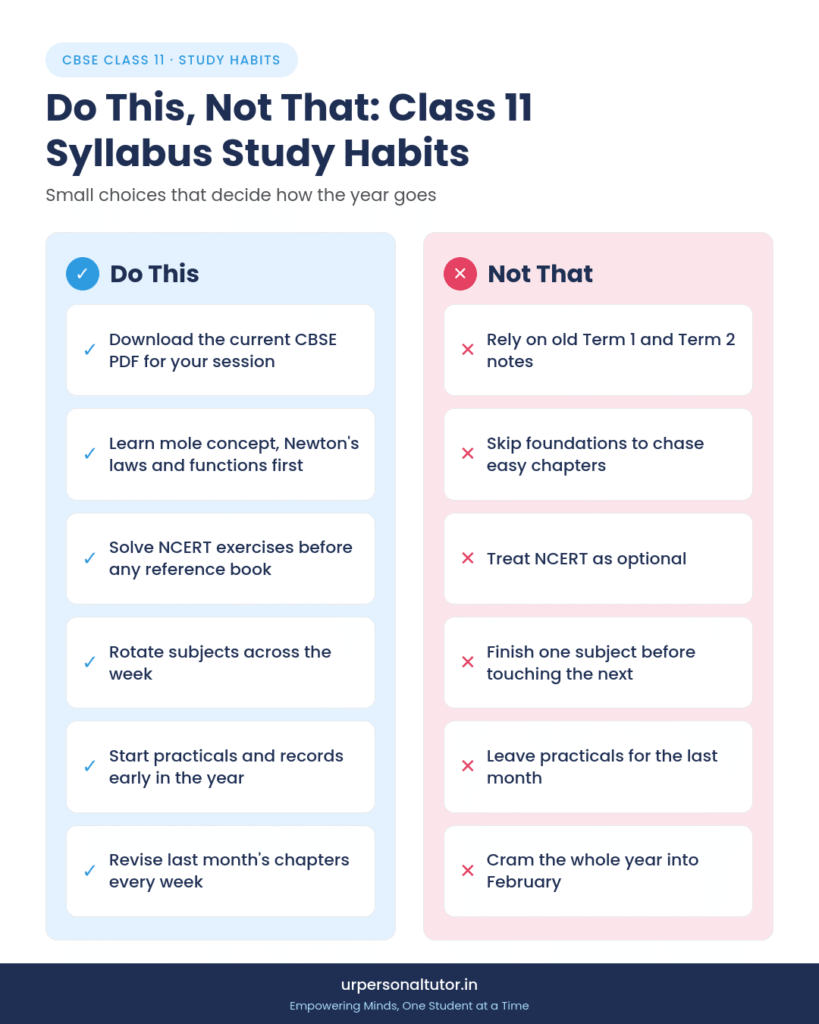
This matters because old term-wise PDFs still circulate online. Notes labelled Term 1 or Term 2 from 2021-22 no longer match the revised syllabus of class 11 CBSE that your school follows now. Download the current PDF for your session from CBSE’s academic website instead, since the board trims and adjusts topics from time to time, and plan around the CBSE 11 syllabus as one continuous year.
Why the Order You Study the CBSE 11 Syllabus Matters
Plenty of students say Class 11 is so difficult compared with Class 10, yet the chapters themselves are rarely the real problem. Class 10 rewards recognising question patterns. The CBSE class 11 curriculum expects you to derive results and apply them to situations you haven’t seen before.
That’s why sequence beats speed. Foundation chapters need to be locked in first because later chapters borrow from them. The mole concept sits behind almost every Chemistry calculation in Class 12, Newton’s laws underpin most of Physics, and functions are the entry ticket to calculus. Skip any of these to chase an easier chapter and the difficulty simply shows up later, usually closer to the exam.
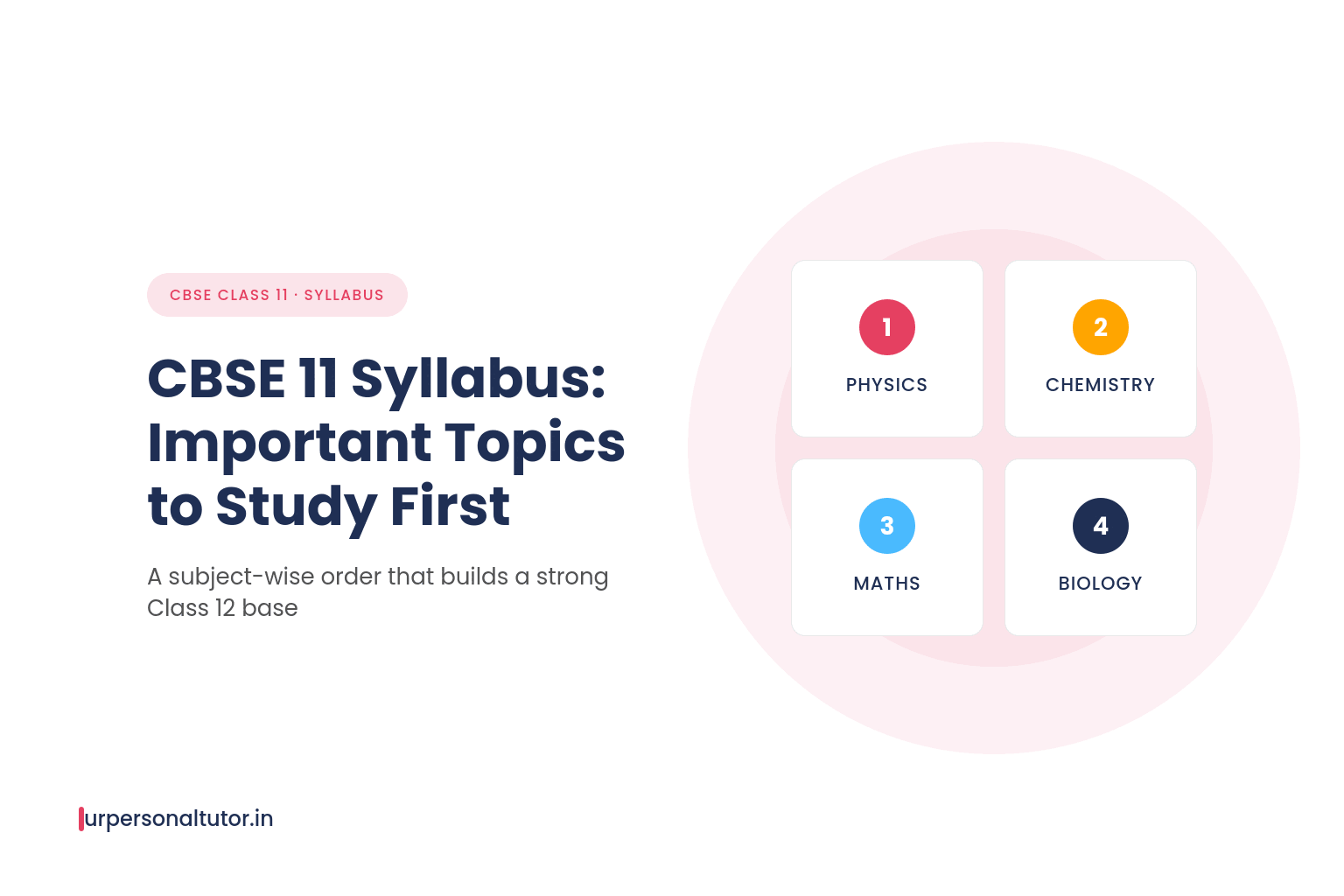
Physics in the CBSE 11 Syllabus: Where to Start
Begin with Units and Measurements. It’s short, it’s scoring, and it trains the habit of checking dimensions that saves marks across every later numerical. Kinematics and Laws of Motion come next, with Work, Energy and Power right behind them. Mechanics dominates the first half of the year for a reason: nearly every later chapter reuses its ideas.
Rotational motion and gravitation deserve a slower pace than most students give them. Teachers who handle CBSE physics see the same trap each year. Students treat Laws of Motion as a formula chapter, then struggle when rotation asks them to apply the same thinking in a new setting. Thermodynamics, kinetic theory, oscillations and waves can follow once the mechanics is steady, though oscillations in particular depends on clean kinematics.
Chemistry: Foundation Chapters First
Some Basic Concepts of Chemistry comes first, and the mole concept inside it deserves real time. Structure of Atom follows, then Classification of Elements and Chemical Bonding. These early chapters hold the vocabulary that the rest of the CBSE 11 syllabus assumes you already own.
Physical chemistry then takes over with Thermodynamics, Equilibrium and Redox Reactions. These are numerical-heavy, so practise problems as you go rather than only reading the theory. For organic chemistry, the chapter on basic principles and techniques is the one that shapes how Class 12 organic feels. Do it carefully before moving to Hydrocarbons.
Maths: Chapters That Carry Forward
Sets, Relations and Functions open the book and should be treated as groundwork, not a warm-up. Trigonometric Functions come next and reward steady practice, since identities only stick through repetition. Complex Numbers, Permutations and Combinations, the Binomial Theorem and Sequences and Series can then be taken in the order your school teaches them.
Limits and Derivatives is the chapter to start early. It’s the first taste of calculus, and Class 12 builds directly on it. Straight Lines and Conic Sections need steady diagram practice, while Probability and Statistics are lighter and fit comfortably into revision weeks.
Biology: Start With the Cell
The Living World and Biological Classification are descriptive and quick, so they make a gentle opening. The first chapter to take seriously is Cell: The Unit of Life, followed by Biomolecules and the Cell Cycle. Plant and human physiology depend on this material, so weak cell biology makes everything after it feel harder than it is.
Morphology and Anatomy of Flowering Plants and Animals are memory-heavy. Reading them once rarely works. Plan two or three short revision passes spread across the year, with labelled diagrams drawn from memory each time.
English and the Class 11 All Subject Syllabus
If you want the class 11 all subject syllabus in one place, the official CBSE PDFs list each subject separately, which makes it easy to check what applies to your stream. English Core splits into reading comprehension, writing tasks, grammar and literature from Hornbill and Snapshots. It’s easy to neglect next to the science subjects, so give it a fixed weekly slot instead of leaving it for exam month.
Building a Study Plan Around the Full CBSE 11 Syllabus
Most students do better with a study timetable for Class 11 that rotates subjects across the week than with one that finishes a subject before touching the next. Rotation keeps older chapters alive in memory, which is what makes the final exam manageable. Two focused hours on weekdays and about four on weekends is a realistic target alongside school.
Aim to cover the foundation chapters above before the half-yearly exams, then use October and November for revision and for the weaker topics your tests exposed. Keep one revision slot every week for chapters taught the previous month. That single habit prevents the pile-up that makes February feel impossible.
Mistakes Students Make With the CBSE 11 Syllabus
Treating NCERT as optional is the most expensive one, since school papers lean heavily on it, and reference books work better as a second layer. Leaving practicals for the last month is another. Thirty marks in the sciences depend on records, experiments and viva, and rushing them shows. A third is ignoring internal assessments, which quietly decide how comfortable your final marks feel.
Ready to Plan Your Class 11 Year?
Knowing the CBSE 11 syllabus is half the job. Turning it into a plan that fits your school hours and energy is where most students need support
Frequently Asked Questions
Do I need to finish the entire CBSE 11 syllabus if I’m preparing for JEE or NEET?
Yes. Class 11 content makes up roughly half of the JEE and NEET syllabi, and the entrance papers don’t skip it. The difference is depth. Entrance prep asks for harder problems on the same chapters, so finish the school syllabus first, then add difficulty.
Do Class 11 marks count toward the CBSE board result?
No. The board result is based on Class 12 alone. Class 11 marks matter for promotion in your school and sometimes for stream or subject choices, but they don’t carry into the final CBSE marksheet.
Is the class 11th syllabus the same in every CBSE school?
The syllabus is the same across the board. Schools differ in the order they teach chapters, the pace they follow, and how they design unit tests and half-yearly papers, so your school’s calendar can feel different from a friend’s.
Should I study NCERT or a reference book first?
NCERT first, always. Finish a chapter in the textbook and solve its exercises, then move to a reference book only for extra practice or harder problems.
Where can I find the official syllabus PDF for my subjects?
CBSE publishes every subject’s current syllabus on its academic website, organised class-wise. Download the one marked for your session and keep it beside your timetable as a checklist.