
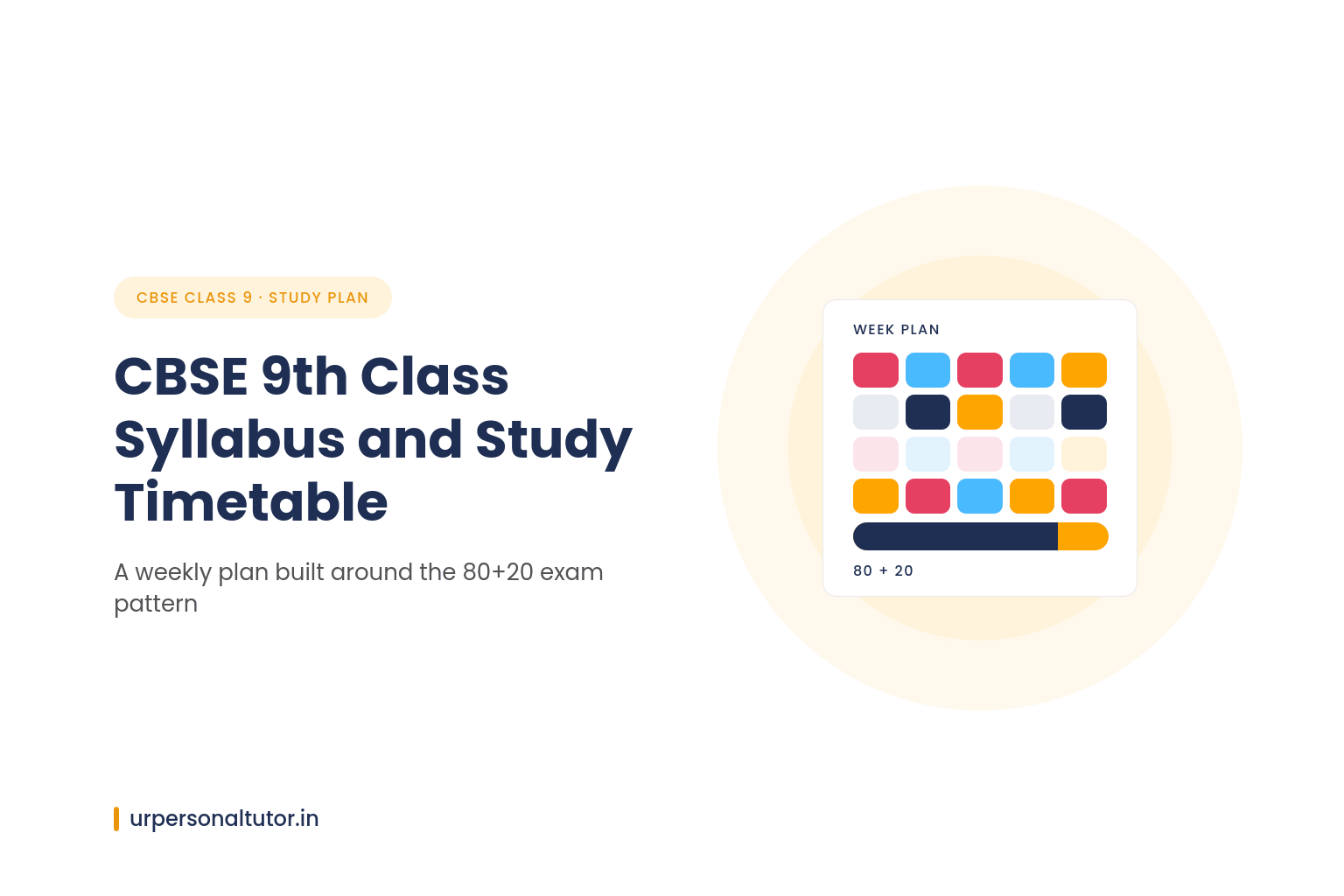
The CBSE 9th class syllabus for 2026-27 spans Mathematics, Science, Social Science and a three-language framework that includes English, with new computational thinking and AI modules added on top. It ends in one school-conducted annual exam of 80 marks, and another 20 marks come from internal assessment. A timetable only works if it mirrors that structure, so this guide starts with what the syllabus actually contains and then builds the weekly plan around it.
What the CBSE 9th Class Syllabus Covers in 2026-27
This session is not a routine refresh. CBSE has moved Class 9 to new textbooks aligned with the National Curriculum Framework of 2023, so older editions no longer match what is taught in class. Mathematics and Science now come in two levels: a standard course that every student takes and an optional advanced course. Every Class 9 student also studies three languages, at least two of them Indian, and takes compulsory computational thinking and AI modules that are assessed internally. The first Class 10 board exams under this structure arrive in 2028.
That is the real CBSE board class 9th syllabus in practice. The subject load is heavier than it looks on paper, with a third language added to the week and a layer of internally assessed work that needs steady attention rather than last-minute effort.
Is There a Term 1 and Term 2 Split in the CBSE 9th Class Syllabus?
Not officially. CBSE ran a two-term system for the 2021-22 session only and went back to a single annual assessment from 2022-23. Pages that still talk about the class 9 CBSE term 1 syllabus or the CBSE class 9 term 2 syllabus describe a system that no longer exists. Class 9 follows one annual syllabus, and the annual exam is set and conducted by your school.
Many schools still divide the year into a half-yearly exam and an annual exam, and that is the split worth planning around. Your school circular will name the chapters that fall before the half-yearly. If it does not, assume roughly half the syllabus is covered by then and adjust once your teachers confirm.
CBSE Exam Pattern for Class 9th: 80 Marks Theory, 20 Marks Internal
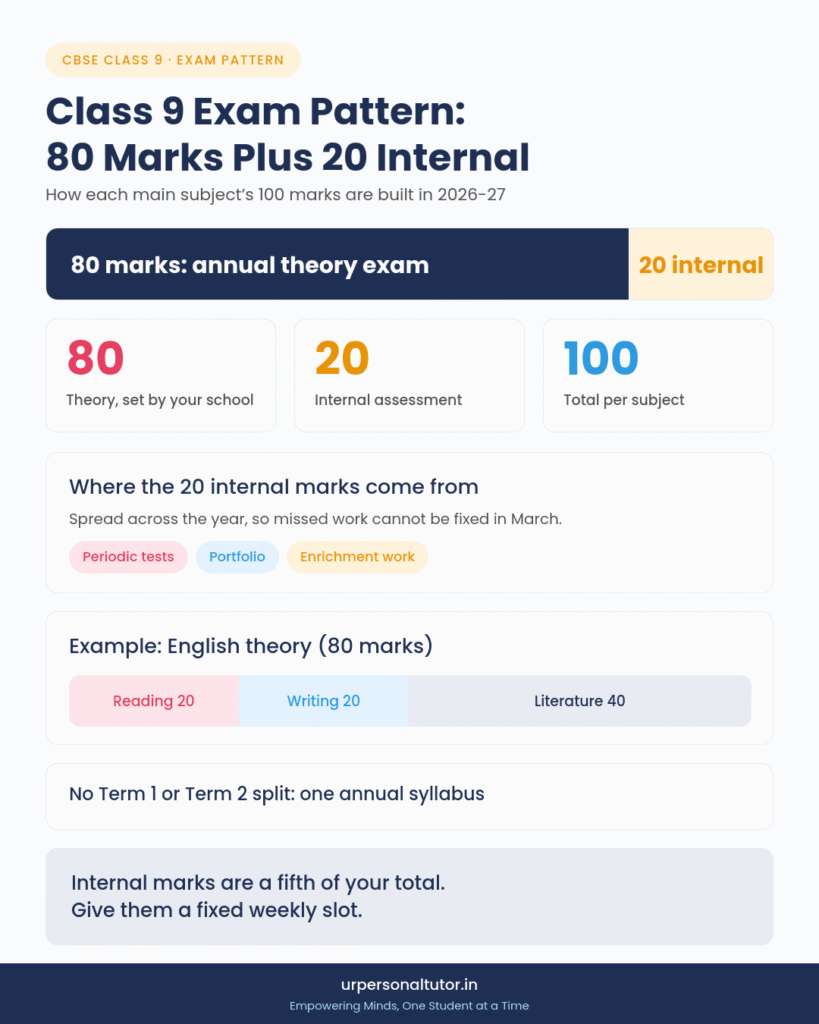
Each main subject carries 100 marks: 80 for the annual theory paper and 20 for internal assessment. The internal marks come from periodic tests, a portfolio and subject enrichment or practical work, and the exact split shifts a little between subjects. English shows the theory side clearly, with 20 marks for Reading, 20 for Writing and Grammar, and 40 for Literature.
Twenty marks is a fifth of the total, and it is the easiest fifth to lose through a missed submission or a skipped periodic test. A good timetable gives it a fixed weekly slot instead of treating it as an extra.
Why the CBSE 9th Class Syllabus Matters Beyond Class 9
Class 9 marks do not travel to the Class 10 board marksheet, which is exactly why many families relax during this year, and why the CBSE 9th class syllabus ends up being studied less carefully than it deserves. That is a costly habit. Class 10 builds directly on the Class 9 base, and the Class 11 syllabus assumes it without revisiting any of it. A student who coasts through Class 9 pays for it two years later, when the pace picks up and there is no slack left to repair old gaps.
How to Split Your Weekly Hours Across the CBSE 9th Class Syllabus
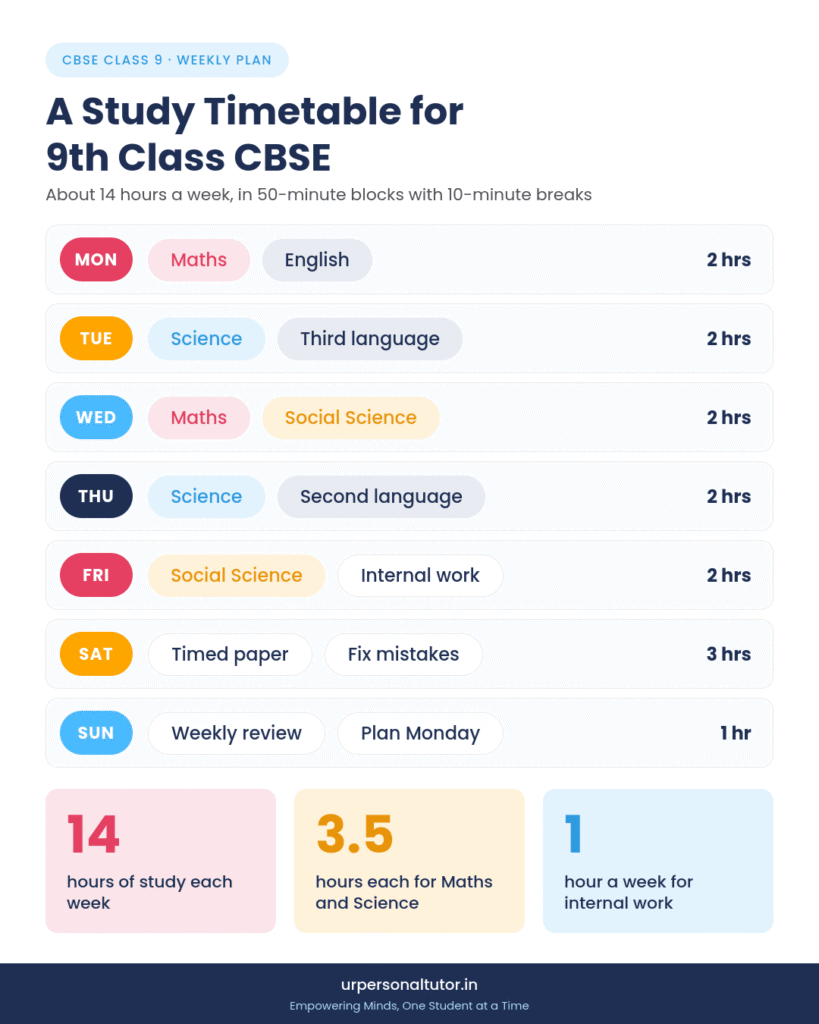
A realistic target for Class 9 is about 14 hours of home study a week: two hours on each weekday, three on Saturday and one on Sunday. Maths and Science get 3.5 hours each, Social Science gets 2.5, English gets 1.5, and the second and third languages get an hour apiece. The last hour goes to internal assessment work such as the portfolio and project tasks. These numbers are a starting point, not a rule. A student who finds Maths easy and Social Science heavy should move an hour across, and the plan should change the moment a periodic test says otherwise.
Mathematics and Science: Practice Beats Rereading
Maths improves through repetition, so a fixed set of 8 to 10 questions every study day does more than one long weekend session. Science needs both reading and numericals. The physics portion in particular gets more calculation-heavy as the years go on, and a comfortable habit with formulas and units now makes CBSE physics less of a shock later.
Social Science and Languages: Short and Frequent
Social Science rewards a different rhythm: read a chapter once, then write answers from memory and check them against the book. Languages work best in short daily slots. The third language is new for many students this year, so ten to fifteen minutes a day will do more for it than a single weekly hour. English benefits from the same treatment: one page of reading aloud and a few lines of writing daily build the Reading and Writing marks far more steadily than a cram before the paper.
A Study Timetable for 9th Class CBSE: The Weekly Template
On weekdays, pair one heavy subject with one lighter one so no evening feels like a wall. Maths and English fit together on Monday, Science and the third language on Tuesday, Maths and Social Science on Wednesday, Science and the second language on Thursday, and Social Science with internal assessment work on Friday. Each block runs about 50 minutes with a 10-minute break between them.
Saturday carries the long session: one timed section of a practice paper, followed by a review of every mistake. Sunday is one hour only. Reread the error notebook, tick off the week, and write down what Monday starts with.
Adjusting the Timetable Before Half-Yearly and Annual Exams
Three weeks before the half-yearly, cut new-chapter study to one block a day and turn Saturday into a full timed paper. After the exam, go back to the normal rhythm and use the first weekend to fix whatever the paper exposed.
For the annual exam, try to finish the CBSE 9th class syllabus by the middle of January if your school’s pace allows it. That leaves six to eight weeks for two full revision passes, which is far more useful than racing through the last chapters in February and revising once in a panic.
When One Subject Keeps Slipping
If marks in one subject stall across two periodic tests despite regular timetable hours, effort is rarely the problem. A concept gap usually sits underneath, and extra hours spent on top of it just repeat the same confusion. A few targeted sessions of one-to-one CBSE tuition can locate that gap faster than adding more self-study.
Timetable Mistakes That Fall Apart by Week Three
The most common failure is overpacking. A plan that tries to cover the whole CBSE 9th class syllabus at a sprint, with four hours every evening, survives about ten days, and then the whole thing is abandoned instead of trimmed. Start lighter than you think you need to and add time only after two clean weeks.
Skipping the weekly review is the second one. Without it, small errors repeat until they turn into habits. Internal assessment work also tends to slide, because nothing about it feels urgent until a submission date lands. Treat each portfolio piece like a mini deadline with its own date in the planner, and the last-week panic mostly disappears.
Ready to Turn the CBSE 9th Class Syllabus Into a Timetable?
A timetable works best when it reflects your actual strengths, your school’s pace and the hours you really have. The CBSE 9th class syllabus is manageable when it is broken into weekly pieces, and overwhelming when it is faced as one big heap. If you would like help building one, book a consultation with Ur Personal Tutor or read more preparation guides on the blog.
Frequently Asked Questions
Do Class 9 marks count toward the Class 10 board result?
No. Class 9 results come from your school’s annual exam and do not carry into the Class 10 board marksheet. They still decide promotion, and the habits built this year decide how comfortable Class 10 feels.
Can I use older books for the CBSE 9th class syllabus?
Not as your main source. The 2026-27 textbooks are new and aligned with the 2023 curriculum framework, so older editions may skip topics or teach them in a different order. Use them only for extra practice, and check anything unfamiliar against the current textbook.
Should I take advanced Maths and Science?
The standard level is mandatory and the advanced level is optional. Ask your school how and when the choice is made, and look at your current comfort with Class 8 Maths and Science before deciding. A student still shaky on fractions, ratios or basic force concepts is better served by mastering the standard course first.
Should I start Class 10 topics early?
A light preview is fine, but depth in Class 9 pays off more. Spending your extra hour on weak Class 9 chapters will lift Class 10 marks more reliably than meeting Class 10 chapters half-prepared.
How do I know if my timetable is working?
Check after three weeks. If your periodic test scores are steady or rising, your error notebook is shrinking and you are finishing most planned blocks, keep going. If you are missing more than two blocks a week, the plan is too heavy and needs trimming.