
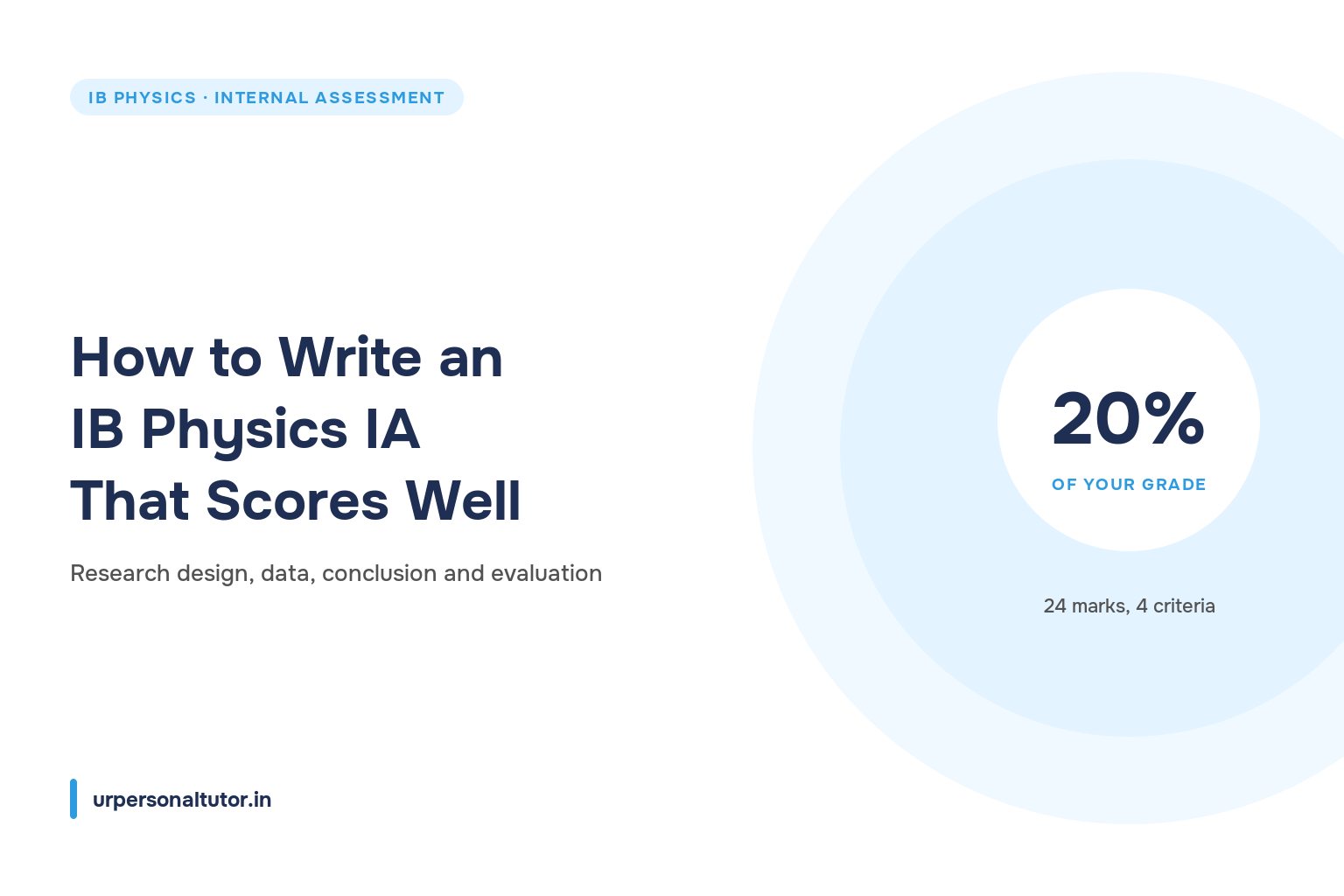
The IB Physics Internal Assessment is worth 20 percent of your final grade, and it is the only part of the course where you control the timing, the topic and the quality of the final product. No exam hall, no surprise questions. Just you, an experiment and a report of up to 3,000 words. Yet every year I see capable students lose easy marks on it, usually not because their physics is weak but because they misread what the moderator is looking for.
I have helped a lot of students through this piece of work, and the patterns repeat. So let me walk you through how the IA is actually assessed and what separates a mediocre report from one that scores well.
How the IB Physics IA Is Marked
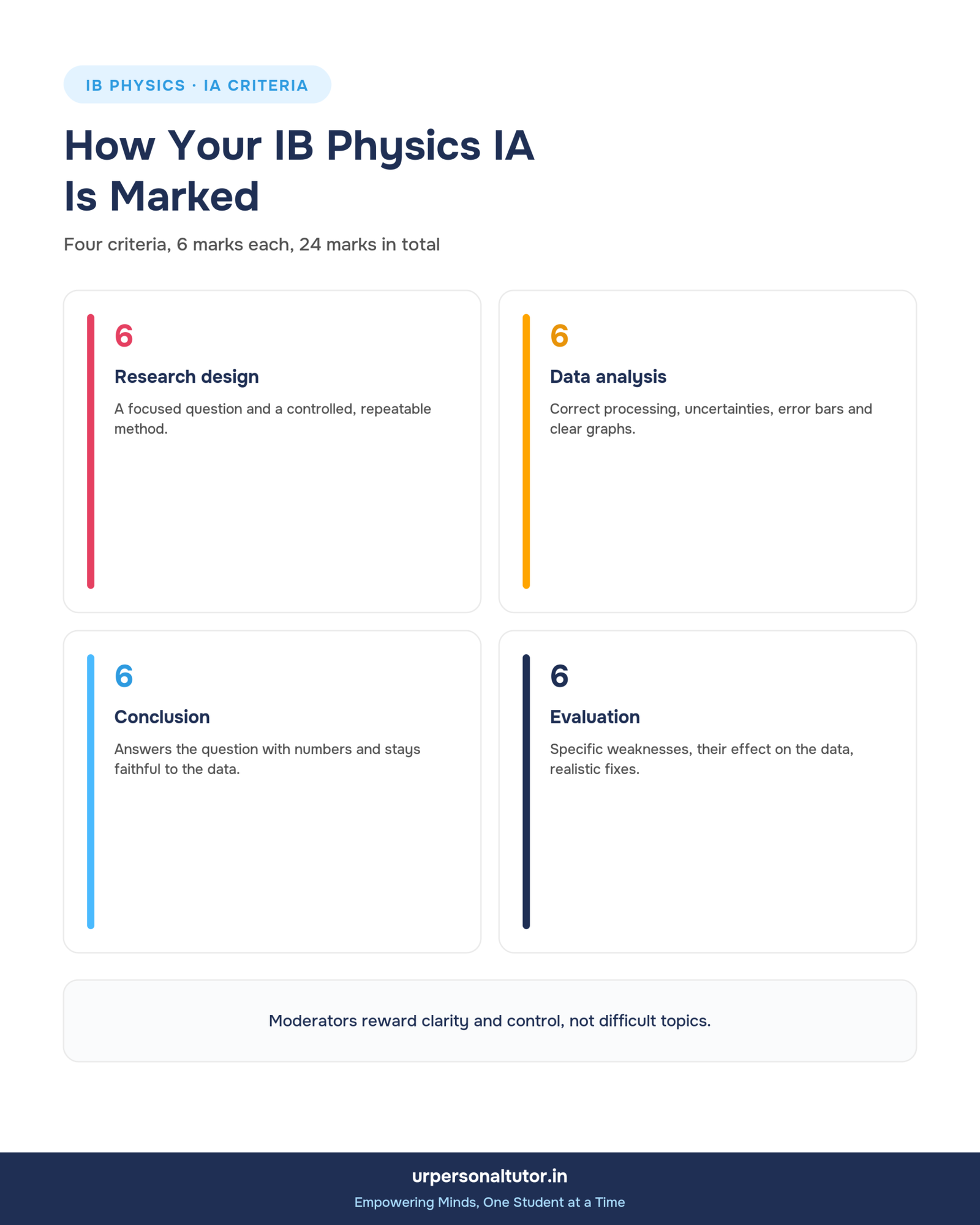
Under the current syllabus, the scientific investigation is marked out of 24 using four criteria, each worth 6 marks:
- Research design: Is your question focused, and is your method appropriate, controlled and repeatable?
- Data analysis: Did you process raw data correctly, handle uncertainties and present it clearly?
- Conclusion: Does your conclusion answer the research question and stay faithful to the data?
- Evaluation: Do you identify real weaknesses in your method and suggest realistic improvements?
Notice something important. There is no criterion for “interesting topic” or “difficult physics.” A simple pendulum investigation done rigorously can outscore an ambitious project done carelessly. Moderators reward clarity, honesty and control, not complexity.
Step 1: Choose a Research Question That Can Actually Be Answered
A good research question names one independent variable, one dependent variable and the system you are studying. Compare these two:
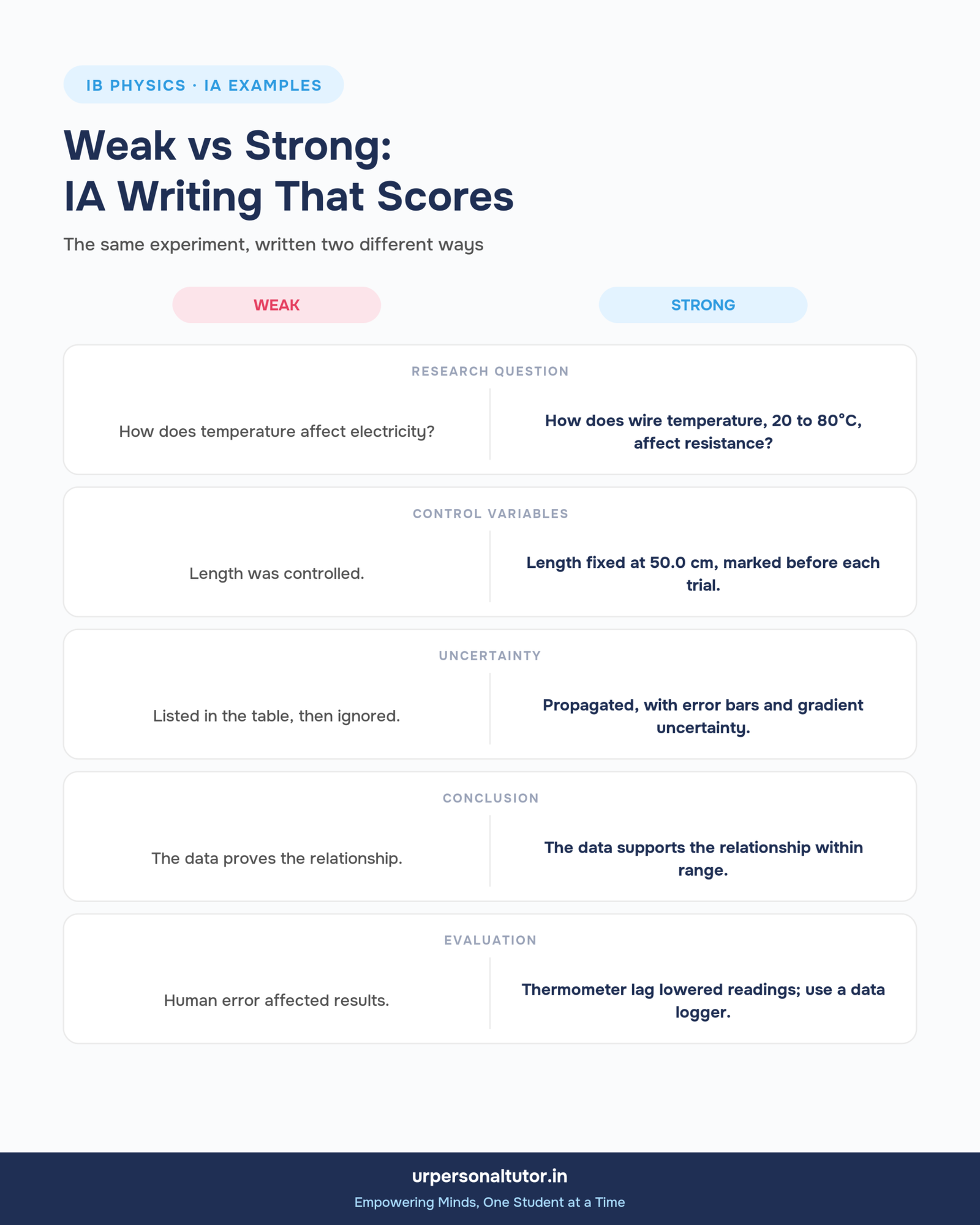
- Weak: “How does temperature affect electricity?”
- Strong: “How does the temperature of a copper wire, between 20°C and 80°C, affect its electrical resistance?”
The second question tells the moderator exactly what you will change, what you will measure and over what range. That clarity makes everything after it easier to mark.
Two practical tests before you commit. First, can you collect at least five values of the independent variable, with repeats, in the time available? Second, is there a physical relationship you can compare your data against? If you can predict the shape of the graph from theory, your conclusion section almost writes itself.
Step 2: Design a Method That Controls What Matters
Research design marks come from showing the moderator that you thought ahead. List your control variables and explain how each was kept constant, not just that it was. “The length of the wire was kept at 50.0 cm by marking it against a metre rule before each trial” is far stronger than “length was controlled.”
Include enough detail that another student could repeat your experiment. Mention equipment resolution, the number of trials, and any safety or ethical considerations. If your setup is unusual, a labelled diagram or photo saves you a hundred words.
Step 3: Treat Uncertainties as a Core Skill, Not an Afterthought
This is where most IAs lose marks. Students record uncertainties in the raw data table and then never mention them again. Moderators notice.
Strong data analysis does a few consistent things:
- States the uncertainty of every measuring instrument and justifies it
- Propagates uncertainties through calculations correctly
- Shows error bars on the graph
- Draws a line of best fit plus maximum and minimum gradient lines to find the uncertainty in the gradient
That last point is a quiet differentiator. When you report a gradient as 0.42 ± 0.03 rather than just 0.42, you show the moderator you understand what your data can and cannot claim.
Step 4: Write a Conclusion That Stays Honest
Your conclusion should answer the research question directly, using numbers. Then compare your result with theory or an accepted value, and state whether the difference falls within your uncertainty.
The most common mistake here is overclaiming. If your data shows a clear trend with a lot of scatter, do not write that it “proves” the relationship. Write that it “supports” the relationship within the range tested. That small word change reflects scientific maturity, and moderators reward it.
Step 5: Evaluate Like a Scientist, Not a Student
“Human error” is not an evaluation. It tells the moderator nothing. Strong evaluations identify specific weaknesses, explain their effect on the data, and propose realistic fixes.
For example: “The thermometer had a response time of several seconds, so readings taken during heating likely lagged behind the true wire temperature, making measured resistances appear lower than expected at higher temperatures. Using a data logger with a thermocouple attached directly to the wire would reduce this lag.”
That one paragraph names the weakness, explains the direction of its effect, and suggests a concrete improvement. Three or four paragraphs like that and your evaluation is in excellent shape.
Timeline: How to Pace Your IA
Most schools give you a few weeks of class time, but the best reports are planned well before the first measurement. A realistic pacing looks like this: a week to choose and refine the question, a session or two of pilot testing, the main data collection, then two weeks of writing and redrafting. Pilot testing is the step students skip most, and it is the step that saves the most marks, because it exposes problems with range, resolution and method before they ruin your real data.
Frequently Asked Questions
How much is the IB Physics IA worth?
The internal assessment counts for 20 percent of the final grade at both SL and HL. It is marked out of 24 across four criteria: research design, data analysis, conclusion and evaluation.
What is the word limit for the IB Physics IA?
The report has a maximum of 3,000 words. Moderators are not required to read beyond that, so long reports risk losing their conclusion and evaluation entirely.
Can I do a simulation or database IA instead of a hands-on experiment?
Yes. Investigations using simulations or secondary data are allowed, but they must still show genuine design choices, proper data analysis and critical evaluation. They are not an easier option.
What are good IB Physics IA topics?
Good topics have one clear independent variable, a measurable dependent variable and a known theoretical relationship. Pendulums, resistance and temperature, projectile range, magnetic field strength, and cooling curves all work well when done rigorously.
How do I get full marks in IB Physics IA data analysis?
Record instrument uncertainties, propagate them through calculations, include error bars, and calculate the uncertainty in your gradient using maximum and minimum lines. Then refer to these uncertainties in your conclusion.
Stuck choosing an IA question or unsure if your draft is on track? I review IB Physics IA plans and drafts one-to-one, before the deadline turns small problems into lost marks. Book a session with Ur Personal Tutor.