
ICSE Class 10 Physics has a reputation for being tougher than its CBSE equivalent, and in one sense that reputation is fair. ICSE expects precise definitions, careful numerical working and clean diagrams, and it rarely gives marks for answers that are “nearly right.” But that strictness has an upside. ICSE Physics is very predictable once you know where marks come from.
Here is a chapter-wise guide to what tends to get asked, and how to prepare each part of the syllabus for the board exam.
The ICSE Physics Paper Pattern
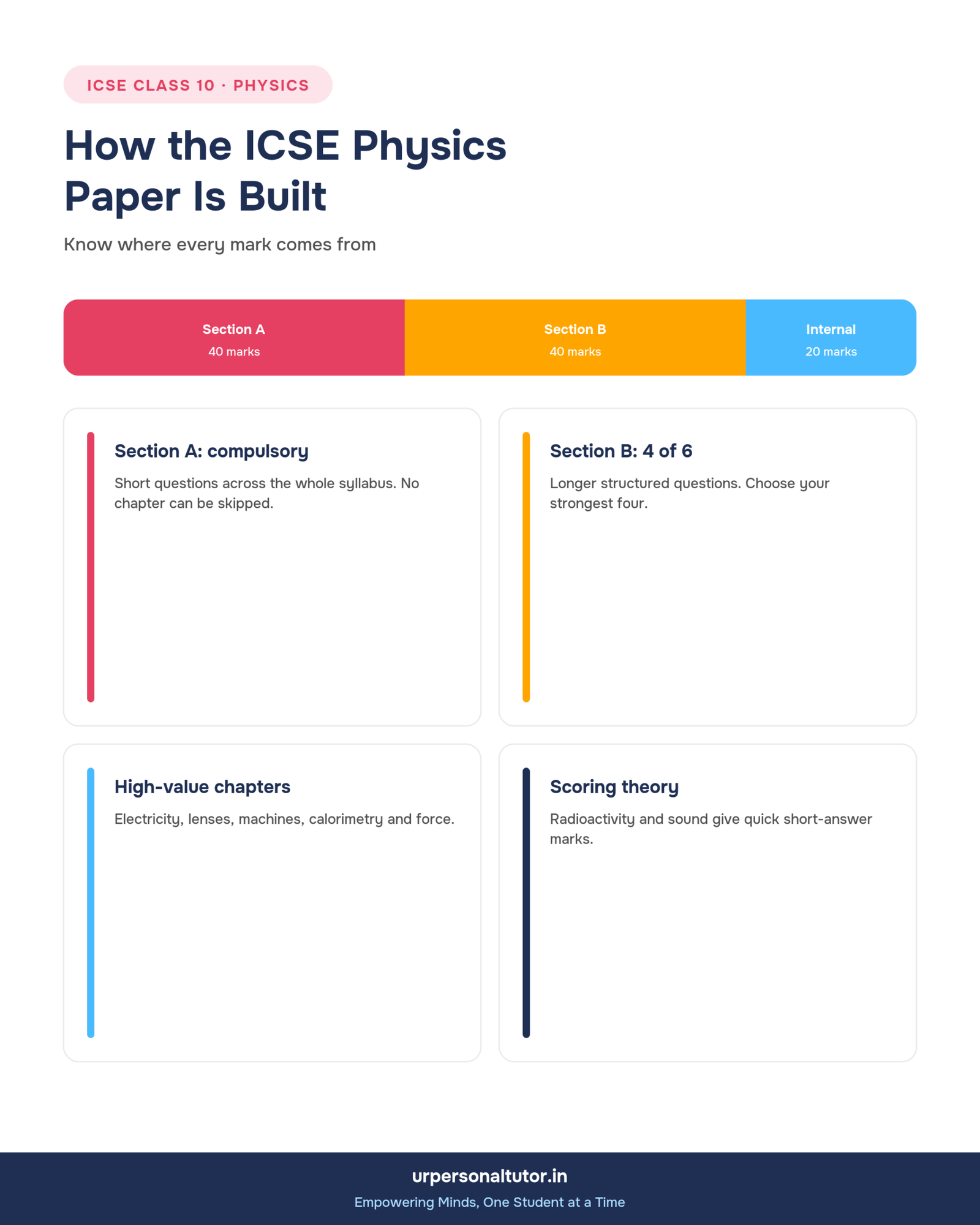
Physics is Science Paper 1 in ICSE. The theory paper is 80 marks and two hours long, with a further 20 marks from internal assessment through practical work. The theory paper has two sections:
- Section A (40 marks): Compulsory. Short questions across the whole syllabus, including multiple choice, definitions, short numericals and reasoning questions.
- Section B (40 marks): Attempt any four of six questions. Longer structured questions with numericals, diagrams and explanations.
Section A tests breadth, so no chapter can be skipped. Section B tests depth, but the choice lets you play to your strengths.
Chapter-Wise Focus Areas
The board does not publish fixed marks per chapter, but question patterns repeat clearly across years. Here is what to prioritise in each unit.
Force, Work, Power and Energy: Moments and couple, centre of gravity, uniform circular motion, work energy theorem, conservation of energy. Expect numericals on moments and power.
Machines: Levers (classes with examples), pulleys and pulley systems, mechanical advantage, velocity ratio and efficiency. Block and tackle numericals appear frequently.
Light: Refraction at plane surfaces, total internal reflection, critical angle, refraction through lenses, and the spectrum. Ray diagrams for convex and concave lenses are high-value and must be precise.
Sound: Reflection and echoes, natural and forced vibrations, resonance, and characteristics of sound. Echo numericals are common.
Electricity and Magnetism: Ohm’s law, combinations of resistors, electrical power and energy, household circuits and safety, magnetic effect of current, electromagnetic induction and the AC generator. Resistor combination numericals are among the most repeated questions on the paper.
Heat: Calorimetry, specific heat capacity, latent heat. Calorimetry numericals require careful heat balance and units.
Modern Physics: Radioactivity, alpha, beta and gamma emissions, nuclear changes, and safety. Mostly short theory questions, which makes this a scoring chapter.
Question Types That Repeat Every Year
Across ICSE papers, certain formats come up again and again:
- Definitions with SI units (“Define power. State its SI unit.”)
- Reasons (“Why does a stone tied to a string move in a circle?”)
- Ray diagrams with labelled positions of objects and images
- Multi-step numericals in electricity, calorimetry and machines
- Comparisons (“State two differences between natural and forced vibrations.”)
Practise each format separately, then mix them.
How to Score High in ICSE Physics
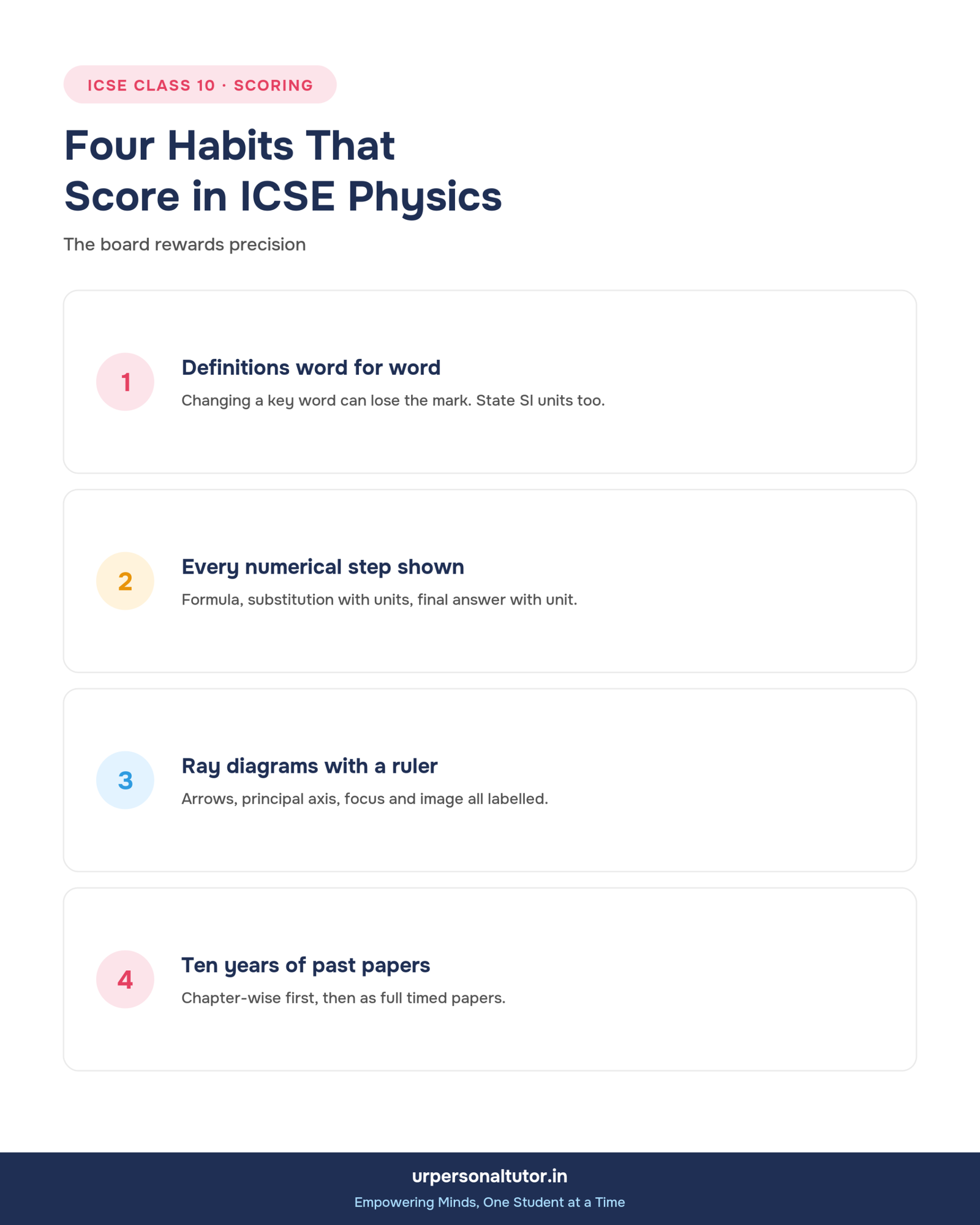
Learn definitions word for word. ICSE examiners look for precise wording. A definition that changes a key word can lose its mark.
Show every numerical step. Write the formula, substitute values with units, and give the final answer with the correct unit. Steps earn marks even if the final answer slips.
Draw ray diagrams with a ruler and arrows. Label the principal axis, focus and image. Messy diagrams lose marks that are easy to keep.
Solve ten years of papers. ICSE patterns repeat. Solving past papers chapter-wise first, then as full papers, is the most effective preparation.
Frequently Asked Questions
How many marks is ICSE Class 10 Physics?
Physics is Science Paper 1, with an 80-mark, two-hour theory paper and 20 marks of internal assessment, for a total of 100.
Which chapters are most important in ICSE Class 10 Physics?
Electricity, light (especially lenses), machines, calorimetry and force are the most heavily tested through numericals and diagrams. Radioactivity and sound provide scoring short questions.
How do I prepare for ICSE Physics numericals?
Learn the formulas for each chapter, practise with SI units, and solve previous year numericals chapter-wise. Always show formula, substitution and final answer with units.
Is ICSE Class 10 Physics harder than CBSE?
ICSE Physics expects more precise definitions and slightly more detailed numerical work, but it is very predictable. Students who practise past papers thoroughly usually score well.
How many questions do I answer in Section B of ICSE Physics?
You answer any four of the six questions in Section B. Section A is compulsory.
Looking for ICSE Physics support that focuses on exactly what the board rewards? Ur Personal Tutor offers personalised ICSE Physics tuition. Book a free first session.