
Choosing between IB Chemistry HL and SL feels like a small decision on a subject selection form. It is not. It shapes your workload for two years, it can open or close university courses, and it decides whether Chemistry becomes one of your strongest scores or the subject that quietly drains your time from everything else.
Students usually ask me one question: “Is HL much harder?” The honest answer is that HL is not just SL with extra chapters. It is longer, deeper and more mathematical. Whether that is worth it depends on where you are heading, not on whether you are “good at science.”
The Core Difference in One Line
SL Chemistry gives you a solid working understanding of chemistry. HL Chemistry asks you to explain why that chemistry works, often with more calculation and more abstract reasoning. Both share the same core content. HL adds additional higher level material on top of it and tests everything more deeply.
Teaching Time and Content
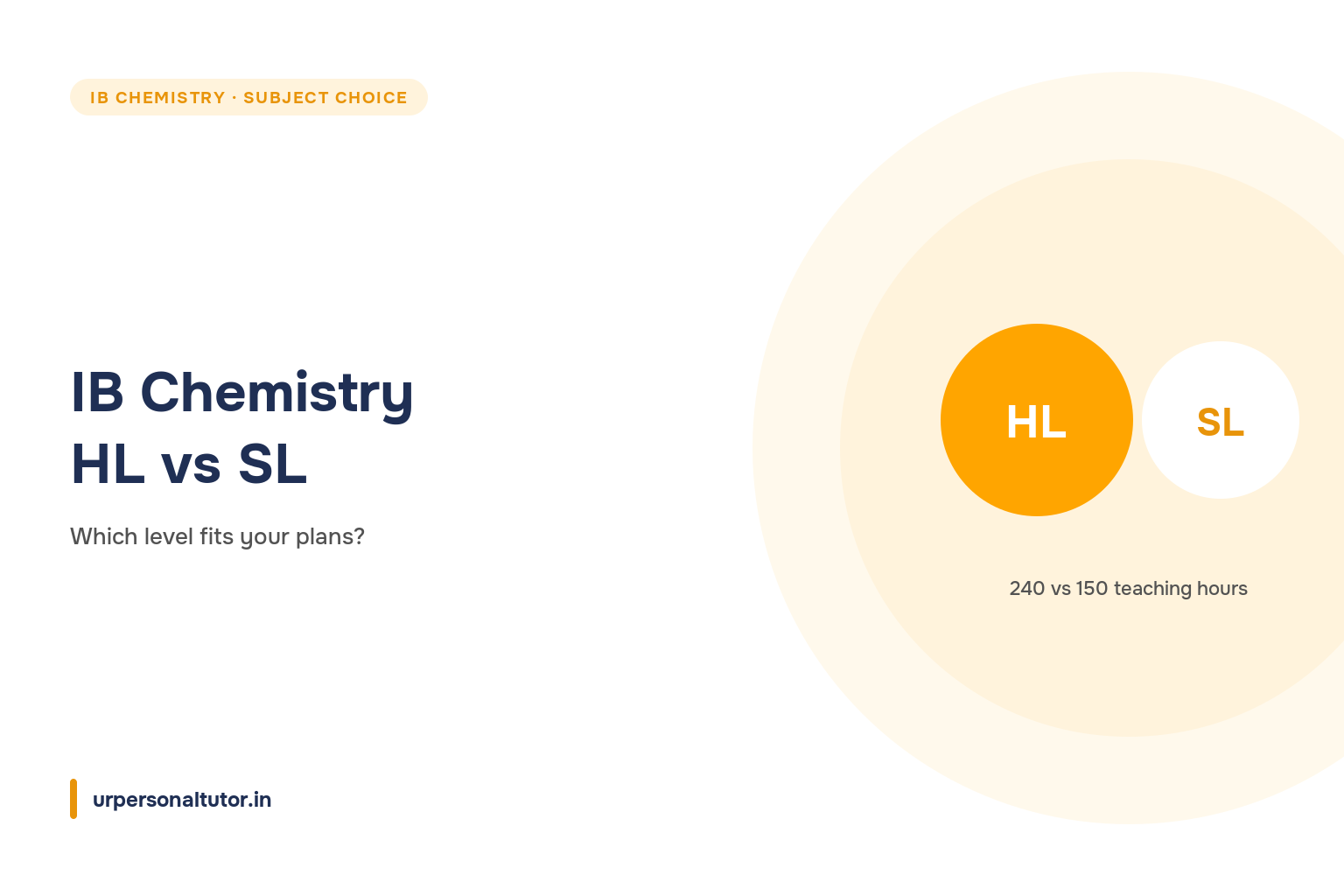
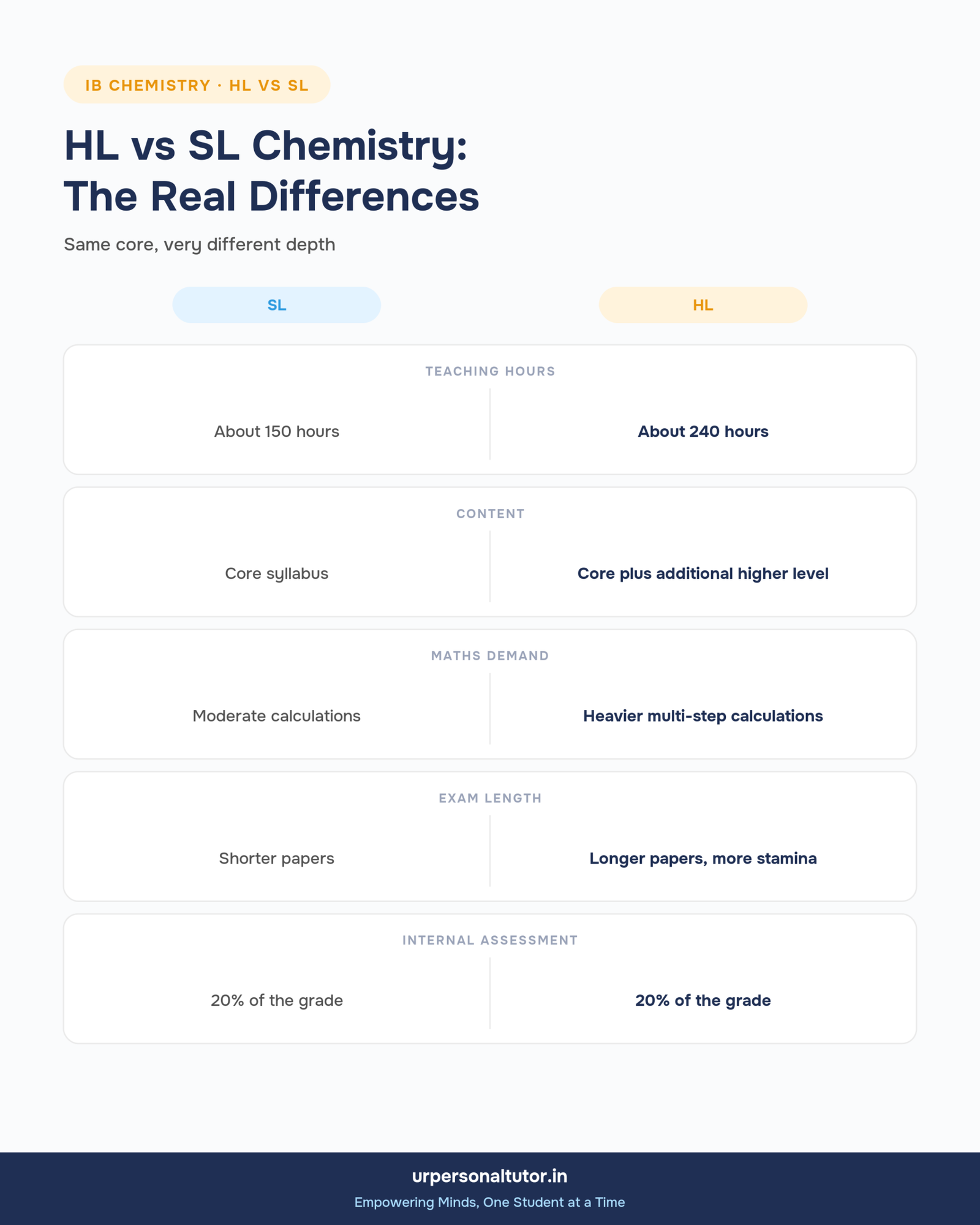
The IB recommends roughly 150 teaching hours for SL and 240 hours for HL. That extra 90 hours is the clearest measure of the gap. It is not spread evenly. It concentrates in areas like advanced energetics, equilibrium calculations, acids and bases, electrochemistry, and organic reaction mechanisms, which are exactly the topics students find most demanding.
The current syllabus is organised around two big themes, the structure of matter and the reactivity of matter, connected by linking questions that ask you to apply ideas across topics. HL students meet more of these connections and are expected to handle them with greater independence.
Exams and Assessment
Both levels sit two written papers plus the internal assessment, a scientific investigation worth 20 percent of the final grade. The difference is in length and depth. HL papers are longer, contain more questions, and include the additional higher level content. At both levels, Paper 1 combines multiple choice with data-based questions, and Paper 2 is extended written response.
In practice, HL papers demand more stamina and much more confidence with multi-step calculations. If you find long, structured problem solving tiring, you will feel that on HL papers.
Which Universities Care About HL Chemistry?
This is where the decision often makes itself:
- Medicine and dentistry: Many programmes, especially in the UK, require or strongly prefer HL Chemistry. Check each university before you choose.
- Chemistry, chemical engineering, pharmacy, biochemistry: HL Chemistry is usually expected and often required.
- Biology-heavy courses: HL is frequently preferred, though some accept SL with HL Biology.
- Engineering (non-chemical), physics, computer science: SL Chemistry is generally fine. Maths and Physics matter more.
- Non-science courses: SL is usually enough, and HL may cost you time better spent elsewhere.
If you are even considering medicine, check requirements before you lock your subjects. Switching from SL to HL later is possible in some schools, but catching up on missed HL content mid-course is painful.
How to Decide: Four Honest Questions
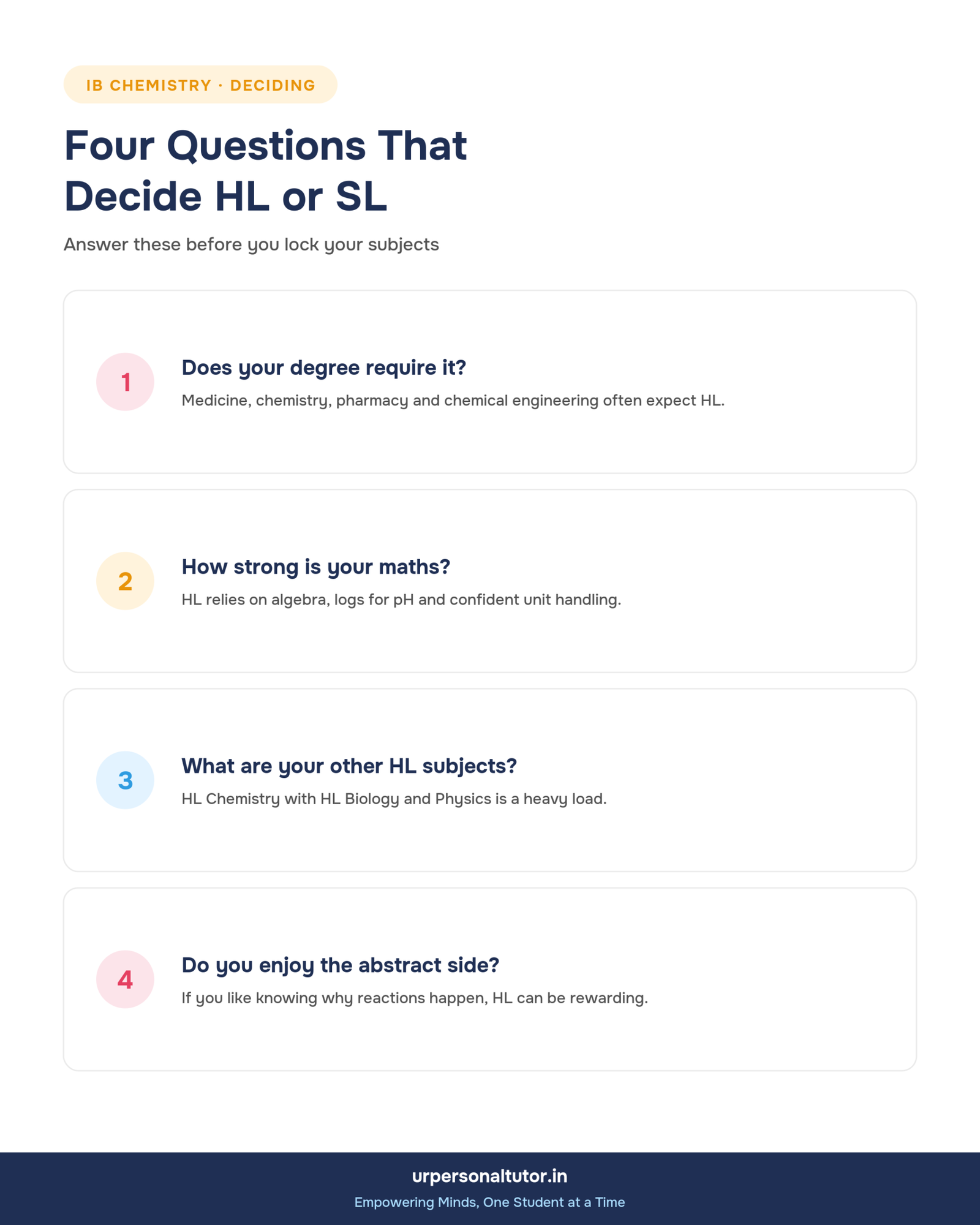
1. Does your intended degree require it? If yes, the decision is made. Take HL.
2. How strong is your maths? HL Chemistry relies on comfortable algebra, logarithms for pH, and confident handling of units and significant figures. If maths is shaky, HL will feel twice as hard.
3. What are your other HL subjects? HL Chemistry alongside HL Biology and HL Physics or Maths AA is a heavy load. Look at the whole timetable, not one subject.
4. Do you enjoy chemistry when it gets abstract? If you like knowing why reactions happen, HL can be rewarding. If you mainly enjoy the practical side, SL may give you a better score with less stress.
Common Mistakes Students Make When Choosing
The first mistake is choosing HL “to look impressive” without a university reason. A 6 or 7 in SL Chemistry often helps your total more than a 4 in HL. The second is choosing SL to protect time, then discovering a dream course needs HL. The third is assuming SL is easy. SL Chemistry is still a rigorous course, and students who treat it casually are surprised by the exam.
Frequently Asked Questions
Is IB Chemistry HL much harder than SL?
Yes, noticeably. HL has about 90 extra teaching hours, additional higher level content, longer exams and more demanding calculations. Students with strong maths and a clear reason to take it usually manage well.
Do I need HL Chemistry for medicine?
Many medical schools, particularly in the UK, require or strongly prefer HL Chemistry. Requirements differ by university and country, so check each programme before choosing your subjects.
Can I switch from IB Chemistry SL to HL?
Some schools allow it early in the course. The later you switch, the more HL content you must catch up on independently, so decide as early as possible.
Is SL Chemistry enough for engineering?
For most engineering branches other than chemical engineering, SL Chemistry is generally acceptable, with Maths and Physics carrying more weight. Always confirm with your target universities.
What percentage of IB Chemistry is the internal assessment?
The internal assessment is worth 20 percent of the final grade at both SL and HL.
Not sure whether HL or SL fits your plans, or already finding HL Chemistry heavy? We offer one-to-one IB Chemistry support at Ur Personal Tutor, matched to your level and your university goals.