
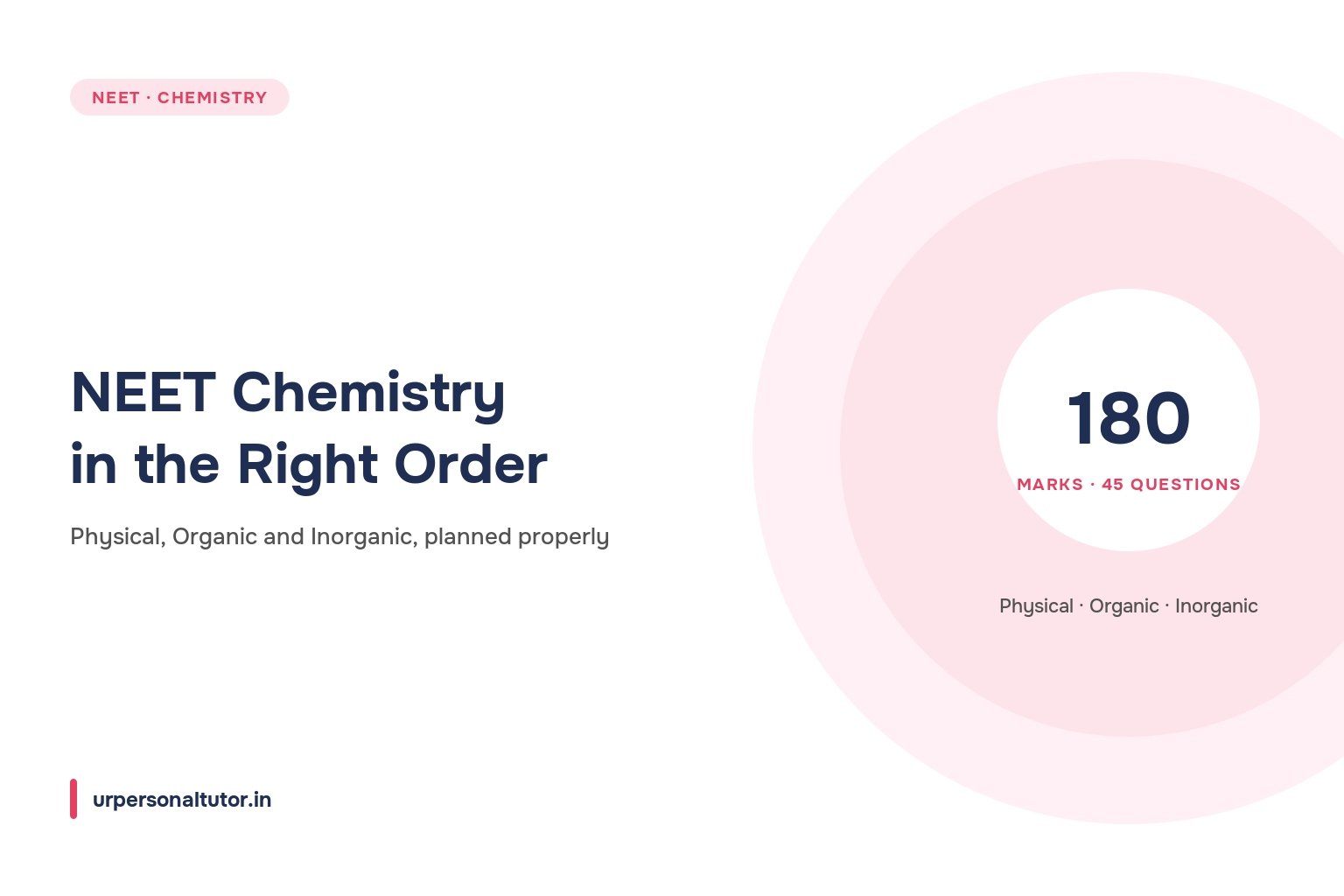
NEET Chemistry is worth 180 marks, exactly the same as Physics, and for most students it is the most scoring subject on the paper. It is also the subject students prepare in the most random way. They read Organic one week, jump to Inorganic the next, panic about mole concept, then go back to Organic. Six months later, nothing feels solid.
Chemistry rewards order. The three branches are not equal, they do not need the same method, and some of them depend on others. When you study them in the right sequence with the right technique, Chemistry stops feeling like three subjects and starts feeling like one.
The NEET Chemistry Paper at a Glance
NEET has 45 Chemistry questions worth 4 marks each, with 1 mark deducted for every wrong answer. The questions spread across three branches:
- Physical Chemistry: Numerical and concept based. Mole concept, thermodynamics, equilibrium, electrochemistry, kinetics, solutions.
- Organic Chemistry: Reaction based. Mechanisms, named reactions, conversions, isomerism, biomolecules.
- Inorganic Chemistry: Fact based. Periodic trends, chemical bonding, coordination compounds, p, d and f block elements.
Inorganic questions lean very heavily on NCERT, often almost line by line. That single fact should shape your entire plan.

Branch 1: Physical Chemistry First, Because Everything Needs It
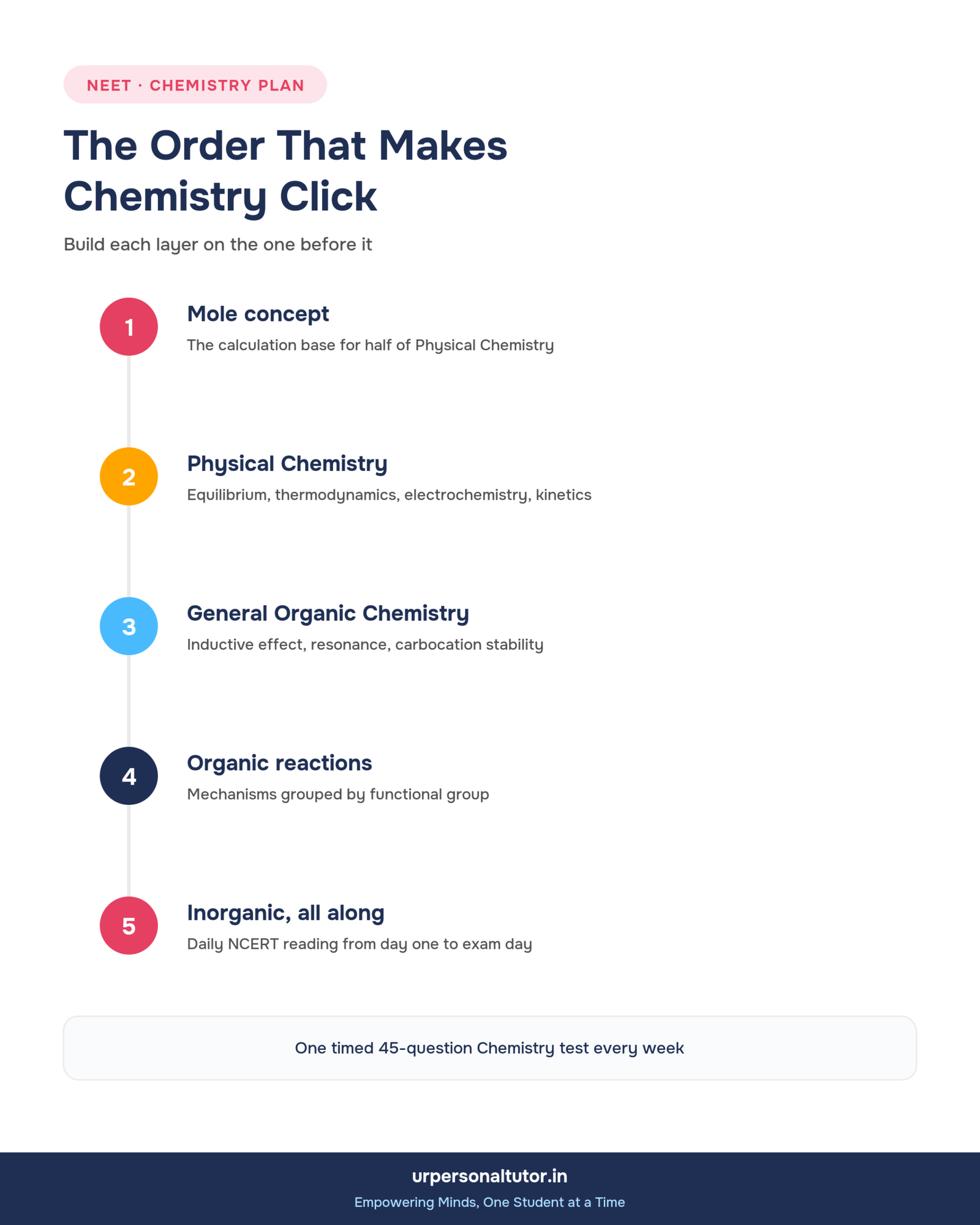
Start with Physical Chemistry, and start with mole concept. It sounds boring, but stoichiometry, concentration terms and basic calculation skills sit underneath equilibrium, solutions, electrochemistry and even parts of Organic. A student weak in mole concept loses marks in five chapters without realising why.
Method: Treat Physical Chemistry like Physics. Understand the concept, learn the few core formulas, then solve a lot of numericals. Aim for 150 to 250 questions per major chapter, starting from NCERT examples and moving to previous year NEET questions.
Watch out for: Unit conversions, significant figures in options, and sign conventions in thermodynamics. Most Physical Chemistry errors are careless, not conceptual.
Branch 2: Organic Chemistry Second, Built on Mechanisms
Begin Organic only after General Organic Chemistry (GOC) is strong. Inductive effect, resonance, hyperconjugation and carbocation stability explain almost every reaction you will meet later. Students who skip GOC end up memorising hundreds of reactions as unrelated facts and forgetting them in weeks.
Method: Learn mechanisms, not just reactions. Then build a conversion chart: one page per functional group showing how it is made and what it turns into. Practise conversion chains daily, because NEET loves two and three step conversions.
Watch out for: Named reactions and reagents. Keep a single running list and revise it every week.
Branch 3: Inorganic Chemistry, Continuously, With NCERT
Inorganic is different. It is not a chapter you finish; it is a set of facts you keep warm. Read the NCERT text closely, including tables, exceptions and the small notes students skip. Then revisit it on a schedule.
Method: Make short notes of exceptions and trends. Revise Inorganic in small daily doses, 20 to 30 minutes, rather than long weekend sessions. Read NCERT at least three times before the exam.
Watch out for: Exceptions in periodic properties, colours and oxidation states in d block, and coordination compound nomenclature and isomerism.
A Simple Weekly Structure
Here is a balance that works for most NEET aspirants studying Chemistry alongside Physics and Biology:
- Four days a week: One main block on either Physical or Organic, alternating, with fresh numericals or mechanisms.
- Every day: 20 to 30 minutes of Inorganic NCERT reading or flashcards.
- One day a week: A timed Chemistry section test of 45 questions in about 45 minutes.
- One session a week: Review mistakes, update your error notebook, re-solve wrong questions.
The Mistakes That Cost NEET Chemistry Marks
The first is skipping NCERT for coaching modules. Coaching material is useful, but NEET Chemistry is written from NCERT, and the exact wording matters. The second is leaving Inorganic until the last two months, which turns a scoring section into a memory crisis. The third is guessing on negative marking. If you cannot eliminate at least two options, skipping is often wiser.
Frequently Asked Questions
How many questions come from Chemistry in NEET?
NEET has 45 Chemistry questions, each worth 4 marks, for a total of 180 marks. One mark is deducted for each incorrect answer.
Which part of NEET Chemistry should I start with?
Start with Physical Chemistry, beginning with mole concept, because its calculation skills support many later chapters. Begin Organic with General Organic Chemistry, and revise Inorganic continuously from NCERT.
Is NCERT enough for NEET Chemistry?
NCERT is essential and is almost sufficient for Inorganic Chemistry. For Physical and Organic, add previous year questions and enough practice problems to build speed and accuracy.
How can I improve my NEET Chemistry score quickly?
Revise Inorganic NCERT thoroughly, practise Organic conversions daily, and fix calculation errors in Physical Chemistry with timed practice. Inorganic gives the fastest returns because it is closely tied to NCERT text.
How do I remember Organic Chemistry reactions?
Understand mechanisms through GOC concepts first, then group reactions by functional group on conversion charts. Practise multi-step conversions regularly rather than memorising reactions in isolation.
Chemistry should be your safest NEET subject, not your most stressful one. We help NEET aspirants build a structured Chemistry plan at Ur Personal Tutor. Get in touch for a free assessment.