
Sixty days before the CBSE Class 10 board exam, most students are in one of two moods. Some are calm because they “studied all year” and plan to revise lightly. Others are panicking because half the syllabus feels foreign. Both groups usually make the same mistake: they open the textbook at chapter one and start reading.
Reading is not revision. With 60 days left, Science needs a plan that rebuilds weak chapters, trains answer writing, and makes the exam format feel familiar long before exam day. Here is the plan I use with my Class 10 students.
Understand the Paper Before You Revise
CBSE Class 10 Science is marked out of 100: 80 marks for the theory paper and 20 marks for internal assessment. The theory paper mixes several question types:
- Multiple choice and assertion-reason questions
- Short answer questions
- Long answer questions
- Case-based or source-based questions
Physics, Chemistry and Biology chapters all appear in one paper, so you cannot afford to have a “weak branch.” A student strong in Biology but weak in Chemistry will feel that gap on every page.
From 2026, CBSE has introduced a second board exam opportunity for Class 10, with the first exam in February being the main sitting. Treat the first exam as your real exam. Plan to do your best there, not to rely on the second chance.
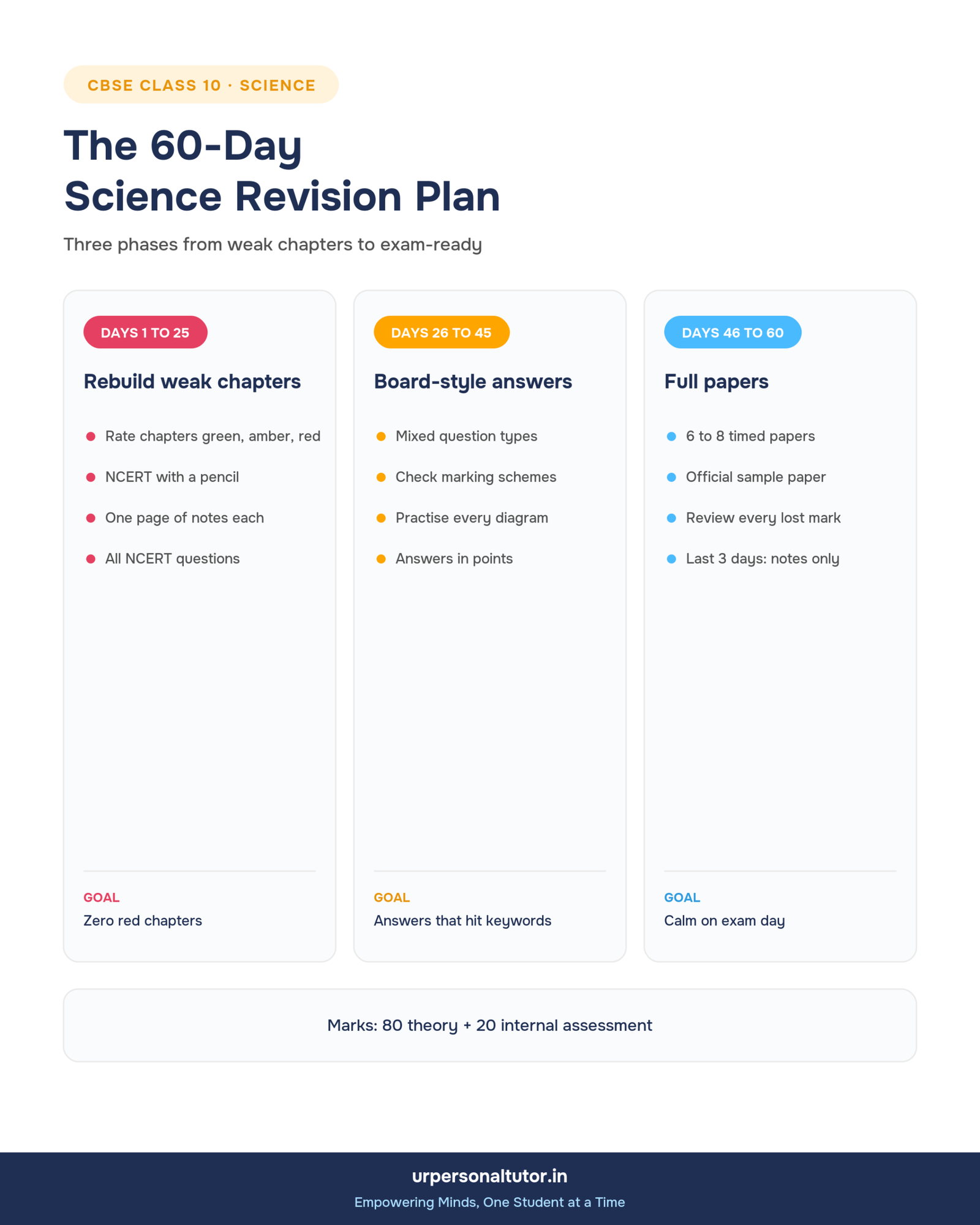
Phase 1, Days 1 to 25: Rebuild the Weak Chapters
Start with an honest audit. List every Science chapter and mark each one green (confident), amber (shaky), or red (weak). Then work through the reds first.
For each chapter:
- Read the NCERT chapter actively, with a pencil, marking definitions and key diagrams
- Make one page of short notes: formulas, definitions, reactions, labelled diagrams
- Solve every NCERT in-text and end-of-chapter question
- Solve 10 to 15 previous year board questions from that chapter
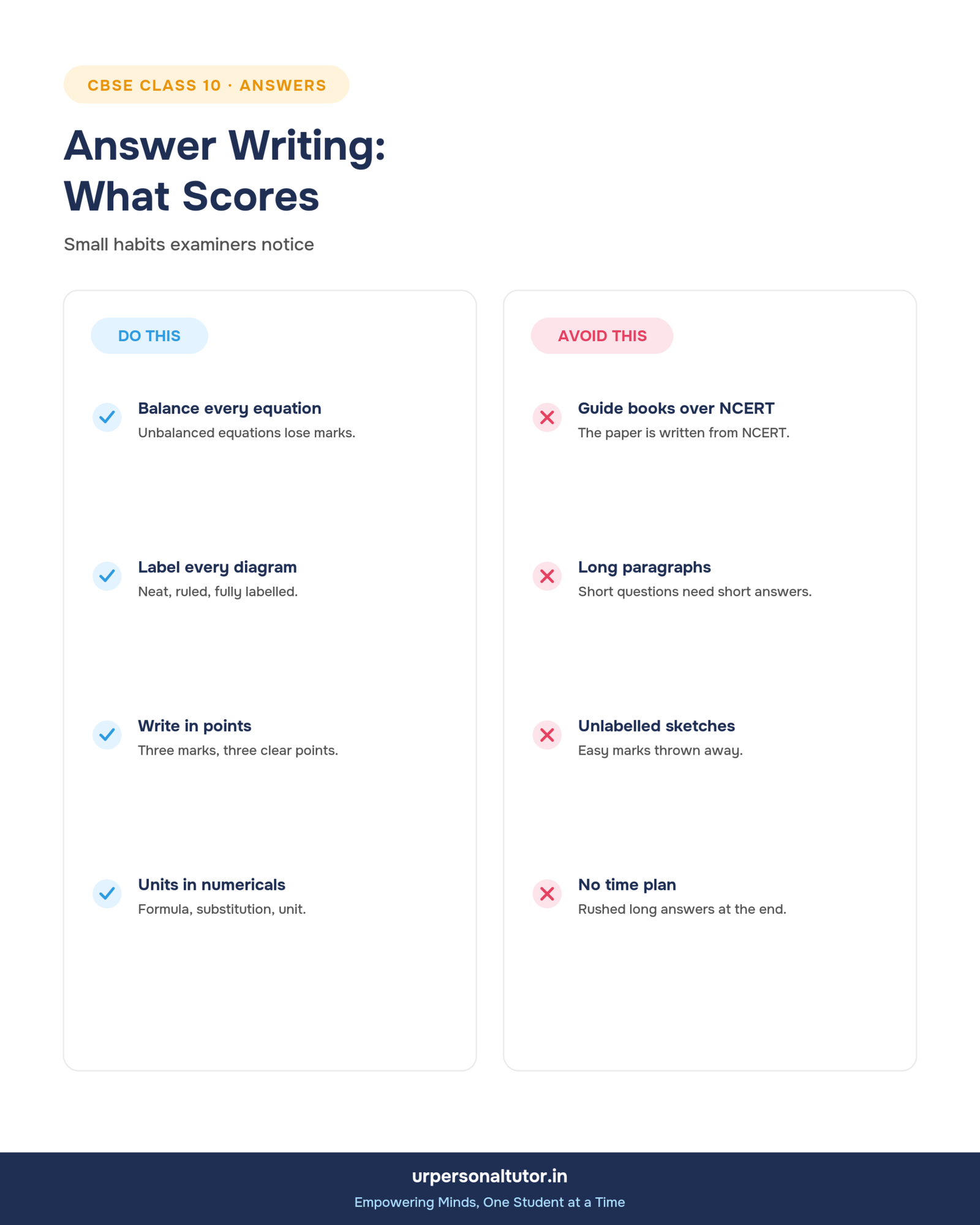
Chemistry chapters often need extra attention because chemical equations must be balanced and written exactly. Physics chapters need numerical practice, especially electricity and light. Biology chapters need diagrams drawn, not just viewed.
Phase 2, Days 26 to 45: Practise Board-Style Answers
This is where marks are won. Many students know the content but write answers that miss marking points. CBSE marking schemes reward specific keywords, complete steps, correct units and neat labelled diagrams.
During this phase:
- Solve chapter-wise questions mixing all question types
- Compare your answers with CBSE marking schemes, not just the answer key
- Practise diagrams until you can draw them quickly and label them correctly
- Write long answers in points, with headings where helpful
A three-mark answer typically needs three clear points. A five-mark answer needs structure. Neatness is not decoration; it helps the examiner find your marks.
Phase 3, Days 46 to 60: Full Papers Under Exam Conditions
In the final two weeks, sit full sample papers in three hours, at the same time of day as your real exam. Aim for at least six to eight full papers, including the official CBSE sample paper.
After every paper, spend an hour reviewing. Note every lost mark and why: forgot a unit, incomplete diagram, misread the question, ran out of time. Then fix those exact problems the next day. In the last three days, stop new papers and revise your short notes, diagrams and error list calmly.
Daily Routine During the 60 Days
On school days, aim for about two focused hours of Science, split into two sessions. On holidays, three to four hours is enough when it is focused. Rotate Physics, Chemistry and Biology so no branch goes untouched for more than three days. Keep 10 minutes daily for diagrams, because they are the easiest marks to lose and the easiest to secure.
Mistakes That Cost Class 10 Science Marks
Students lose marks by skipping NCERT for guide books, by not balancing chemical equations, by drawing diagrams without labels, and by writing long paragraphs for short questions. The most common time problem is spending too long on the first section and rushing the long answers. Practise papers with a clock, and keep a fixed time budget for each section.
Frequently Asked Questions
Is 60 days enough to revise CBSE Class 10 Science?
Yes. Sixty days is enough for a full revision if you follow a structure: rebuild weak chapters first, then practise board-style answers, then sit full papers under timed conditions.
Is NCERT enough for the CBSE Class 10 Science board exam?
NCERT is the foundation and covers what the paper tests. Add previous year questions, the CBSE sample paper and marking schemes to learn how answers are rewarded.
How many sample papers should I solve for Class 10 Science?
Aim for six to eight full sample papers in the final two weeks, including the official CBSE sample paper, with careful review after each one.
How can I score full marks in CBSE Class 10 Science?
Know NCERT thoroughly, practise diagrams until they are quick and accurate, balance every chemical equation, include units in numericals, and write answers in clear points matched to the marks.
How are marks divided in CBSE Class 10 Science?
Class 10 Science is marked out of 100, with 80 marks for the theory exam and 20 marks for internal assessment.
Want a Class 10 Science plan built around your child’s weak chapters? Ur Personal Tutor offers one-to-one board preparation for CBSE students. Reach out for a free first session.