
Taking a drop year for NEET is one of the hardest decisions a student can make. Friends move on to college. Relatives ask awkward questions. And quietly, a fear sits in the background: what if the second attempt goes the same way?
I have worked with many NEET droppers, and here is what I have seen. The students who improve dramatically are not the ones who study more hours. They are the ones who study differently. A drop year that simply repeats the first year’s method usually produces the first year’s result.
Step 1: Diagnose Before You Restart
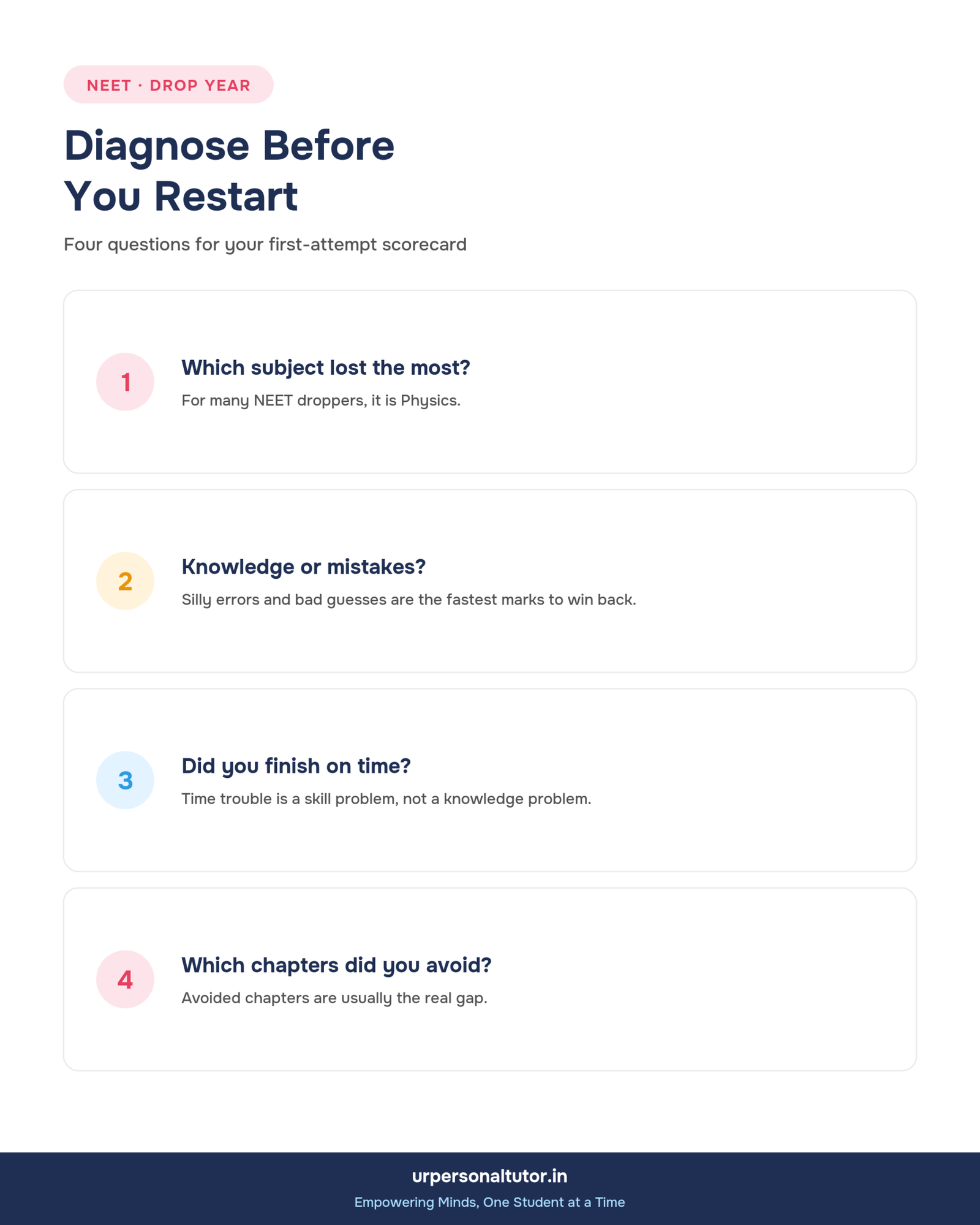
Before opening a single book, sit down with your NEET scorecard and your last few mock tests. Answer these questions honestly:
- Which subject lost the most marks? For many students, it is Physics.
- Were the lost marks from not knowing, or from mistakes? Silly errors and wrong guesses on negative marking are fixable fast.
- Did you finish the paper on time? Time trouble is a skill problem, not a knowledge problem.
- Which chapters did you avoid? Avoided chapters are usually the real gap.
Write this diagnosis down. It becomes the foundation of your entire year.
Step 2: Fix the Foundation, Not Just the Surface
Many droppers make the mistake of starting with advanced mock tests because they “already did the syllabus.” But if your first attempt fell short, some of your foundations are cracked. Mock tests on cracked foundations just measure the cracks.
Spend the first three to four months rebuilding. Read NCERT Biology line by line again. Rebuild Physics concepts from the core principles with a diagram for every question. Strengthen Physical Chemistry calculations. This feels slow, but it is what separates a 100-mark improvement from a 20-mark one.
Step 3: Structure the Year in Phases
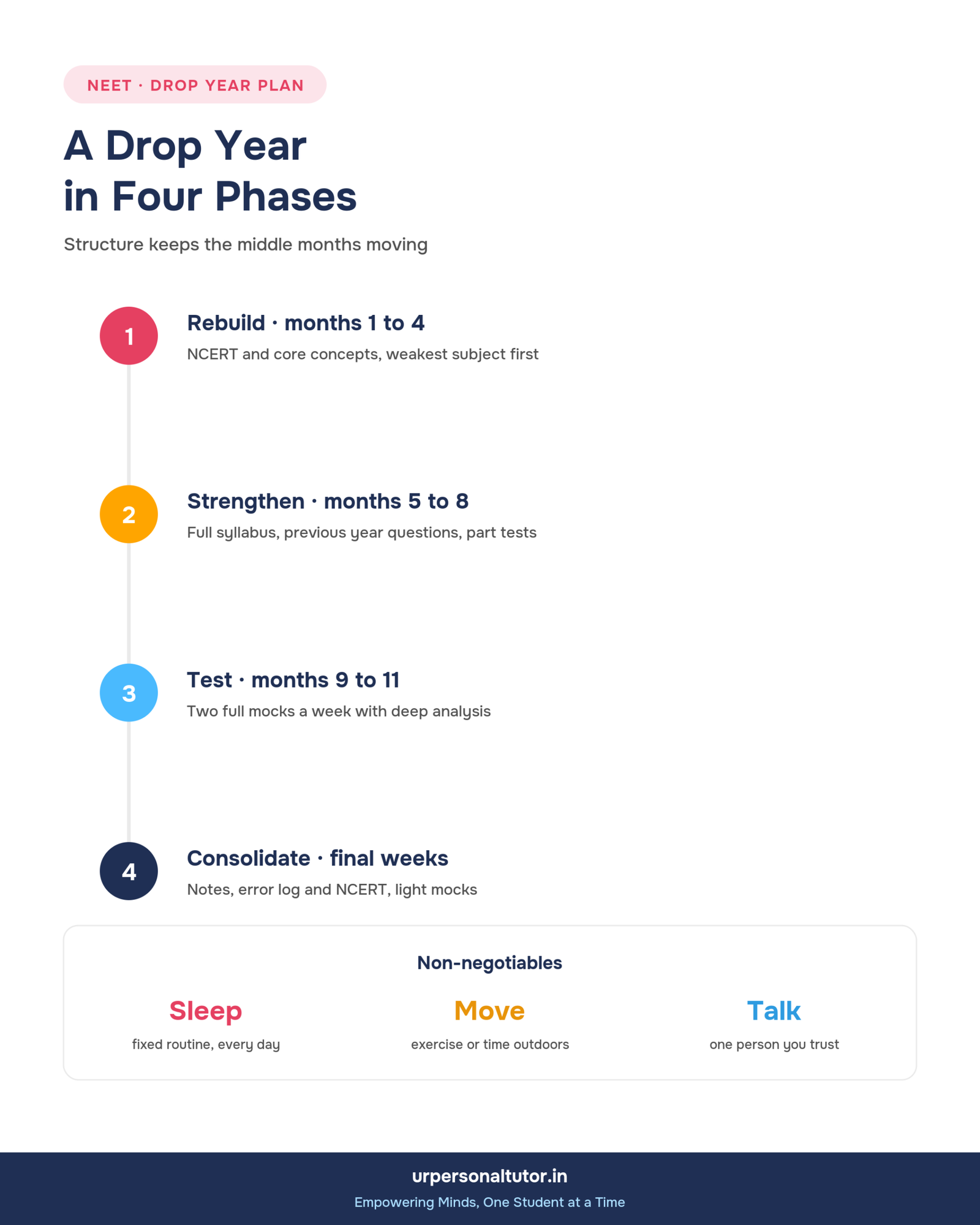
A drop year is long, and without structure the middle months drift. A phased plan keeps you moving:
- Months 1 to 4: Rebuild. Concepts, NCERT and chapter-wise practice. Weakest subject gets the most time.
- Months 5 to 8: Strengthen. Full syllabus coverage, previous year questions, weekly part tests.
- Months 9 to 11: Test. Full mock tests twice a week, with detailed analysis after each.
- Final weeks: Consolidate. Revision of notes, error log and NCERT, with light mock practice.
Step 4: Take Mock Analysis Seriously
A mock test is only valuable if you analyse it. After every test, spend as long reviewing as you spent writing. Classify every lost mark: concept gap, calculation error, misread question, or bad guess. Then fix those exact issues before the next test.
Track your scores across months. A drop year is a long race, and seeing your score climb from 450 to 550 to 620 keeps motivation alive far better than any quote on a wall.
Step 5: Protect Your Mental Health
This is not a soft topic. A drop year can be isolating, and anxiety directly affects your performance. Keep a few things non-negotiable:
- A fixed daily routine with proper sleep
- Some exercise or outdoor time every day
- One person you can talk to honestly, whether a parent, friend, mentor or counsellor
- Limited social media, especially posts about others’ college lives
If you find yourself feeling persistently low or overwhelmed, talk to someone you trust or a professional. Asking for help is a strength.
Step 6: Stop Comparing
Your friends are in college. Some are posting photos from campus. That is their path. Yours is one year longer and possibly leading somewhere better. Every hour spent comparing is an hour not spent improving.
Frequently Asked Questions
Is taking a drop year for NEET worth it?
It can be, if you are clear about what went wrong and willing to change your method. Students who diagnose their first attempt honestly and rebuild foundations often improve significantly.
How much can I improve in a NEET drop year?
Improvement varies, but students who fix their weakest subject, especially Physics, and analyse mocks properly often gain 100 marks or more.
Should a NEET dropper join coaching or study at home?
Either can work. What matters is structure, regular testing and quick doubt clearing. Many droppers do well with self-study plus a personal tutor for weak subjects.
How many hours should a NEET dropper study daily?
Around 8 to 10 focused hours works for most droppers, with breaks, exercise and good sleep. Quality and consistency matter more than raw hours.
How do I stay motivated during a drop year?
Track your mock scores over time, keep a fixed routine, limit comparison on social media, and stay connected with people who support you.
A drop year deserves a plan built around your first attempt, not a generic timetable. Ur Personal Tutor works one-to-one with NEET droppers, especially on Physics. Book a free assessment.