
How to Pass Maths GCSE: The Direct Answer
Passing maths GCSE comes down to three things done consistently: covering the full syllabus in the right order, practising exam-style questions rather than just reading notes, and reviewing mistakes properly instead of moving straight past them. Students who follow this pattern for two to three months before the exam pass comfortably, even if maths isn’t their strongest subject. The rest of this guide breaks each part down so you know exactly where to start.
Start With the GCSE Maths Syllabus, Not Random Topics
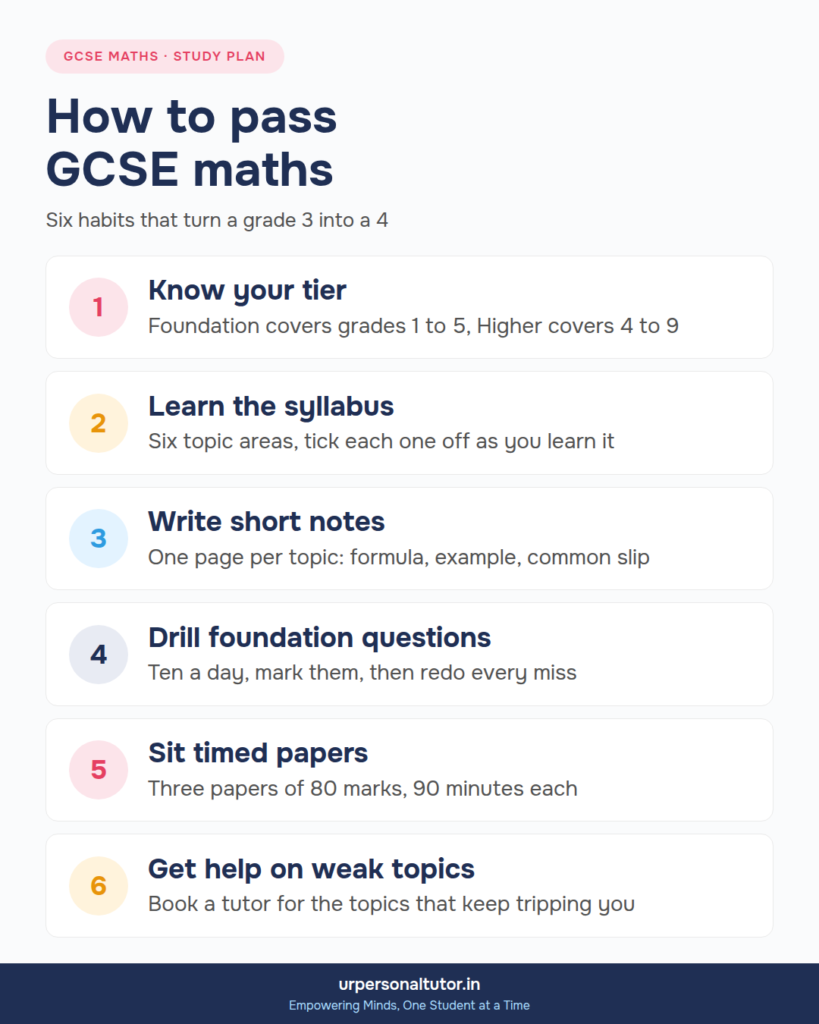
A lot of students jump straight into past papers without checking what’s actually on the syllabus first. That’s backwards. The GCSE maths syllabus is organised into clear strands, usually number, algebra, ratio and proportion, geometry, probability, and statistics, and each carries different weight in the final exam. Algebra and number typically make up the largest share of marks, so they deserve the most revision time, not an equal split across every topic.
Before building a revision plan, it helps to map out which topics from the syllabus you’ve already covered in class and which ones still feel shaky. Working through the syllabus properly, rather than the same three chapters you already feel confident in, is often what separates a pass from a stronger grade.
Foundation or Higher Tier: Choosing the Right Path
Maths GCSE is split into Foundation and Higher tiers, and this decision shapes everything else about how to pass maths GCSE. Foundation tier caps out at a grade 5, while Higher tier opens up grades 4 through 9 but includes harder content and a higher risk of scoring below a 4 if the paper feels tough. Teachers usually make this call based on mock results, but it’s worth discussing directly if you’re unsure, since sitting the wrong tier can undo months of otherwise solid preparation.
Students on the Foundation tier often assume the content is easier across the board, but some foundation maths questions still require multi-step reasoning, just built around more familiar numbers. Practising these properly matters just as much as Higher tier practice does.
Building GCSE Maths Notes That Actually Help on Exam Day
Good GCSE maths notes aren’t a copy of the textbook. They’re a condensed version built around worked examples, common mistakes, and formulas that don’t come printed on the exam paper. For each topic, jot down the method in two or three steps, one worked example, and any trap the question type usually sets, like negative signs in algebra or unit conversions in geometry.
Rewriting notes the week before the exam wastes time better spent on practice questions. The most useful notes get built gradually across the term, then get revisited and trimmed down closer to the exam so the final version is short enough to review in under an hour.
Practising Exam-Style Questions, Not Just Textbook Problems
Textbook questions teach a method in isolation. Exam questions often blend two or three topics into one problem, asking you to spot which method applies before you even start calculating. This is usually where students who understood every topic individually still lose marks, because the exam rarely tells you which method to use the way a textbook chapter does.
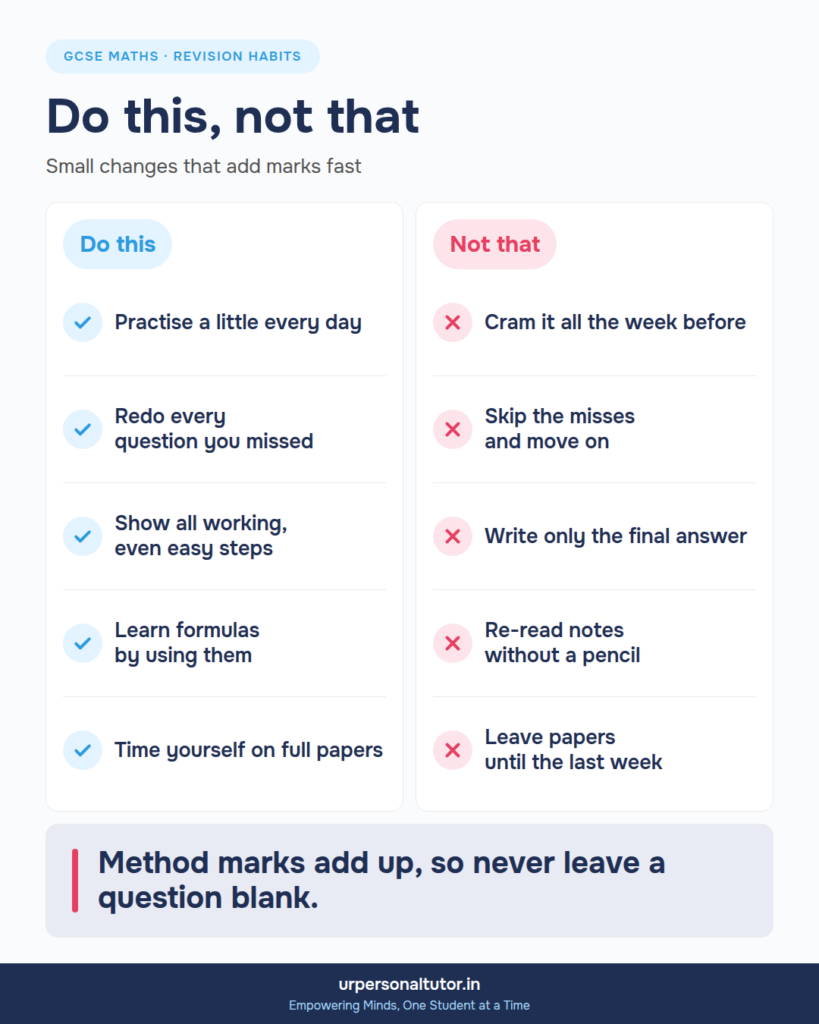
Past papers are the closest thing to real practice available, and working through them under timed conditions from at least six weeks before the exam builds the pattern recognition that separates a pass from a comfortable pass. Marking your own paper against the official scheme, rather than just checking the final answer, shows exactly where marks were lost to method versus a simple slip.
Common Topics That Trip Students Up
A few topics come up again and again as the reason students fall short of a pass. Simultaneous equations and quadratic formulas cause trouble when the algebra itself is fine but the setup from a worded question goes wrong. Compound interest and percentage change problems often get mixed up with each other despite using different formulas. Angle rules in geometry get forgotten under exam pressure even when a student knew them perfectly two weeks earlier.
None of these need a complete restart of the topic. A short, focused session revisiting just the setup step, the part where most errors actually happen, usually fixes the problem faster than reworking the whole chapter again.
How Much Practice You Actually Need Before the Exam
There’s no single number that works for every student, but a workable target is one full past paper a week for the last six to eight weeks, alongside shorter topic-specific practice on weaker areas in between. Cramming ten papers into the final week rarely helps, since there’s no time left to properly review mistakes from paper eight before sitting paper nine.
Spacing practice out this way also builds exam stamina. GCSE maths papers run for 90 minutes, and maintaining focus and accuracy for that long is its own skill that only builds with repeated timed practice, not just topic revision.
When to Bring In a Tutor
Self-study works well for students who are broadly on track but need structure. Where it tends to fall short is when a student has been stuck on the same two or three topics for weeks despite repeated attempts, since it’s hard to spot your own blind spots without outside feedback. A physics and maths tutor who can walk through a wrong answer step by step often closes that gap faster than another week of solo practice, particularly when the sticking point turns out to be a small misunderstanding rather than a lack of effort.
It’s also worth remembering that every student’s starting point is different, and progress doesn’t need to match a classmate’s pace to still count as real progress toward a pass.
Frequently Asked Questions
What grade counts as a pass in GCSE maths?
A grade 4 counts as a standard pass, and a grade 5 counts as a strong pass. Most colleges and sixth forms ask for at least a 4 or 5 in maths for further study.
Can I pass GCSE maths without a calculator?
One of the two maths papers is non-calculator, so yes, part of the exam has to be done without one. Practising mental arithmetic and non-calculator methods specifically, rather than assuming calculator skills will transfer, matters for that paper.
How many past papers should I complete before deciding I’m ready?
There’s no fixed number, but most students feel exam-ready after 8 to 10 full past papers completed under timed conditions, provided each one is reviewed properly rather than just attempted and set aside.
Is it possible to move from Foundation to Higher tier late in the year?
It’s possible but not ideal, since Higher tier introduces new content Foundation doesn’t cover. A late switch usually needs extra catch-up time on topics like the sine and cosine rules, which only appear on Higher papers.
Does GCSE maths difficulty vary much between exam boards?
The core content is broadly similar across boards like AQA, Edexcel, and OCR, but question style and paper structure differ slightly. Checking past papers for your specific board matters more than the board’s general reputation for difficulty.