
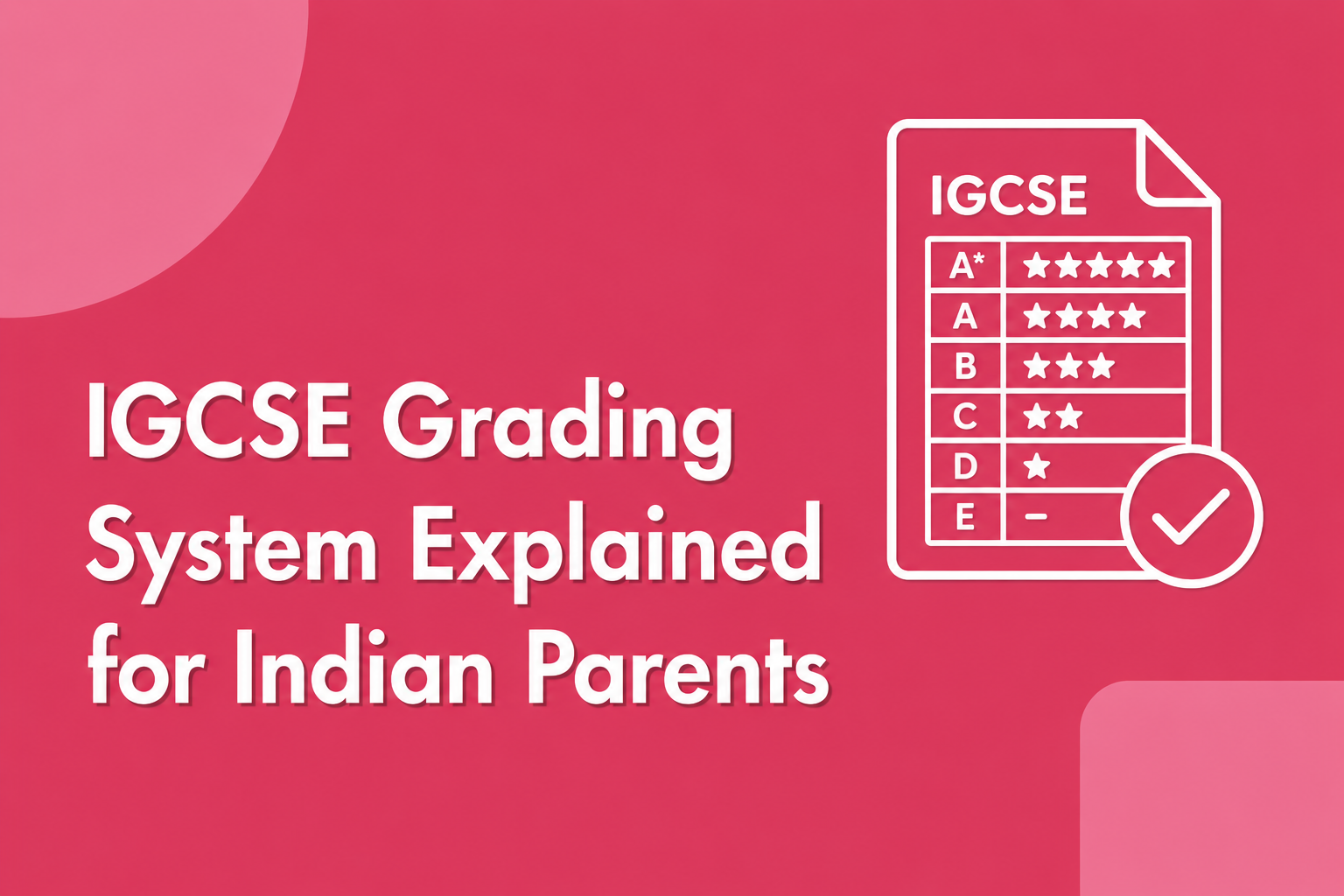
Quick answer: The IGCSE grading system uses two scales: the traditional A* to G scale and the newer 9 to 1 scale, where 9 is the highest grade. There are no percentages or ranks on the certificate, only grades. Raw exam marks are converted to grades using grade thresholds, which Cambridge sets fresh for every exam session based on paper difficulty. A Grade C (or 4 and above) counts as a pass, and the Association of Indian Universities recognises five IGCSE passes at Grade C or above as equivalent to a Class 10 qualification in India.
If that paragraph already answered your question, good. But if your child has just moved into an IGCSE school, or you are staring at a report card full of letters where you expected a percentage, stay with me. The IGCSE grading system confuses almost every CBSE and ICSE parent I work with, and the confusion usually peaks at results time.
I tutor IGCSE students across India, and the same conversation happens every year. A parent calls, worried, because their child scored “only a B” and they have no idea whether that is a 60 percent or a 90 percent. The honest answer is that it is neither, and understanding why will change how you read every report card from now on.
What Is the IGCSE Grading System?
The IGCSE grading system is the method Cambridge Assessment International Education (CAIE) uses to report student performance. Instead of marks out of 100, students receive a grade per subject. Each subject is graded independently, there is no aggregate percentage, no division, no rank, and no overall pass or fail for the certificate as a whole.
This is the first mental shift for Indian parents. In CBSE, a child “gets 92 percent.” In IGCSE, a child gets an A in Physics, a B in English, and an A* in Maths, and those three results are never averaged into one number. Universities and schools read the subject grades individually, because a grade in IGCSE Physics tells them something specific about ability in Physics.
Pearson Edexcel also offers an International GCSE with a similar structure, but since most Indian schools run the Cambridge version, this guide follows the Cambridge system.
IGCSE Grades: The Two Scales Your School Might Use
Cambridge currently runs two parallel grading scales, and Indian schools use both, which is where a lot of the confusion starts.
The A* to G scale. This is the classic scale most Indian IGCSE schools still use. It runs A*, A, B, C, D, E, F, G, with A* at the top. Anything below G is marked U, meaning ungraded. Grade C is the conventional benchmark for a pass.
The 9 to 1 scale. This numeric scale was introduced to align with reformed GCSEs in the UK. It runs from 9 down to 1, with 9 as the highest. A grade 4 is considered a standard pass and a 5 a strong pass. The two scales map roughly like this: 9 sits above A*, 8 straddles A* and A, 7 equals A, 6 sits between B and A, 4 equals C.
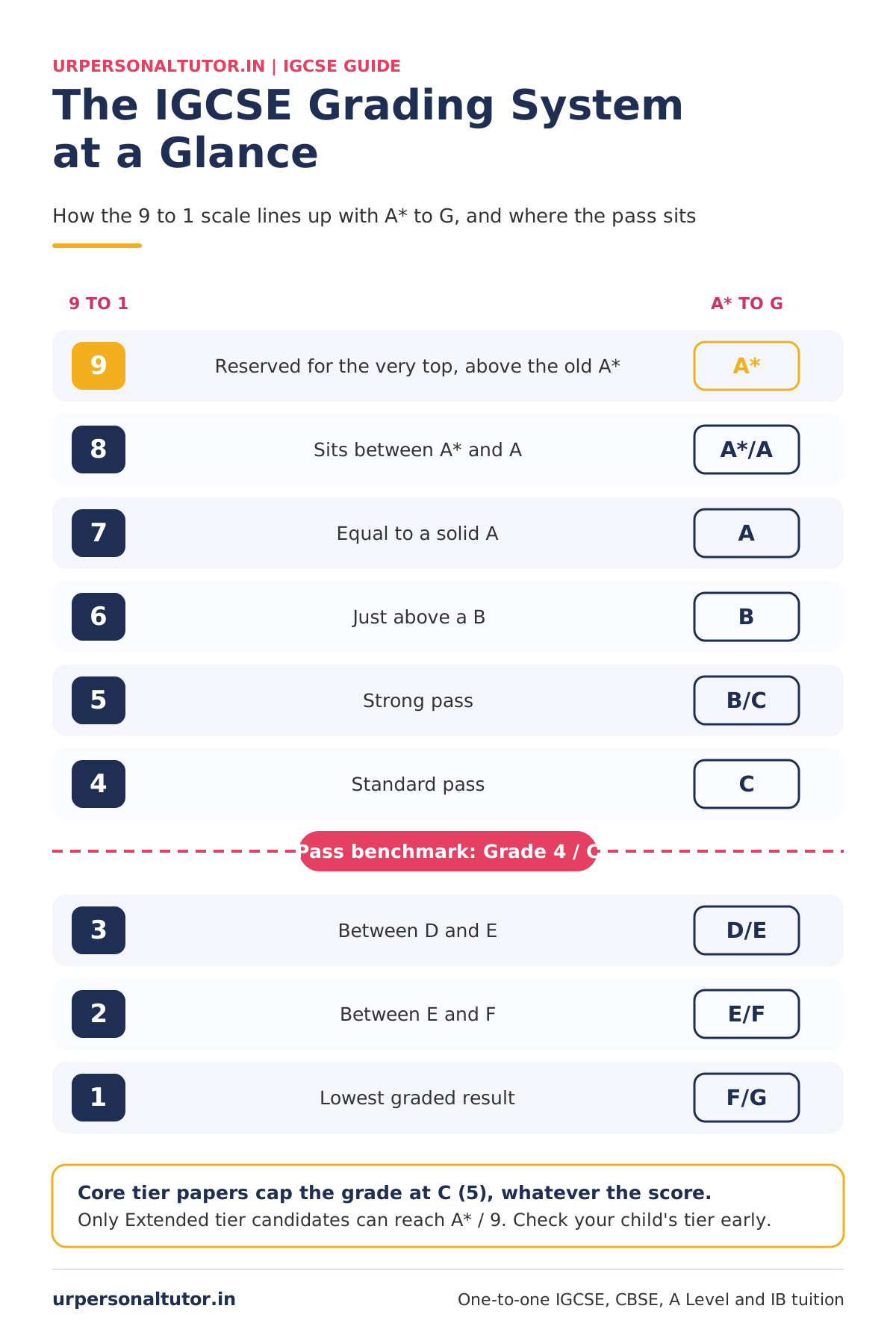
One practical note from my own students: a 9 is deliberately harder to get than an old A*. It was designed to separate the very top performers. So if your child’s school switched scales and their “A* child” is now getting 8s, nothing went wrong. The measuring stick changed.
Core vs Extended: The Ceiling Most Parents Don’t Know About
Here is the detail that catches Indian families off guard. In many IGCSE subjects, students sit either the Core papers or the Extended papers, and the tier decides the maximum grade available.
Core candidates can only earn grades C to G (or 5 to 1 on the numeric scale). Extended candidates can earn the full range up to A* or 9. A Core student can score every single mark on their paper and still walk away with a C, because C is the ceiling of that tier.
Schools usually decide tier entry in Class 9 or early Class 10 based on internal performance. If your child is aiming for competitive sixth forms, A Levels in the sciences, or strong university applications, they need to be on Extended papers in their key subjects. This is a conversation worth having with the school early, not in the final term when entries are already locked.
IGCSE Grade Thresholds: How Marks Actually Become Grades
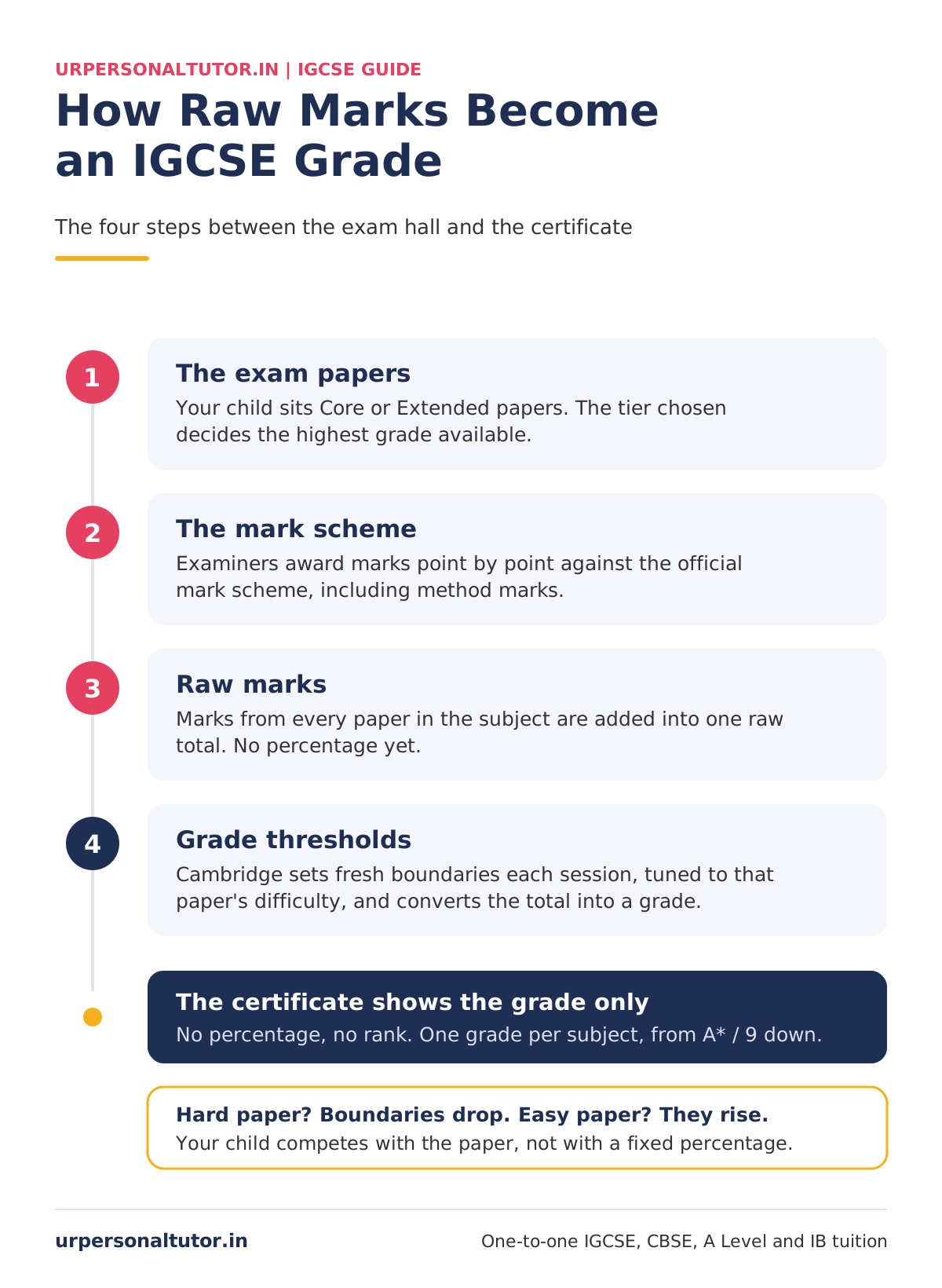
Now to the machinery. IGCSE grade thresholds are the minimum raw marks needed for each grade in each subject, in each exam session. Cambridge publishes them after results are released, and they change every single session.
Why do they change? Because papers vary in difficulty, and thresholds are Cambridge’s way of keeping grades fair across years. If the June Physics paper was brutal, the threshold for an A might drop several marks. If the paper was gentle, the threshold rises. This is why nobody, including tutors, can tell you before results day exactly what mark earns an A*.
As a rough anchor from recent sessions, the A* threshold in many subjects lands somewhere in the 80s as a percentage of total marks, but I have seen it sit noticeably lower in hard papers. Treat any fixed number you read online with suspicion. The only reliable source is the threshold table Cambridge publishes for that specific syllabus and session.
What this means for your child’s preparation is quite freeing, actually. They are not chasing a magic percentage. They are competing against the paper, and a well-prepared student on a hard paper is protected by the threshold system rather than punished by it.
IGCSE Mark Scheme vs Grade Thresholds: Two Different Documents
Parents often use these terms interchangeably. They are not the same thing, and knowing the difference makes past paper practice far more effective.
The IGCSE mark scheme is the examiner’s answer key for one specific paper. It shows exactly which points earn marks, how method marks work in Maths and Physics, and what alternative answers are accepted. When my students practise past papers, marking their own work against the official mark scheme is where most of the improvement happens, because they start writing answers the way examiners award them.
Grade thresholds, on the other hand, sit one level above. They take the total raw mark produced by that mark scheme and convert it into a grade. Mark scheme first, threshold second. A student who studies mark schemes seriously usually stops worrying about thresholds altogether, because their raw marks climb well clear of the boundaries.
How IGCSE Grades Translate in India
Three things about the IGCSE grading system matter for Indian families.
First, recognition. The Association of Indian Universities treats Cambridge IGCSE with passes in five subjects at Grade C or above as equivalent to Class 10 from an Indian board. Your child is not disadvantaged for Indian progression at this stage.
Second, percentage conversion. Some Indian institutions ask for a percentage equivalent, and schools handle this with notional conversion tables. There is no single official Cambridge percentage conversion, so if a college asks, request the conversion certificate from your child’s school rather than calculating one yourself.
Third, progression. IGCSE grades decide A Level and IB subject entry. Most schools want at least a B, and often an A, in a subject before allowing it at A Level. In my experience, students entering A Level sciences with a C-grade foundation struggle badly, so the IGCSE grade is an honest signal, not just a certificate line.
What Should Your Child Aim For?
After years of tutoring IGCSE students, my practical benchmarks are these. For a child planning A Levels or IB in science and maths subjects, aim for A or A* (7 to 9) in those subjects specifically. For overseas school applications, a spread of As with no grade below B reads well. And for any child, a C in a core subject is a signal to intervene now, not a disaster to mourn. IGCSE grades respond quickly to targeted work because the exam rewards technique, and technique can be taught.
FAQ: IGCSE Grading System
What is a passing grade in IGCSE?
Grade C on the letter scale, or grade 4 on the numeric scale, is the standard pass benchmark. Grades below this still appear on the certificate, but most schools, universities, and the AIU equivalence treat C or 4 as the minimum meaningful pass.
Is there a percentage system in IGCSE?
No. The IGCSE grading system reports letter or number grades only. Raw marks are converted through session-specific grade thresholds, and no percentage appears on the certificate. Schools can issue notional percentage conversions if an Indian institution requires one.
What percentage is an A* in IGCSE?
There is no fixed percentage. Grade thresholds change every session with paper difficulty. In many recent sessions the A* boundary has fallen in the 80s as a share of total marks, but the only accurate figure is the published threshold for that subject and session.
Are IGCSE grades accepted in India?
Yes. The IGCSE grading system is fully recognised in India: the AIU treats five IGCSE passes at Grade C or above as equivalent to Class 10, which allows progression into Indian streams, A Levels, or IB within India.
Is grade 9 the same as A*?
Not exactly. Grade 9 is set higher than the old A*, so fewer students achieve it. An 8 corresponds broadly to a strong A* to A performance, and a 7 to an A.
The Bottom Line
The IGCSE grading system is fairer than it first looks. Thresholds protect students from hard papers, mark schemes make preparation transparent, and each subject stands on its own merit. What the system rewards, above everything, is exam technique built through past paper practice against real mark schemes.
That is exactly how we prepare students at UrPersonalTutor. If your child is working toward IGCSE exams in Physics, Maths, or the sciences and you want their preparation matched to how Cambridge actually awards marks, book a one-to-one demo class with us and see the approach in action.