

What Personal Attention Actually Looks Like With a Private Tutor for NEET
Personal attention from a private tutor for NEET means one specific thing: the teacher can see exactly where a student is losing marks, in any of the three subjects, and change the lesson because of it in the same session, not the following week. It shows up in small decisions rather than big promises. A tutor skips a chemistry topic a student already has cold. A tutor slows down on genetics because two consecutive mock tests show the same error pattern in biology, while spending less time revisiting a physics chapter the student has already mastered. That kind of responsiveness, across all three subjects at once, is close to impossible in a room with 40 students working through one fixed syllabus at one fixed pace. This article walks through what that attention actually looks like in practice, both in person and through online private tutoring for NEET, so parents and students can tell the difference between real personalisation and a smaller version of the same batch class. What “Personal Attention” Really Means When You Hire a Private Tutor for NEET Coaching institutes use the phrase loosely. A “personal attention batch” often just means 15 students instead of 60, taught from the same slide deck, at the same speed, with the same three doubt-clearing sessions a week for everyone, regardless of whether a student’s actual gap is in physics numericals, organic chemistry mechanisms, or biology diagrams. A private tutor for NEET works from a different starting point: the student’s own performance data across all three subjects. NEET is worth 720 marks total, split evenly across physics, chemistry, and biology at 180 marks each. A tutor watching one student’s full scorecard can point to exactly which questions are recoverable in each subject with better technique, not just more content. A batch teacher, working across 40 different scorecards and often three different subject teachers who never compare notes, simply cannot do that at the same resolution. The difference is diagnostic. One approach teaches the syllabus. The other teaches the student who happens to be sitting in front of it, subject by subject. How Online Private Tutoring for NEET Recreates That Same Attention on a Screen Parents often assume personal attention only works face to face. In practice, online private tutoring for NEET replicates most of it, and in a few ways it does the job better, especially when a student needs support across multiple subjects. A tutor working online can share a digital whiteboard, mark up a student’s own handwritten chemistry equation or biology diagram live, and pull up last week’s mock test paper in the same window within seconds. There’s no flipping through three separate physical notebooks to find where a mistake happened weeks ago. Recorded sessions also mean a student revisiting the Krebs cycle or Newton’s laws before an exam can rewatch the exact fifteen minutes where the tutor worked through their specific confusion, not a generic explanation aimed at nobody in particular. Response time matters too. A well-run online private tutoring for NEET setup includes a doubt-clearing channel where questions get answered within a few hours, not at the start of next week’s class, whether the doubt is a physics numerical, a chemistry reaction mechanism, or a biology classification question. For a student juggling all three subjects in the final six months before the exam, that turnaround is often the difference between fixing a misconception the same day and repeating it for a week. Anyone deciding between formats can read more on the physics-specific side of this, since choosing between a group setup and a one-to-one tutor comes down to similar questions regardless of subject. Inside a Real Session With a Private Tutor for NEET A typical 90-minute session doesn’t open with a lecture, in any subject. It opens with the previous test paper. The tutor scans for patterns first, not just wrong answers. Maybe a student got four questions wrong in organic chemistry, but the actual issue is mixing up two reagent names, not a conceptual gap. That gets fixed in ten minutes with three targeted questions, not a full re-teach of the chapter. In biology, a student might consistently lose marks on labelled diagrams rather than theory, which changes what the tutor spends time on entirely. In physics, the same wrong-answer count might trace back to a sign convention error in three different numericals. The remaining hour goes toward whatever that student’s NEET preparation plan says is next for that subject, but even that gets adjusted live. If a student solves the first two problems without hesitation, the tutor moves faster and spends the saved time on a weaker area instead of finishing a pre-planned worksheet out of habit. This is where the value of a private tutor for NEET actually sits: not in access to better notes, since NCERT and standard reference material cover most of what’s needed across all three subjects, but in a person who adjusts the plan every single session based on what just happened, and knows which subject needs the attention that week. Where physics numericals specifically are the recurring weak point, a structured chapter-wise practice routine helps, since knowing how many questions a student actually needs per chapter, rather than solving everything or nothing, applies just as much to chemistry and biology practice sets. Signs You Are Actually Getting Personal Attention, Not Just a Smaller Batch A few markers separate genuine personalisation from an Authorized NEET personal tutor marketing label, and they hold across physics, chemistry, and biology equally. The tutor can describe, without checking notes, what a student struggled with two sessions ago, in whichever subject came up. The pacing changes week to week based on test results in each subject rather than following a fixed 12-month calendar identical for every student. Homework is assigned by weak topic and weak subject, not by “whatever chapter we covered today.” And feedback comes with numbers attached, per subject: not “you’re improving,” but “your accuracy in biology went from 58% to 74% over
Class 12 CBSE Physics: Chapter-Wise Weightage and Important Questions
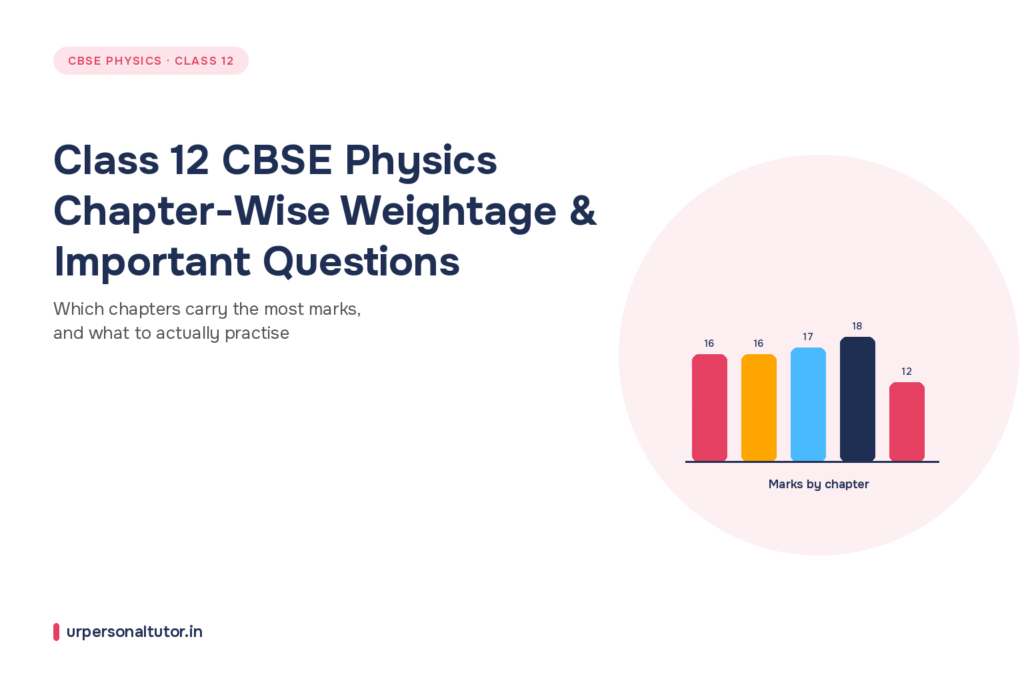
If you only have time to prioritise five chapters this year, make them Optics, Electromagnetic Induction, Current Electricity, Electrostatics, and Magnetism. Together they account for 46 of the 70 theory marks in the CBSE Class 12 Physics board exam. That single fact should shape how you plan the next few months, and it’s the starting point for every set of CBSE Class 12 physics important questions worth practising. This isn’t a guess. CBSE releases a fixed unit-wise blueprint each academic year, and the 2025-26 version keeps the theory paper at 70 marks across 9 units and 14 chapters, with 30 marks reserved for practicals. Once you know where those 70 marks actually sit, chapter-wise important questions stop feeling like a random pile of PYQs and start looking like a study plan — and it also makes it easier to spot common mistakes in CBSE Physics before they cost you marks, since most of them come from misjudging where the exam actually rewards effort. That’s also how important derivations for Class 12 Physics should be approached. Derivation-heavy chapters aren’t evenly distributed either, and a handful of them show up in the long-answer section almost every year. CBSE Class 12 Physics Chapter-Wise Weightage (2025-26) Here’s the official unit breakdown for the current session: Unit Chapters Marks Electrostatics Electric Charges and Fields, Electrostatic Potential and Capacitance 16 Current Electricity Current Electricity 16 Magnetic Effects of Current and Magnetism Moving Charges and Magnetism, Magnetism and Matter 17 Electromagnetic Induction and AC Electromagnetic Induction, Alternating Current 17 Electromagnetic Waves Electromagnetic Waves 18 Optics Ray Optics and Optical Instruments, Wave Optics 18 Dual Nature of Radiation and Matter Dual Nature of Radiation and Matter 12 Atoms and Nuclei Atoms, Nuclei 12 Electronic Devices Semiconductor Electronics 7 A few things jump out once you lay it out like this. Optics and Electromagnetic Waves are grouped separately on paper but often examined together, since wave behaviour connects both. Semiconductor Electronics carries the least weight at 7 marks, yet students routinely spend a disproportionate number of revision hours on it out of familiarity rather than payoff. That’s the kind of mismatch chapter-wise important questions are meant to fix. Why Chapter-Wise Weightage Should Drive Your Revision Order Marks-per-chapter tells you where your hours are worth the most, and that’s really what “important questions” means in practice. A chapter worth 18 marks with three question formats deserves repeated numerical practice, not a single read-through the night before. A 7-mark chapter deserves solid conceptual clarity and maybe fifteen past-year questions, not three weeks of your calendar. Set a rough rule: spend revision time roughly proportional to marks, then add a buffer for chapters you personally find slow, regardless of weightage. Ray optics is a good example — it’s only worth marks within the 18-mark Optics unit, but the diagram work and sign conventions take longer to get fluent in than the mark weight alone suggests. Unit-Wise Important Questions for CBSE Class 12 Physics Electrostatics and Current Electricity — 32 Marks Combined This pair is the most numerical-heavy portion of the paper, and CBSE tends to test it through a mix of derivations and applied problems rather than pure theory recall. Magnetic Effects, Electromagnetic Induction and AC — 34 Marks Combined This is the largest combined block on the paper, and questions here frequently connect two chapters in one problem — for instance, a moving conductor generating both a magnetic force and an induced EMF. Optics and Electromagnetic Waves — 36 Marks Combined The single highest-weightage block in the syllabus, and it rewards students who can move fluidly between ray diagrams, lens formulas, and wave-based reasoning for the same concept. Modern Physics: Dual Nature, Atoms and Nuclei — 24 Marks Combined Modern physics tends to carry a heavier conceptual load relative to its marks, and CBSE regularly frames questions as short numericals tied to a named law or equation. Semiconductor Electronics — 7 Marks Small weightage, but almost always tested through circuit-based or comparison questions rather than derivations. Turning Important Questions Chapterwise Into an Actual Study Routine [INSERT INFOGRAPHIC 1] Knowing the questions isn’t the same as being able to answer them under exam conditions. A workable routine looks something like this: pick one high-weightage chapter, work through 15-20 past-year and sample questions from it, then check how many you solved without referring back to notes. If that number is under 60%, the chapter needs another pass before you move on — no exceptions, even if the calendar says otherwise. Pacing this across an entire syllabus is where most students lose the plot, which is exactly what these time management tips for CBSE Physics preparation are built to fix — allocating study hours by chapter weight rather than by whichever topic feels most comfortable that week. Common Myths Around CBSE Class 12 Physics Important Questions Myth: solving only PYQs guarantees a repeat question. CBSE rarely repeats a question exactly, though it frequently repeats the underlying concept in a new numerical wrapper. Practising PYQs builds pattern recognition, not a guessed answer key. Myth: low-weightage chapters can be skipped entirely. Semiconductor Electronics is only 7 marks, but skipping it outright means giving up marks you could have secured with a few hours of focused revision. Skipping isn’t the same as deprioritising. Myth: memorising derivations word-for-word is enough. CBSE’s marking scheme awards marks for correct steps and reasoning, not verbatim recall. A student who understands why each step follows the last usually scores better than one who memorised the sequence but freezes when the question is phrased differently. Chapter-wise weightage is a planning tool, not a shortcut past actually working through problems. If you’d rather have someone map out a personalised schedule around these numbers instead of building one from scratch, you can book a session with a CBSE physics tutor and get a plan built around your specific gaps and exam date. Frequently Asked Questions Which chapter has the highest weightage in CBSE Class 12 Physics? Optics carries 18 marks, tied with Electromagnetic Waves