
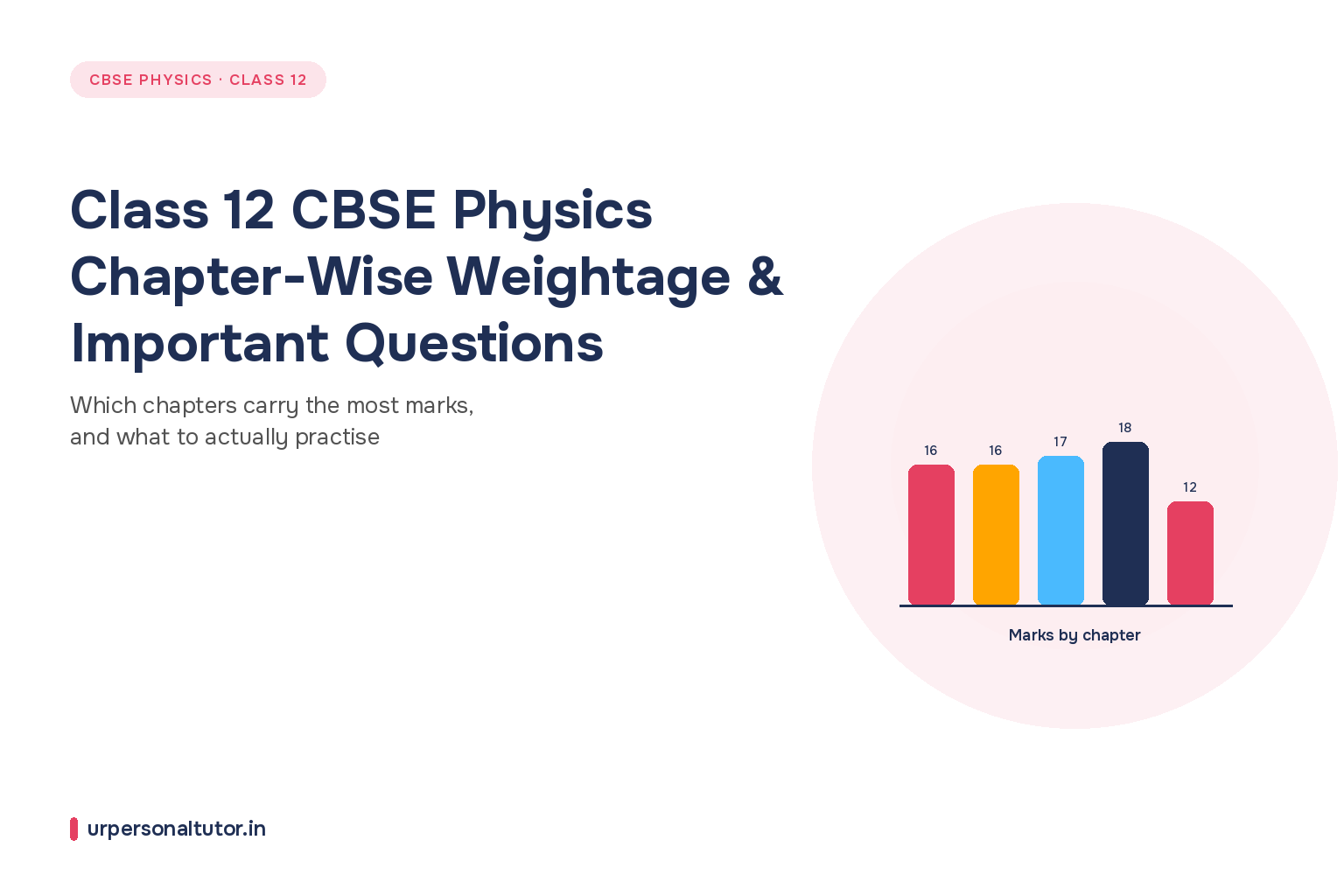
If you only have time to prioritise five chapters this year, make them Optics, Electromagnetic Induction, Current Electricity, Electrostatics, and Magnetism. Together they account for 46 of the 70 theory marks in the CBSE Class 12 Physics board exam. That single fact should shape how you plan the next few months, and it’s the starting point for every set of CBSE Class 12 physics important questions worth practising.
This isn’t a guess. CBSE releases a fixed unit-wise blueprint each academic year, and the 2025-26 version keeps the theory paper at 70 marks across 9 units and 14 chapters, with 30 marks reserved for practicals. Once you know where those 70 marks actually sit, chapter-wise important questions stop feeling like a random pile of PYQs and start looking like a study plan — and it also makes it easier to spot common mistakes in CBSE Physics before they cost you marks, since most of them come from misjudging where the exam actually rewards effort.
That’s also how important derivations for Class 12 Physics should be approached. Derivation-heavy chapters aren’t evenly distributed either, and a handful of them show up in the long-answer section almost every year.
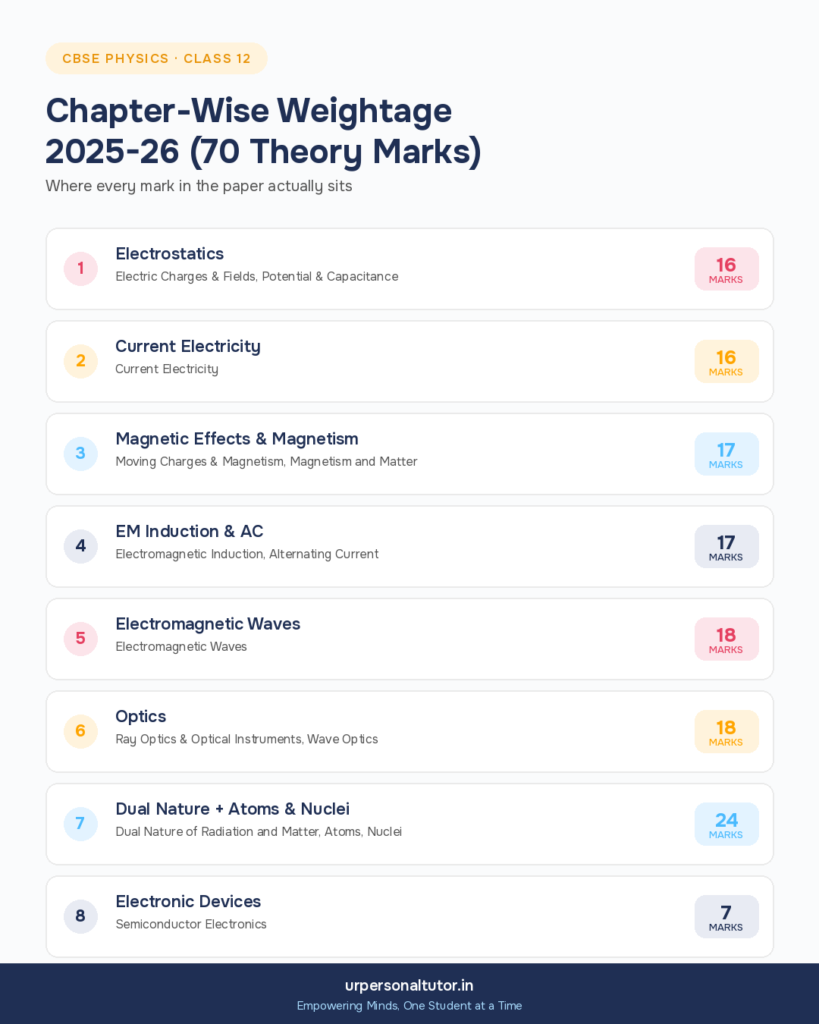
CBSE Class 12 Physics Chapter-Wise Weightage (2025-26)
Here’s the official unit breakdown for the current session:
| Unit | Chapters | Marks |
|---|---|---|
| Electrostatics | Electric Charges and Fields, Electrostatic Potential and Capacitance | 16 |
| Current Electricity | Current Electricity | 16 |
| Magnetic Effects of Current and Magnetism | Moving Charges and Magnetism, Magnetism and Matter | 17 |
| Electromagnetic Induction and AC | Electromagnetic Induction, Alternating Current | 17 |
| Electromagnetic Waves | Electromagnetic Waves | 18 |
| Optics | Ray Optics and Optical Instruments, Wave Optics | 18 |
| Dual Nature of Radiation and Matter | Dual Nature of Radiation and Matter | 12 |
| Atoms and Nuclei | Atoms, Nuclei | 12 |
| Electronic Devices | Semiconductor Electronics | 7 |
A few things jump out once you lay it out like this. Optics and Electromagnetic Waves are grouped separately on paper but often examined together, since wave behaviour connects both. Semiconductor Electronics carries the least weight at 7 marks, yet students routinely spend a disproportionate number of revision hours on it out of familiarity rather than payoff. That’s the kind of mismatch chapter-wise important questions are meant to fix.
Why Chapter-Wise Weightage Should Drive Your Revision Order
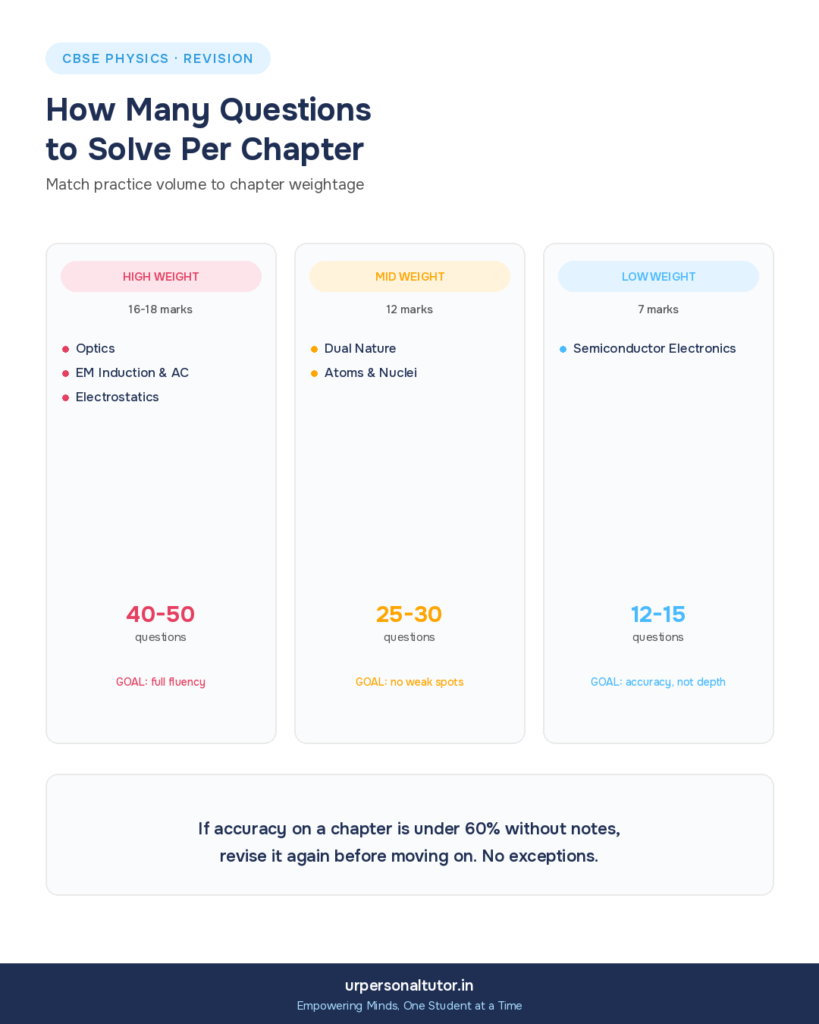
Marks-per-chapter tells you where your hours are worth the most, and that’s really what “important questions” means in practice. A chapter worth 18 marks with three question formats deserves repeated numerical practice, not a single read-through the night before. A 7-mark chapter deserves solid conceptual clarity and maybe fifteen past-year questions, not three weeks of your calendar.
Set a rough rule: spend revision time roughly proportional to marks, then add a buffer for chapters you personally find slow, regardless of weightage. Ray optics is a good example — it’s only worth marks within the 18-mark Optics unit, but the diagram work and sign conventions take longer to get fluent in than the mark weight alone suggests.
Unit-Wise Important Questions for CBSE Class 12 Physics
Electrostatics and Current Electricity — 32 Marks Combined
This pair is the most numerical-heavy portion of the paper, and CBSE tends to test it through a mix of derivations and applied problems rather than pure theory recall.
- Derive the expression for electric field on the axial line of an electric dipole.
- A parallel plate capacitor is connected to a battery; explain what happens to charge, potential difference, and energy stored when a dielectric slab is inserted while the battery stays connected, versus when it’s disconnected first.
- State Kirchhoff’s laws and use them to find current in a circuit with two EMF sources and unequal internal resistances.
- Derive the condition for balance in a Wheatstone bridge and explain why a meter bridge is a practical application of it.
- Define drift velocity and derive the relation between current and drift velocity for a conductor of given area and electron density.
Magnetic Effects, Electromagnetic Induction and AC — 34 Marks Combined
This is the largest combined block on the paper, and questions here frequently connect two chapters in one problem — for instance, a moving conductor generating both a magnetic force and an induced EMF.
- Derive an expression for the magnetic field at a point on the axis of a current-carrying circular loop.
- Explain Lenz’s law with a numerical example involving a bar magnet moving through a coil, and connect it to the law of conservation of energy.
- A coil rotates in a uniform magnetic field to generate AC. Derive the expression for instantaneous EMF and explain the phase relationship between current and voltage in a purely inductive circuit.
- Compare the working of a moving coil galvanometer and how it’s converted into an ammeter versus a voltmeter.
- Derive the resonance condition for an LCR series circuit and explain why power factor matters at resonance.
Optics and Electromagnetic Waves — 36 Marks Combined
The single highest-weightage block in the syllabus, and it rewards students who can move fluidly between ray diagrams, lens formulas, and wave-based reasoning for the same concept.
- Derive the lens maker’s formula and use it to find the focal length of a plano-convex lens given the refractive index and radius of curvature.
- Explain Young’s double-slit experiment and derive the expression for fringe width.
- A compound microscope and an astronomical telescope both use two convex lenses — compare their construction, magnifying power, and typical use case.
- Describe how a prism causes dispersion and explain why the violet ray deviates more than red.
- List the electromagnetic spectrum in order of increasing frequency and give one practical use for microwaves, infrared, and X-rays each.
Modern Physics: Dual Nature, Atoms and Nuclei — 24 Marks Combined
Modern physics tends to carry a heavier conceptual load relative to its marks, and CBSE regularly frames questions as short numericals tied to a named law or equation.
- State Einstein’s photoelectric equation and use it to find the stopping potential given the work function and incident frequency.
- Derive the expression for the de Broglie wavelength of an electron accelerated through a potential difference.
- Explain Bohr’s postulates and derive the expression for the radius of the nth orbit in a hydrogen atom.
- Define binding energy per nucleon and explain why it first rises and then falls across the periodic table, using the curve.
- Distinguish between nuclear fission and fusion, giving one real-world example of each.
Semiconductor Electronics — 7 Marks
Small weightage, but almost always tested through circuit-based or comparison questions rather than derivations.
- Explain the difference between an intrinsic and extrinsic semiconductor, and how doping changes conductivity.
- Draw the V-I characteristic of a p-n junction diode in forward and reverse bias, and label the knee voltage.
- Explain the working of a full-wave rectifier using a labelled circuit diagram.
Turning Important Questions Chapterwise Into an Actual Study Routine
[INSERT INFOGRAPHIC 1]
Knowing the questions isn’t the same as being able to answer them under exam conditions. A workable routine looks something like this: pick one high-weightage chapter, work through 15-20 past-year and sample questions from it, then check how many you solved without referring back to notes. If that number is under 60%, the chapter needs another pass before you move on — no exceptions, even if the calendar says otherwise.
Pacing this across an entire syllabus is where most students lose the plot, which is exactly what these time management tips for CBSE Physics preparation are built to fix — allocating study hours by chapter weight rather than by whichever topic feels most comfortable that week.
Common Myths Around CBSE Class 12 Physics Important Questions
Myth: solving only PYQs guarantees a repeat question. CBSE rarely repeats a question exactly, though it frequently repeats the underlying concept in a new numerical wrapper. Practising PYQs builds pattern recognition, not a guessed answer key.
Myth: low-weightage chapters can be skipped entirely. Semiconductor Electronics is only 7 marks, but skipping it outright means giving up marks you could have secured with a few hours of focused revision. Skipping isn’t the same as deprioritising.
Myth: memorising derivations word-for-word is enough. CBSE’s marking scheme awards marks for correct steps and reasoning, not verbatim recall. A student who understands why each step follows the last usually scores better than one who memorised the sequence but freezes when the question is phrased differently.
Chapter-wise weightage is a planning tool, not a shortcut past actually working through problems. If you’d rather have someone map out a personalised schedule around these numbers instead of building one from scratch, you can book a session with a CBSE physics tutor and get a plan built around your specific gaps and exam date.
Frequently Asked Questions
Which chapter has the highest weightage in CBSE Class 12 Physics?
Optics carries 18 marks, tied with Electromagnetic Waves at 18 marks, making this the single largest scoring zone in the theory paper.
How many marks does Modern Physics carry in the board exam?
Dual Nature of Radiation and Matter, Atoms, and Nuclei together carry 24 marks, spread across three separate chapters rather than one large unit.
Is Semiconductor Electronics worth studying in depth given its low weightage?
It’s worth studying for accuracy rather than depth. At 7 marks, the return on extensive extra study is low, but the concepts are straightforward enough that skipping them risks losing easy marks.
Do CBSE Class 12 Physics important questions change significantly every year?
The underlying concepts stay fixed by the syllabus, but the specific numbers, scenarios, and question framing change each year. That’s why practising the reasoning behind a question matters more than memorising a fixed answer.
What’s the fastest way to check if a chapter is exam-ready?
Solve 15-20 questions from that chapter without referring to notes. Anything below 60% accuracy means it needs another revision pass before moving on.