
Personal attention from a private tutor for NEET means one specific thing: the teacher can see exactly where a student is losing marks, in any of the three subjects, and change the lesson because of it in the same session, not the following week. It shows up in small decisions rather than big promises. A tutor skips a chemistry topic a student already has cold. A tutor slows down on genetics because two consecutive mock tests show the same error pattern in biology, while spending less time revisiting a physics chapter the student has already mastered. That kind of responsiveness, across all three subjects at once, is close to impossible in a room with 40 students working through one fixed syllabus at one fixed pace.
This article walks through what that attention actually looks like in practice, both in person and through online private tutoring for NEET, so parents and students can tell the difference between real personalisation and a smaller version of the same batch class.
What “Personal Attention” Really Means When You Hire a Private Tutor for NEET
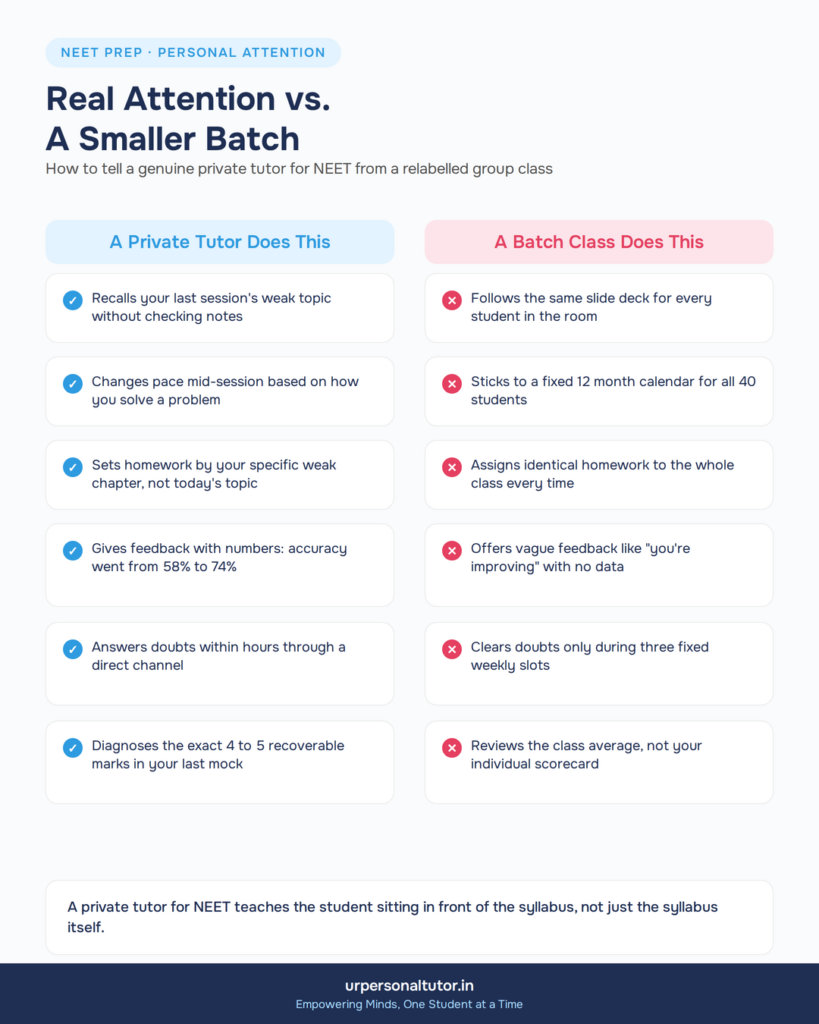
Coaching institutes use the phrase loosely. A “personal attention batch” often just means 15 students instead of 60, taught from the same slide deck, at the same speed, with the same three doubt-clearing sessions a week for everyone, regardless of whether a student’s actual gap is in physics numericals, organic chemistry mechanisms, or biology diagrams.
A private tutor for NEET works from a different starting point: the student’s own performance data across all three subjects. NEET is worth 720 marks total, split evenly across physics, chemistry, and biology at 180 marks each. A tutor watching one student’s full scorecard can point to exactly which questions are recoverable in each subject with better technique, not just more content. A batch teacher, working across 40 different scorecards and often three different subject teachers who never compare notes, simply cannot do that at the same resolution.
The difference is diagnostic. One approach teaches the syllabus. The other teaches the student who happens to be sitting in front of it, subject by subject.
How Online Private Tutoring for NEET Recreates That Same Attention on a Screen
Parents often assume personal attention only works face to face. In practice, online private tutoring for NEET replicates most of it, and in a few ways it does the job better, especially when a student needs support across multiple subjects.
A tutor working online can share a digital whiteboard, mark up a student’s own handwritten chemistry equation or biology diagram live, and pull up last week’s mock test paper in the same window within seconds. There’s no flipping through three separate physical notebooks to find where a mistake happened weeks ago. Recorded sessions also mean a student revisiting the Krebs cycle or Newton’s laws before an exam can rewatch the exact fifteen minutes where the tutor worked through their specific confusion, not a generic explanation aimed at nobody in particular.
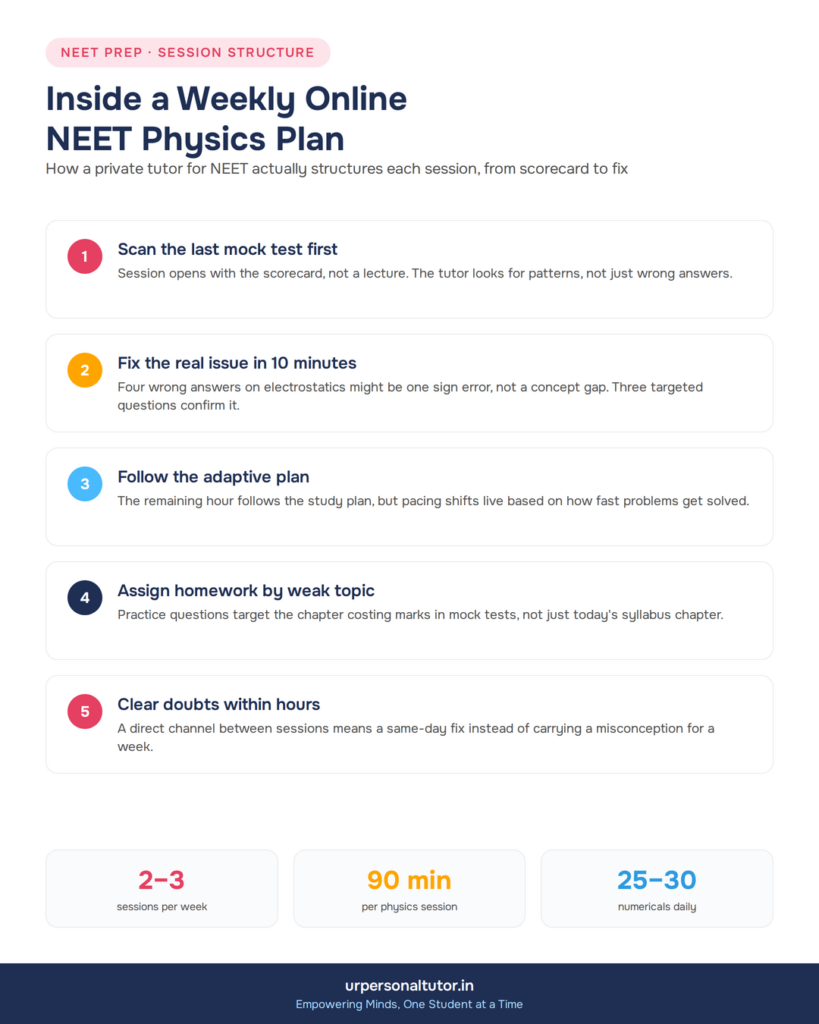
Response time matters too. A well-run online private tutoring for NEET setup includes a doubt-clearing channel where questions get answered within a few hours, not at the start of next week’s class, whether the doubt is a physics numerical, a chemistry reaction mechanism, or a biology classification question. For a student juggling all three subjects in the final six months before the exam, that turnaround is often the difference between fixing a misconception the same day and repeating it for a week. Anyone deciding between formats can read more on the physics-specific side of this, since choosing between a group setup and a one-to-one tutor comes down to similar questions regardless of subject.
Inside a Real Session With a Private Tutor for NEET
A typical 90-minute session doesn’t open with a lecture, in any subject. It opens with the previous test paper.
The tutor scans for patterns first, not just wrong answers. Maybe a student got four questions wrong in organic chemistry, but the actual issue is mixing up two reagent names, not a conceptual gap. That gets fixed in ten minutes with three targeted questions, not a full re-teach of the chapter. In biology, a student might consistently lose marks on labelled diagrams rather than theory, which changes what the tutor spends time on entirely. In physics, the same wrong-answer count might trace back to a sign convention error in three different numericals. The remaining hour goes toward whatever that student’s NEET preparation plan says is next for that subject, but even that gets adjusted live. If a student solves the first two problems without hesitation, the tutor moves faster and spends the saved time on a weaker area instead of finishing a pre-planned worksheet out of habit.
This is where the value of a private tutor for NEET actually sits: not in access to better notes, since NCERT and standard reference material cover most of what’s needed across all three subjects, but in a person who adjusts the plan every single session based on what just happened, and knows which subject needs the attention that week. Where physics numericals specifically are the recurring weak point, a structured chapter-wise practice routine helps, since knowing how many questions a student actually needs per chapter, rather than solving everything or nothing, applies just as much to chemistry and biology practice sets.
Signs You Are Actually Getting Personal Attention, Not Just a Smaller Batch
A few markers separate genuine personalisation from an Authorized NEET personal tutor marketing label, and they hold across physics, chemistry, and biology equally.
The tutor can describe, without checking notes, what a student struggled with two sessions ago, in whichever subject came up. The pacing changes week to week based on test results in each subject rather than following a fixed 12-month calendar identical for every student. Homework is assigned by weak topic and weak subject, not by “whatever chapter we covered today.” And feedback comes with numbers attached, per subject: not “you’re improving,” but “your accuracy in biology went from 58% to 74% over the last month, while chemistry numericals are still lagging.”
If none of that is happening in at least two of the three subjects, it’s worth asking whether the label “personal attention” is doing more work than the actual teaching is.
What a Private Tutor for NEET Cannot Do For You
It’s worth being honest here, because the phrase gets oversold. A private tutor for NEET cannot sit the exam for a student, and no amount of one-to-one time replaces the hours a student has to put in solving problems and revising diagrams independently, across all three subjects. A tutor can diagnose a weak chapter in ten minutes, in physics, chemistry, or biology; the student still has to put in the repetition needed to actually fix it.
Personal attention also doesn’t mean shorter study hours. NEET aspirants who use online private tutoring for NEET still need a consistent study routine covering all three subjects, not just the one getting tutoring support. Where physics is the specific gap, a structured physics preparation routine outside the tutoring sessions themselves still matters. What a good tutor changes is the efficiency of those hours across the full syllabus: less time spent practising things a student has already mastered in any subject, more time spent on the two or three chapters, wherever they sit, actually costing marks in the mock tests.
A Note on Choosing the Right Fit
Not every student needs a private tutor for NEET across all three subjects, and not every private tutor is a good match for every student. Some students genuinely thrive in a batch environment for two subjects and only need one-to-one support where a specific gap keeps showing up, often physics, since it tends to be the subject most students find hardest to self-correct without guidance. The honest answer is that personal attention is worth paying for when a student’s mock test scores plateau despite regular batch attendance, or when a specific chapter in any subject keeps recurring as a weak point across multiple tests. At that point, a tutor who can watch that one pattern closely, in the subject where it’s actually happening, tends to move the needle faster than another round of the same group class.
Getting a NEET score to move from a plateau usually takes more than a change in notes. It takes someone watching the pattern closely enough to know what’s actually broken, and in which subject. If that sounds like what your NEET preparation is missing, you can book a consultation with our team to talk through where the gaps are, or browse the blog for more on building a NEET plan that actually adapts to test results instead of a fixed calendar.
Frequently Asked Questions
Is a private tutor for NEET actually better than group coaching?
It depends on what’s holding the score back, and in which subject. If a student’s problem is a handful of specific weak chapters in physics, chemistry, or biology, a private tutor for NEET closes that gap faster because the sessions target only those chapters. If the problem is a lack of discipline or structure across the board, a batch environment with peer pressure and a fixed timetable can sometimes work better for that particular student.
Does a private tutor for NEET cover physics, chemistry, and biology together, or one subject at a time?
Both models exist. Some students take one-to-one support for a single subject where they’re weakest and stay in batch classes for the other two. Others prefer a tutor, or a small tutoring team, covering all three subjects so pacing and revision schedules stay coordinated across the full syllabus instead of three disconnected timetables.
How many hours a week does online private tutoring for NEET typically need?
Most effective setups run two to three sessions of 90 minutes each per week per subject, plus independent problem-solving or diagram practice between sessions. Students closer to the exam, within the final three to four months, often move to shorter, more frequent sessions focused purely on mock test review across all three subjects.
Does personal attention mean the tutor solves problems for the student?
No, and a tutor who does this is doing more harm than good, in any subject. Real personal attention means the tutor identifies exactly where a student’s own method breaks down, whether that’s a physics numerical, a chemistry mechanism, or a biology concept, corrects that method, then steps back and has the student solve similar problems independently to confirm the fix actually held.