
I have been tutoring IB Physics for years now, and if there is one conversation I have over and over again, it is this one. A student shows me a mock exam where they scored a 5, and they are baffled. “But I understood everything,” they tell me. “I studied for weeks.” And here is the thing: they usually did understand everything. Understanding was never the problem. The problem is that IB Physics is not marked on understanding. It is marked on what you write down, line by line, against a markscheme that is far more rigid and far more predictable than most students realise.
So this post is not another list of generic study tips. You already know you should do past papers and get enough sleep. Instead, I want to walk you through how your exam is actually marked, because once you see the paper the way an examiner sees it, a 7 stops being a mystery and starts being a process.
First, the good news: you do not need to be perfect
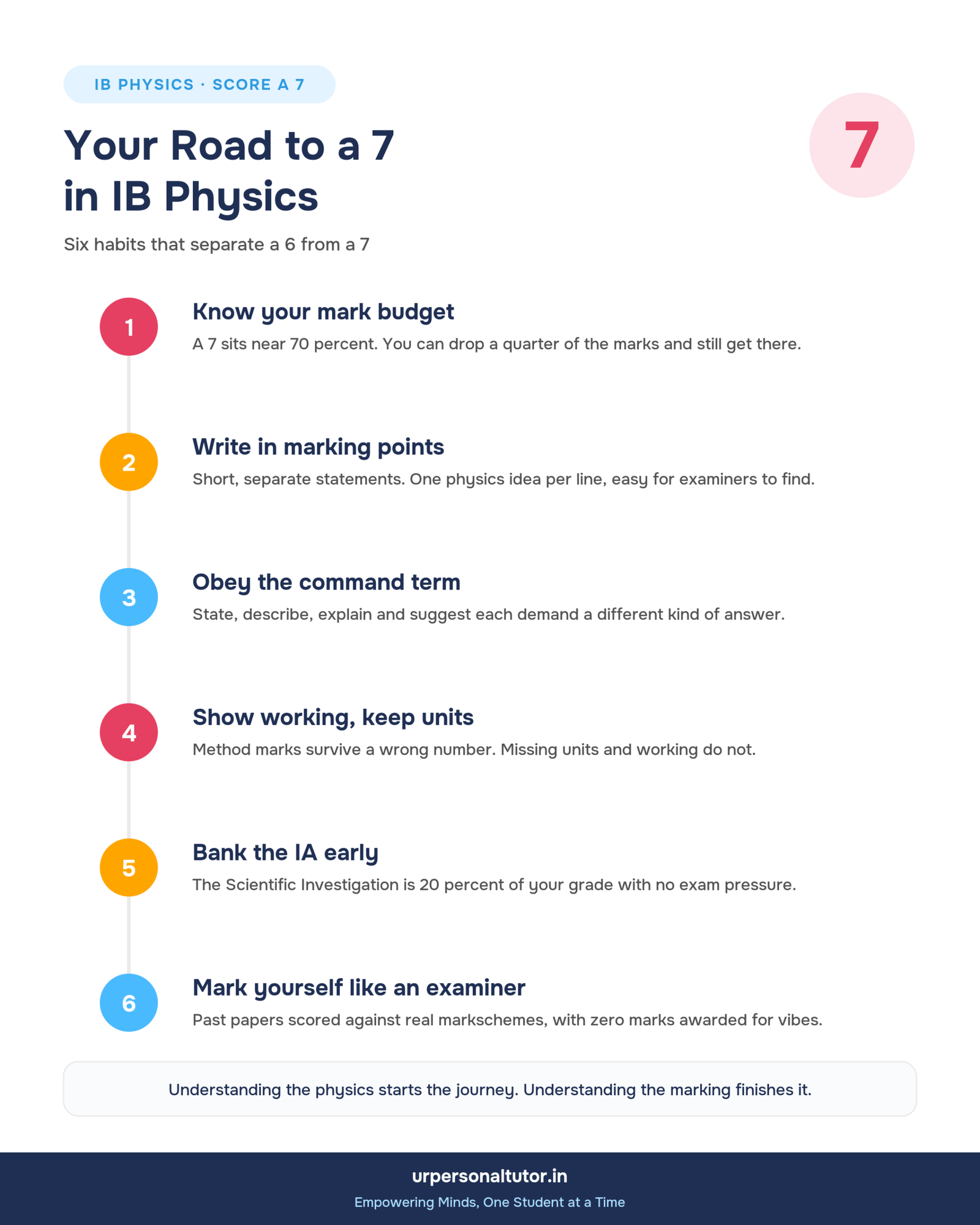
Let me start with something that surprises almost every student I work with. The grade boundary for a 7 in IB Physics typically sits somewhere in the region of 70 percent, give or take a few percent depending on the session and the level. Think about what that means. You can drop roughly a quarter of the available marks and still walk away with the top grade.
This changes everything about how you should approach the exam. Students chasing perfection panic when they hit a question they cannot do, and that panic bleeds into the questions they could have done. Students chasing a 7 know they have a mark budget. They can afford to abandon a nasty two-mark question, bank the easy marks elsewhere, and come back if time allows. The 7 student is not the one who knows the most physics. It is the one who collects marks most efficiently.
How examiners actually mark your paper
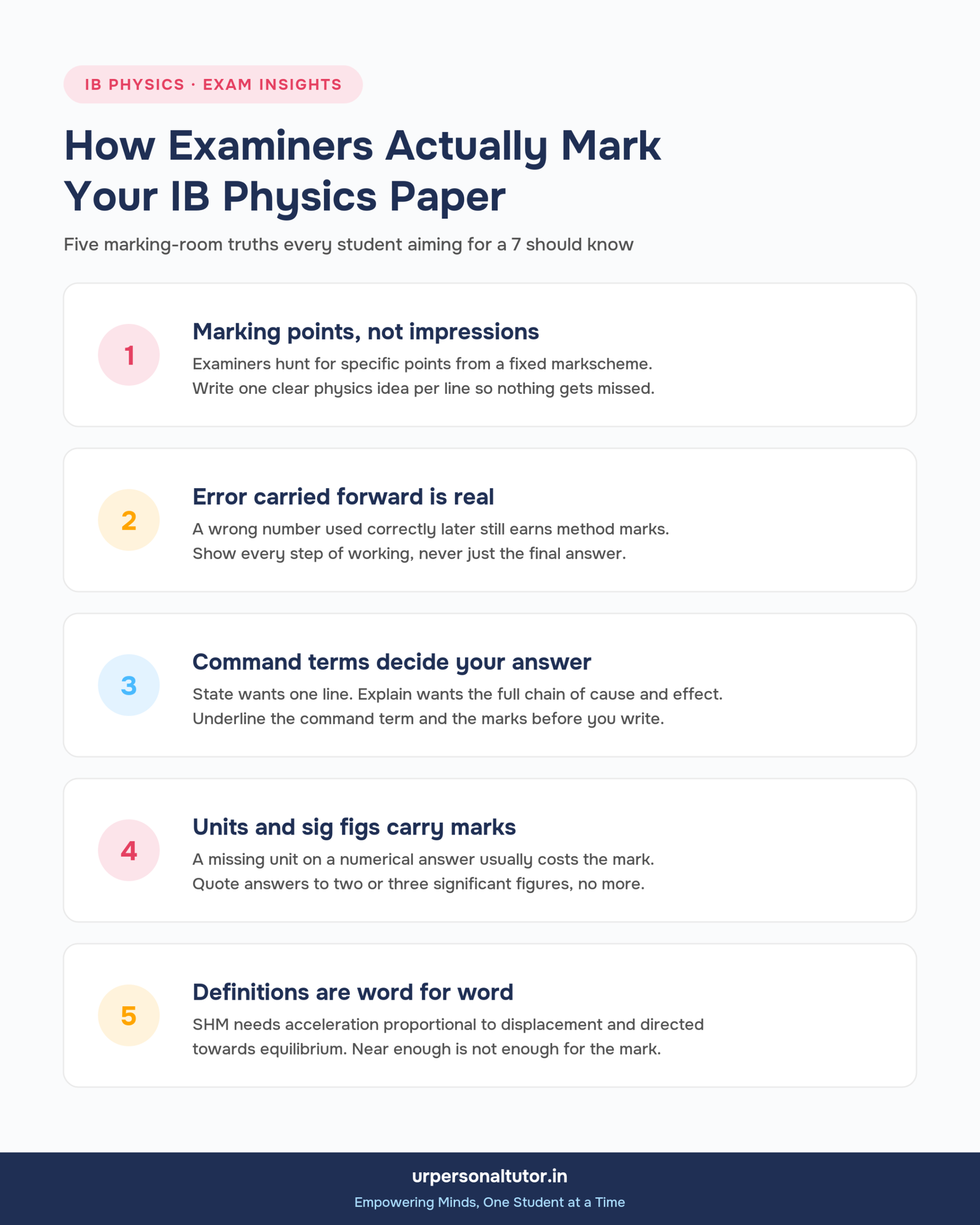
Here is the part nobody tells you in class. Examiners do not read your answer, form a general impression, and then award a mark out of three. They work from a markscheme that lists specific marking points, and they hunt for those points in your writing. If the markscheme says the mark is for “energy is conserved” and you wrote a beautiful paragraph about momentum, you get nothing, no matter how elegant your paragraph was.
Every marking point is essentially a checkbox. Three-mark question, three checkboxes. The examiner scans your answer looking for each one. They are marking hundreds of scripts, they are working quickly, and they are not going to excavate your answer for buried meaning. Your job is to make the marking points impossible to miss.
What does that look like in practice? Short, separate sentences. One physics idea per line. If a question is worth three marks, I tell my students to write three distinct statements, because the structure of your answer should mirror the structure of the markscheme. When you write a long flowing paragraph, you make the examiner work to find your points, and sometimes they genuinely cannot tell whether you made a point or just gestured at it.
There is another marking convention you should know about: error carried forward, often written as ECF. If you make a numerical mistake in part (a) and then use that wrong answer correctly in part (b), you still get the marks for part (b). The method is what earns the mark. This is exactly why you must show every step of your working. A wrong final answer with clear working might lose you one mark. A wrong final answer with no working loses you all of them. I have seen students throw away five or six marks across a paper purely because they did calculations on their calculator and wrote down only the final number.
Command terms are the rules of the game
The IB publishes a list of command terms, and each one has a precise meaning that tells you exactly what the markscheme wants. Most students skim past these words. Examiners do not.
“State” means give the answer, no explanation needed. If you write three sentences for a one-mark state question, you have wasted time you will want back later. “Describe” means give a detailed account of what happens, but you do not need to say why. “Explain” is the big one, and it is where most marks die. Explain means give the reasons, the mechanism, the chain of cause and effect. A typical explain question carries a mark for each link in the chain. So if you are asked to explain why the current decreases when temperature rises in a thermistor question, you cannot just say “because resistance changes.” You need the full chain: temperature rises, so more charge carriers are released, so resistance falls, so for a fixed potential difference the current increases. Each link is potentially a mark.
Then there are “determine,” “calculate,” “deduce,” and “suggest.” Suggest is worth a special mention because it signals that the examiners want you to apply your physics to an unfamiliar situation. There is no memorised answer. They want plausible reasoning grounded in principles you know. Students freeze on suggest questions because they think they missed something in the syllabus. They did not. The question is testing whether they can think, and the markscheme usually accepts a range of sensible responses.
My advice: before you write a single word of any answer, underline the command term and check the mark allocation. Those two pieces of information tell you what to write and how much of it.
Paper by paper, where the marks hide
On the multiple choice paper, the wrong options are not random. They are engineered from the most common student errors: forgetting to square a term, mixing up radius and diameter, dropping a factor of two. This means “my answer is one of the options” is not evidence you are right. It is evidence the examiners predicted your mistake. Work each question properly, and when you check, check the physics rather than just re-running the same flawed calculation. No calculator is allowed on the multiple choice section, so practise estimating and manipulating numbers by hand well before exam day.
The data-based questions deserve real practice too, because they reward habits more than brilliance. Read graphs carefully, including the axes and units, which are frequently not the base units you expect. When you draw a line of best fit, draw it with a ruler and make it actually fit. When asked about uncertainties, remember the standard rules: add absolute uncertainties when adding or subtracting quantities, add percentage uncertainties when multiplying or dividing. These are gift marks for prepared students and a bloodbath for everyone else.
On the long paper, units and significant figures matter. A numerical answer with no unit will usually cost you the mark. An answer quoted to eight significant figures when the data justified three signals to the examiner that you are not thinking like a physicist. Two or three significant figures is almost always right. And learn your definitions word for word. When a question asks you to define simple harmonic motion, the markscheme wants acceleration proportional to displacement and directed towards the equilibrium position. Miss the direction part and you have lost the mark, even though you clearly sort of knew it.
The IA: twenty percent you control completely
The Scientific Investigation is worth 20 percent of your final grade, and unlike the exams, you get weeks to polish it with no time pressure. If you are serious about a 7, treat the IA as the cheapest marks available to you.
Moderators mark against four criteria, and they mark positively, looking to award rather than deduct. But certain weaknesses come up in moderator reports year after year. Research questions that are too vague to investigate properly. Uncertainties recorded in the raw data table and then never mentioned again. Conclusions that overclaim, stating that the data “proves” a relationship when a scattered graph clearly says otherwise. Evaluations that list “human error” as a limitation, which tells the moderator precisely nothing.
The students who score highly do a few consistent things. They pick a focused question with a clearly identified independent and dependent variable. They propagate uncertainties through their calculations and draw error bars that actually mean something. They compare their result to an accepted value or theoretical prediction where one exists. And they evaluate specific weaknesses in their method, explaining the direction and size of the effect each one had. That level of honesty about your own experiment reads as scientific maturity, and it is rewarded.
Train the way you will be tested
Everything above points to one revision method, and it is the one I insist on with every student aiming for a 7. Do past paper questions, then mark them yourself with the real markscheme, ruthlessly. Not “I basically said that.” Either you wrote the marking point or you did not. Award yourself nothing for vibes.
The first few sessions of this are humbling. Students who feel confident discover they are dropping a third of the marks on questions they “knew.” But something valuable happens after ten or fifteen papers marked this way. You start to predict the markscheme before you look at it. You read an explain question and you can feel the three marking points it is fishing for. At that moment you have stopped writing answers and started writing markschemes, and that is the real difference between a 6 and a 7.
Build this into a weekly rhythm from as early in the course as you can. One or two timed question sets, self-marked, with a running list of the exact marking points you missed. Revisit that list. Your mistakes are the most personalised syllabus you will ever own.
The honest summary
A 7 in IB Physics is not reserved for geniuses. Every year I watch determined, well-organised students get there, and almost none of them are the stereotypical physics prodigy. What they share is a way of working: they know the boundary leaves room for error, they write in marking points rather than paragraphs, they obey command terms, they show every line of working, they bank the IA marks early, and they mark their own practice like an examiner on a deadline.
Understanding the physics gets you into the conversation. Understanding the marking gets you the 7. Start doing both, and start now. And if you want a second pair of eyes on your practice answers or your IA draft, that is exactly what a good tutor is for. Bring me your marked scripts, not just your questions.