
Every exam season, my inbox fills with some version of the same message. “My daughter’s IGCSEs start in three months and she hasn’t started revising. Is it too late?” And every year I give the same answer: no, it is not too late. Twelve weeks is not a compromise. Twelve weeks, used properly, is the sweet spot. It is long enough to fix real gaps and short enough that the exam feels close, which keeps everyone honest.
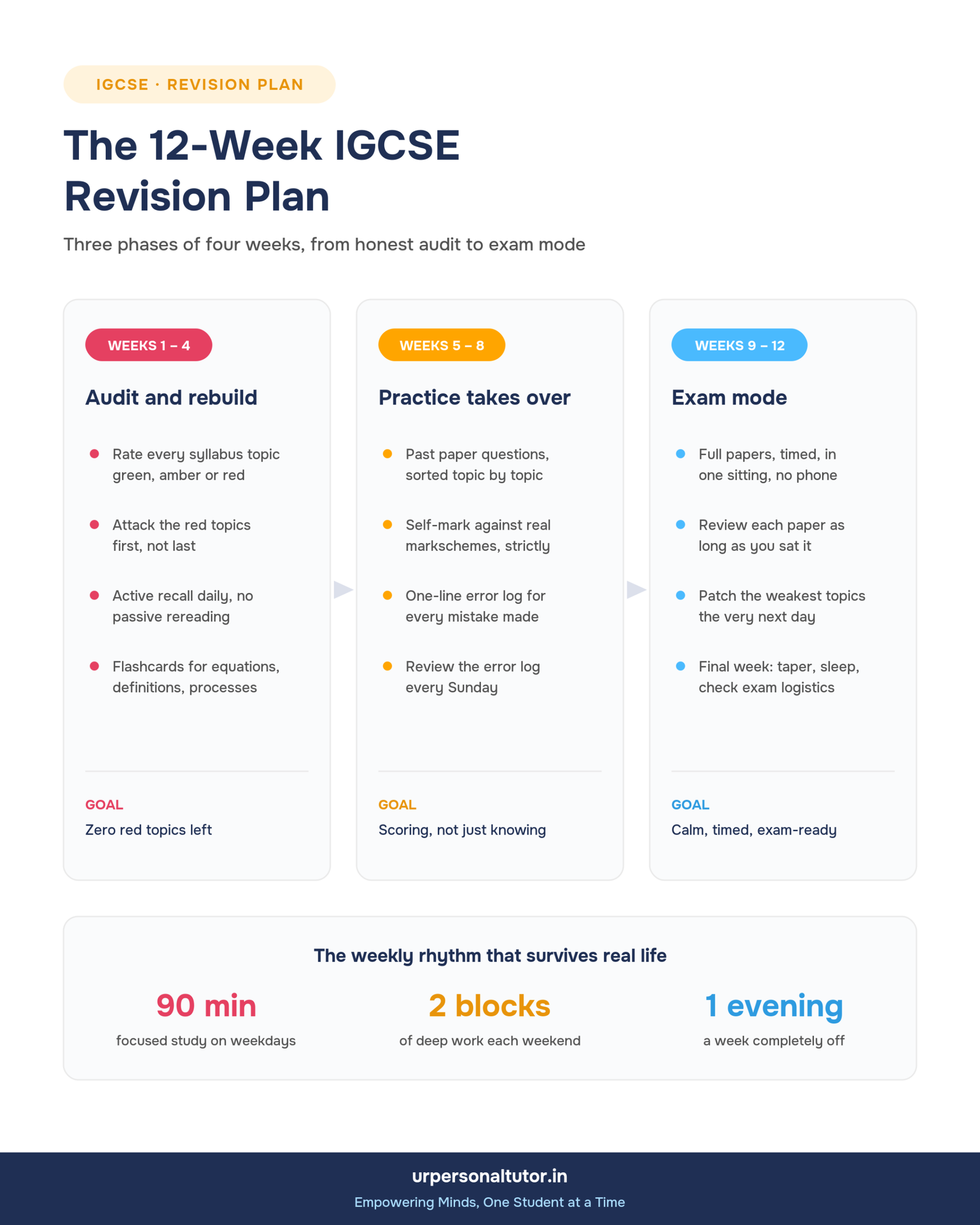
What most students lack is not time or effort. It is a structure. Left alone, teenagers revise the subjects they like, reread notes they already know, and quietly avoid the topics that scare them. A good plan does the opposite. So here is the exact structure I use with my own IGCSE students, broken into three phases of four weeks each.
Before week one: understand the exam you are sitting
Spend one afternoon on this before any revision begins, because it changes everything that follows.
First, know your exact syllabuses. Cambridge IGCSE subjects have codes, and papers differ between Core and Extended tiers. A student sitting Extended Maths is preparing for different papers, and a different grade range, than a Core student. Download the syllabus document for each subject from the Cambridge website. It is written as a list of things you can be tested on, which makes it the single best revision checklist in existence, and it is free.
Second, collect past papers and their markschemes. Not to sit them yet, just to have them ready. Three to five years’ worth per subject is plenty.
Third, look at how each subject is examined. Which paper is multiple choice? Which one carries the practical or alternative-to-practical? How many marks per paper, and how long per mark? Students who know the shape of the exam stop being surprised by it, and unsurprised students perform better.
Finally, glance at the published grade thresholds from recent sessions. Most families are shocked to learn that top grades rarely require anywhere near full marks. Knowing that an A* in a subject might sit around 80 percent changes the psychology of the whole preparation: you are not chasing perfection, you are collecting enough marks, and you are allowed to lose some along the way.
Weeks 1 to 4: the audit and the rebuild
Phase one is about finding out where you actually stand, then fixing foundations. Print each syllabus and go through it topic by topic with three highlighters: green for topics you could answer questions on today, amber for ones you half know, and red for ones that make your stomach drop. Be brutal. An honest red is worth more than a flattering amber, because reds are where your marks are hiding. Most students discover their subjects are about one third green, one third amber, one third red, and the mix varies wildly between subjects.
Then spend these four weeks working through the reds and ambers, one chunk at a time, using active methods only. Reading the textbook does not count as revision. Instead: close the book and write down everything you remember, then check what you missed. Make flashcards for definitions, equations, and processes, and test yourself daily. Explain a topic out loud to a parent or a wall. If you can teach it, you know it. If you stumble, you have found tomorrow’s work.
The target by the end of week four is simple: no reds left anywhere. Amber is acceptable. Red is not.
Weeks 5 to 8: practice becomes the syllabus
Phase two flips the ratio. Learning drops to maybe a third of your time and practice takes over, because at IGCSE the difference between knowing chemistry and scoring in chemistry is the ability to answer exam questions under exam conditions.
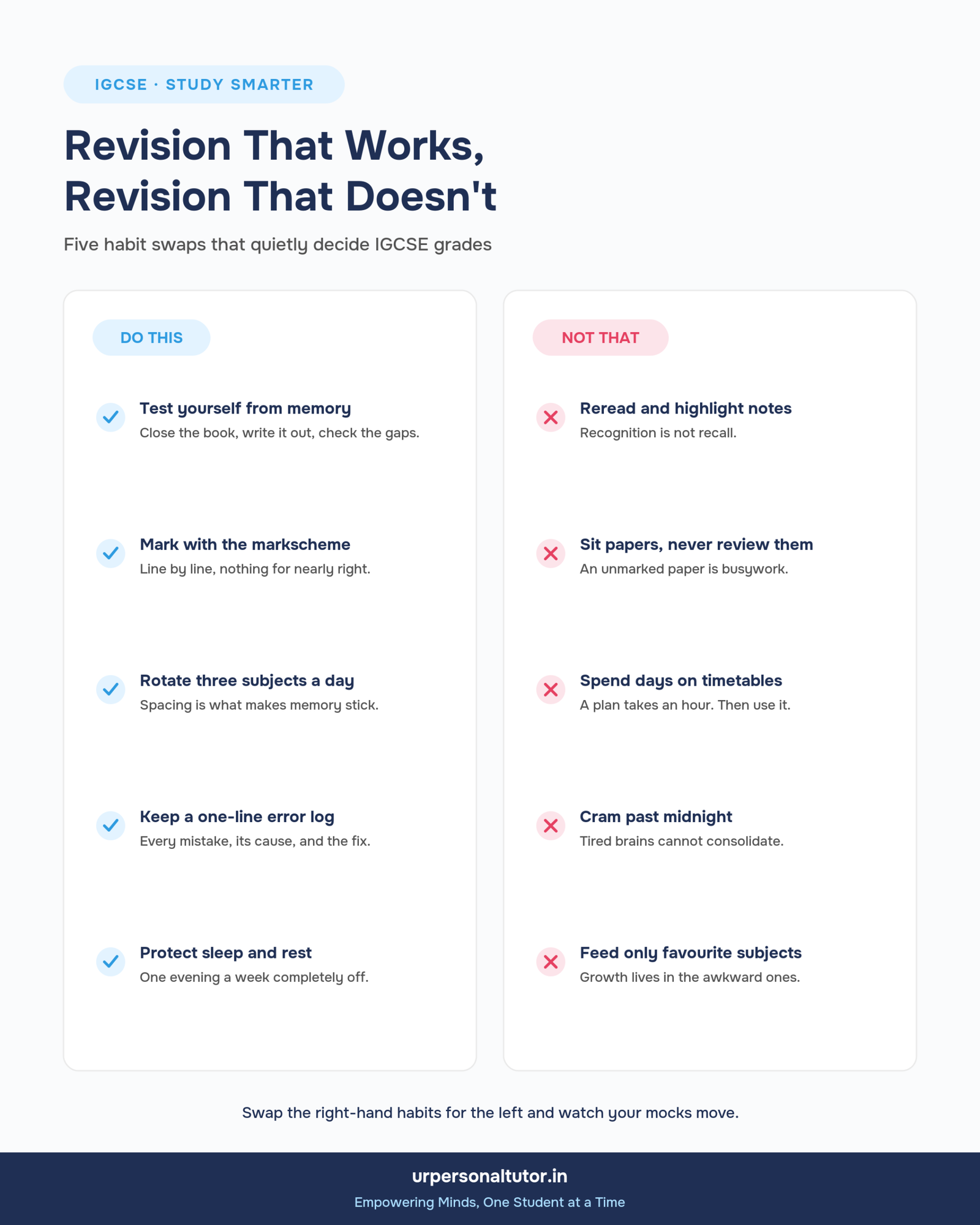
Work through past paper questions grouped by topic rather than sitting whole papers. Topic-sorted practice lets you hammer one area until it holds. Do a set of questions, then mark them yourself against the real markscheme, line by line. Award nothing for answers that are nearly right. The markscheme is a window into the examiner’s head: you will quickly notice that it rewards specific keywords, complete reasoning chains, correct units, and working shown, and it ignores waffle entirely.
Keep an error log. One notebook, one line per mistake: the question, what went wrong, and the fix. “Forgot to convert cm to m.” “Confused mitosis with meiosis.” “Ran out of time on the last question.” After a few weeks this notebook becomes the most personalised revision guide ever written, because it contains only your weaknesses. Review it every Sunday.
Weeks 9 to 12: full dress rehearsals
Phase three is exam mode. Now you sit complete papers, timed, in one sitting, with no phone in the room and no notes on the desk. One or two full papers per subject per week, rotated so every subject gets attention. The goal is not just knowledge but stamina, timing, and calm.
After each paper, spend as long reviewing it as you spent sitting it. A marked paper you never review is a wasted paper. Feed every mistake into the error log, then spend the next day patching the two or three weakest topics the paper exposed before you touch another paper.
In the final week, taper. Light review of the error log and flashcards, early nights, and logistics: check the exam timetable twice, pack the calculator and spare pens, know the seating arrangements. Nobody adds marks by cramming until 2 a.m. the night before, but plenty of students lose marks that way.
What a realistic week looks like
School does not stop for revision, so the plan has to survive real life. On weekdays, aim for around 90 focused minutes: two or three short sessions with genuine breaks, not one glassy-eyed marathon. On the weekend, two blocks of two to three hours each, which is where past papers live. And one full evening a week completely off, protected as fiercely as any study session. Rest is not a reward for revision. It is part of it, because a tired brain cannot consolidate anything.
Rotate subjects daily rather than dedicating whole weeks to one subject. Three subjects touched briefly beats one subject exhausted, and the spacing between visits is exactly what makes memory stick. If a day collapses because of a school test or a family commitment, do not try to repay the debt by doubling tomorrow. Just rejoin the plan where it stands. Consistency over twelve weeks beats heroics in any single week, every time.
The mistakes I see every single year
A few habits quietly sink more IGCSE grades than any difficult topic ever does. Highlighting and rereading feel productive and achieve close to nothing, because recognition is not recall. Spending three days building a beautiful colour-coded timetable is procrastination wearing a costume; a plan should take an hour, then get used. Revising only favourite subjects builds confidence in exactly the wrong place. Sitting past papers without ever marking them properly turns your best resource into busywork. And sacrificing sleep, meals, or exercise for extra hours at the desk trades away far more marks than it gains.
One more, for parents especially: comparing your child’s schedule to other children’s. Some students need six hours a weekend, others need twelve, and the child who needs twelve is not failing. They are just fighting a different battle, and they need backup, not a scoreboard.
Where parents genuinely help
Parents ask me constantly what they should be doing, and the honest answer is: less than you think, but better. Protect the routine, keep the fridge stocked, and be the audience when your child wants to explain photosynthesis at dinner. Ask “what did you figure out today?” instead of “how much did you do?” Quantity questions invite performance. Curiosity questions invite thinking. And if the plan slips for a week, help them restart rather than relitigating the lost days. Guilt is a terrible study partner.
Twelve weeks is enough
I have watched this plan carry students from panic to genuinely strong results more times than I can count. Not because it is clever, but because it forces the two things that actually move grades: honest confrontation with weaknesses early, and relentless exam-style practice late. The syllabus tells you what to learn. Past papers teach you how to score. The error log makes sure no mistake gets to bite you twice.
If your child needs help turning this skeleton into a personalised plan, or a subject specialist to clear the stubborn red topics, that is exactly what we do at Ur Personal Tutor. But plan or no plan, start this week. Twelve weeks from now, the exams will arrive either way. The only question is who walks in prepared.