
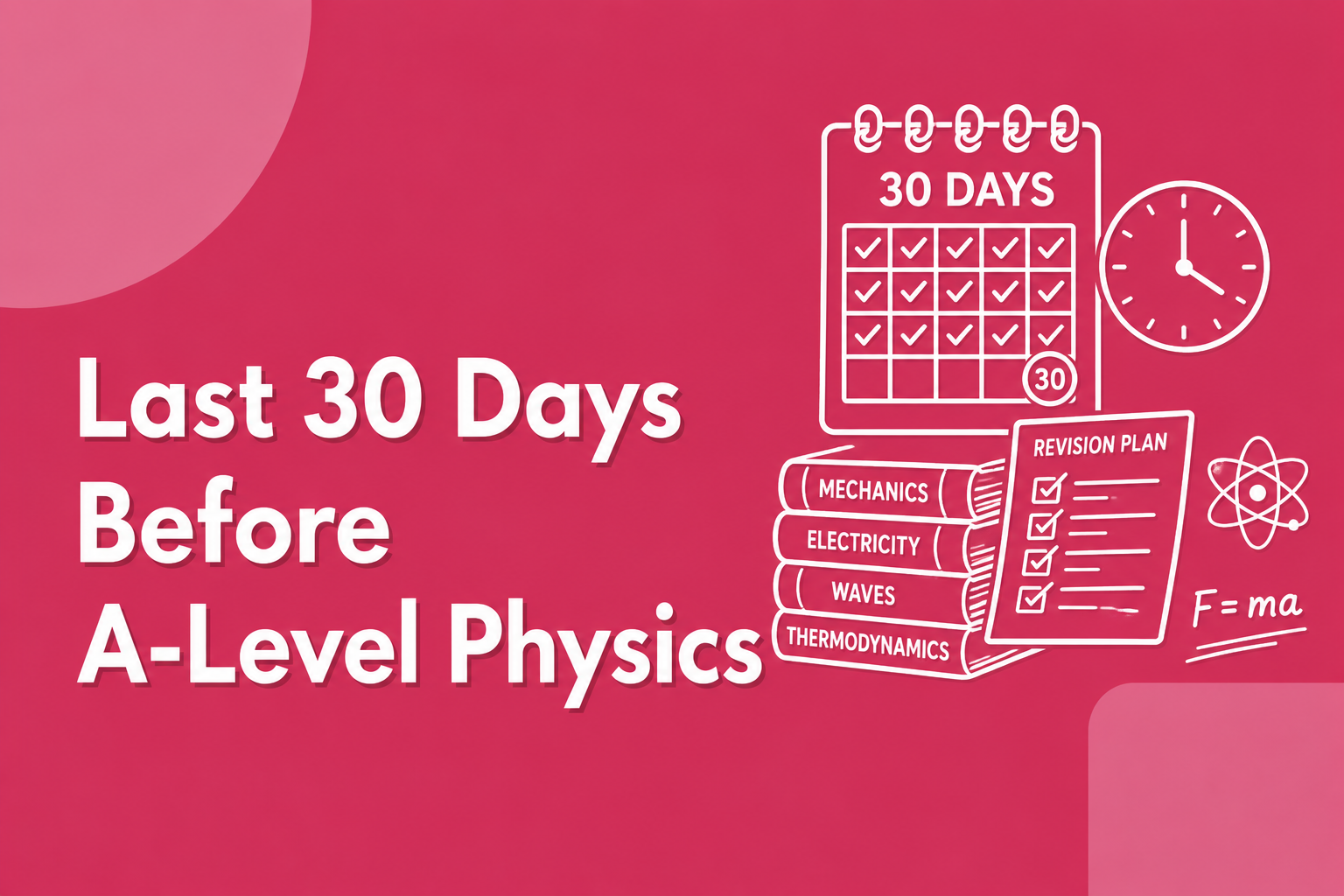
There is a particular phone call I get every year, usually about a month before the A-Level Physics papers begin. A parent, trying to sound calm, tells me their son or daughter has “sort of been revising” since March, and now the exam is thirty days away and everyone in the house is quietly panicking. So let me say up front what I say to them: thirty days is enough to move your grade, sometimes by a lot. But only if you stop revising the way most students revise and start working the way the last month demands.
The last month is not the time for beautiful notes, fresh textbooks, or heroic plans to relearn the entire course. It is the time for triage, repetition, and exam craft. Here is the plan I actually run with my A-Level students, week by week.
Days 1 to 7: diagnose before you treat
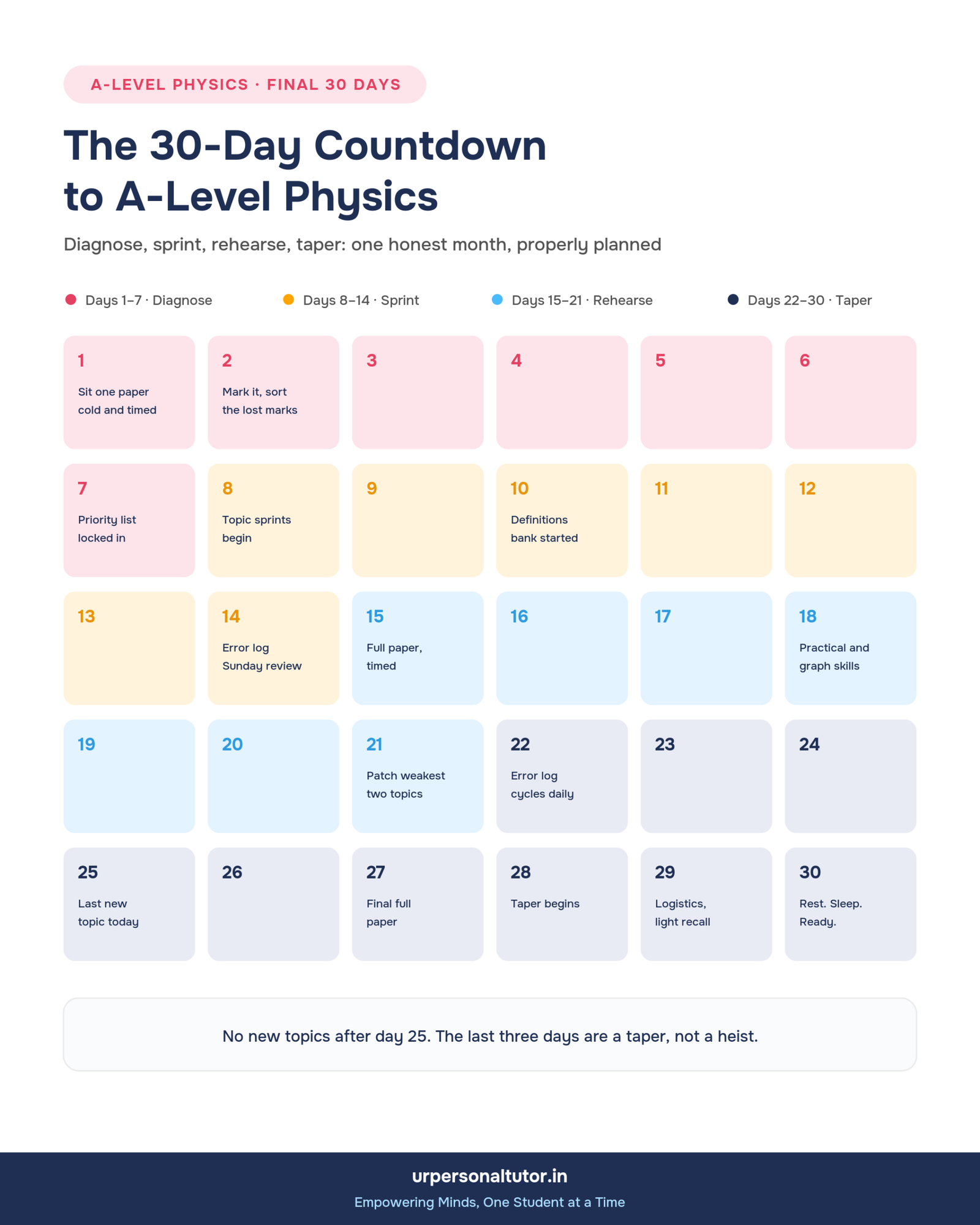
Do not start with your favourite topic. Start with a full, recent past paper, sat cold, under timed conditions, on day one. Yes, cold. It will feel unpleasant and the score will probably sting. That is the point. You cannot plan a rescue without knowing exactly where the marks are leaking.
Then mark it against the real markscheme, slowly and honestly, and sort every lost mark into one of three buckets. Knowledge gaps: you simply did not know the physics. Application gaps: you knew it but could not use it in an unfamiliar setting. Craft gaps: you knew it, used it, and still lost the mark through units, significant figures, sloppy definitions, or running out of time. Most students are stunned to discover that the third bucket is the biggest. Craft marks are also the fastest to win back, which is why we find them first.
Spend the rest of the week converting that autopsy into a priority list. Rank topics by marks lost, not by how much you dislike them. A topic that cost you nine marks outranks a topic that cost you two, even if the two-mark one feels scarier. By day seven you should have a short written list of your highest-value repairs, and you should already have started on the top three.
Days 8 to 14: topic sprints, not topic marathons
Week two is repair week. Take your priority list and work through it in sprints: one topic, one sitting, roughly ninety minutes. Twenty minutes of active relearning from a summary or your syllabus, then straight into past paper questions on that topic only, then mark them against the markscheme. The sequence matters. Reading about capacitors for two hours feels safe and achieves little. Answering eight capacitor questions and marking them brutally tells you precisely what you still cannot do.
While you sprint, build two small documents that will carry you through the final fortnight. The first is a definitions bank: every definition, law, and derivation the syllabus can ask for, written exactly as the markscheme wants it, because A-Level Physics definitions are marked word by word, not vibe by vibe. The second is the error log: one line per mistake, what happened, and the fix. “Dropped the negative sign in the field equation.” “Used diameter as radius, again.” Thirty days of honest logging produces the most personal revision document you will ever own.
Days 15 to 21: rehearse the real thing
Week three is when practice turns into rehearsal. Two or three full papers this week, timed, in one sitting, no phone in the room. Rotate the paper types rather than repeating your favourite, because each one tests a different skill and the uncomfortable one is where your marks are hiding.
Give the practical-based papers particular respect. Planning, analysis, graph work, and uncertainty questions are among the most learnable marks in the whole qualification, because they follow patterns that repeat year after year: how to linearise an equation, how to read gradients and intercepts with their units, how to combine percentage uncertainties, how to describe one genuine improvement to a method. Students treat these papers as unpredictable. They are the opposite. Sit three or four of them with markschemes and the patterns become almost embarrassingly visible.
Do not neglect the multiple choice paper either. Its danger is time, not difficulty: roughly ninety seconds per question, with wrong options engineered from predictable slips like unconverted units and factor-of-two errors. Practise it as a timing drill. If a question refuses to yield in ninety seconds, circle it, move on, and return at the end. Guarding your pace on paper one is worth several marks on its own.
After every paper, the review rule from my other posts applies double here: spend as long marking and reviewing the paper as you spent sitting it, and patch the two weakest topics it exposed the very next day. A paper you never review is a wasted afternoon.
Days 22 to 30: sharpen, then taper
The final stretch is about consolidation, not conquest. No new topics after day 25. None. The syllabus you have by then is the syllabus you are taking into the hall, and late-stage cramming of unfamiliar material mostly manufactures panic.
Instead, cycle daily through the two documents you built: the error log and the definitions bank. Ten minutes of definitions at breakfast. An evening pass through the error log, covering the fixes and testing yourself. Re-attempt old mistakes cold to prove they are actually fixed, because a mistake you recognised is not yet a mistake you have repaired. Keep doing short timed question sets to hold your speed, but drop the full papers after around day 27.
The last three days are a taper, exactly like an athlete before a race. Light recall, short sessions, proper meals, and aggressively protected sleep. Check the exam timetable twice, charge the calculator, pack spare pens. Nobody has ever added a grade at 2 a.m. the night before a physics paper, but plenty of students have subtracted one.
What a single day should look like
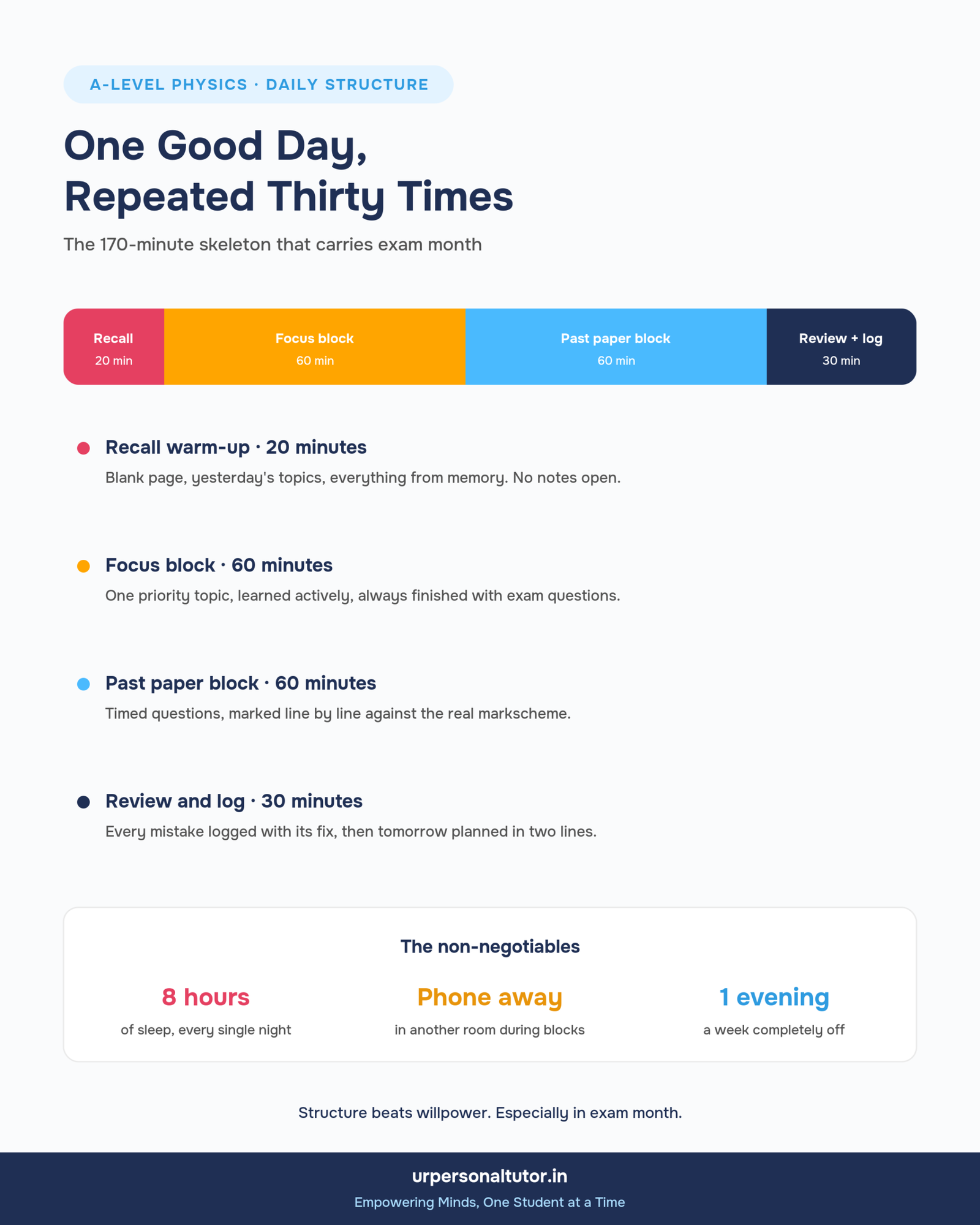
Structure beats willpower, especially in exam month. The daily skeleton I set is simple and takes under three hours outside school time. Start with a twenty-minute recall warm-up: blank page, yesterday’s topics, write everything you remember, no notes open. Then one sixty-minute focus block on a priority topic, ending with exam questions rather than reading. Then a sixty-minute past paper block, timed and marked properly. Finish with thirty minutes of review: log the mistakes, skim the definitions bank, and write tomorrow’s plan in two lines so future-you starts instantly instead of deliberating.
And the non-negotiables, which I enforce more strictly than any of the physics: eight hours of sleep, the phone in another room during blocks, and one evening a week that is completely, guiltlessly off. A month is a marathon at sprint distance. Recovery is part of the training.
The traps of the final month
Every year the same three traps catch good students. The first is rewriting notes, which feels like work and is actually decoration; if the hand is moving but the brain is not retrieving, it is not revision. The second is difficulty tourism: burying yourself in the hardest possible questions to feel prepared, while the routine six-mark questions that actually decide grades go unpracticed. The third is comparison. Your friend claiming ten-hour days is either exaggerating or revising badly, and either way it has nothing to do with your plan.
There is a fourth trap for the strongest students specifically: polishing topics you have already mastered because it feels good. If you are consistently scoring full marks on mechanics questions, mechanics no longer needs you. The B-grade topics you avoid are worth more than the A-star topics you love.
Thirty days is a real amount of time
I will not pretend a month can do the work of two years. It cannot. But I have watched a month of triage, sprints, rehearsal, and taper lift students a full grade, sometimes two, more times than I can count, because most students sitting A-Level Physics have never actually been taught how to convert knowledge into marks. That conversion is a skill, it is learnable, and thirty days is enough time to learn it.
If you want a specialist in your corner for exam month, our A-Level Physics tutors run exactly this kind of focused, personalised sprint at Ur Personal Tutor. But whether you do it with us or alone at your desk: sit that first cold paper today. Not Monday. Today. The countdown has already started, and the students who accept that first are the ones smiling in August.