
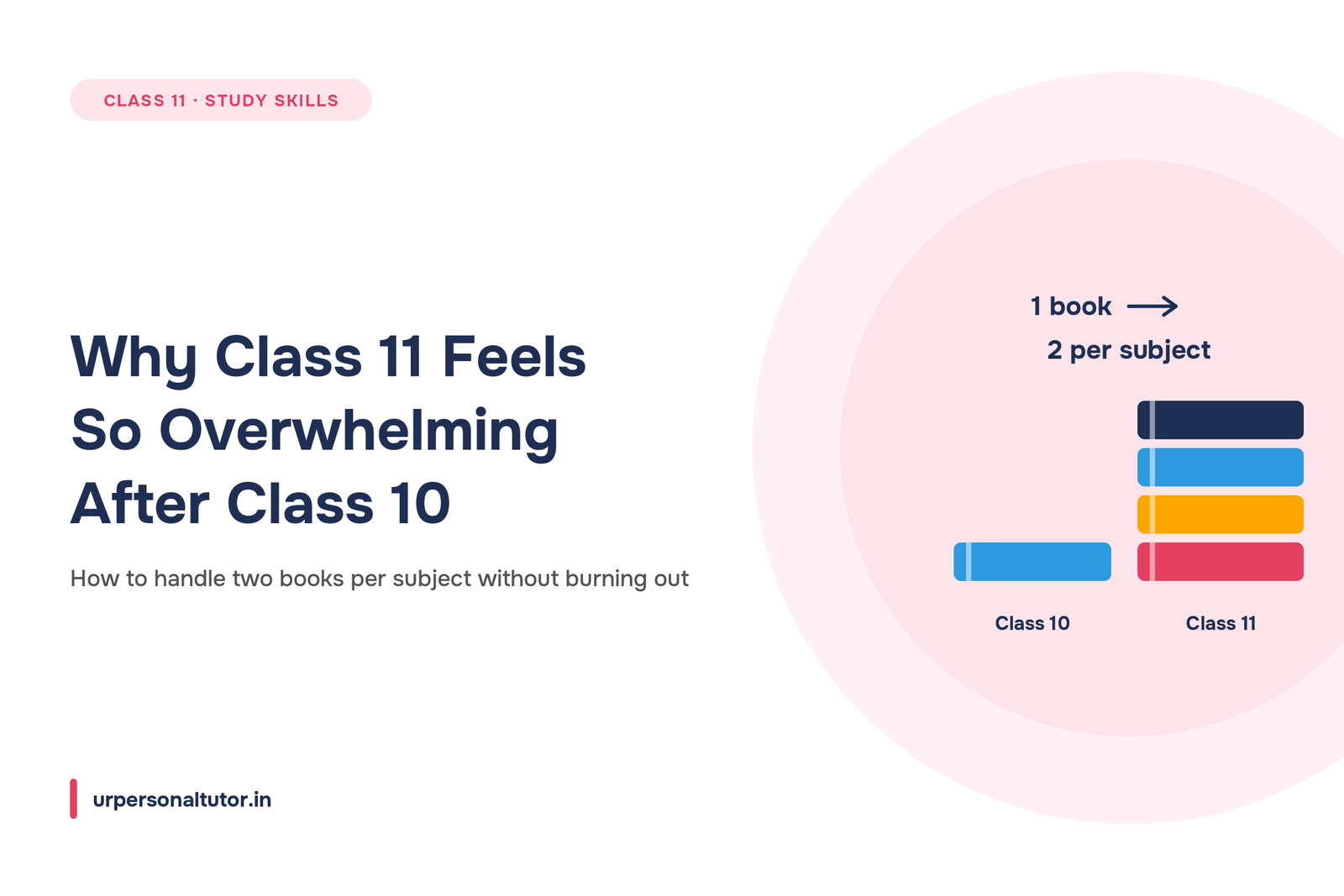
Class 11 feels overwhelming because the syllabus genuinely is 3 to 4 times bigger than Class 10. In 10th, you had one book covering all of science. In 11th, Physics alone has two NCERT books. So does Chemistry. So does Biology or Maths. You are not imagining the jump. It is real, it is steep, and every student in your class is feeling it, including the ones who look calm.
The good news? The students who do well in Class 11 are not the ones who avoid this shock. They are the ones who adjust their study method in the first two to three months instead of using their 10th class approach on an 11th class syllabus.
I have taught this transition for years, and the same pattern repeats every single batch. Let me walk you through what actually changes and what to do about it.
What Actually Changes From Class 10 to Class 11
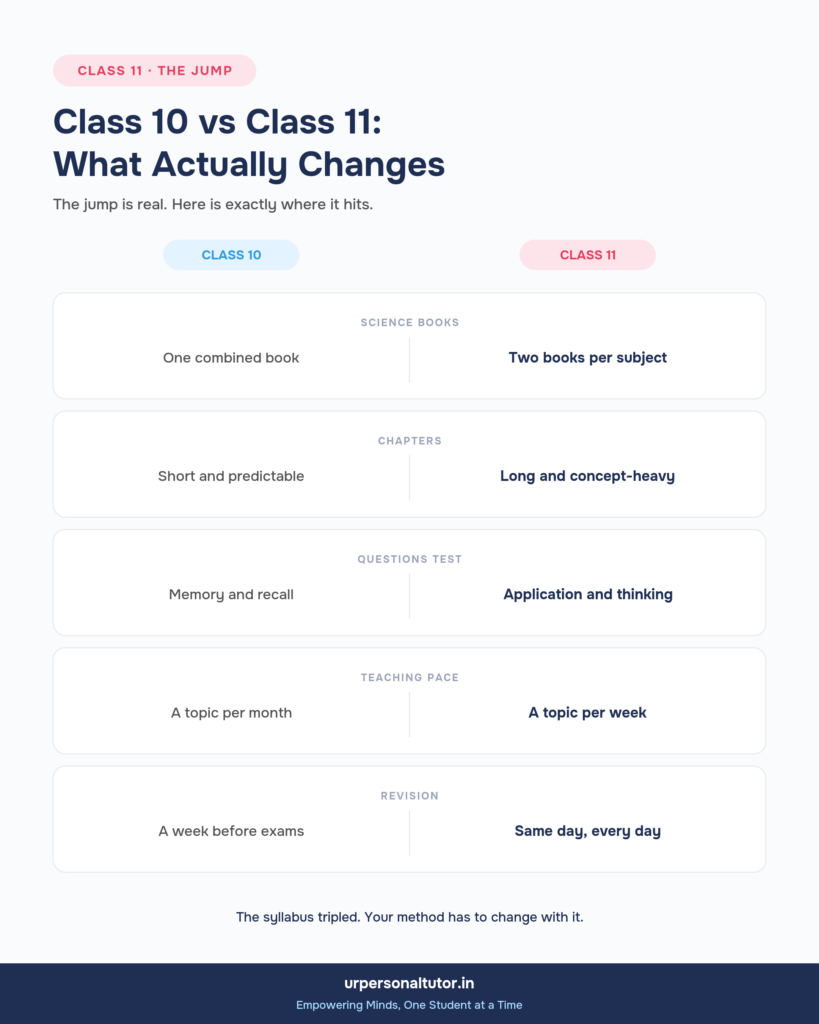
In Class 10, one science book covered Physics, Chemistry and Biology together. Chapters were short. Questions were predictable. You could revise the entire science syllabus in a week before boards.
In Class 11, here is what you are looking at:
- Physics: 2 NCERT books, around 14 chapters, heavy on derivations and numericals
- Chemistry: 2 NCERT books covering Physical, Organic and Inorganic Chemistry
- Biology: 2 NCERT books with far more depth per topic than 10th ever had
- Maths: 1 thick book, but each chapter is 3 times the length of a 10th class chapter
And it is not just volume. The nature of the content changes. Class 10 tested memory. Class 11 tests understanding. A question in 10th asked you to state Newton’s second law. A question in 11th asks you to apply it to a block on an inclined plane with friction, connected to a pulley.
Why Even Toppers Feel Lost in the First Few Months
If you scored 90 percent plus in 10th and now feel like you understand nothing, you are in the majority. This happens for three reasons:
The pace is faster. Schools and coaching institutes cover in one week what your 10th class teacher would have stretched over a month.
Concepts stack on each other. If you did not fully understand vectors in the first month, kinematics becomes hard. If kinematics is shaky, laws of motion feel impossible. Class 10 chapters were independent. Class 11 chapters are a chain.
Marks drop suddenly. Students who never scored below 90 start seeing 60s and 50s in unit tests. That number is not a verdict on your ability. It is feedback on your method.
Struggling with the Class 11 jump? I work one-on-one with students to rebuild their study method in the first term, before shaky basics turn into a shaky year. Reach out for a free first session.
How to Handle Two Books Per Subject Without Burning Out
Here is the system I give every new Class 11 student:
1. Study in topics, not chapters
A Class 11 chapter is too big to be one study unit. Break each chapter into 4 to 6 topics and finish one topic per sitting. “Complete Thermodynamics” is a bad goal. “Understand the first law and solve 10 questions on it” is a good goal.
2. Revise the same day, every day
Do not run three books per subject in month one
Many students panic-buy reference books and try to run NCERT, a coaching module and HC Verma simultaneously from day one. Start with NCERT plus your coaching material. Add advanced books only after the basics are stable.
3. Accept slower progress as normal
In 10th, you finished a chapter in two days. In 11th, a chapter may take two weeks. That is not you falling behind. That is the syllabus being what it is.
4. Get your doubts cleared within 48 hours
Because concepts stack, an uncleared doubt today becomes three uncleared doubts next week. Whether it is your school teacher, a tutor, or a friend, do not sit on doubts.
The First 90 Days Decide Your Class 11
Students who fix their study method by October usually stabilise and do well across both years. Students who keep waiting for Class 11 to “start feeling like Class 10” lose the whole year waiting.
Your marks in the first three months do not predict your board result or your entrance exam rank. Your habits in the first three months do.
Frequently Asked Questions
1.Is Class 11 harder than Class 10?
Yes, significantly. The Class 11 syllabus is roughly 3 to 4 times larger than Class 10, with two books per subject, faster teaching pace, and application-based questions instead of memory-based ones. Almost every student experiences a drop in marks initially.
Why do Class 11 students score less than they did in Class 10?
Because the testing style changes from recall to application. Students who used memorisation-heavy methods in 10th see the biggest drop. Marks recover once study methods shift toward concept understanding and daily problem solving.
How many hours should a Class 11 student study?
Around 4 to 5 hours of self-study on school days and 6 to 8 hours on holidays works for most students, provided the hours are focused. Consistency matters far more than marathon sessions. Ten focused hours a week beats thirty distracted ones.
Can I manage Class 11 without coaching?
Yes, if you are disciplined with NCERT, solve enough practice questions, and have someone to clear doubts quickly. Coaching provides pace and structure, but plenty of students do well with school plus a personal tutor plus self-study.
When should I start preparing for JEE or NEET?
Class 11 itself is the start. Both exams draw roughly half their questions from the Class 11 syllabus, so studying Class 11 properly is entrance preparation. You do not need to have started in Class 8 to compete, but you cannot afford to treat Class 11 as a rest year.