

Nobody plans to fail in Class 11, but most students fail to plan, and here is the part almost no one talks about: even among students who do make a plan, the majority fail at execution. A beautiful colour-coded timetable made on Sunday night is abandoned by Wednesday, guilt sets in by Friday, and by the next Sunday the student makes another beautiful timetable. I have watched this cycle eat entire academic years.
So this post gives you two things, because you need both: a realistic Class 11 timetable that accounts for school, coaching, and being human, and an execution system that keeps you on it past Wednesday.
Why Most Study Timetables Fail by Wednesday
Student timetables fail for predictable reasons:
- They are built for a robot. Six hours of self-study on a school-plus-coaching day is fantasy. When you inevitably miss it, you feel like a failure and abandon the whole plan.
- They have no buffer. One surprise school test or one family function derails the week, because the plan assumed nothing would ever go wrong.
- They schedule subjects, not tasks. “Physics 7 to 9 pm” is vague. Vague slots get filled with passive reading. “Solve 20 questions from Laws of Motion” is a task you can finish and tick.
- They ignore energy. All hours are not equal. Planning your hardest subject for 10 pm after a full day is planning to fail politely.
A Realistic Class 11 Timetable (School Plus Coaching Days)
Here is a frame that survives contact with real life. Adjust timings to your schedule; keep the structure.
Weekdays (school plus coaching):
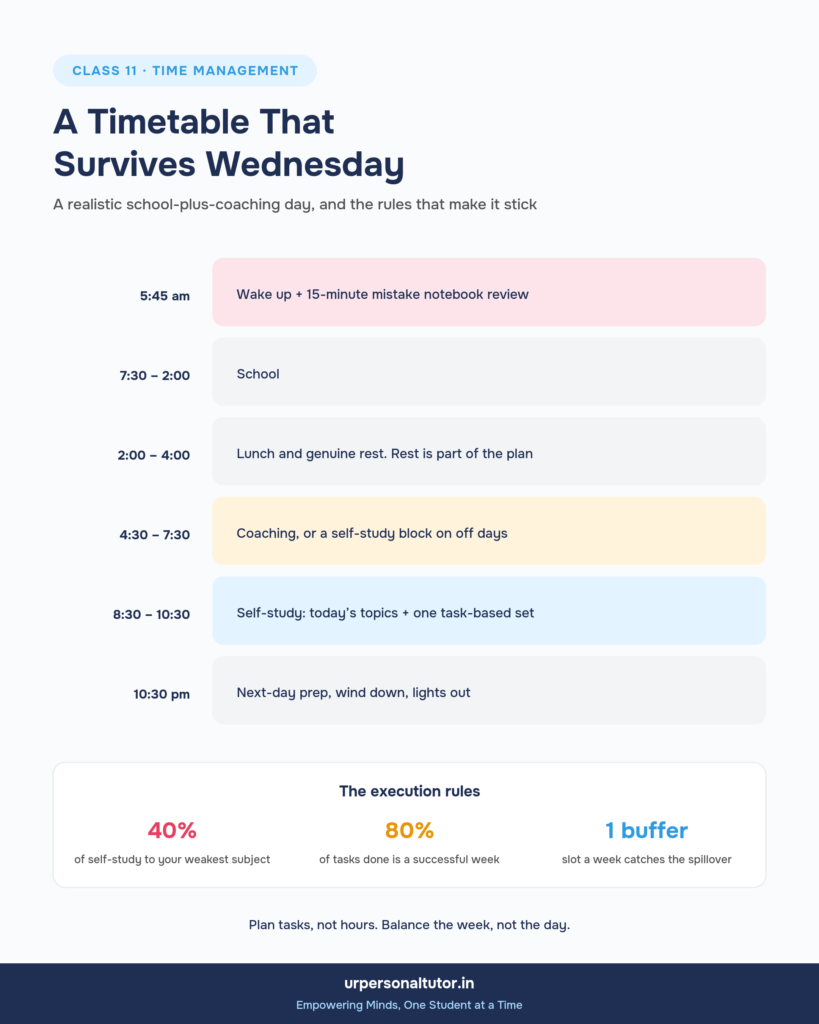
- 5:45 to 7:00 am: Wake up, get ready, quick 15-minute review of yesterday’s mistake notebook
- 7:30 am to 2:00 pm: School
- 2:00 to 4:00 pm: Lunch and genuine rest. Rest is part of the plan, not a betrayal of it
- 4:30 to 7:30 pm: Coaching (on coaching days) or self-study block (on off days)
- 8:00 to 8:30 pm: Dinner
- 8:30 to 10:30 pm: Self-study: today’s coaching topics revised plus one task-based problem set
- 10:30 to 11:00 pm: Next-day school prep and wind down
That gives roughly 2.5 to 3 focused self-study hours on the heaviest days, which is honest and sustainable.
Weekends and holidays:
- Morning block (3 hours): Your weakest subject, freshest mind
- Afternoon block (2 hours): Question solving for the week’s chapters
- Evening block (2 hours): Weekly revision plus one timed mini-test
- Keep one half-day fully free. A weekly recovery slot is what makes the other six days repeatable
The Weekly Balance Formula for PCB or PCM
Across a week, split self-study time roughly like this:
- 40 percent to your weakest subject (for most NEET aspirants, Physics)
- 35 percent split across the other two subjects
- 25 percent to revision and testing
Most students do the opposite: they give the most hours to their favourite subject because it feels productive. Feeling productive and becoming rank-worthy are different things. Ranks are decided by your weakest subject, so your timetable should attack it.
How to Execute the Plan You Made (The Part Everyone Skips)
Planning is a Sunday activity. Execution is a system. Use these five rules:
1. Plan tasks, not hours
Every study slot gets a completable task: a question count, a topic, a test. You end each slot knowing clearly whether you did the thing or not. Clarity is what keeps momentum honest.
2. Follow the 80 percent rule
A week where you complete 80 percent of planned tasks is a successful week. Chasing 100 percent creates the guilt-abandon cycle. Consistency at 80 beats perfection that quits.
3. Keep a buffer slot
Reserve one evening or half-day per week for spillover. Missed tasks go there instead of silently dying. A plan with a buffer bends. A plan without one breaks.
4. Review for 10 minutes every Sunday
Before making next week’s plan, check this week’s: which tasks got skipped and why? Was it the plan’s fault (too ambitious) or execution’s fault (phone)? Fix the actual cause. A plan that never gets reviewed never improves.
5. Make the phone boring during study slots
Most execution failure is one device. Study slots mean phone in another room, or app blockers on. Willpower is not a strategy. Distance is.
Balance Is Built Weekly, Not Daily
One last reframe. Students try to balance all subjects every single day and feel like failures when a day goes entirely to one subject. Balance across a week, not a day. A Monday that is all Physics is fine if the week’s totals respect your formula. Zoom out to the week and the pressure drops while the output rises.
I don’t just teach subjects, I build and monitor each student’s weekly plan, so execution stops depending on teenage willpower. If your child keeps making timetables and breaking them, that is fixable. Reach out.
Frequently Asked Questions
What is the best study timetable for a Class 11 student?
The best timetable gives 2.5 to 3 focused self-study hours on school-plus-coaching days and 6 to 7 hours on holidays, allocates 40 percent of self-study time to your weakest subject, includes a weekly buffer slot for missed tasks, and schedules tasks rather than vague subject hours.
How many hours should a Class 11 JEE or NEET aspirant study?
Around 3 focused self-study hours on weekdays and 6 to 8 on weekends, on top of school and coaching. Total weekly self-study of 25 to 30 focused hours is sufficient for most aspirants. Focus quality matters more than raw hours.
How do I balance school, coaching and self-study in Class 11?
Revise coaching topics the same evening they are taught, use school free periods for homework so evenings stay free for entrance preparation, keep weekends for your weakest subject and weekly tests, and balance subjects across the week rather than within each day.
Why do I make timetables but never follow them?
Usually because the timetable is overambitious, schedules vague hours instead of specific tasks, and has no buffer for real life. Switch to task-based planning, aim for 80 percent completion instead of 100, and add one weekly buffer slot. Execution improves almost immediately.
Which subject should get the most study time in Class 11?
Your weakest subject should get around 40 percent of self-study time, because entrance ranks are limited by your weakest subject, not lifted by your strongest. For most NEET aspirants that means Physics gets prime time daily.