
The Cambridge IGCSE Maths syllabus (0580) covers nine topic areas, is sat at either Core or Extended tier, and is assessed through two written papers with no coursework. Most students meet the real demands of those papers late, usually in the last month. A better move is to start working through maths IGCSE past papers early, once you know which tier you are sitting and how each paper is built. This guide sets out the topics, the exam structure and a practical way to use past papers at every stage.
What the IGCSE Maths Syllabus Covers
The syllabus is split into nine topics. Every one of them appears in the papers, though the weight and depth change with the tier.
- Number
- Algebra and graphs
- Coordinate geometry
- Geometry
- Mensuration
- Trigonometry
- Transformations and vectors
- Probability
- Statistics
Extended students go deeper into algebra and trigonometry and pick up material that Core never reaches, including differentiation. Data collection is taught in class but is not examined, so you will not see a question on it in any paper.
Core vs Extended Tier: Which One Are You Sitting?
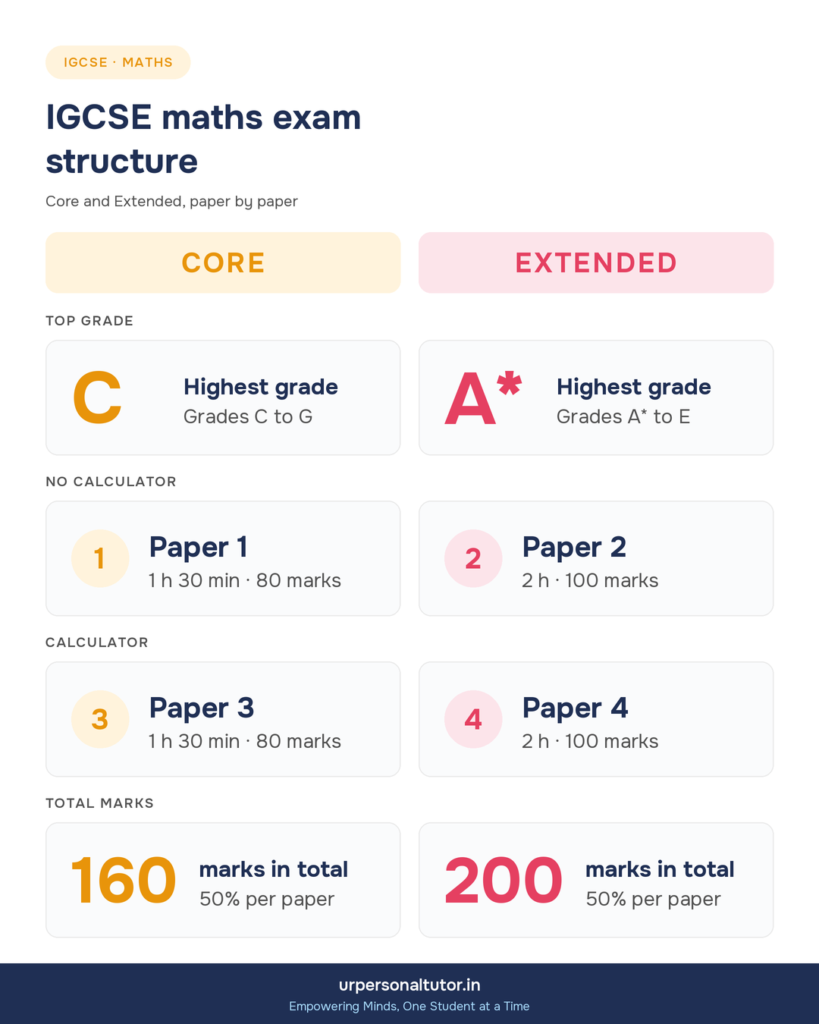
Your tier decides your ceiling. Core candidates can earn grades C to G, which means a C is the highest result available. Extended candidates are graded A* to E, so anyone aiming for a B or above has to sit Extended. Schools make the entry decision, usually after mock results, so raise it with your teacher well before entries close.
A fair rule of thumb: if you are scoring above 60 percent on Core papers in practice, you are probably ready to be stretched. The jump to Extended is real, though. Questions chain several skills together and give far less guidance about what to do first. If you want to see how Cambridge turns raw marks into letters, the IGCSE grading system post walks through thresholds and what they mean in practice.
IGCSE Maths Exam Structure: Papers, Marks and Timing
Each tier has two papers, one without a calculator and one with. Both papers count for 50 percent of the final grade.
| Tier | Paper | Calculator | Duration | Marks |
|---|---|---|---|---|
| Core | Paper 1 | Not allowed | 1 h 30 min | 80 |
| Core | Paper 3 | Allowed | 1 h 30 min | 80 |
| Extended | Paper 2 | Not allowed | 2 h | 100 |
| Extended | Paper 4 | Allowed | 2 h | 100 |
One detail catches students out. Cambridge rebalanced the papers for the 2025 series, so older papers have different lengths and mark totals. A paper from 2022 is still excellent for practice, but do not time yourself against its old duration. Use the current format above and treat older papers as question banks.
Maths IGCSE Past Papers: How Core and Extended Differ
Pacing is the first difference you will notice. A Core paper gives you 90 minutes for 80 marks, roughly 1.1 minutes per mark. Extended gives 120 minutes for 100 marks, closer to 1.2 minutes per mark. Those numbers look similar, but Extended marks are harder to earn.
igcse core maths past papers lean on short, direct questions that test whether the fundamentals are secure: fractions, percentages, basic algebra, area and simple probability. Slips on these cost marks that you cannot win back later in the paper. Working through Core papers repeatedly is how those fundamentals become automatic.
With igcse mathematics extended past papers, the questions are longer and the early parts often feed into the later ones. A wrong answer in part (a) can quietly damage parts (b) to (d). That is why Extended students should read mark schemes carefully and note where method marks were available even when the final answer was wrong.
How to Use Maths IGCSE Past Papers by Topic
Do not begin with full papers. Begin with igcse math past papers by topic, picking one syllabus area at a time and doing every question on it from the last five or six years. A student who attempts 25 algebra questions in a week will see the same patterns repeat: simultaneous equations, rearranging formulae, factorising quadratics. By the end of the week those patterns feel familiar instead of frightening.
A workable split is topic-by-topic practice for the first eight weeks, then timed full papers in the final four. If you want a ready-made calendar for this, the 12-week revision plan fits neatly around it.
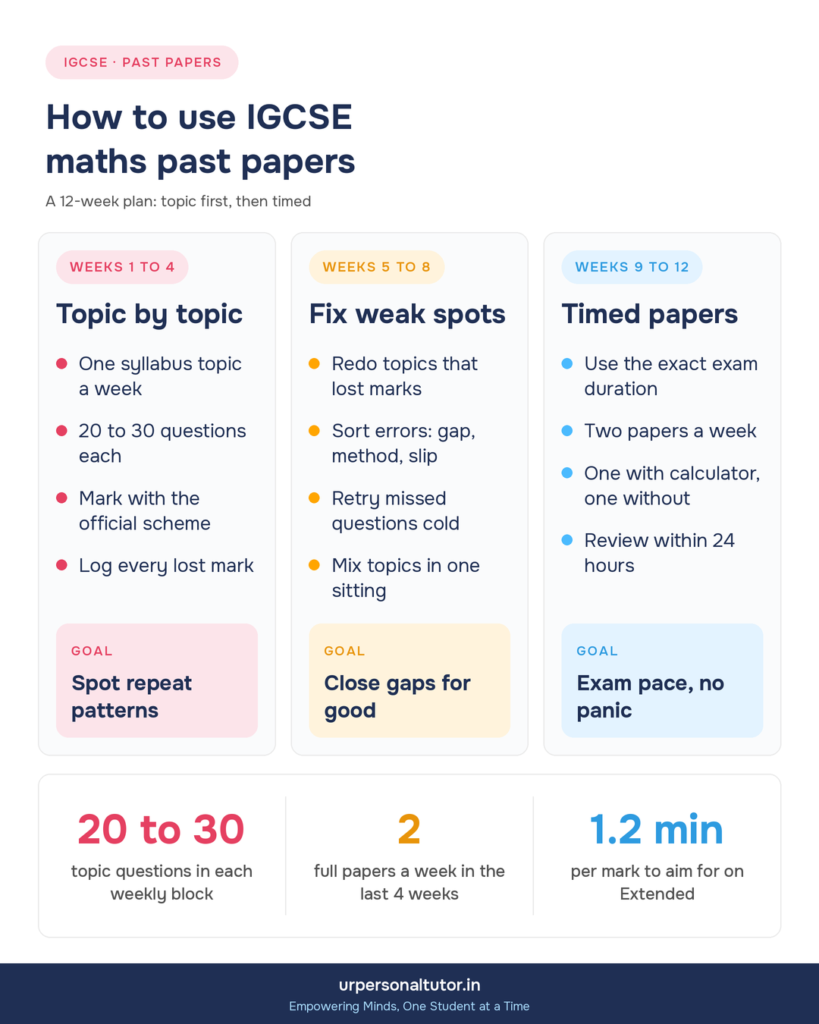
After each paper, mark it yourself using the official mark scheme. Then sort every lost mark into one of three bins: knowledge gap, method error or careless slip. Knowledge gaps need re-learning. Method errors need worked examples. Careless slips need slower final checks. Mixing these up is the most common reason students plateau.
IGCSE Add Maths Past Papers and the Extra Syllabus
Additional Mathematics (0606) is a separate qualification, not a harder tier of 0580. It has two 2-hour papers of 80 marks each, one without a calculator and one with, and it covers functions, logarithms, indices and surds, circular measure, differentiation and integration. Students who plan to take A Level Maths often sit it alongside Extended Maths.
igcse add maths past papers are best saved for after you have settled into your 0580 routine. The algebra demands are a clear step up, and attempting them too early tends to shake confidence rather than build it. Start with the quadratics and functions questions, then widen out once those feel comfortable.
Common Mistakes Students Make With Maths IGCSE Past Papers
The first mistake is doing papers without a timer. Untimed practice feels productive but hides the real problem, which is speed on the non-calculator paper. Set the clock to the exact duration, every time.
Another is working a paper, glancing at the answers and moving on. If you did not write down why you lost each mark, you have only taken a test, not studied from one. A third is leaning on the same two or three papers because they feel easy. Rotate through different years and tiers so that unfamiliar question styles do not surprise you in the exam hall.
Finally, many students ignore the non-calculator papers until late. Paper 1 and Paper 2 reward mental arithmetic and clean written method, and both skills need weeks of steady work rather than a weekend of panic.
Get Personal Help With Maths IGCSE Past Papers
Plenty of students understand a topic in class and still freeze when a past paper puts three skills in one question. That gap is easier to close with someone watching how you work. At UrPersonalTutor, our IGCSE tuition is one-to-one, and we build practice around the maths IGCSE past papers that match your tier and your weak topics. Book a consultation and we will map out a plan around the exam date you actually have.
FAQs
Where can I download official maths IGCSE past papers?
Cambridge International publishes past papers, mark schemes and examiner reports, and your school exam officer can usually give you access to the full set. Third-party sites host copies too, but always check that the paper code is 0580 and that the mark scheme matches the series.
How many past papers should I attempt each week?
In the topic phase, aim for one topic block of 20 to 30 questions per week. In the final four weeks, two full papers per week is realistic, one calculator and one non-calculator, with a day set aside to review each.
Should I take Additional Maths if I am sitting Extended?
Only if you plan to study A Level Maths or a maths-heavy degree, and only if your Extended results are comfortably strong. Add Maths is an extra subject with its own workload, so it should not come at the cost of your core grades.
Can I move from Core to Extended late in the course?
Tier entry is decided by your school, and entries close ahead of each series. Speak to your teacher as early as possible, because moving up needs enough time to cover the Extended-only topics properly.
Is it worth redoing a past paper I have already marked?
Yes, but wait two to three weeks and attempt it cold. If you still lose marks on the same questions, that topic needs fresh teaching, not another attempt.