
IBDP Physics Notes Should Follow the Five Themes, A to E
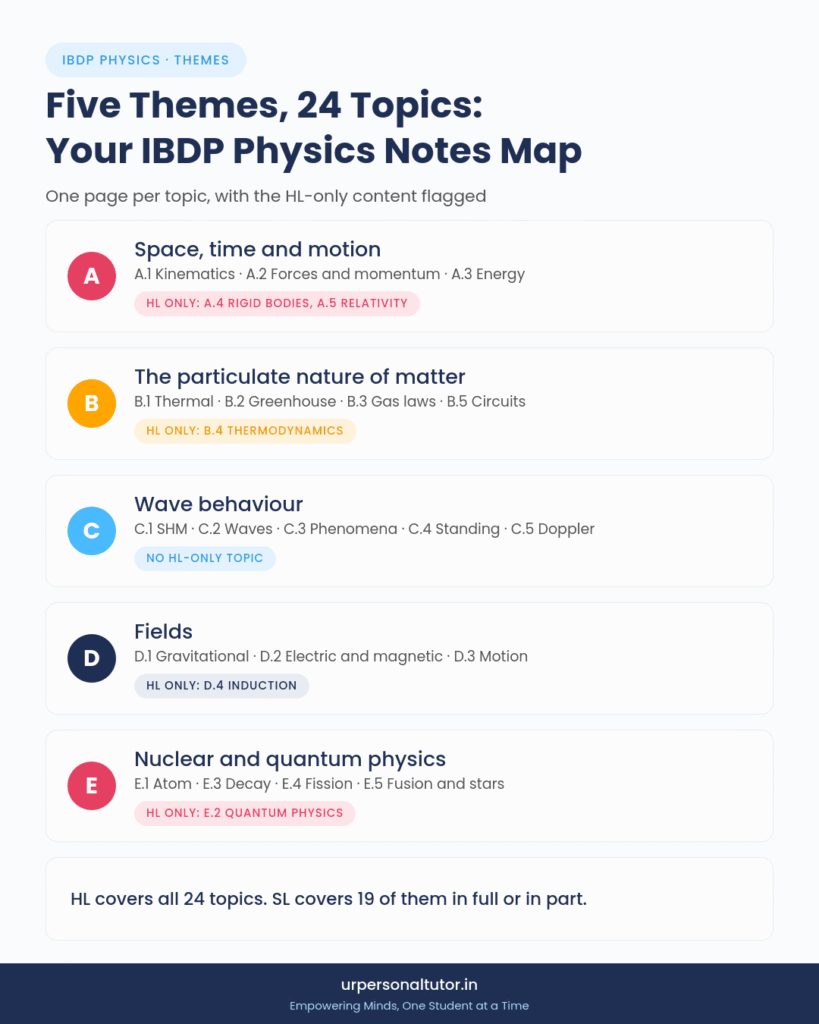
Good IBDP physics notes follow the structure of the current syllabus: five themes labelled A to E, split into 24 numbered topics from A.1 to E.5. Every question in Paper 1 and Paper 2 traces back to one of those topics, so notes organised any other way make revision slower than it needs to be.
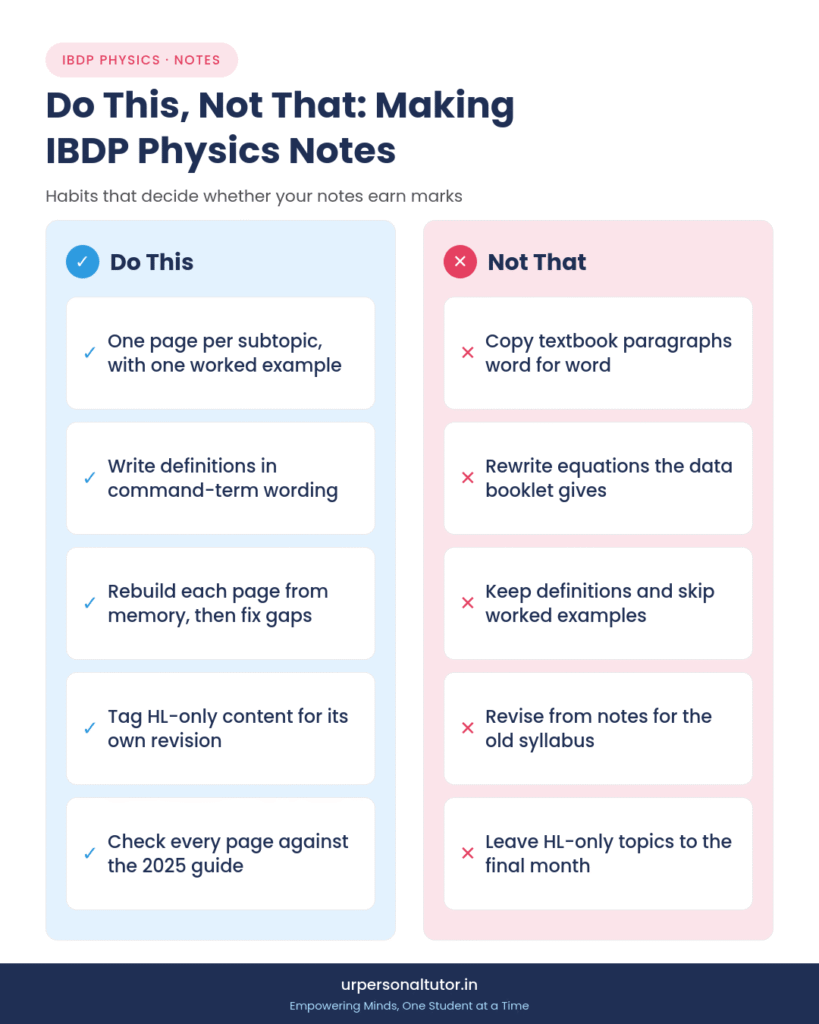
The course was first assessed in May 2025 and dropped the old options paper. That matters if you are borrowing physics ibdp notes from an older student, because the topic numbers and some of the content no longer match. Check every borrowed page against the current guide before you trust it.
The sections below go through each theme, flag what is HL only, and then cover how to format and use the notes so they raise marks instead of just filling a folder.
Theme-Wise IBDP Physics Notes: What Goes in Each Theme
Theme A: Space, Time and Motion
Theme A opens the course. A.1 covers kinematics and A.2 forces and momentum, which is where circular motion lives. A.3 then moves on to work, energy and power. HL students add A.4 rigid body mechanics, with torque and moment of inertia, plus A.5 on Galilean and special relativity.
Notes for this theme should hold more worked problems than prose. A definition of momentum earns very little unless you can apply it to a collision and keep the signs straight.
Theme B: The Particulate Nature of Matter
This theme pairs thermal physics with electricity. B.1 handles thermal energy transfers, B.2 the greenhouse effect, B.3 gas laws and B.5 current and circuits. B.4 thermodynamics is HL only.
The greenhouse effect page should state the energy balance in words, since examiners ask you to explain it rather than calculate it. Circuit notes need a clear section on internal resistance, where marks slip away quietly.
Theme C: Wave Behaviour
Theme C runs from simple harmonic motion in C.1 and the wave model in C.2 to wave phenomena in C.3. C.4 covers standing waves and resonance, and C.5 the Doppler effect.
Draw the graphs. Displacement, velocity and acceleration against time for SHM come up often, and a labelled sketch in your notes does more than a paragraph describing the same curves.
Theme D: Fields
D.1 covers gravitational fields, D.2 electric and magnetic fields and D.3 motion in electromagnetic fields. D.4 induction is HL only.
Fields notes work best as a side-by-side table. Newton’s law of gravitation and Coulomb’s law share the same inverse square shape, so putting them in adjacent columns shows what carries over and what does not, such as gravity only ever attracting.
Theme E: Nuclear and Quantum Physics
E.1 looks at the structure of the atom and E.3 at radioactive decay, with E.4 on fission and E.5 on fusion and stars. E.2 quantum physics is HL only.
Keep a short list of what is conserved in each nuclear reaction. A large share of lost marks here comes from nuclear equations where the mass numbers or charges do not balance.
IBDP Physics HL Notes vs SL Notes: What Actually Changes
HL notes need five extra topics and extra depth inside shared ones, while SL notes cover the same five themes with less. The five HL-only topics are A.4, A.5, B.4, D.4 and E.2. Teaching time reflects the gap, at 110 hours for SL and 180 for HL, though both levels carry 80% external assessment and 20% internal assessment.
The trap is assuming those five topics are the whole difference. Several shared topics carry additional HL content, so it pays to read the HL syllabus line by line before deciding what your ibdp physics hl notes still lack.
A simple habit helps both groups. Mark every HL-only derivation or subtopic with a corner tag, so an SL student can skip it without losing the thread and an HL student can see at a glance what needs separate revision.
Circular Motion IBDP Physics Notes, With a Worked Example
An object moving at constant speed v on a circle of radius r accelerates towards the centre at a = v²/r. The net inward force is called the centripetal force, and it is not a new force. It is the resultant of forces you already know, such as friction, tension or gravity.
The equations to keep on the page are F = mv²/r and F = mω²r, with ω = 2π/T linking angular speed to the period. Check which of these your data booklet already supplies, so your notes spend space on understanding rather than copying.
Here is the kind of example worth writing out. A 1,200 kg car takes a bend of radius 50 m at 15 m/s. The inward force needed is 1,200 × 15² ÷ 50 = 5,400 N, and on a flat road that has to come entirely from friction. If the tyres cannot supply it, the car stops following the curve.
Plenty of students search for a circular motion ibdp physics notes pdf, but a downloaded file only helps if you have worked through every line yourself. A better route is to build this one page in your own words, add the free-body diagram, then save or print it as your own PDF. The same page connects forward to D.1, where gravity plays the role of centripetal force for satellites.
How to Format IBDP Physics Notes So You Can Revise From Them
Aim for one page per subtopic. Each page needs the definition in the wording a mark scheme would reward, the key equations with every symbol explained, one clear diagram, a worked example carried through with units, and a line on the mistake students most often make there.
Write definitions around command terms. “State” wants a short fact, “explain” wants a reason, and “determine” wants a calculated value with working. Seeing the same term attached to the same type of answer, page after page, trains the habit faster than rereading.
Once a page is written, cover it and rebuild it from memory. The gaps you find are the only parts worth rewriting.
Using IBDP Physics Notes Before Paper 1 and Paper 2
Paper 1 mixes multiple-choice items with data-based questions, so your notes should include the quantities and units you are likely to meet in a graph or table. Paper 2 rewards structured written answers with full working, so the worked examples carry more weight there than the definitions do.
Notes alone rarely separate a 5 from a 7. The gap is usually precise wording and unit discipline, which are the same habits behind scoring a 7 in the written papers.
In the final eight weeks, give each theme roughly one week, then spend the remaining time on timed past papers. Go back to the notes only to patch what the papers expose.
Mistakes That Make IBDP Physics Notes Less Useful
Copying textbook paragraphs is the most common one. It feels productive and leaves almost nothing in memory, because nothing in the process forced you to decide what mattered.
Notes with no worked examples are nearly as bad. Physics is applied, and a page of definitions will not help when Paper 2 asks you to use them on a situation you have not seen.
Rewriting equations the data booklet already gives wastes pages. So does ignoring the HL-only topics if you sit the higher level, a gap that tends to surface only in the final month.
A Two-Year Plan for Building Your Notes
Write each page within a week of the topic being taught, while the lesson is still fresh. By the end of the first year you should have a draft page for most topics, 19 of them required in full or in part at SL and all 24 at HL.
In the second year, compress rather than expand. Trim each draft to something you can scan in two minutes, and keep the longer versions only for topics that still feel shaky. If a topic like induction or quantum physics still will not click after two passes, an IB physics tutor can find the exact step where your reasoning breaks far faster than a third rewrite of the notes.
Frequently Asked Questions
Can I still use notes written for the pre-2025 IB physics syllabus?
Only in part. Core ideas like Newton’s laws and wave behaviour carry over, but topic numbering changed and the options material is gone, so match each page to the current guide before relying on it.
Is it better to make my own IBDP physics notes or use ready-made ones?
Make your own for anything you find hard, since the writing is part of the learning. Ready-made notes are useful as a checklist to compare against, not as a replacement for working through the page yourself.
Can I take notes into the IB physics exam?
No. You are given the data booklet and can use an approved calculator, so your notes have to live in your memory by exam day.
Do I need separate notes for the internal assessment?
Yes, though they look different. The internal assessment is 20% of the grade and rewards a well-kept lab record, so keep dated entries on method, raw data and uncertainties as you go instead of reconstructing them later.
Are handwritten or digital notes better?
Handwriting suits diagrams, graphs and derivations, where you need to move freely around the page. Digital notes win for searching and reordering, so many students use both.