
The IB Physics HL syllabus is organised into five themes, assessed through two exam papers and one internal assessment, with no separate options paper. That’s the short version. If you started researching this course using notes from an older sibling or a random PDF online, some of what you read is probably out of date, because the syllabus was rebuilt for first examination in May 2025.
New IB Physics HL students often walk in expecting the old core-plus-options format. That structure is gone. What replaced it is, in some ways, simpler to plan around, but it demands more from you within each topic. This breakdown covers what’s actually in the IB Physics HL syllabus today, how it’s assessed, and where the weight sits, useful groundwork whether you’re just getting oriented or already thinking ahead to scoring a 7 in IB Physics following breakdown may help.
What the IB Physics HL Syllabus Actually Covers
The IB Physics HL syllabus groups all content into five themes, labelled A through E. Every student, SL or HL, studies the same five themes. The difference is depth: HL adds extra material inside several of them and includes five topics that only Higher Level students sit.
The five themes are:
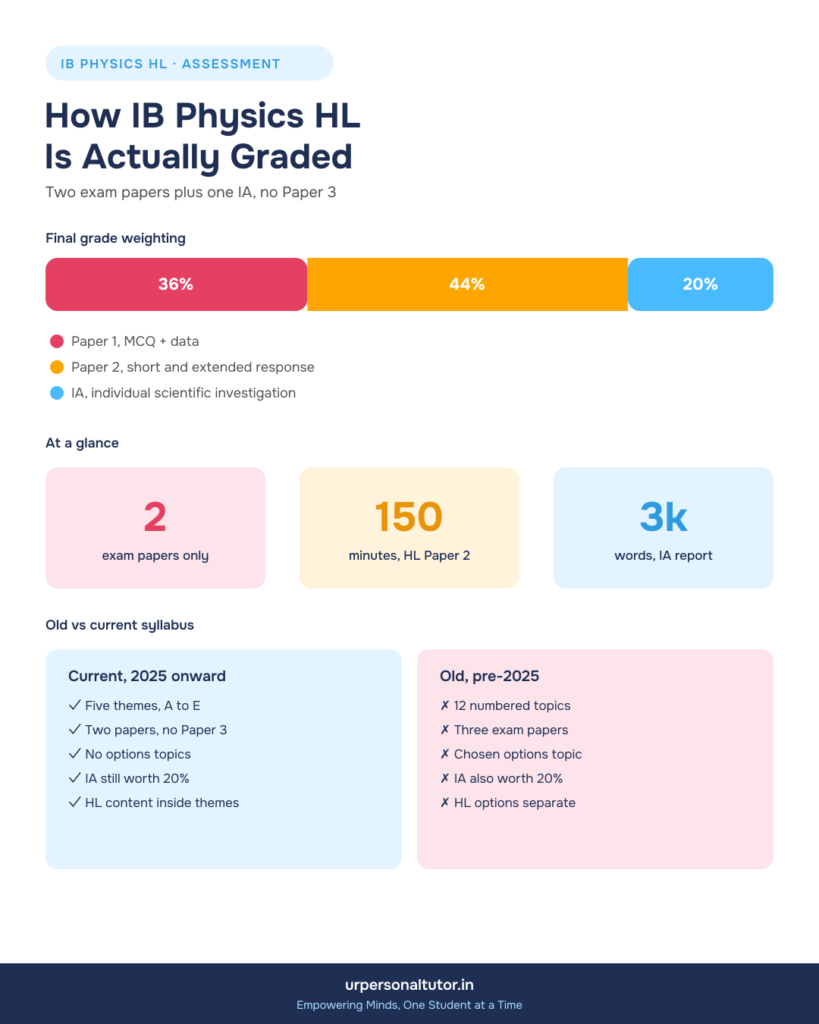
Theme A — Space, Time and Motion. Kinematics, forces, momentum, and energy sit here, along with two HL-only additions: rigid body mechanics and special relativity.
Theme B — The Particulate Nature of Matter. This covers thermal physics, gases, and at HL, a full treatment of thermodynamics that SL students don’t sit.
Theme C — Wave Behaviour. Wave properties, interference, and standing waves, building toward more advanced optics content at HL.
Theme D — Fields. Gravitational, electric and magnetic fields, with electromagnetic induction reserved for HL.
Theme E — Nuclear and Quantum Physics. Radioactivity and atomic structure for everyone, plus a dedicated quantum physics topic that only HL students study.
Across those five themes sit 24 topics in total, and five of them are HL-exclusive. That’s a meaningful chunk of extra content layered onto the shared core, which is part of why HL carries roughly 240 recommended teaching hours against 150 for SL.
Core Content vs the Five HL-Only Topics
Because HL students share four-fifths of their syllabus with SL, it helps to know exactly which pieces belong to you alone. The five HL-only topics are rigid body mechanics, special relativity, thermodynamics, electromagnetic induction, and quantum physics. Each one builds directly on an SL topic in the same theme rather than sitting off to the side, so weak SL foundations tend to resurface as HL struggles later in the course.
Quantum physics in particular tends to catch students off guard. It leans heavily on abstract reasoning rather than the equation-plugging that works for mechanics, and teachers report it as one of the topics where HL students lose the most avoidable marks.
How the IB Physics HL Syllabus Is Assessed
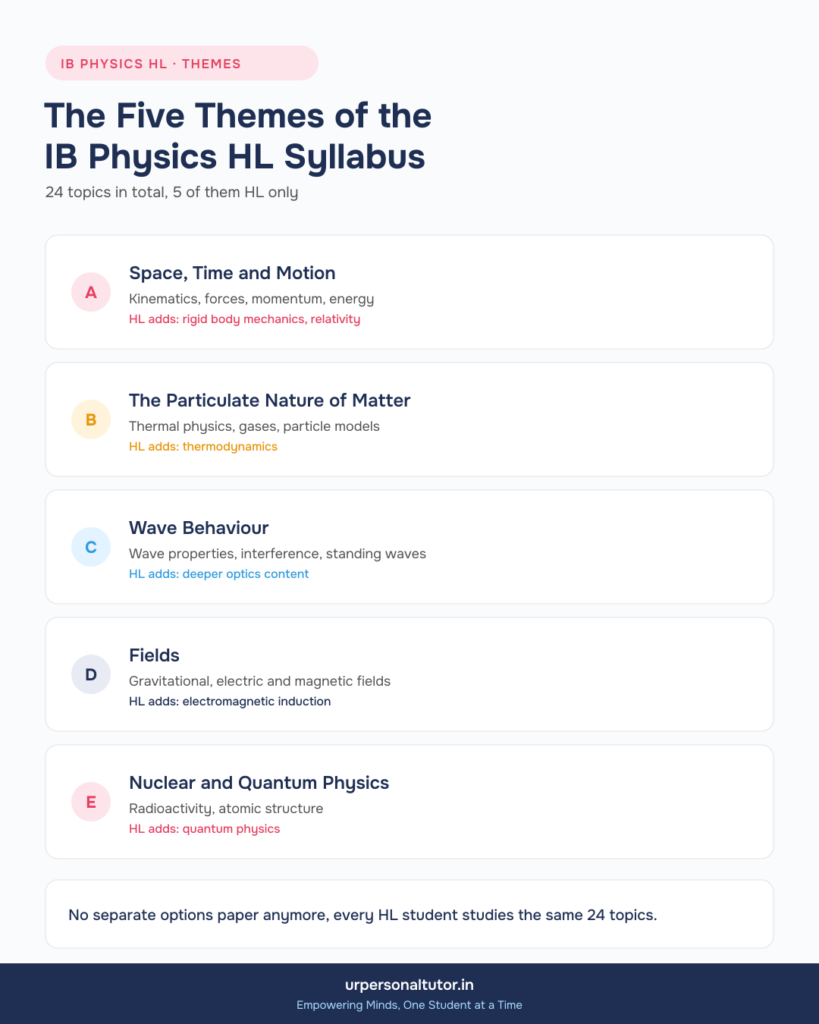
There are only two exam papers now, not three. Paper 1 combines multiple-choice questions with a data-based section and no calculator is allowed. Paper 2 is short-answer and extended-response, and it runs for 150 minutes at HL against 90 minutes at SL, reflecting the extra content and the deeper reasoning expected in every answer.
The scientific investigation, still commonly called the IA, is worth 20% of your final grade and is built from roughly ten hours of practical class time. It’s an individually designed experiment written up in a report of around 3,000 words, marked by your teacher and moderated externally.
Weighting across the three components looks like this: Paper 1 sits at 36%, Paper 2 at 44%, and the IA holds the remaining 20%. Paper 2 carrying the largest share is worth noting, because it rewards sustained, connected reasoning across a topic rather than quick recall, which changes how you should be revising.
What Happened to the Old Options Topics
If you’ve come across mentions of astrophysics, engineering physics, imaging, or relativity as separate “options” in IB Physics HL, that structure no longer exists. Those topics were folded into the core syllabus or dropped entirely when the course was rebuilt. Relativity, for instance, now sits inside Theme A as an HL-only topic rather than as a standalone option a student could choose or avoid. Every HL student studies the same content now, with no elective specialisation, which removes one decision from your planning but means there’s nowhere to hide from a topic you dislike.
Why IB Physics HL Past Papers Need a Careful Read
Searching for IB Physics HL past papers is one of the most common things new students do, and it’s a good instinct, but the syllabus change means older papers need to be read with some caution. Anything from before the May 2025 session was written against the old 12-topic, three-paper structure, and while the underlying physics hasn’t changed, the way questions are framed and grouped has. A past paper on “options” content, for example, won’t map onto anything you’ll actually sit.
The safest approach is to prioritise the official specimen papers released alongside the new syllabus, then use the first genuine May 2025 papers once your school has access to them. Older papers still have value for practising raw problem-solving on shared topics like mechanics or electricity, just don’t rely on them to judge question style or timing for your real exam.
Building a Study Plan Around the New Structure
A syllabus this different from what came before rewards a study plan built from scratch rather than one borrowed from an older student. Two things are worth locking in early: a topic-by-topic schedule that respects how much heavier Theme A and Theme E tend to be in teaching hours, and regular short blocks of past-paper practice rather than long cramming sessions close to the exam. Much of the pacing logic behind a solid revision plan for A-Level physics carries over here even across a different board, and the discipline of consistent, timed Paper 2 practice usually does more for a final grade than extra content revision once the syllabus itself is covered.
Common Mistakes New IB Physics HL Students Make
The most frequent mistake isn’t skipping content, it’s misjudging where the marks actually sit. Students pour hours into memorising formulas that the IB Physics data booklet already provides during every exam, while under-practising the data-analysis questions that now make up a meaningful chunk of Paper 1.
Another recurring issue is starting IA planning too late. Because the investigation is worth a fifth of the final grade and needs a genuine experimental design rather than a repeated textbook demonstration, students who leave it until study leave tend to submit weaker reports than those who start scoping ideas in the first term.
A third pattern shows up around the HL-only topics specifically: students treat them as separate units to tackle at the end, when in practice they’re extensions of core SL material and study better when paired with the SL topic they build on, not isolated as an afterthought.
Getting the Timing Right From Day One
Because the IB Physics HL syllabus front-loads so much shared content before the HL-only material appears, a lot of the early terms feel deceptively similar to what SL students are doing. That gap widens fast once thermodynamics, induction, and quantum physics enter the picture, and students who haven’t built a proper exam time management routine tend to feel that jump hardest, mostly because they’re still treating first-term physics like a subject they can catch up on later rather than one that compounds.
FAQs
How many topics are in the IB Physics HL syllabus?
There are 24 topics spread across five themes, with five of those topics reserved for HL students only.
Is IB Physics HL harder than the old syllabus?
It covers similar ground overall, but with two exam papers instead of three and more marks concentrated in extended-response questions, the exam itself demands more sustained reasoning per question than the previous format did.
Do IB Physics HL students still choose an options topic?
No. The options structure was removed entirely, and the content that used to sit in options like relativity has been absorbed into the compulsory HL syllabus instead.
How much does the IA affect an IB Physics HL final grade?
The scientific investigation is worth 20% of the total grade, the same weighting it held under the previous syllabus.
Where should a new IB Physics HL student start revising first?
Starting with Theme A is usually sensible, since it carries some of the highest teaching hours and its concepts, especially forces and motion, recur throughout later themes rather than staying self-contained.