
If there is one chapter that makes JEE and NEET aspirants nervous, it is rotational motion. Students who sailed through kinematics and laws of motion suddenly hit moment of inertia, torque and rolling, and the confidence drains away. Many decide to “leave it for later.” Later never comes, and it becomes the hole in their Physics preparation.
Here is the secret that changes everything: rotational motion is not a new kind of physics. It is linear motion wearing a different costume. Once you see the costume, the chapter becomes one of the most logical in the syllabus.
The Big Idea: Every Linear Quantity Has a Rotational Twin
Everything you learned about linear motion has a direct rotational equivalent:
- Displacement becomes angular displacement (θ)
- Velocity becomes angular velocity (ω)
- Acceleration becomes angular acceleration (α)
- Mass becomes moment of inertia (I)
- Force becomes torque (τ)
- Momentum becomes angular momentum (L)
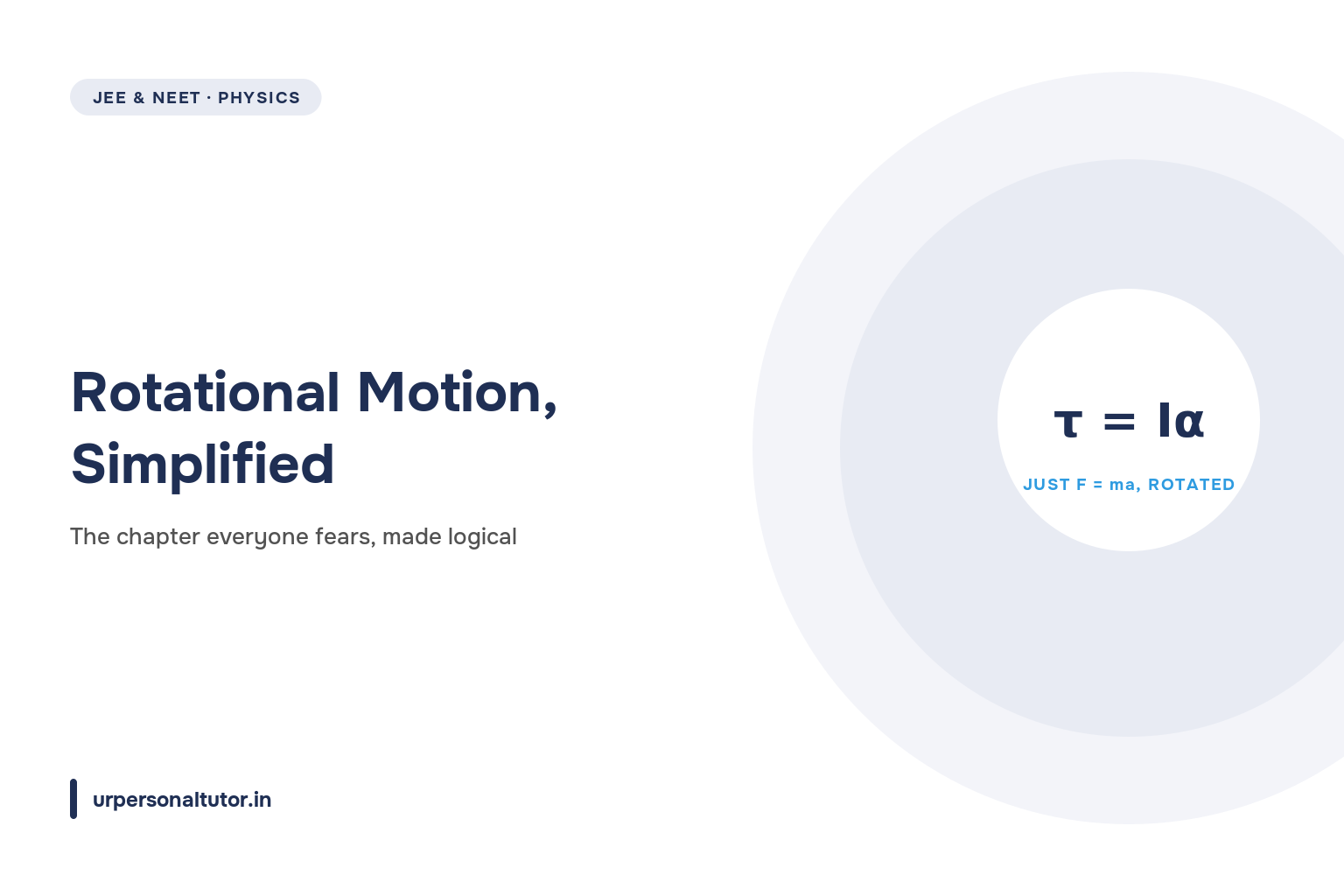
- F = ma becomes τ = Iα
- ½mv² becomes ½Iω²
Even the equations of motion carry over. v = u + at becomes ω = ω₀ + αt. Learn the table once and half the chapter is already familiar.

Moment of Inertia: Mass, But Location Matters
Moment of inertia tells you how hard it is to rotate an object. Unlike mass, it depends on where the mass sits relative to the axis. Mass far from the axis makes rotation harder.
You must know the standard results: ring, disc, solid sphere, hollow sphere, rod about centre and end. Then master two tools:
- Parallel axis theorem: I = I_cm + Md², to shift the axis away from the centre of mass
- Perpendicular axis theorem: I_z = I_x + I_y, for flat (planar) objects only
Most moment of inertia questions are combinations of standard results plus one theorem.
Torque: The Rotational Force
Torque is force times perpendicular distance from the axis, τ = r × F. Students lose marks by using the full distance instead of the perpendicular distance. Draw the force, draw the line from the axis, and find the perpendicular component every time.
For equilibrium questions, net force is zero and net torque about any point is zero. Choosing a clever point to take torques about, often where an unknown force acts, removes that unknown from your equation.
Angular Momentum: The Conservation Law Examiners Love
When no external torque acts, angular momentum is conserved: I₁ω₁ = I₂ω₂. This produces classic questions: a skater pulling in their arms, a person walking on a rotating platform, a mass sliding along a rotating rod. If moment of inertia decreases, angular speed increases.
Watch for energy traps. Angular momentum may be conserved while kinetic energy changes, because internal work is done.
Rolling Motion: Where the Chapter Peaks
Rolling without slipping links linear and rotational motion with one condition: v = Rω. The total kinetic energy is ½mv² + ½Iω².
On an incline, objects with smaller moment of inertia per unit mass reach the bottom faster. Solid sphere beats disc, which beats ring. That one comparison answers a surprising number of conceptual questions.

How to Practise Rotational Motion
Do not jump into mixed problems first. Build in layers:
- Moment of inertia calculations with both axis theorems
- Torque and rotational equilibrium
- τ = Iα problems, including pulleys with mass
- Angular momentum conservation
- Rolling motion and energy on inclines
Solve 40 to 60 questions per layer before combining them. Draw a diagram for every single question, marking the axis, forces and directions of rotation.
How Much Does It Matter?
Rotational motion typically contributes a small number of questions in JEE Main and NEET each year, often one to three. But its ideas also appear inside mechanics problems in other chapters, so mastering it strengthens your whole mechanics score.
Frequently Asked Questions
Is rotational motion important for NEET?
Yes. It usually contributes one to three questions and underpins other mechanics topics. Focus on moment of inertia, torque, angular momentum conservation and rolling.
Why is rotational motion so difficult?
Students meet several new quantities at once. Using the analogy with linear motion makes it much easier, because each rotational quantity mirrors a linear one.
What is the parallel axis theorem?
I = I_cm + Md², where I_cm is the moment of inertia about an axis through the centre of mass and d is the distance to a parallel axis.
Which rolls down an incline fastest?
Among objects rolling without slipping, the one with the smallest moment of inertia relative to mR² is fastest. A solid sphere reaches the bottom before a disc, which reaches it before a ring.
How many questions should I practise on rotational motion?
Aim for 250 to 300 questions across the chapter, built in layers from moment of inertia through to rolling motion, before attempting mixed mechanics problems.
Rotational motion is easier with someone who can show you the analogy step by step. Ur Personal Tutor offers one-to-one Physics coaching for JEE and NEET aspirants.