
Ask an A Level Chemistry student which paper worries them most and they will usually name Paper 4 or the organic chemistry questions. Ask an examiner where students lose marks they could easily have kept, and the answer is often Paper 3 and Paper 5. These practical skills papers do not reward cramming. They reward habits, and habits take practice.
For Cambridge International A Level Chemistry (9701), the two practical papers test different things. Here is how each one works and how to prepare for both.
Paper 3: Advanced Practical Skills
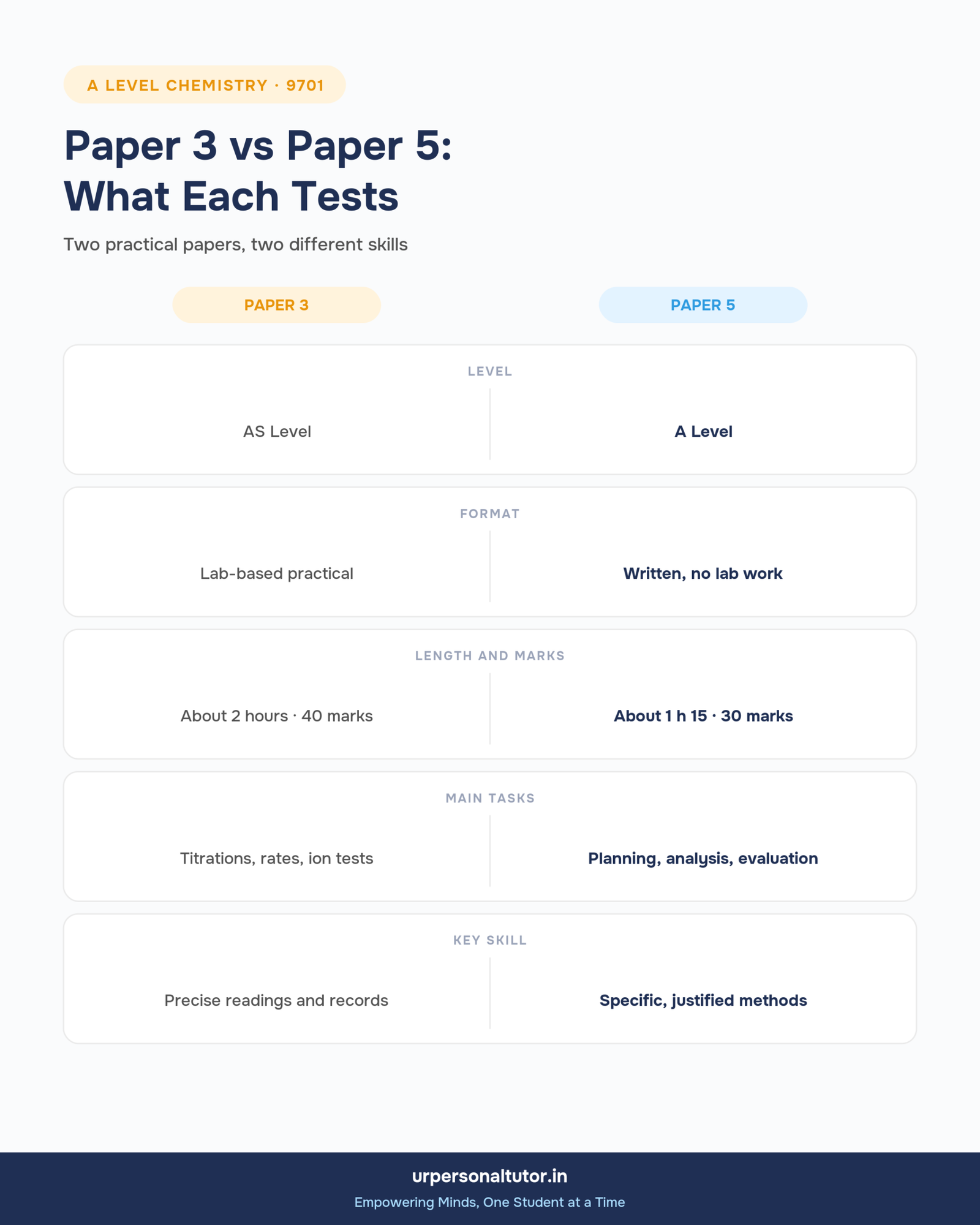
Paper 3 is an AS Level practical exam, usually around two hours long and worth 40 marks. You carry out experiments in a lab under exam conditions. Typical tasks include:
- Titrations: Accurate burette readings, concordant results, and calculations
- Rates or energetics experiments: Measuring temperature change or reaction time
- Qualitative analysis: Identifying ions using tests and recording observations
Marks come from three areas: how you collect data, how you present and process it, and how you evaluate the procedure.
How to Score in Paper 3
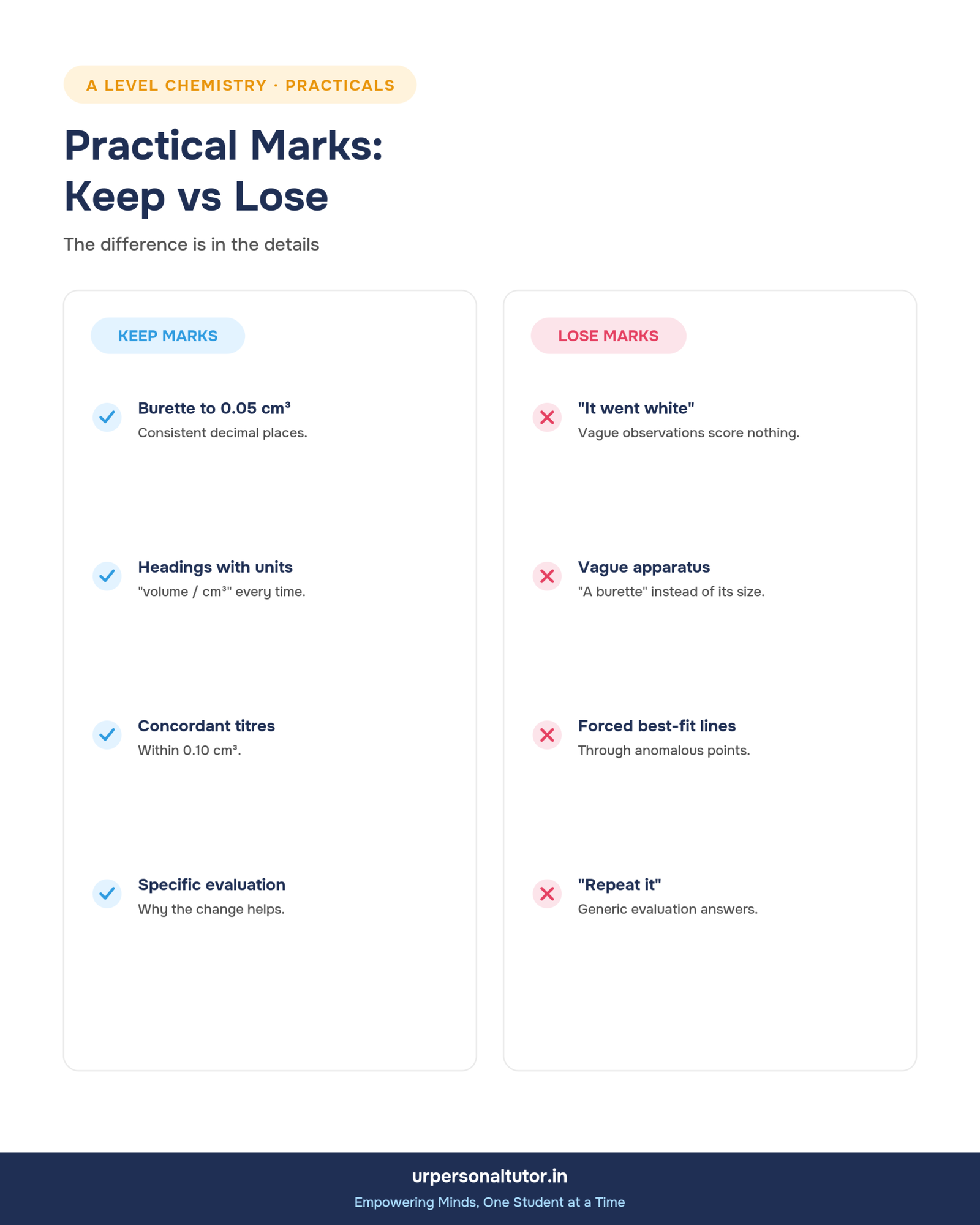
Record every reading to the correct precision. Burette readings to the nearest 0.05 cm³. Thermometer readings to the precision of the instrument. Inconsistent decimal places cost marks.
Use proper table headings with units. Write “volume / cm³” style headings, not just “volume.” This is a small habit with a reliable payoff.
Aim for concordant titres. Two titres within 0.10 cm³ of each other show the examiner your technique is sound. Take extra runs if needed and time allows.
Write full observations. In qualitative analysis, “white precipitate, soluble in excess” scores; “it went white” does not. Learn the standard observations for each test.
Paper 5: Planning, Analysis and Evaluation
Paper 5 is an A Level written paper, around 1 hour 15 minutes and worth 30 marks. There is no practical work. Instead, you plan an experiment, analyse given data and evaluate results.
Planning
You might be asked to design an experiment to measure a rate, determine a concentration or investigate an equilibrium. Strong plans include:
- The independent, dependent and controlled variables
- Specific apparatus with sizes and precision (“50.0 cm³ burette,” not “a burette”)
- Step-by-step method with quantities
- How results will be processed
- A relevant safety precaution linked to a specific hazard
Analysis
You process data provided in a table: calculating values, plotting a graph, drawing a line of best fit, finding a gradient and using it in further calculations. Precision and units matter at every step.
Evaluation
You identify anomalous results, assess the reliability of data, and suggest improvements. Generic answers such as “repeat the experiment” earn little. Specific answers that explain why a particular change would improve accuracy earn the marks.
Common Mistakes Across Both Papers
- Inconsistent decimal places in data tables
- Missing units in table headings and final answers
- Vague apparatus in planning (“measuring cylinder” when a pipette is needed for accuracy)
- Lines of best fit forced through anomalous points
- Generic evaluation answers that could apply to any experiment
How to Prepare
For Paper 3, nothing replaces lab time. Practise titrations until reading the burette is automatic, and memorise qualitative test observations using flashcards. For Paper 5, work through past papers with mark schemes. You will see the same planning and evaluation expectations repeated, often in nearly identical wording.
Frequently Asked Questions
What is Paper 3 in A Level Chemistry?
For Cambridge 9701, Paper 3 is the AS Level Advanced Practical Skills paper. It is a lab-based exam of about two hours, worth 40 marks, covering experiments such as titrations, rates and qualitative analysis.
What is Paper 5 in A Level Chemistry?
Paper 5 is the A Level Planning, Analysis and Evaluation paper. It is a written exam of about 1 hour 15 minutes, worth 30 marks, with no practical work.
How do I improve my titration results?
Read burettes to 0.05 cm³, rinse equipment with the correct solutions, add titrant drop by drop near the end point, and aim for two concordant titres within 0.10 cm³.
How do I prepare for A Level Chemistry Paper 5?
Practise past papers using the mark scheme to learn what planning answers must include: variables, specific apparatus, quantities, method, processing and safety. Practise graph analysis and specific evaluation.
Do I need to memorise qualitative analysis tests?
Yes. Learn the tests and exact observations for common cations, anions and gases, because precise wording is required to score marks.
Practical papers reward habits that a good tutor can build quickly. Ur Personal Tutor offers A Level Chemistry support for Papers 3 and 5. Book a session today.