
Students often tell me IGCSE Biology is “just memorising.” Then they sit a past paper and lose marks on questions where they knew the biology perfectly well. The problem is rarely knowledge. It is the way IGCSE Biology asks questions, and the specific shape of answer each question type expects.
The good news: Cambridge IGCSE Biology (0610) repeats its question patterns with remarkable consistency. Once you learn to recognise them, past papers stop feeling like new challenges and start feeling like familiar formats with different examples.
The Papers You Will Sit
IGCSE Biology has three components. You sit a multiple choice paper (Paper 1 for Core or Paper 2 for Extended), a theory paper (Paper 3 for Core or Paper 4 for Extended), and a practical component, either Paper 5 (Practical Test) or Paper 6 (Alternative to Practical). The patterns below appear across all of them, especially in the theory and practical papers.
Pattern 1: “Describe the Graph”
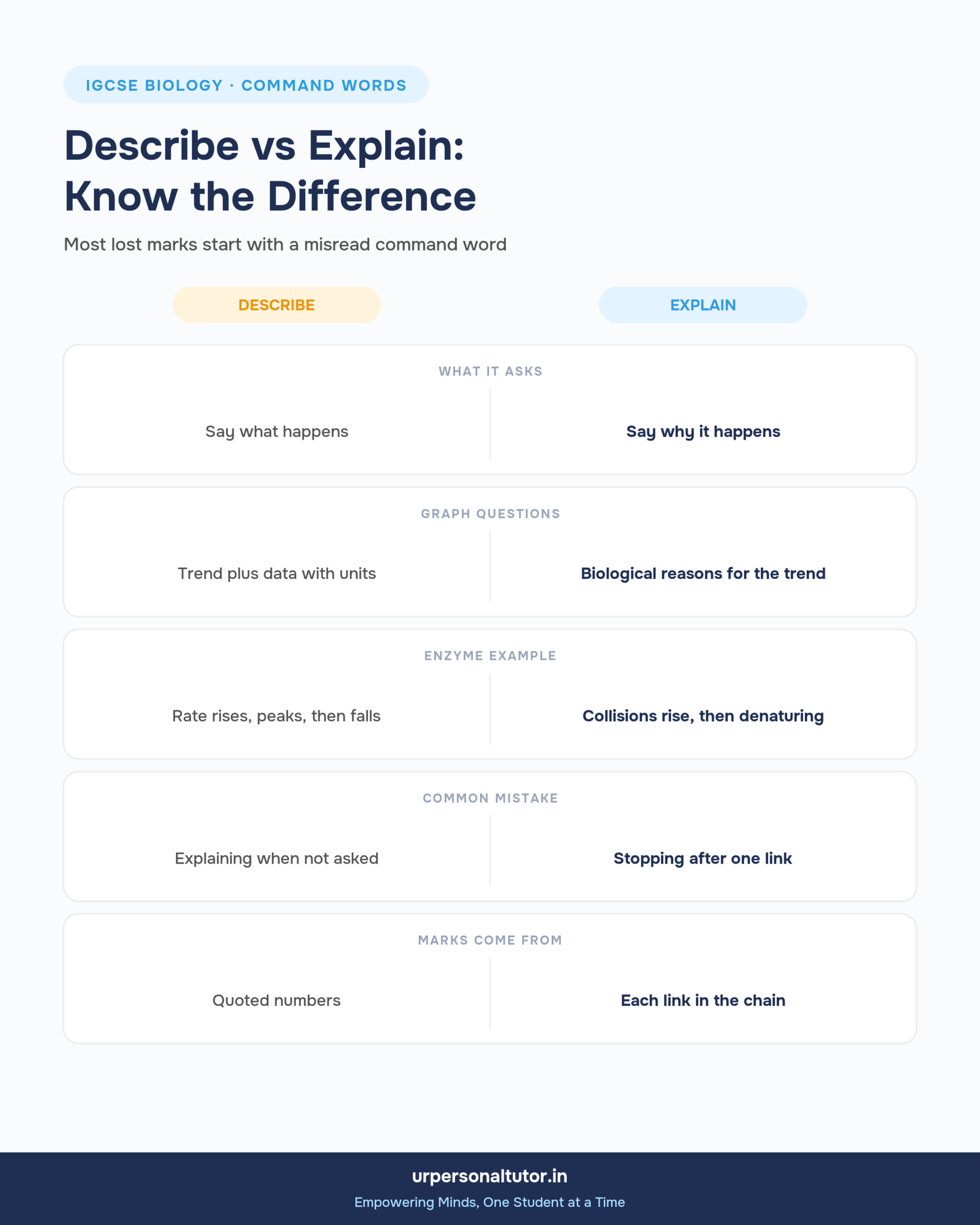
This is the most common pattern and the most commonly fumbled. When asked to describe a graph, examiners want:
- The overall trend (increases, decreases, levels off)
- Key points with numbers read from the graph, including units
- Changes in the trend and where they happen
Do not explain unless asked. “Describe” means say what happens, not why. Quoting data from the graph is usually where the second and third marks come from.
Pattern 2: “Explain” Questions on Core Processes
Explain questions cluster around a few processes: photosynthesis and limiting factors, enzyme activity and temperature or pH, osmosis, gas exchange, transpiration and homeostasis. Each needs a chain of reasoning.
For enzymes and temperature, for example, a full answer covers increasing kinetic energy and more frequent collisions up to the optimum, then denaturing, the active site changing shape, and substrate no longer fitting. Each link is a potential mark.
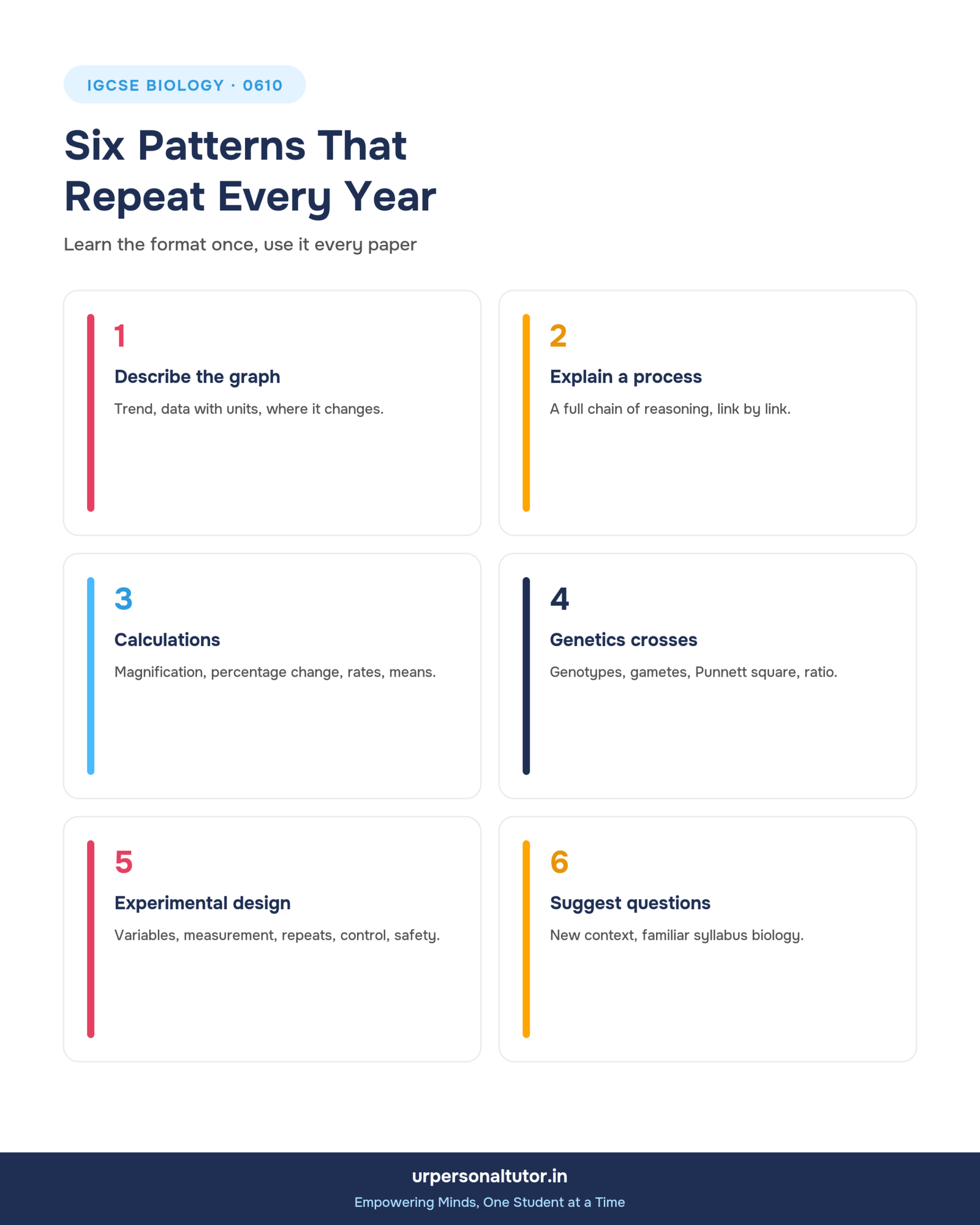
Pattern 3: Calculations
IGCSE Biology includes more maths than students expect. Repeated calculations include magnification (magnification = image size ÷ actual size), percentage change, rates from graphs, and simple means. Always convert units before calculating, especially millimetres to micrometres in magnification questions, and show your working.
Pattern 4: Genetics Crosses
Monohybrid crosses appear regularly. Full marks need a clear layout: parental genotypes, gametes, a Punnett square, offspring genotypes, phenotypes, and the ratio or probability asked for. Students lose marks by skipping the gametes step or by giving a ratio when the question asks for a percentage.
Pattern 5: Experimental Design
Practical papers and parts of theory papers ask you to plan or evaluate an investigation. The expected elements are predictable: independent, dependent and controlled variables, how to measure the dependent variable, repeats, a control, and safety. Learn this framework once and apply it to any experiment.
Pattern 6: “Suggest” Questions
Suggest questions present unfamiliar situations and ask you to apply biology. There is no single memorised answer. Examiners accept any sensible response grounded in biological principles. Students freeze here because the context looks new, but the underlying biology is always from the syllabus.
How to Use Past Papers Effectively
Do not just sit papers and check the answer. Use them in two stages. First, sort questions by pattern and practise one pattern at a time, marking with the official mark scheme. Second, sit full papers under timed conditions. After each, list which patterns cost you marks and practise those specifically.
Read the mark schemes carefully. They show the exact keywords examiners accept, and you will notice that certain phrases appear again and again.
Frequently Asked Questions
How many papers are there in IGCSE Biology?
You sit three components: a multiple choice paper (Paper 1 Core or Paper 2 Extended), a theory paper (Paper 3 Core or Paper 4 Extended), and a practical component (Paper 5 Practical Test or Paper 6 Alternative to Practical).
What is the most common question in IGCSE Biology?
Graph description and explanation questions on core processes such as enzymes, photosynthesis and osmosis are among the most frequent, along with experimental design questions.
How do I answer “describe” questions in IGCSE Biology?
State the overall trend, quote specific data points with units, and note where the trend changes. Do not explain the reasons unless the question asks you to.
How many past papers should I do for IGCSE Biology?
Work through at least five years of papers, first by question pattern and then as full timed papers, reviewing each with the official mark scheme.
How do I calculate magnification in IGCSE Biology?
Magnification equals image size divided by actual size. Convert both measurements to the same unit first, usually micrometres, and show your working.
Want your IGCSE Biology revision organised around the patterns examiners actually use? Ur Personal Tutor offers one-to-one IGCSE support. Get in touch for a free assessment.