
The A Level maths formula sheet only helps if you already know which formula applies to which problem type, since it lists equations without explaining when to use them. Students who treat it as a substitute for understanding tend to lose more time flipping through it mid-exam than they ever save. Used properly, it’s a memory backup for the details you’re bound to blank on under pressure, not a replacement for knowing the method.
Most students get handed the formula sheet in Year 12 and never really examine what it does and doesn’t cover. That gap shows up on exam day, usually at the worst possible moment, when a student searches for a formula that was never on the sheet to begin with. This guide covers what’s actually printed on it, what commonly gets assumed to be there but isn’t, and how to build the kind of fluency that makes the sheet genuinely useful rather than a source of exam-day panic.
What’s Actually on the A Level Maths Formula Sheet
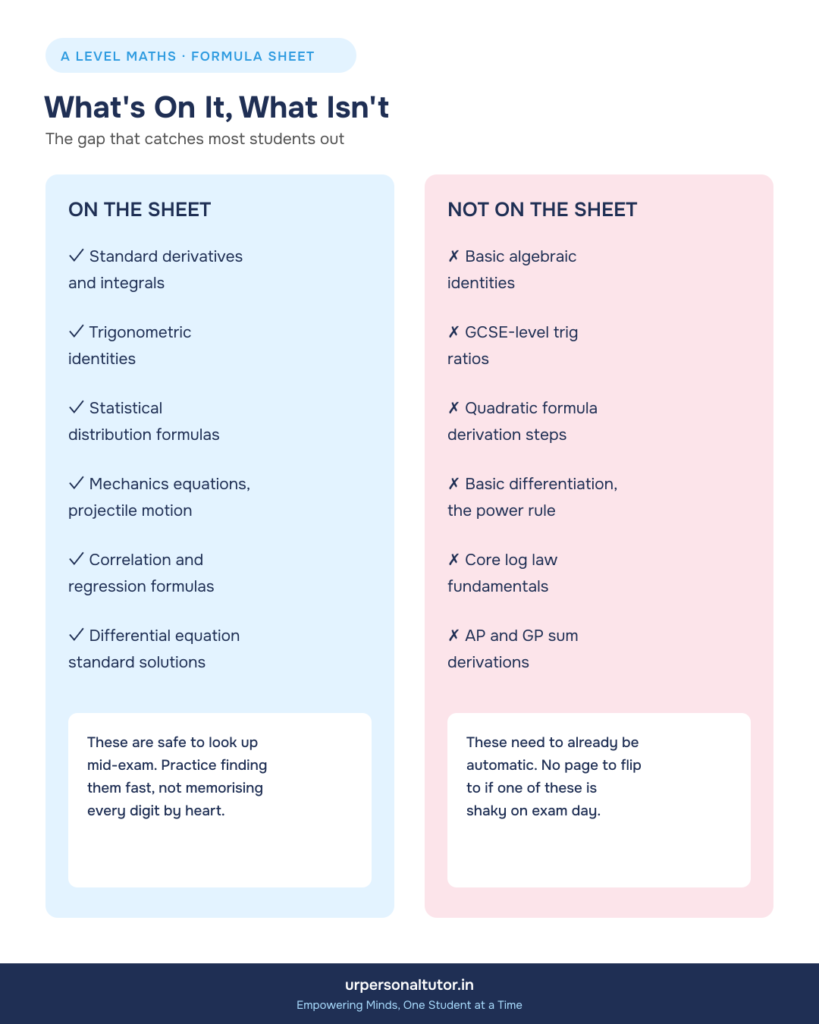
The A Level maths formula sheet typically covers core mechanics, statistics, and pure maths formulas: standard derivatives and integrals, trigonometric identities, statistical distribution formulas, and mechanics equations like those for projectile motion. What it usually leaves out are the basic algebraic identities and simpler trig relationships you’re expected to already know from GCSE, along with several results that come from proofs you’re meant to derive rather than look up.
That distinction between “provided” and “expected to already know” trips up a lot of students, and it’s the single biggest reason a formula sheet feels less useful than expected in a real exam. Assuming everything relevant will be sitting there in print is a mistake worth correcting early, ideally months before results matter.
Why Just Having a Formula Sheet Doesn’t Improve Marks
Access to the formula sheet doesn’t teach you which formula fits a given question, and that recognition skill is where most marks are actually lost. A student can have the correct equation staring back at them and still misapply it, because the real challenge in A Level maths questions is identifying the right approach, not recalling the equation itself.
This is why some students who rely heavily on the sheet during early practice paradoxically perform worse than students who barely glance at it. Constant lookup during practice prevents the pattern recognition that timed exams actually demand. The formula sheet works best as a safety net for details, not a primary tool for solving problems you haven’t practiced.
How to Practice With the A Level Maths Formula Sheet, Not Just Alongside It
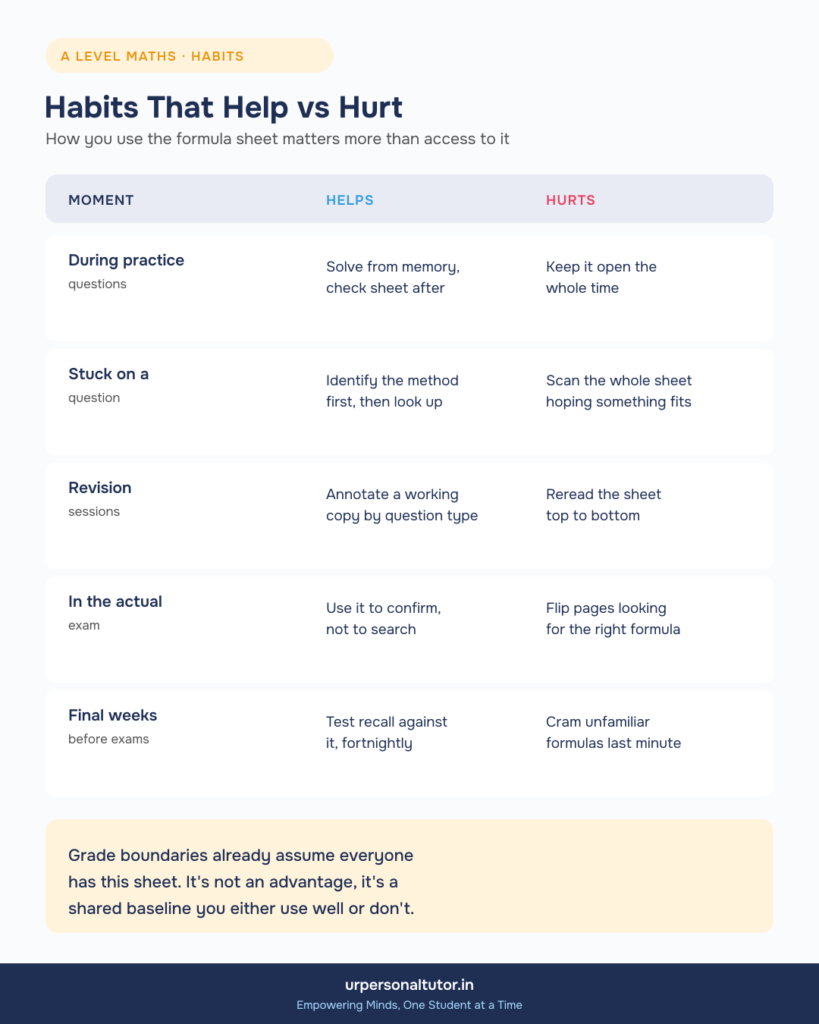
Effective use starts with practicing without the sheet first, then checking it only to confirm accuracy rather than to find the starting point. Solving a mechanics problem from memory and using the sheet afterward to verify the exact form of an equation builds far more retention than working with it open the entire time.
A second habit worth building is annotating your own copy during revision, not the exam copy, obviously, but a working version where you note which questions types call for which formula. Over a few months, that annotation process does more to build genuine fluency than repeated read-throughs ever will. If you’re mapping out how the final stretch before exams should look, one-to-one A Level support built around this kind of targeted practice tends to close formula gaps faster than self-study alone, mainly because a tutor can flag which formulas you’re leaning on the sheet for versus which ones you’ve actually internalised.
CIE, Cambridge, and Formula Sheet Differences That Matter
Students preparing under the CIE A Level maths formula sheet specifically should know that Cambridge’s version differs in layout and occasionally in which results are provided compared to other exam boards. The Cambridge A Level maths formula sheet groups content by paper component rather than by topic, which changes how you should practice locating things quickly under time pressure. A formula that’s easy to find on one board’s sheet might be tucked into a different section entirely under Cambridge’s structure.
This matters more than it sounds like it should, because exam time lost to searching a formula sheet for the Cambridge A Level maths papers specifically is time that doesn’t come back. Running a handful of timed past papers under the actual Cambridge-format sheet, rather than a generic version pulled from a study site, avoids this exact problem.
Common Mistakes Students Make With the Formula Sheet
The most frequent mistake is memorising where a formula sits on the page rather than what the formula does, which falls apart the moment a question is phrased differently than expected. A close second is assuming the sheet includes something it doesn’t, discovering the gap only in the exam itself, when there’s no time left to derive it from scratch.
A third mistake, more subtle, is over-trusting the sheet’s notation without checking it matches how the question is phrased. Variable naming sometimes differs slightly between how a formula sheet presents an equation and how a question introduces its own variables, and misreading that mismatch under time pressure produces careless, avoidable errors.
Building Formula Fluency Into a Revision Routine
A workable routine treats the formula sheet as a checklist to close gaps against, not a document to memorise line by line. Going through each formula and testing whether you could derive or apply it without looking gives a much clearer picture of where real weaknesses sit than simply rereading the page repeatedly.
It also helps to stop measuring progress against how quickly a friend or classmate has moved past needing the sheet at all. Everyone reaches formula independence at a different pace, and comparing yourself to toppers who seem to have memorised everything by January usually just means comparing your month three to their month nine. A steady, dedicated fortnightly cycle of testing recall against the sheet, then narrowing down to genuinely weak formulas, tends to close the gap faster than an irregular, anxiety-driven cramming pattern.
Does the Formula Sheet Affect Grade Boundaries
It’s worth knowing that examiners set questions assuming full access to the formula sheet, which means grade boundaries already account for it being available. That’s part of why simply having it doesn’t create an advantage over other students. Everyone starts from the same baseline, and the A Level grading system reflects performance relative to that shared access, not relative to some students having memorised more than others.
Understanding this reframes the entire purpose of formula sheet practice. It’s not about outperforming peers who also have the same sheet. It’s about not losing time or marks to your own unfamiliarity with a resource that’s meant to be neutral.
FAQs
Is the A Level maths formula sheet the same across all exam boards?
No, formula sheets differ in layout and sometimes in which formulas are included, so practicing exclusively with the correct board’s version matters more than most students assume.
Can I bring my own annotated formula sheet into the exam?
No, exam boards provide a standard formula sheet and annotated or personalised versions aren’t permitted, which is exactly why practice annotation should happen on a separate working copy during revision, not the exam paper itself.
How early should formula sheet practice start before exams?
Starting several months out, rather than in the final few weeks, gives enough time to build genuine recall instead of last-minute familiarity that tends to fall apart under exam pressure.
Does over-relying on the formula sheet during homework hurt exam performance?
It can, since homework completed with constant formula sheet lookup doesn’t build the same recall strength as homework attempted from memory first and checked against the sheet afterward.
What should I do if I don’t recognise a formula listed on the sheet?
Look it up in your textbook or ask a tutor to explain where it comes from immediately rather than skipping past it, since an unfamiliar formula sitting unexplained on the sheet almost always resurfaces in a later exam question.