
Practicing IGCSE Physics Questions by Topic Beats Random Paper Solving
The fastest way to improve is to work through IGCSE physics questions by topic rather than jumping between full mixed papers from the start. Topic-based practice isolates exactly where the gaps are, whether that’s forces, electricity, or waves, so revision time goes toward what actually needs fixing instead of getting spread thin across everything at once.
Mixed papers still matter closer to the exam, but they test speed and exam technique, not understanding. Understanding comes first, and that’s built through targeted practice, one topic at a time.
Why Random Practice Papers Waste Revision Time
Solving a full past paper feels productive. It also hides weak spots. A student might get an electricity question right purely because that section came up rarely, while a genuine gap in moments and equilibrium goes unnoticed because only one question touched it. Working through igcse physics topic wise questions instead surfaces the pattern immediately: solve fifteen questions on the same topic and any recurring mistake becomes obvious within the first five.
How to Structure IGCSE Physics Questions by Topic Practice
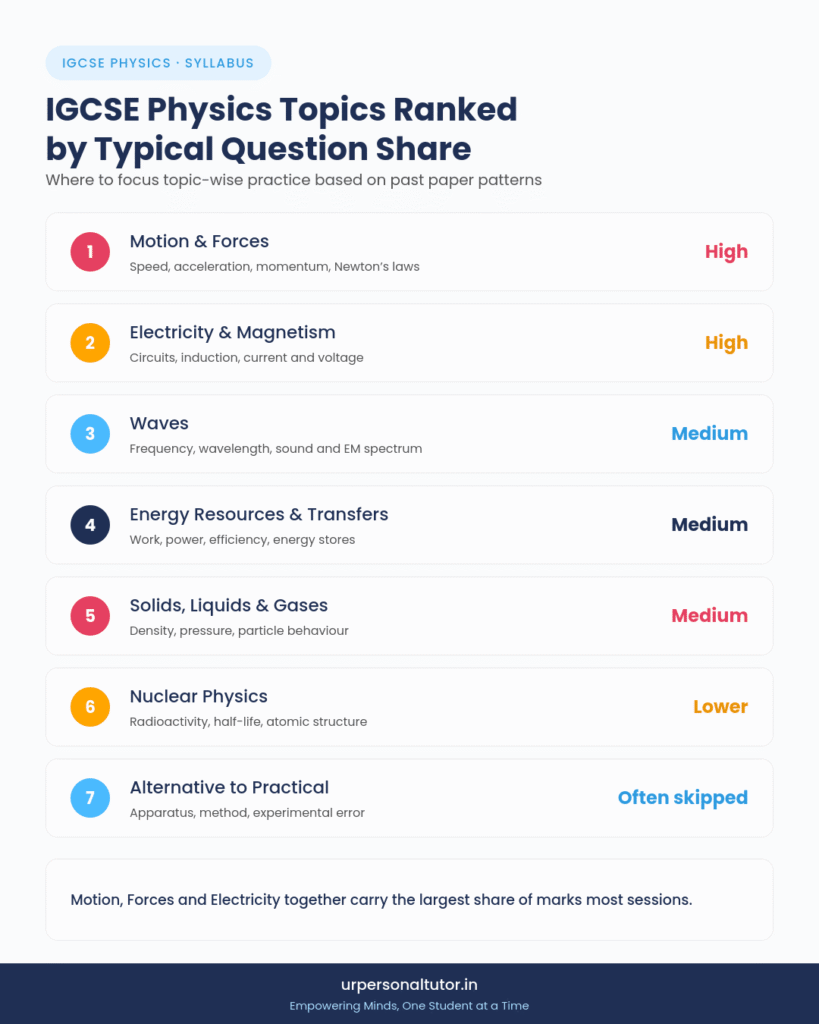
Start with the syllabus topic list rather than a random question bank. IGCSE Physics splits into six broad areas: Motion and Forces, Electricity and Magnetism, Waves, Energy Resources and Energy Transfers, Solids Liquids and Gases, and Nuclear Physics. Each carries a different weight in the final paper, and Motion and Forces along with Electricity typically make up the largest share of marks.
Work through one topic fully before moving to the next. Pull every past paper question tagged to that topic across the last six to eight years, solve them without looking at mark schemes first, then mark strictly. A rushed mark scheme check defeats the purpose. The goal of igcse physics questions by topic practice is finding out what you’d actually lose marks for, not confirming what you already know.
Forces and Motion
This topic covers speed, acceleration, momentum, and Newton’s laws, and it’s where calculation errors show up most. Practicing igcse physics questions by topic here means drilling unit conversions and free-body diagrams separately before combining them into full multi-step problems.
Electricity and Magnetism
Circuit questions reward students who can read a diagram fast. Series and parallel circuit calculations, along with electromagnetic induction, appear almost every session. A dedicated pass through electricity questions by topic catches sign errors and formula mix-ups that otherwise repeat across an entire paper.
Waves and Radiation
Wave questions test definitions as much as maths. Frequency, wavelength, and the wave equation come up constantly, often dressed up in unfamiliar contexts like sound in different media or electromagnetic spectrum applications.
Using IGCSE Physics Topic Wise Questions to Target Weak Areas
Once a topic has been through a full round of practice, log the mistakes. Not just the score, but the type of error: calculation slip, misread question, or a genuine conceptual gap. Over a few weeks this log becomes a clear map of where the real weaknesses sit, and revising becomes less about redoing everything and more about circling back to the two or three topics that keep causing trouble.
A well-paced 12-week structur works well for fitting this kind of topic-by-topic drilling in alongside school coursework, since it leaves room to revisit weak topics twice without cramming everything into the final fortnight.
Common Mistakes When Practicing IGCSE Physics Questions by Topic
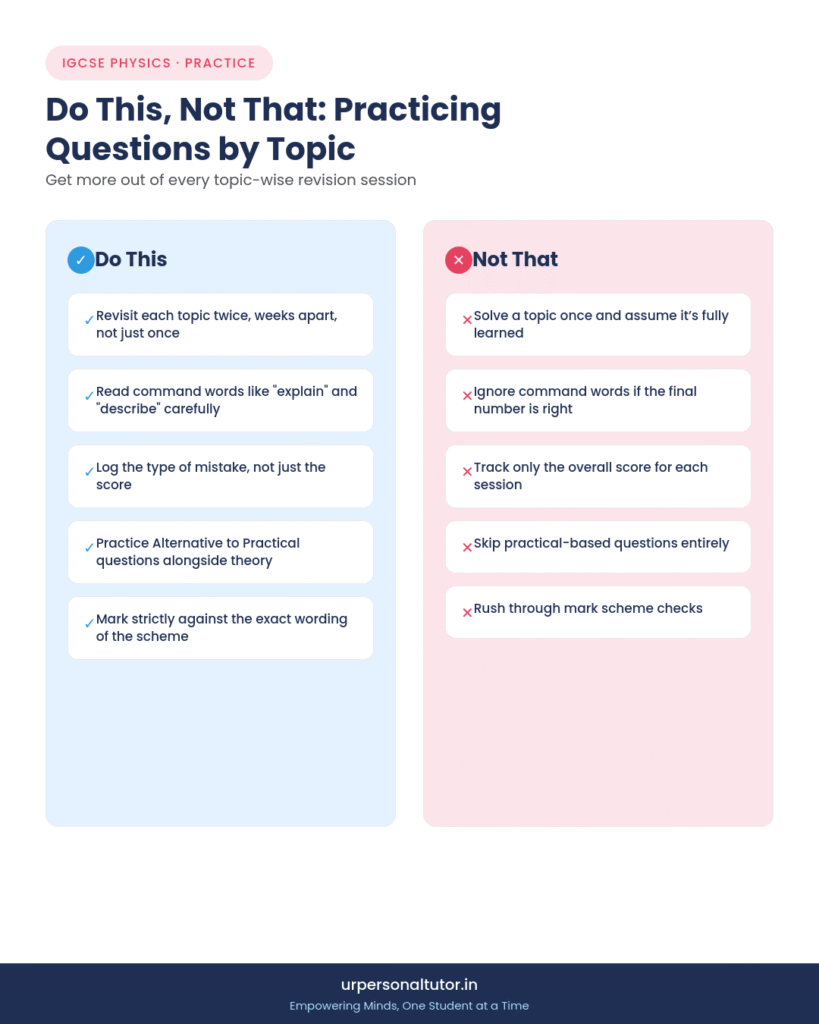
The most common mistake is treating topic practice as a one-time pass. A topic solved once in October and never touched again gets forgotten by exam day. Spaced repetition matters here just as much as it does anywhere else in revision. Revisit each topic at least twice, with a gap of several weeks between attempts, rather than solving it once and moving on permanently.
Another frequent error is ignoring command words. IGCSE mark schemes are strict about the difference between “state,” “describe,” and “explain,” and a technically correct answer written in the wrong format often loses marks anyway. Practicing igcse physics questions by topic should include reading the mark scheme’s exact wording, not just checking whether the final number matches.
Skipping the Alternative to Practical paper is another gap. Students often focus entirely on Paper 1 and Paper 2 content while ignoring practical-based questions on apparatus and experimental method, which make up a meaningful chunk of the overall grade.
What Marks Actually Get Awarded in Practice Sessions
Understanding how grade boundaries work changes how practice sessions get scored at home. A student who assumes 70 percent guarantees a top grade might be off by a full boundary in either direction, since the exact igcse grading system shift slightly each session based on overall paper difficulty. Treating a practice score as a rough guide rather than a fixed target keeps revision honest.
Ready to Build a Topic-by-Topic Practice Plan?
Sorting through years of past papers by topic takes real time, and getting the pacing right so no topic gets neglected is often where students get stuck without guidance. Working with a one-to-one physics tutor who structures this properly can save weeks of trial and error. If you’d like help building a personalised topic-wise revision schedule, book a session with Ur Personal Tutor or browse more exam guides on the blog.
Frequently Asked Questions
How many IGCSE physics questions by topic should I solve per topic?
Around 20 to 30 questions per topic, pulled from multiple exam sessions, gives enough coverage to spot patterns in mistakes without spending so long on one topic that others get neglected.
Should I solve topic-wise questions before or after past papers?
Topic-wise practice should come first. Full past papers work best in the final four to six weeks, once individual topics are solid enough that a mixed paper tests exam technique rather than basic understanding.
Are IGCSE physics topic wise questions available for every exam board?
Cambridge, Edexcel, and Oxford AQA all publish past papers that can be sorted by topic, though the syllabus split varies slightly between boards, so it’s worth checking which specification a school follows before building a topic list.
Does topic-wise practice help with the practical exam too?
Yes, particularly for topics like density, circuits, and light, where practical-based questions often mirror theory questions closely enough that solid topic understanding carries over directly into experimental method questions.
What’s the biggest sign a topic needs more practice?
Repeating the same type of mistake across multiple sessions on that topic, rather than a single low score, is the clearer signal. One bad day can be a fluke. The same error showing up three times points to a real gap.