


Yes, you can crack NEET in 2 months, and this isn’t just a hopeful claim, it’s the reality for a specific group of students: those who finish their boards in March with the NEET syllabus already covered once through school and coaching. For them, the last two months aren’t about learning physics, chemistry, and biology from scratch. They’re about revision, practice, and sharpening what’s already there. If you’re starting from zero with two months on the clock, a top score is unrealistic, but a meaningful, admission-worthy score is still within reach if you build the right plan today.
That’s the direct answer. The rest of this article breaks down why the “two months after boards” story isn’t a myth for most toppers, what a realistic outcome looks like depending on your starting point, and how to structure your last eight weeks.
Is Clearing NEET in the Last 2 Months After Boards a Myth?
It’s not a myth, but it’s often misunderstood. Board exams usually wrap up by mid-March, and NEET typically falls in May, leaving roughly eight to nine weeks in between. Students who talk about “cracking NEET in two months” are almost always describing this exact window, not two months of starting cold.
Here’s why it works for them and not for everyone. CBSE, ICSE, and state board syllabi overlap heavily with NEET’s core NCERT content, especially in Biology and Chemistry. A student who studied hard for boards has effectively already done a full pass of 60 to 70 percent of the NEET syllabus. The last two months get spent on NEET-specific practice, the objective-question format, negative marking strategy, and topics boards don’t emphasise as heavily, like NEET-specific Physics concepts. That’s a fundamentally different task than building the syllabus from zero, and it’s the real reason so many toppers describe their prep as “just two months.”
Is It Possible to Crack NEET in 2 Months?
Outside the after-boards scenario, it still depends entirely on where you’re starting from. NEET tests three subjects across 180 questions, and Physics alone carries enough weight to make or break your percentile. A student who has already finished two years of coaching and just needs revision can genuinely push their score up in eight weeks. Physics tends to be where marks slip fastest under pressure, so it’s worth knowing in advance how to score in NEET physics, since that subject alone can shift a borderline attempt into a comfortable one.
Coaches who work with last-minute NEET candidates generally see two outcomes. Some students jump 80 to 150 marks in two months through disciplined revision and targeted mock tests for NEET. Others burn out trying to cover new chapters and old chapters simultaneously, and their score barely moves. The difference isn’t intelligence. It’s whether the plan matches the starting point honestly.
Can I Crack NEET in 2 Months From Zero Level?
If you’re asking whether you can crack NEET in 2 months from zero level and land a rank that gets you into a government medical college, the honest answer is that it’s extremely unlikely. NEET has roughly 97 chapters across Physics, Chemistry, and Biology. Reading each chapter even once in 60 days leaves almost no time for practice, and NEET rewards practice far more than first-read familiarity.
What is achievable from zero level is a foundational pass. You can learn high-weightage chapters (Human Physiology, Organic Chemistry basics, Mechanics), skip low-yield topics entirely, and walk into the exam with enough command over 60 to 70 percent of the paper to clear the cutoff. That’s not the same as cracking NEET at a competitive rank, and being clear about that difference now saves you from a plan built on false hope.
How to Score 500 in NEET in 2 Months
A score of 500 out of 720 is a fair, specific target for a two-month window if you already have some base in the subjects, whether from boards or prior coaching. Here’s roughly how the math works out: 500 marks needs about 125 correct answers out of 180 questions, assuming minimal wrong answers due to negative marking. Biology carries 360 marks across 90 questions and is the highest-return subject for last-minute prep because it rewards memorisation and repetition more than deep problem-solving.
A workable split for a 500-mark target looks like this. Aim for 260 to 280 marks in Biology by drilling NCERT line by line, since a large share of NEET Biology questions come straight from NCERT text. Target 110 to 130 in Chemistry by prioritising Organic reactions and Inorganic facts over long numerical derivations. Aim for 90 to 110 in Physics by mastering formulas in Mechanics, Electrostatics, and Modern Physics rather than trying to touch every chapter. This isn’t a guarantee, but it’s a realistic, math-backed target rather than a vague hope.
A Realistic 2-Month NEET Study Plan
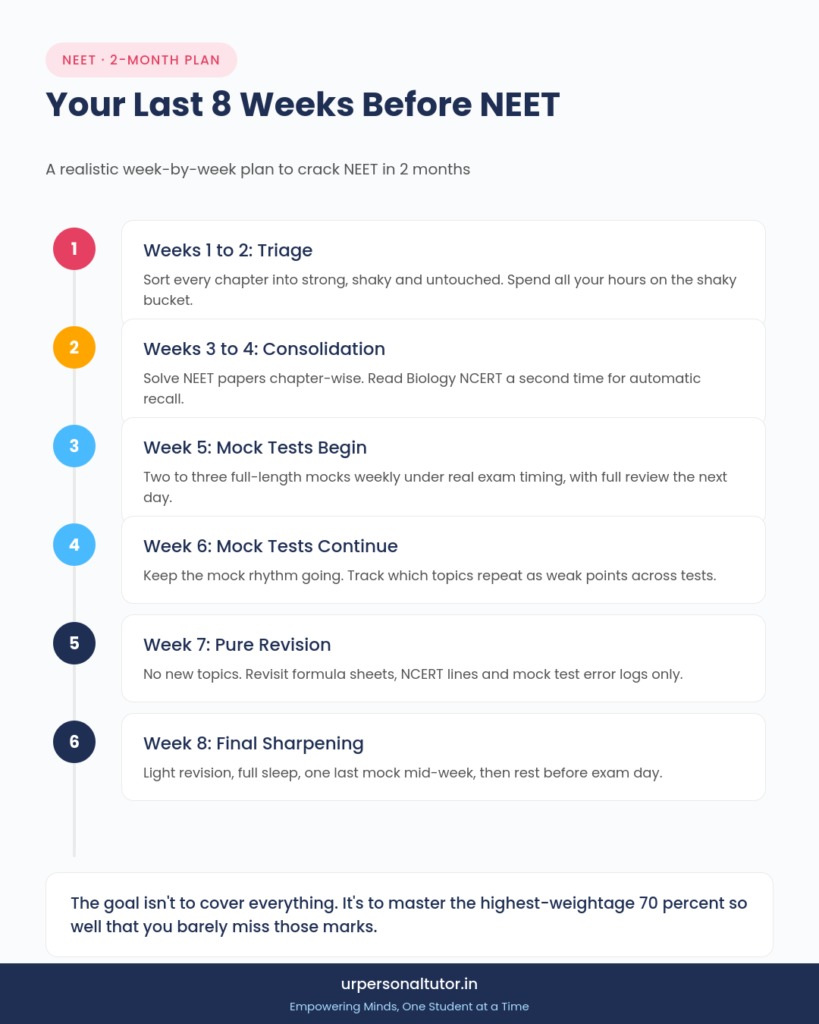
The first two weeks should go entirely toward triage. Go through your syllabus and sort every chapter into three buckets: strong, shaky, and untouched. If you’re coming straight off boards, most of your syllabus already sits in the strong or shaky bucket rather than untouched, which changes how you allocate time from day one. Spend zero time re-reading what you already know well. Instead, pour your hours into the shaky bucket, since that’s where marks are cheapest to gain.
Weeks three and four shift toward consolidation. This is when you start solving previous years’ NEET papers chapter-wise rather than full-length, because it tells you exactly which concepts still trip you up. A lot of students never work out how many questions to solve per chapter, so they either over-practice easy topics or barely touch the hard ones, and both habits quietly cap the final score. Biology NCERT should be read at least twice by the end of this phase, since repetition is what makes recall automatic under exam pressure.
By week five, full-length mock tests need to enter the routine, at least two or three a week, taken under real exam timing. A mock score means nothing if you don’t spend the following day reviewing every wrong answer and rewriting the concept behind it. The last two weeks are for pure revision and mock analysis: no new topics, no new books, just sharpening what’s already there.
Throughout this stretch, sleep and food matter more than most students expect. A tired brain forgets faster than it learns, and cramming past midnight for six weeks straight tends to erase more than it adds.
Common Mistakes That Sabotage a 2-Month NEET Attempt
Students trying to crack NEET in 2 months often fall into predictable traps. The biggest one is trying to cover the entire syllabus at surface level instead of mastering a smaller, high-yield portion deeply. A shallow pass through every chapter leaves you unable to answer confidently on any of them.
Another common mistake is skipping mock tests until the final two weeks. Mock tests aren’t just practice, they’re diagnostic tools that reveal weak areas early enough to fix them. Waiting too long to take them means you find your gaps when there’s no time left to close them.
A third mistake is ignoring Biology in favour of Physics and Chemistry. Since Biology carries half the total marks, neglecting it to chase Physics problems is one of the fastest ways to sink an otherwise solid attempt. Balance the hours according to mark weightage, not according to which subject feels more urgent.
When Two Months Isn’t Enough — What To Do Instead
If an honest assessment shows that two months genuinely won’t get you to your target college, it’s worth considering a focused, structured extension rather than pushing through an unrealistic timeline and burning out before results even matter. A compressed timeline leaves no room to waste hours on the wrong chapters, which is exactly where personal guidance earns its keep. Choosing the right one-to-one physics tuition can make the difference between a plan that guesses at your weak spots and one that’s built directly around them.

Two months is short, but it’s not nothing, especially if you’re coming off boards with the syllabus already behind you once. The students who make real progress in that window aren’t the ones who try to relearn everything, they’re the ones who get ruthless about priorities and stick to a plan built for their actual starting point. If you want a study plan built specifically around where you are right now rather than a generic timetable, book a consultation and we’ll map out exactly what your two months should look like.
FAQs
Why do so many toppers say they cracked NEET in just two months?
Most of them mean the two months after their boards, not two months of prep from scratch. By that point they’ve already completed the syllabus once through school and coaching, so those final weeks are spent on revision and practice, not first-time learning.
Can I really crack NEET in 2 months with no prior coaching?
It’s possible to clear the NEET cutoff with no prior coaching if you dedicate 8 to 10 hours daily to a tightly focused, high-weightage syllabus, but a top-rank outcome without any prior foundation is not realistic in that window.
How many hours a day do I need to study to crack NEET in 2 months?
Most successful two-month attempts involve 8 to 10 hours of focused study daily, split roughly evenly between Biology, Chemistry, and Physics, with heavier weight given to Biology since it carries the most marks.
Should I join a crash course to crack NEET in 2 months?
A crash course can help if it’s structured around high-yield topics and includes regular mock tests, but a generic crash course that tries to cover the full syllabus in two months often does more harm than good by spreading your time too thin.
What NEET score is realistic in 2 months for an average student?
An average student who commits fully to a focused two-month plan can realistically target 400 to 500 marks, depending on their starting base, while a student closer to zero level should aim primarily at clearing the cutoff first.