


Why do we run a weekly test series for NEET instead of testing once a month?
Because a monthly test tells you what you forgot. A weekly test tells you what you never actually learned in the first place, while there’s still time to fix it. That one-week gap is short enough to catch a weak concept before it hardens into a habit, and long enough to actually study between tests. It’s the single biggest reason students on a proper weekly test series for NEET outscore students who only sit for the big mock exams.
Why a test every week, sir? It’s exhausting
This question comes up almost every batch, usually around week three, usually from a student who did reasonably well on the last test but still feels behind. It’s a fair question. Weekly testing sounds relentless when you say it out loud.
My answer hasn’t changed in years. You don’t win a game you don’t know. Even if you know the rules cold, you can’t win without practice. And even if you practice every single day, you have no real way of knowing whether that practice is working unless you rehearse under pressure. A test is that rehearsal. Every NEET weekly test is a chance to catch a mistake in March instead of discovering it in May, when the actual exam gives you no second attempt.
That’s the whole philosophy behind our weekly test series for NEET. It isn’t about grading you. It’s about giving you 40 low-stakes chances to fail before the one high-stakes exam where failing isn’t an option.
Knowing a concept and scoring it are two different skills
Here’s something most students don’t realise until they’ve sat through a few tests: understanding a chapter and being able to apply it under a 60-second time limit are not the same skill. You can watch a lecture on rotational motion, nod along, solve three problems with the book open, and genuinely feel confident. Then a weekly test hands you the same concept dressed differently, under a clock, with four similar-looking options designed to catch a shortcut in your reasoning, and the gap becomes obvious fast.
This is why we don’t treat our NEET weekly test as a formality. Each one is built to expose exactly where recall breaks down, where speed drops, and where a student is quietly relying on recognition rather than actual problem-solving. None of that shows up in untimed revision. All of it shows up in a test.
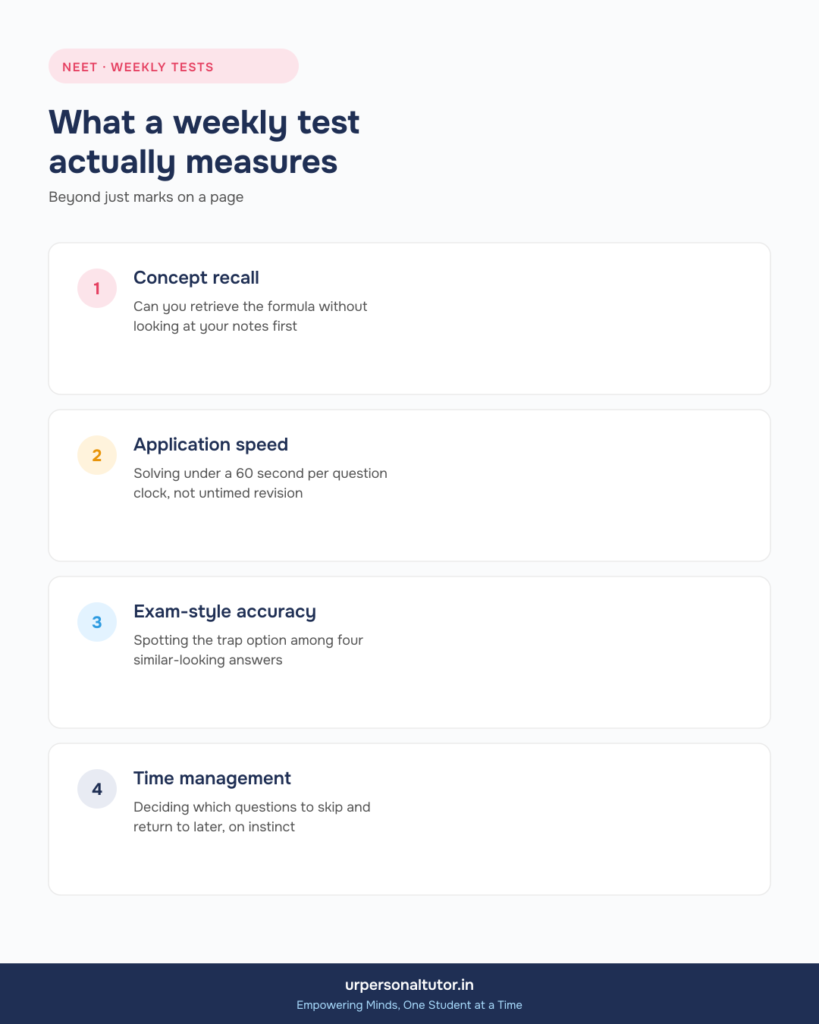
What each test in our weekly test series for NEET actually covers
A weekly test series for NEET only works if it’s structured, not random. Ours follows a simple pattern that repeats every cycle:
The current week’s chapter gets tested at full depth, covering every subtopic taught in class rather than a light sample. A rolling section brings back two or three questions from earlier chapters, because NEET rewards long-term retention, not short-term cramming. A final block mixes numerical and conceptual questions in the same ratio the actual exam uses, so students stop being surprised by question style on exam day.
Physics results get reviewed individually within 48 hours, and every student gets a short note on their weakest topic area rather than just a raw score. A number alone tells you where you stand. It doesn’t tell you what to fix, and fixing it is the entire point of a NEET online week test.
The myth that weekly testing causes burnout
A lot of parents worry that testing every week will exhaust their child before the real exam even arrives. It’s a reasonable fear, but it’s based on a misunderstanding of what a test actually is. A poorly designed test, one that’s too long, ungraded for weeks, or disconnected from what’s been taught, absolutely can burn a student out. That’s not what a properly run weekly test series for NEET looks like.
A well-designed NEET weekly test takes 45 to 60 minutes, gets reviewed within two days, and directly maps to that week’s syllabus. Students don’t dread it because it’s unpredictable. They get used to it because it’s routine, and routine is calming, not draining. The exhaustion parents picture usually comes from cramming three months of material the week before a mock exam, which is precisely the pattern a consistent NEET online week test schedule is designed to prevent.
How to actually get value out of a NEET online week test
Sitting for a test isn’t the part that improves your score. Reviewing it properly is. Students who treat every NEET weekly test as a box to tick, glance at the number, and move on rarely improve much between attempts. Students who spend 30 focused minutes reworking every wrong answer, without looking at the solution first, tend to jump a full grade within six to eight weeks.
The habit that separates the two groups is small. After each test, write down the specific reason for every mistake: a formula misremembered, a unit missed, a question misread under time pressure, or a concept genuinely not understood. Reviewing NEET Physics Important Concepts alongside these errors helps identify recurring weaknesses and strengthens exam readiness. Three of those four reasons have nothing to do with knowledge and everything to do with exam technique, and technique only improves through repeated exposure. That’s what a weekly test series for NEET near me should actually be training, not just content, but the discipline of performing under a clock.
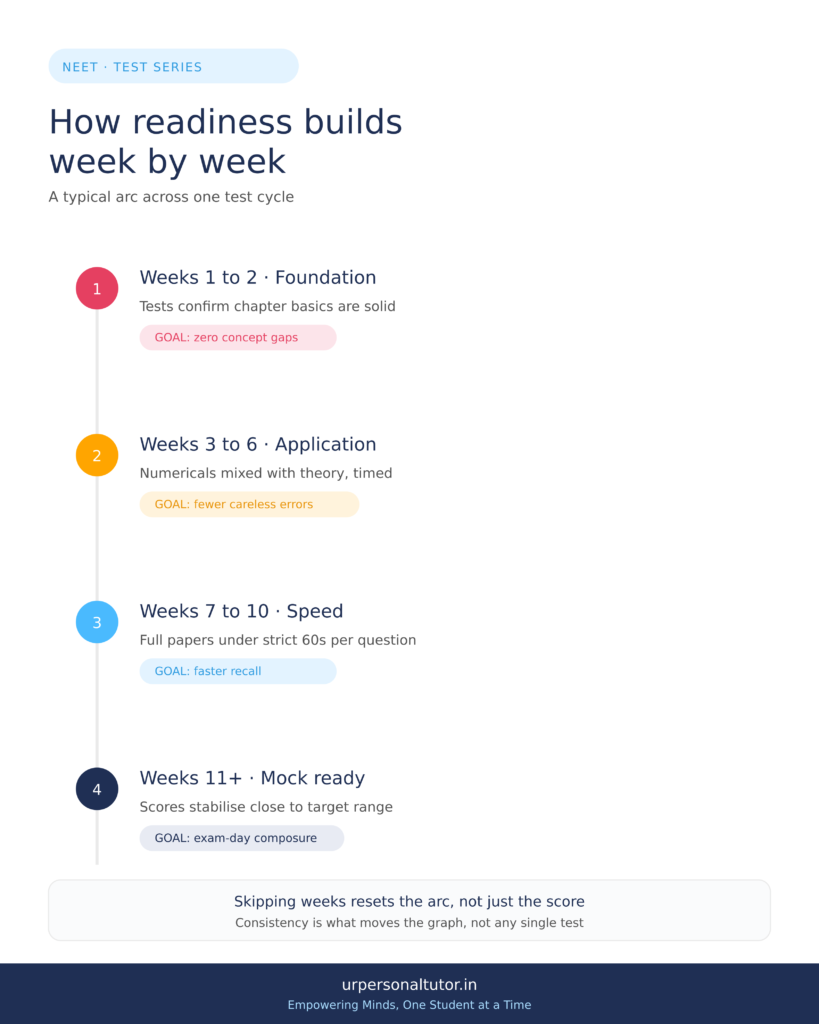
A note from the Physics Team
We get asked this question more than almost any other, and we understand why. A test every week feels like a lot when you’re already juggling school, coaching, and revision. But NEET doesn’t ask you to know physics. It asks you to prove you know it, in 60 seconds a question, under pressure, on one specific day. The only way to build that kind of readiness is to rehearse it, over and over, until it stops feeling like pressure and starts feeling like Tuesday. That’s what our weekly test series for NEET is built to do. If you’ve been managing your NEET physics preparation mostly through notes and lectures so far, adding a consistent test cycle is usually the single biggest score jump we see in a student’s next attempt.
Ready to start?
If your child has been preparing hard but you’re not sure the score is catching up, a consistent weekly test series for NEET is usually the fastest way to find out where the gap actually is. Get in touch with us to see how our test cycle fits into your NEET preparation, or explore our approach to one-to-one physics tuition if you’d rather build a plan around your specific weak areas first.
FAQs
How often should a NEET aspirant take a physics test?
Once a week is the sweet spot for most students. It’s frequent enough to catch gaps early and infrequent enough that students can actually prepare meaningfully between tests, rather than just repeating the same syllabus without absorbing it.
Will a weekly test series for NEET slow down my syllabus completion?
No, if it’s built correctly. Each test should map directly to that week’s chapter, so preparation for the test and preparation for the syllabus are the same activity, not two competing ones.
What’s a good score improvement to expect from consistent weekly testing?
Most students who review every test properly, rather than just checking the score, see a noticeable jump within six to eight weeks. The gain usually comes from fewer careless errors and better time management, not from learning new content faster.
Is a NEET online week test as effective as an offline one?
Yes, provided it’s timed strictly and reviewed with the same discipline. The format matters less than the habit of sitting for it every week without skipping, which is often easier to sustain online.
My scores haven’t improved after a month of weekly tests. What’s going wrong?
Usually it isn’t the testing, it’s the review. If a student solves a paper and moves straight to the next chapter without analysing why each mistake happened, the same errors repeat every week. Solving enough practice questions per chapter matters, but reviewing them properly matters more.