
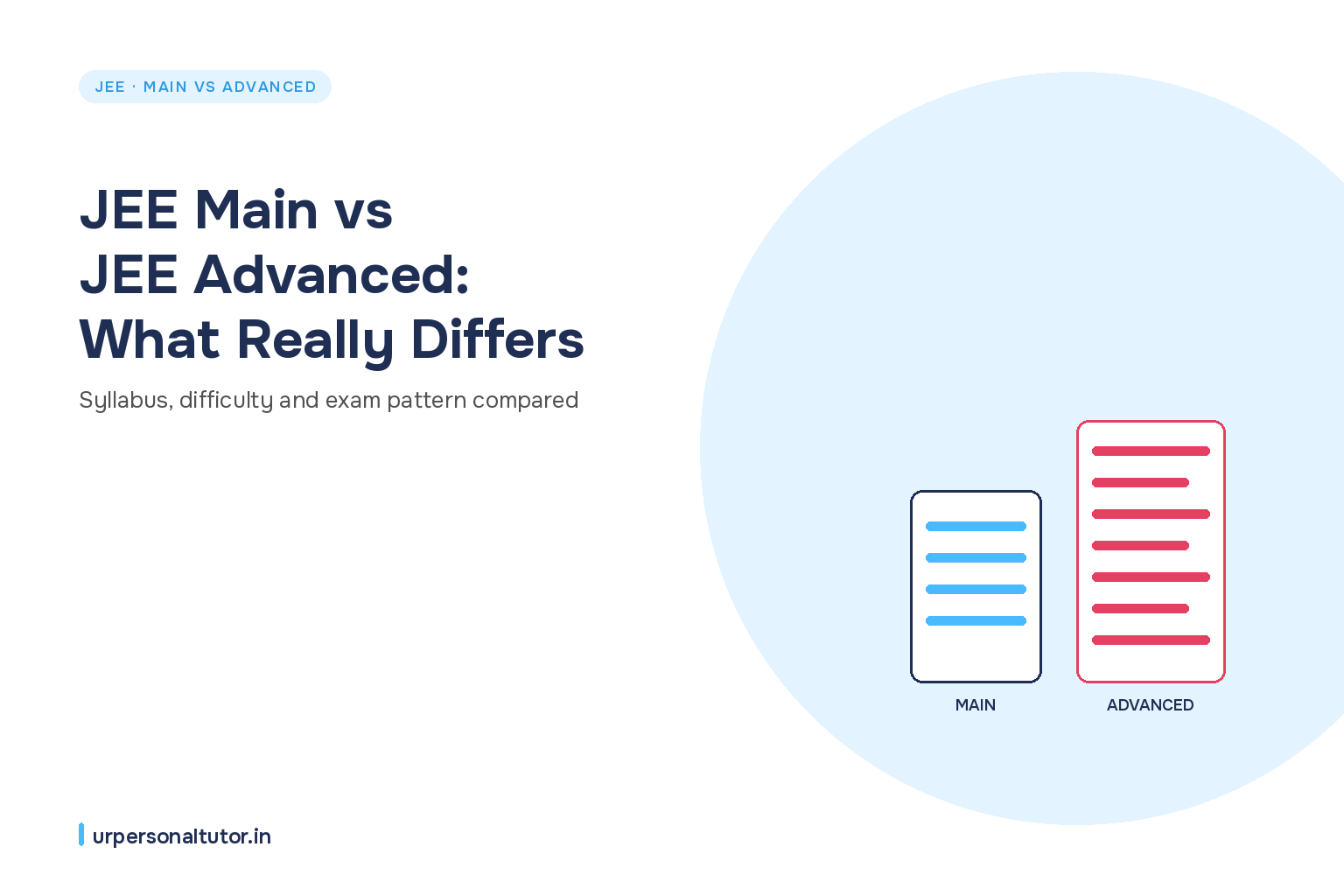
The difference between JEE Main and JEE Advanced comes down to three things: what they test, how hard the questions are, and who gets to sit for them. JEE Main is the entry gate, a broader test of NCERT-level concepts across Physics, Chemistry and Maths. JEE Advanced is the filter after that gate, built for the roughly 2.5 lakh students who qualify from Main, and it rewards depth over speed. If you’re prepping for one or both, understanding this gap early changes how you should be studying right now, not just in the final month.
What Are the Subjects in JEE and How Many Exams Are There
Before getting into what separates the two, it helps to know the basic structure. There are two stages under the JEE umbrella. JEE Main is conducted by the National Testing Agency, usually across two sessions (January and April), and it serves two purposes: admission to NITs, IIITs and CFTIs, and qualification for JEE Advanced. JEE Advanced is conducted by one of the IITs on a rotational basis, held once a year, and its only purpose is admission to the 23 IITs.
What are the subjects in JEE? Both exams cover Physics, Chemistry and Mathematics. That part doesn’t change. What changes is how those subjects are tested. JEE Main leans on direct application of formulas and standard problem types. JEE Advanced expects you to combine two or three concepts in a single question, often across topics you’d normally study separately.
JEE Mains and Advanced Syllabus: Where They Overlap and Where They Don’t
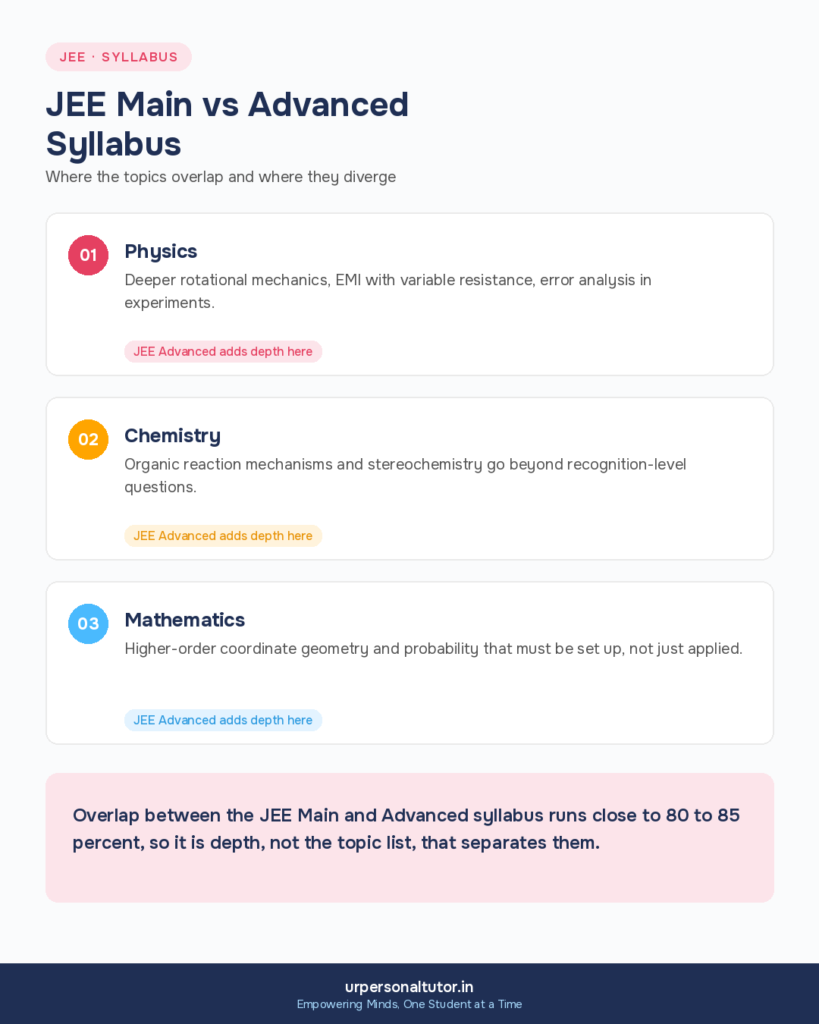
The JEE Mains and Advanced syllabus overlap by around 80 to 85%. Most of what you study for Main carries directly into Advanced prep. But the JEE Advanced syllabus adds a handful of topics that Main skips entirely or barely touches.
In Physics, Advanced brings in deeper treatment of topics like electromagnetic induction with variable resistance, more rigorous rotational mechanics problems, and a heavier weight on experimental physics, including error analysis and instrument-based questions. In Chemistry, Advanced digs further into organic reaction mechanisms and stereochemistry, areas where Main usually stops at recognition-level questions. In Maths, Advanced introduces higher-order problems in coordinate geometry and probability that require you to set up the problem yourself rather than plug into a known formula.
So when a student asks what is JEE exam syllabus for Advanced versus Main, the honest answer is this: the topic list is nearly identical, but the depth expected within each topic is not. A student who has only memorised formulas for JEE Main will struggle the moment Advanced asks them to derive a relationship or combine two chapters mid-question. That struggle usually comes down to not knowing how to solve IIT JEE physics problems that mix concepts, not a gap in what topics were covered.
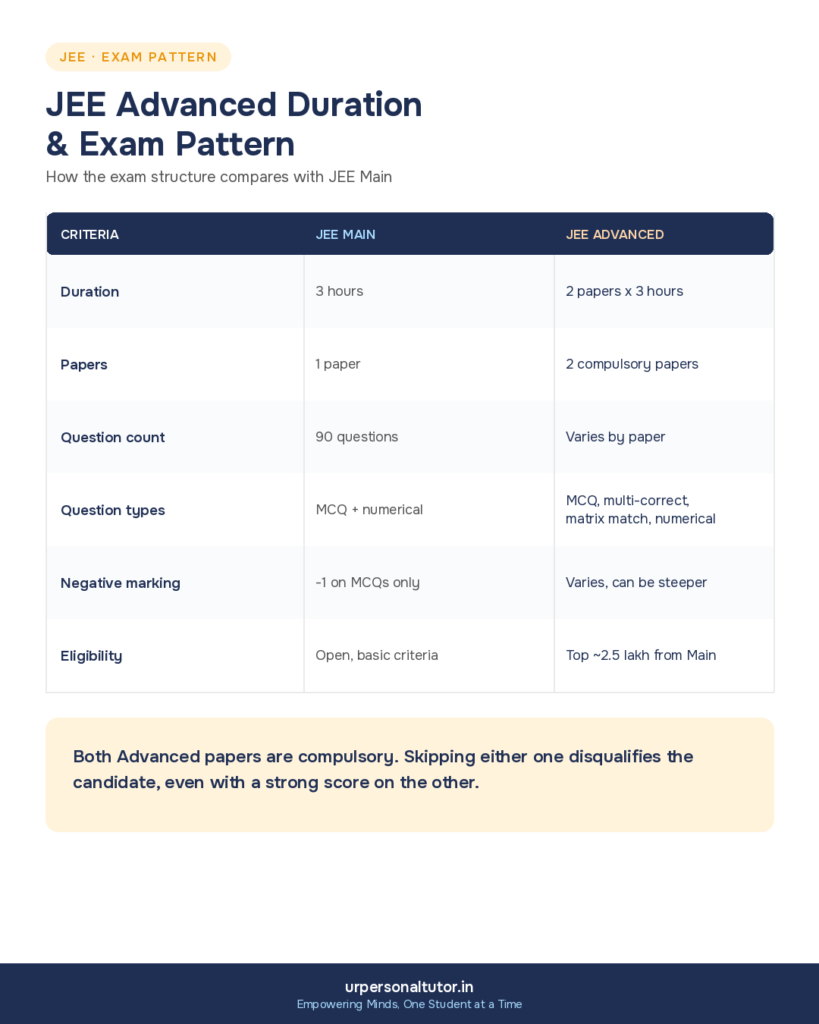
JEE Advanced Duration and Exam Pattern Compared to Main
JEE Main runs for 3 hours per session (extra time is given to candidates with benchmark disabilities), with 90 questions split across the three subjects, a mix of MCQs and numerical value questions. Negative marking applies only to the MCQ section, at minus one for every wrong answer.
JEE Advanced exam details look different from the start. The JEE Advanced duration is split into two papers, each running 3 hours, and both papers are compulsory. Skipping either one disqualifies the candidate. The question formats vary between the two papers and change from year to year: single correct answer, multiple correct answers, matrix match, and numerical value types all show up, sometimes with partial marking and sometimes with negative marking that punishes a wrong guess more heavily than Main does.
This is one of the most underestimated parts of the difference between JEE Main and JEE Advanced. A student who is fast and accurate on Main can still lose marks on Advanced simply by misjudging which questions carry partial credit and which ones penalise a wrong attempt. Reading the instructions for each section on exam day matters as much as knowing the physics.
Difficulty Level: Why Advanced Feels Like a Different Exam
Students who’ve sat both exams describe the jump in difficulty as sudden, not gradual. JEE Main questions are usually solvable within 1 to 2 minutes once you recognise the pattern. JEE Advanced questions often take 4 to 6 minutes and require you to work through two or three logical steps before you even reach the calculation.
Take rotational mechanics as an example. A Main-level question might ask you to find angular velocity given a straightforward torque setup. An Advanced-level question might combine that with energy conservation and a variable moment of inertia in one problem, drawing on the same important derivations in Class 12 CBSE physics that most students memorise without ever working through where they come from.
Eligibility adds another layer. Only the top scorers from JEE Main (roughly the top 2.5 lakh candidates, a number that shifts slightly each year) qualify to attempt Advanced. Main is open to anyone meeting the basic eligibility criteria; Advanced is not.
Myth Check: Does Clearing JEE Main Mean You’re Ready for Advanced
A common myth among aspirants is that a good JEE Main score automatically means Advanced will follow the same way. It doesn’t work like that. Qualifying for Advanced and performing well in Advanced are two separate challenges. Plenty of students who score comfortably above the Advanced cutoff in Main end up with ranks in Advanced that don’t reflect that same standing, simply because they didn’t shift their preparation style in time.
The honest advice here: don’t wait until after Main results to start Advanced-level practice. If your target is an IIT, weave in higher-order problems from December or January onward, not just in the two- or three-week gap between the two exams. That gap is real, and it’s short.
How to Prepare for Both Without Burning Out
You don’t need two separate preparation tracks running in parallel for most of the year. What works better is building your base for Main first, since that base transfers almost entirely to Advanced, and then layering in complexity as the exam date approaches. Chapter-wise practice matters here more than most students realise, and most aspirants underestimate how many questions to solve per chapter for JEE until their mock scores plateau despite hours of study.
It also helps to be honest early about where your foundation is shaky. Students who struggled with the jump from Class 10 to Class 11 often carry that gap forward without realising it, and it resurfaces exactly when Advanced-level questions demand deeper conceptual recall — it’s one of the clearest examples of why toppers fail in Class 11 despite strong school scores.
A Quick Snapshot of the Difference Between JEE Main and JEE Advanced
To sum up where the two exams genuinely diverge: JEE Main tests breadth and speed across a wide but shallow question bank, while JEE Advanced tests depth, requiring you to connect concepts across chapters under a tighter, more punishing marking scheme. Main decides whether you get a seat at an NIT or a shot at Advanced. Advanced decides whether you get a seat at an IIT. Knowing this distinction well before results season lets you plan your last few months with intent instead of scrambling once you see your Main scorecard.
Frequently Asked Questions
Can I directly attempt JEE Advanced without giving JEE Main?
No. JEE Advanced is only open to candidates who qualify through JEE Main and fall within the top rank bracket set for that year, along with meeting the age and attempt-limit criteria set by the organising IIT.
How many attempts are allowed for JEE Advanced compared to JEE Main?
A candidate can attempt JEE Main across multiple sessions within a year, but JEE Advanced can only be attempted twice, and only in two consecutive years after passing Class 12.
Is the physics asked in JEE Advanced completely different from NCERT?
Not completely. The concepts still come from the same NCERT foundation, but Advanced questions test that foundation through unfamiliar combinations and multi-step reasoning rather than direct recall, which is why students who only memorise NCERT solutions without understanding the reasoning behind them tend to struggle.
Does a higher JEE Main percentile guarantee a better JEE Advanced rank?
No. A strong Main percentile shows you can handle speed and breadth, but Advanced ranks depend on how well you handle depth and unfamiliar problem combinations, which is a different skill that needs separate practice.