

Revision notes for NEET work only when they’re built to be read in seconds, not studied like a second textbook. The biggest mistake aspirants make is copying chapter content into a shorter document and calling it a revision note. That’s not revision material. That’s a summary, and summaries still take too long to read three days before the exam. A real revision note is a trigger: one glance at it should pull the full concept back into memory, formula, exception, and common trap included.
What Makes Revision Notes for NEET Different From Regular Notes
Regular class notes explain a concept. Revision notes for NEET recall a concept you’ve already understood once. That distinction changes everything about how they should be written. A class note might spend four lines explaining why Bohr’s model breaks down for multi-electron atoms. A revision note just needs the one line that reminds you of the exception, because by revision time, you’ve already sat through that explanation in class or coaching.
This is why students who try to make revision notes for NEET too early, right when they’re first learning a chapter, usually end up with notes that are just smaller textbooks. Wait until you’ve solved at least 40 to 50 questions from a chapter before condensing it. At that point you actually know which parts trip you up, and those are the only parts worth writing down.
How to Make Revision Notes for NEET That Actually Save Time
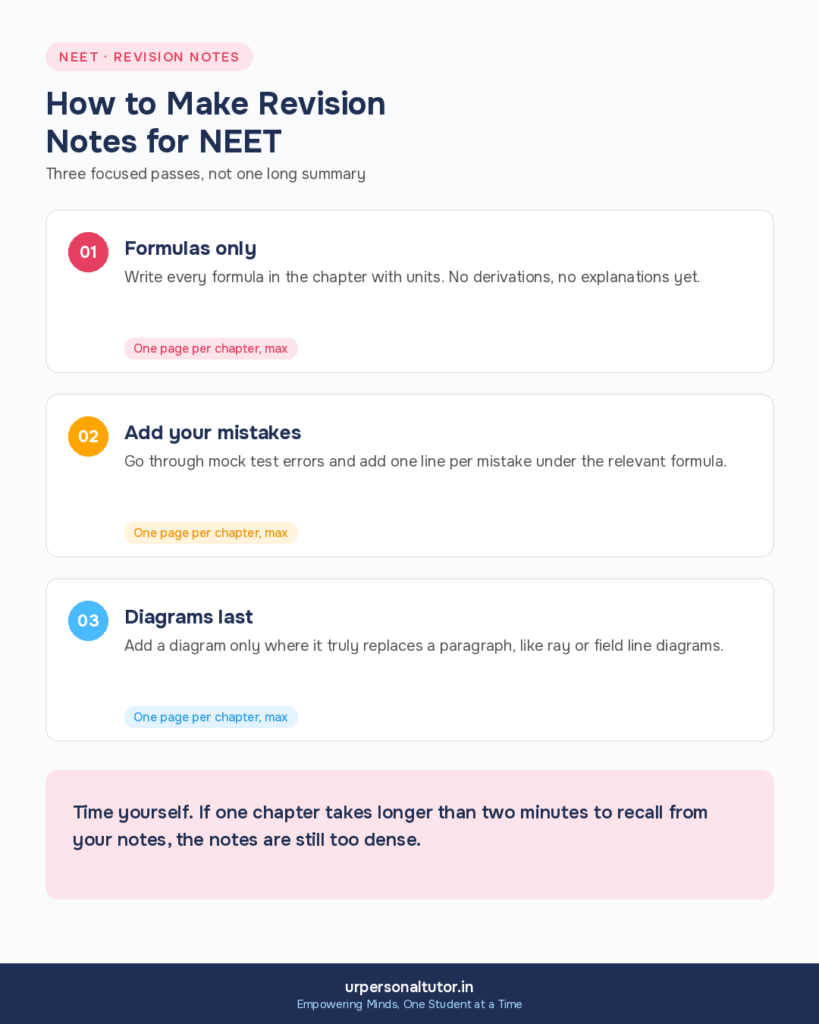
If you’re wondering how to make revision notes for NEET without burning the very time they’re supposed to save you, the answer is to build them in three passes rather than one long sitting.
First pass: write down every formula in the chapter with units, and nothing else. No derivations, no explanations. Second pass: go back through your mistakes from practice questions and mock tests, and add one line per mistake under the relevant formula. This is the part most students skip, and it’s the most valuable part, since your own errors are a far better predictor of what you’ll get wrong again than anything in the textbook. Third pass: add diagrams only where a diagram genuinely replaces a paragraph of text, like field line patterns or ray diagrams, not for the sake of having visuals.
Keep each chapter to one page, front and back at most. If a chapter is running to three pages, you haven’t condensed it, you’ve just made a smaller copy of your textbook. NEET has 180 questions across three subjects in 180 minutes, and Physics alone spans nearly 20 chapters by the time you’re revising the full syllabus. There isn’t room for anything longer than a page per chapter when exam day arrives.
Short Notes for NEET vs Long Notes: Why Length Matters More Than Detail
Short notes for NEET beat long notes for one simple reason: your revision time is fixed, but the number of chapters you need to cover isn’t shrinking. If your Physics revision notes run to 60 pages, you’ll spend your last week reading instead of recalling, and reading isn’t the same skill as retrieval under exam pressure.
A useful gut check is to time yourself. Pick up your notes for a chapter you finished revising last week and see how long it takes to go from opening the page to feeling confident you remember the whole chapter. If it’s over five minutes, the notes are too dense. Cut them down until a single chapter takes 90 seconds to two minutes to run through. That pace is what actually holds up during the final week, when you might be trying to revise 8 to 10 chapters in a single day across three subjects.
Short notes for NEET also force better prioritisation. When you only have half a page for a topic, you’re forced to ask which two or three things about it are actually tested, rather than including everything the chapter covers. That filtering is doing real cognitive work for you before you even sit down to revise.
NEET Last Minute Revision Notes: What Changes in the Final 30 Days
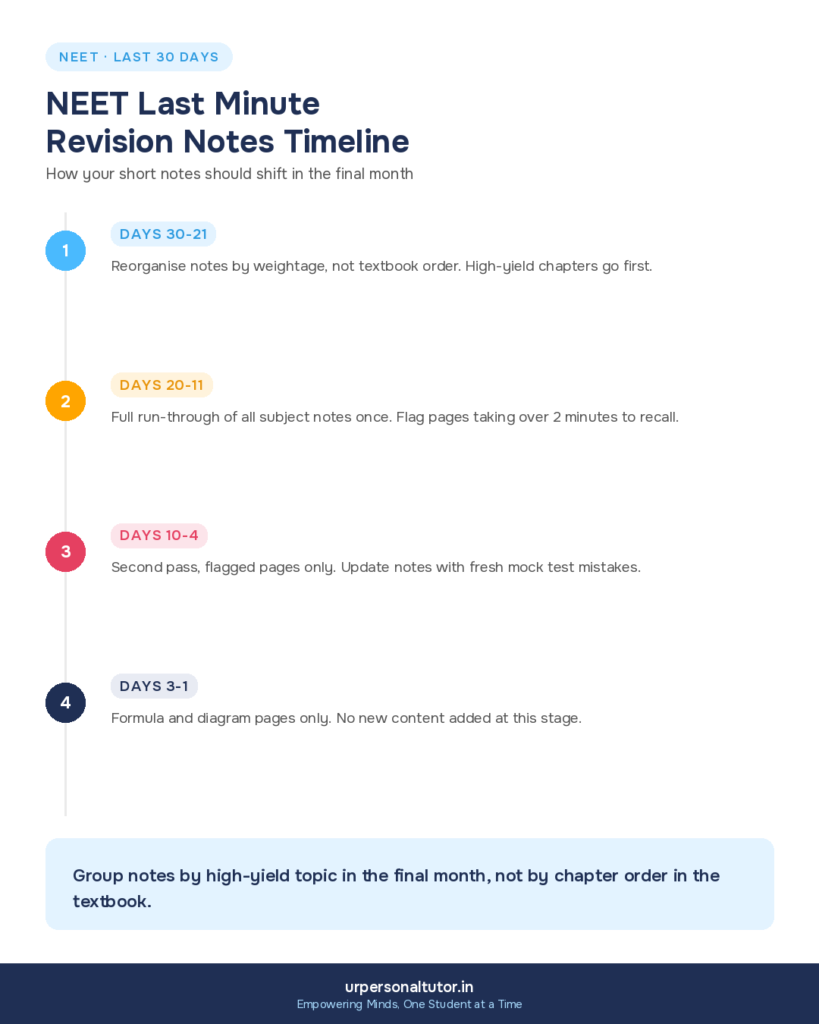
NEET last minute revision notes serve a narrower job than the notes you build through the year. In the last month, you’re not learning anything new from them. You’re doing rapid-fire recall checks, so the notes need to be structured for scanning, not reading line by line.
Group your last-minute notes by high-yield topic rather than by chapter order. Human Physiology, Genetics and Evolution, and Plant Physiology carry disproportionate weight in NEET Biology, and Physics chapters like Mechanics, Electrodynamics, and Modern Physics tend to dominate the Physics section. If your last-30-days notes are still organised the same way your textbook is organised, chapter one through chapter thirty, you’re not prioritising by what actually shows up most in the exam.
It also helps to track how many questions to solve per chapter for JEE and NEET before deciding how much space a topic earns in your notes, since chapters that pull more marks deserve a second read every single revision cycle. That one small habit, checking the questions you solved per chapter for JEE and NEET before you revise it, tells you instantly which pages deserve a second read in the final week and which ones you can skim once.
[INSERT INFOGRAPHIC 2]
Common Mistakes Students Make With Revision Notes for NEET
The most common mistake is writing notes once and never updating them. Revision notes for NEET should evolve every time you take a mock test. If a mock reveals you keep confusing two formulas, that correction belongs on the page immediately, not in a separate mental note you’ll forget by the next test.
Another mistake is colour-coding for the sake of it. Highlighting everything defeats the purpose of highlighting anything. Use colour only to flag the two or three points per chapter that have actually cost you marks before, whether that’s a sign convention you keep getting wrong or an exception to a rule that NEET loves testing.
A third mistake is treating Biology, Physics, and Chemistry notes the same way. Biology rewards dense factual recall, so slightly longer notes with more terms are fine there. Physics rewards formula and application recall, so notes should lean almost entirely on equations and one-line problem-solving cues. Chemistry sits in between, needing both reaction conditions and short mechanistic notes depending on the section.
Myth Check: Do Longer Notes Mean Better Preparation
A lot of aspirants assume that thicker notes signal more thorough preparation. It’s the opposite past a certain point. Notes exist to compress what you already know into something retrievable in seconds. Once a page takes longer to read than the time you’d spend re-deriving the concept from scratch, the notes have stopped doing their job. Detailed understanding still has to come first, built through class, textbooks, and practice questions. Revision notes for NEET are the last mile, not the main preparation. If your notes are carrying the weight of first-time learning, the problem isn’t the notes, it’s that revision started too early relative to how well the chapter had actually been studied.
Foundation matters here too. More often than not, a chapter that keeps feeling incomplete no matter how many times you rewrite it isn’t a note-taking problem at all. It’s the same foundational shortfall that explains why toppers fail in class 11, one that quietly resurfaces years later during NEET revision. If a note for a chapter never feels solid no matter how many times you rewrite it, the gap in why toppers fail in class 11 is worth ruling out before you blame the notes themselves.
Putting It Together: A Simple System for NEET Revision Notes
Build chapter notes only after solving a meaningful number of questions from that chapter, not while first learning it. Keep each chapter to one page. Update every note after every mock test based on what you actually got wrong. Reorganise your last-30-days notes by weightage rather than textbook order. And test your notes the same way you’ll use them on exam day, by timing how fast you can recall a full chapter from a single glance.
Done this way, revision notes for NEET stop being a backup copy of your syllabus and start being what they’re meant to be: the fastest possible route from a half-remembered concept to a confident answer, repeated across every chapter, every subject, right up to exam day. Consistent NEET physics preparation through the year is what makes this system work at all, since notes can only reinforce what’s already been built, not substitute for it.
If your revision notes keep growing instead of shrinking, or you’re not sure which chapters deserve the most weight in your final NEET revision, get in touch with us for a physics session built around your actual mock test data.
Frequently Asked Questions
How many pages should NEET revision notes be per subject?
There’s no fixed number, but as a working rule, aim for one page per chapter across Physics, Chemistry, and Biology. That keeps a full subject revision cycle to roughly 20 to 30 pages, which is realistic to get through multiple times before the exam.
Should I make revision notes digitally or by hand?
Handwritten notes tend to help recall more, since the act of writing forces you to condense information rather than copy-paste it. That said, digital notes are easier to update after every mock test, which matters more in the final two months. A mix works well: handwritten through the year, digital or quickly rewritten during the last 30 days.
Can I use someone else’s revision notes instead of making my own?
Borrowed notes are useful as a reference or a second opinion, but they reflect someone else’s weak points, not yours. The real value of building your own notes comes from the process of figuring out what you personally keep forgetting, which a borrowed set can’t replicate.
When should I stop adding new content to my revision notes?
Around two to three weeks before the exam. After that point, your notes should only be edited for corrections from mock tests, not expanded with new material. Adding fresh content too close to the exam eats into the time you need for repeated revision passes.