
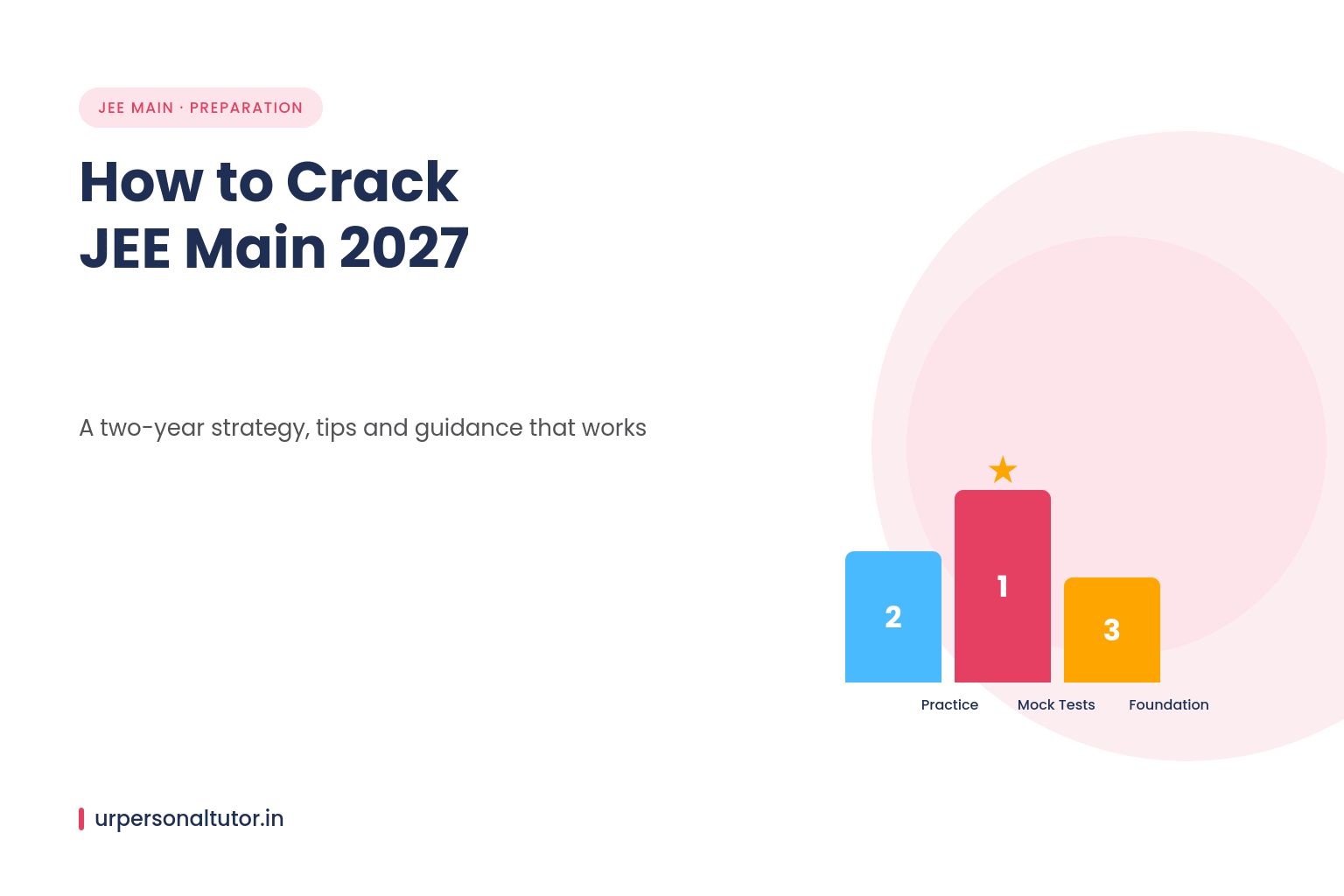
How to crack jee mains, the answer often comes down to three things done consistently over two years: building a strong Class 11 and 12 NCERT foundation, solving enough practice questions per chapter to expose gaps early, and running regular mock tests under real exam conditions before the actual attempt. Students who treat these as a system, not a last-minute scramble, tend to see steady percentile gains rather than lucky spikes.
If you’re a 2027 aspirant just starting out, or already midway through Class 11, this guide lays out a practical, month-by-month way to think about how to crack jee mains without burning out before results day.
Why How to Crack JEE Mains Isn’t One Trick
Search that phrase and you’ll find hundreds of generic checklists. Most miss the real issue: cracking JEE Main isn’t a single hack, it’s the compounding effect of small habits held over roughly 700 days of preparation. A student who solves 15 focused numericals a day for two years will outperform one who does 40 in a panic the week before, even if the second student “feels” like they studied harder.
The exam itself is designed to reward speed and accuracy under pressure, not just raw knowledge. NTA conducts JEE Main across two sessions, typically January and April, and takes the better of the two percentile scores. That structure alone should shape your strategy. A weak first attempt isn’t the end of your JEE Main preparation, it’s data you can act on before the second session.
Build the NCERT Foundation First
Before chasing reference books or coaching modules, physics, chemistry and maths NCERT textbooks need to be genuinely mastered, not skimmed. A large share of JEE Main questions, especially in chemistry, draw directly from NCERT lines that get glossed over in a first read.
Students often ask how to prepare for jee mains when they’re still catching up on Class 11 basics in Class 12. The honest answer is that skipping a shaky foundation rarely works out, and for many students that gap traces back to how hard class 11 even for toppers, hits them right after the relatively gentler pace of Class 10.
How Many Questions You Actually Need Per Chapter
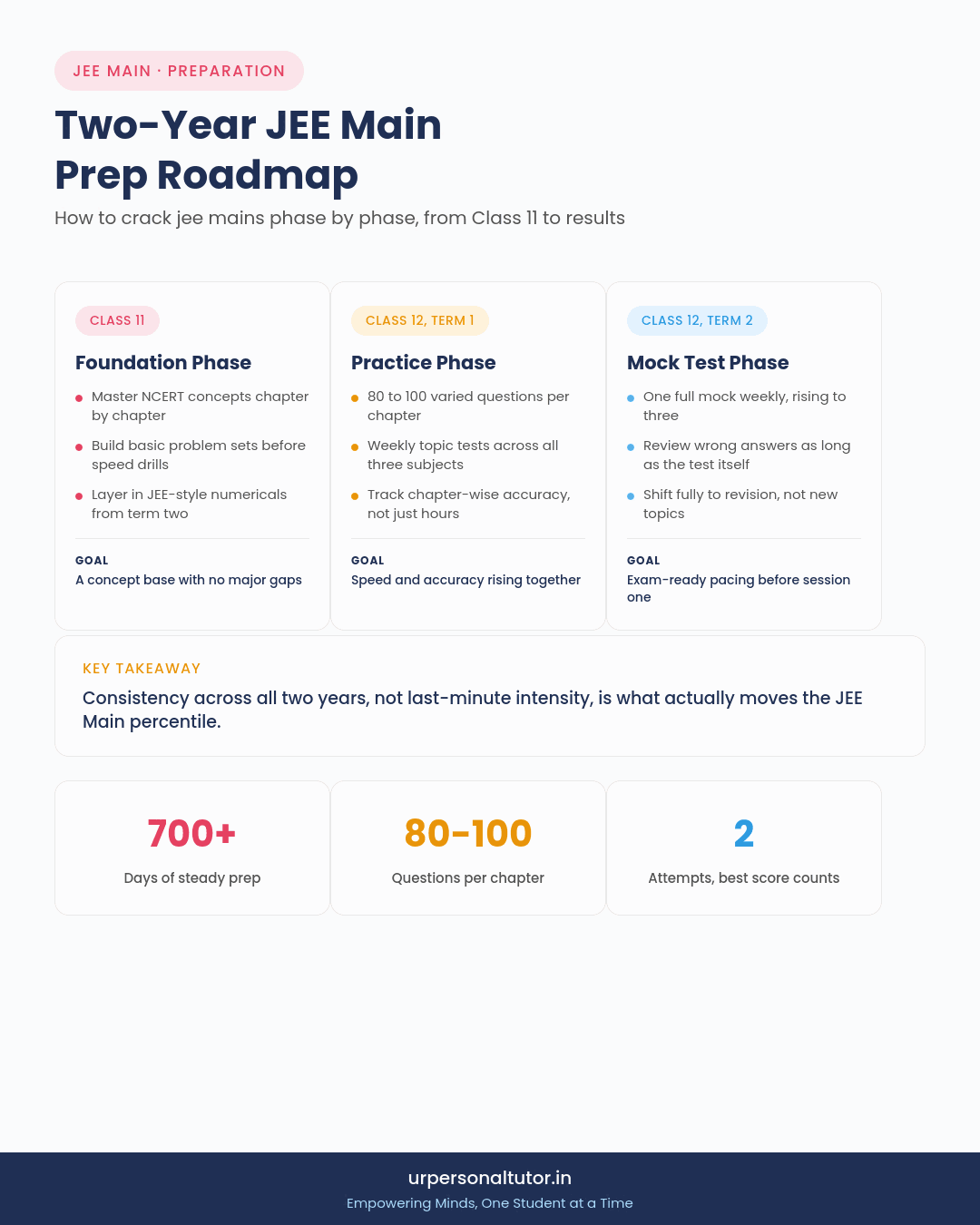
There’s no universal number, but a rough, tested benchmark works well: 80 to 100 varied-difficulty problems per chapter before you can call it “done” for a first pass, then a second pass closer to the exam focused only on the ones you got wrong. Students chasing quantity over pattern recognition often plateau around 60 to 70 percentile despite putting in long hours, simply because they never revisited their mistakes.
Chapter-wise targets help more than a flat daily quota, since a formula-heavy chapter needs a different question count than a concept-heavy one.
A Realistic Two-Year Timeline
Class 11, first six months: focus almost entirely on NCERT and foundational problem sets, without diving into JEE-level tricky questions too early. Class 11, second half: start layering in moderate JEE Main-style numericals alongside board exam prep, since the two overlap more than students expect.
Class 12, first half: this is where jee mains preparation intensity should rise sharply, with weekly topic tests and a growing focus on speed. Class 12, second half, roughly October through January: shift almost entirely into mock tests, revision, and error analysis rather than fresh content, since new topics rarely stick well this close to session one.
Mock Tests Are Not Optional
A student who has covered the entire syllabus but never sat a full three-hour mock under timed conditions is still underprepared. JEE Main rewards time management as much as subject knowledge, and that skill only builds through repetition under pressure, not through solving isolated questions at a relaxed pace.
Aim for at least one full-length mock per week starting four months before your session, rising to two or three per week in the final month. After each one, spend at least as long reviewing wrong answers as you spent taking the test itself. This single habit, more than any other single tip, tends to be the difference between two similar students landing five to ten percentile points apart.
Physics-Specific Problem Solving
Physics tends to separate strong JEE Main scorers from average ones faster than chemistry or maths, mostly because it punishes shaky conceptual understanding immediately rather than letting memorisation carry you through. A student who can recall a formula but can’t identify which scenario it applies to will lose marks consistently across mock after mock.
Getting comfortable with tricky JEE physics problems and solving them early, rather than avoiding the chapters that produce them, closes this gap faster than any amount of formula revision.
Common Mistakes That Slow Down Preparation
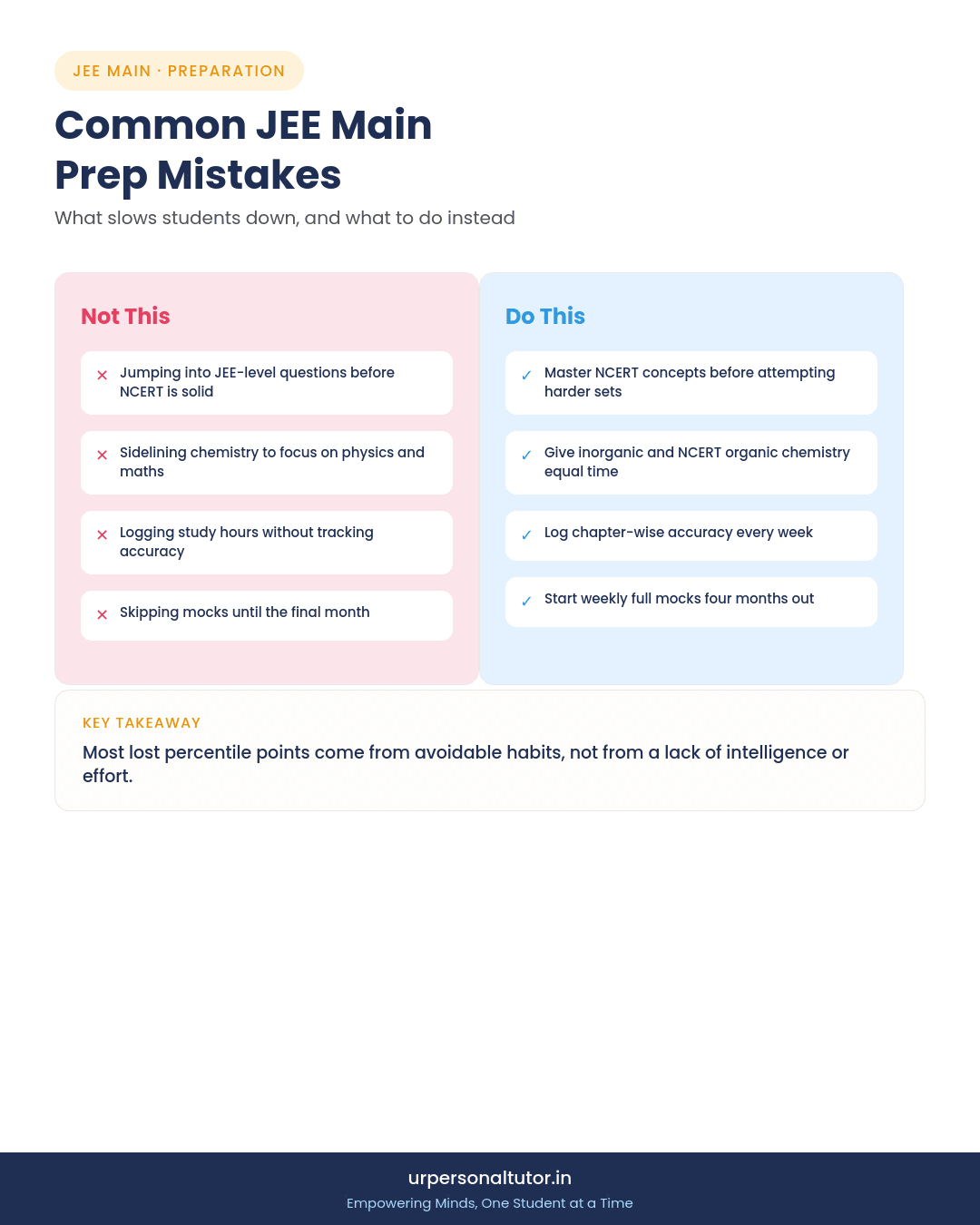
Jumping straight into JEE-level questions before NCERT concepts are solid is one of the most common ones, since it creates an illusion of progress that collapses under exam pressure. Ignoring chemistry, particularly inorganic and NCERT-based organic reactions, in favour of physics and maths is another, and it costs students marks that would have been easy to secure with less effort than a single tough physics numerical.
Studying without tracking accuracy is a third pattern worth naming. Hours logged mean very little if you can’t say whether your accuracy on a given chapter improved from last month. A simple weekly log of chapters attempted and percentage correct catches this early, long before it shows up as a disappointing mock score.
What Actually Moves the Percentile Needle
Consistency beats intensity almost every time in JEE Main preparation. A student studying five focused hours daily for two years will typically outscore one doing twelve hours sporadically for six months before the exam. The exam syllabus is fixed and known well in advance, so the variable that actually separates ranks is execution, not access to better material.
Time management within the exam itself matters just as much as preparation time. Students who practice deciding within 30 to 45 seconds whether a question is worth attempting now or skipping for later consistently score higher than those who get stuck on a single hard problem and lose ten minutes they needed elsewhere.
Frequently Asked Questions
Is coaching necessary to crack JEE Main, or can self-study work?
Both routes work, and results depend more on consistency and self-discipline than on the source of instruction. Self-study demands stronger time management since there’s no external structure forcing weekly progress, while coaching provides pacing but can’t replace the individual practice hours a student puts in independently.
How many hours a day should a JEE Main aspirant study?
There’s no fixed number that guarantees success, but most successful aspirants settle into 5 to 7 focused hours daily during Class 12, alongside school or coaching hours, rather than chasing unsustainable 12-hour days that lead to burnout by December.
Should I attempt both JEE Main sessions even if I score well in the first?
Yes, generally. NTA takes the better percentile of the two attempts, so a second session carries little downside and gives you a chance to improve on any section that underperformed the first time around.
What role does JEE Main percentile play compared to marks?
Percentile reflects your relative rank among everyone who appeared in that session, not a fixed score, which is why the same raw marks can produce different percentiles across sessions depending on how the overall cohort performed.
How different is JEE Main preparation from board exam preparation?
There’s substantial overlap in Class 11 and 12 syllabus content, but JEE Main tests application and speed under multiple-choice conditions, while boards reward detailed written answers, so the same topic often needs to be revised differently for each.
Book a Consultation
Knowing how to crack jee mains in theory is one thing. Building a schedule that actually fits your school timetable, current level, and weak chapters takes a plan built around you specifically, not a generic checklist. If you’d like structured, one to one physics tuition built around your actual gaps rather than re-teaching what you already know, get in touch to book a consultation and put together a realistic plan for JEE Main 2027.