
Neither an integrated course nor a regular school guarantees a JEE or NEET rank on its own. The integrated model buys you a tighter syllabus and less commuting. Regular school paired with outside coaching buys you a broader academic base and more choice in who teaches you physics. The right answer depends on how your child actually studies, not on which brochure sounds more impressive.
Most families researching this are stuck between three options after class 10: join an integrated school that bundles board curriculum with entrance coaching under one roof, stay in a regular school and add a coaching institute on the side, or stay in regular school and bring in private tuition instead of a large coaching batch. All three can work. All three can also fail a student who picks the wrong one for their learning style.
What “Integrated” Actually Means
An integrated school timetables coaching classes into the school day itself. Physics, chemistry and maths periods double as JEE or NEET prep, often taught by coaching faculty rather than regular school teachers. The pitch is efficiency: no separate commute, no clash between school homework and coaching assignments, one calendar instead of two.
In practice, integration varies a lot between institutions. Some genuinely merge the two syllabi so a single physics class covers board concepts and JEE-level problem solving together. Others just run a school in the morning and a coaching batch in the afternoon under one building, with almost no coordination between the two faculties. It’s worth asking a school directly how their integration works before assuming the label means what you think it means.
Regular School Plus Coaching: The Traditional Route
This is still the most common path in most Indian cities. School handles board exams, attendance and internal assessments. A separate coaching institute, joined either in class 11 or sometimes from class 9, handles JEE or NEET-specific problem solving.
The upside is choice. You can pick a coaching institute based on its actual results and teaching quality rather than accepting whichever faculty your school has hired. If a batch or a teacher isn’t working, switching is usually easier than switching schools mid-year. The downside is the load. Two institutions mean two sets of tests, two homework schedules, and a lot more travel time on some evenings. Study timetables for class 11 students that account for this dual load tend to matter more here than the choice of institute itself.
Integrated Course vs Regular School for JEE: The Real Trade-offs
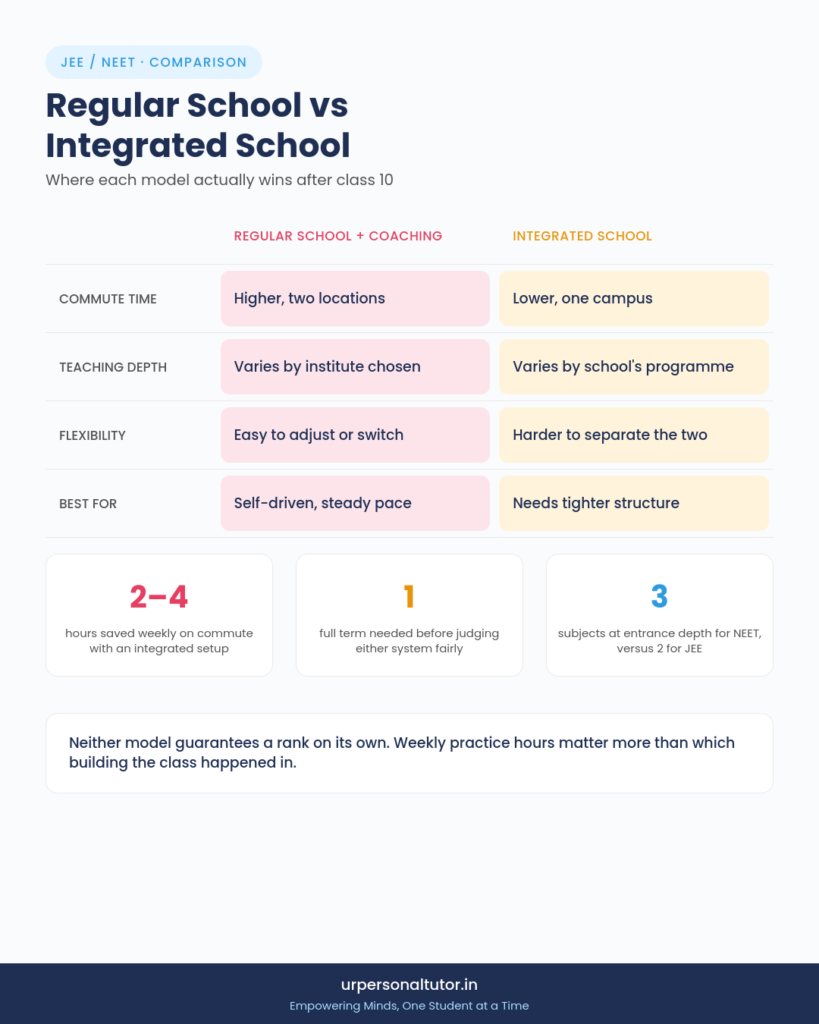
Strip away the marketing and the comparison comes down to three things: time, teaching quality, and flexibility.
Time favours integrated schools. Students save two to four hours a week that would otherwise go to commuting between school and a coaching centre. Over two years that adds up to real study hours, assuming the student actually uses the saved time to study rather than to rest.
Teaching quality is genuinely mixed on both sides. A well-run integrated programme has faculty who understand exactly how the board syllabus connects to entrance-level questions, which can make transitions smoother. A weak integrated programme rushes through concepts because the timetable is packed, leaving gaps that surface later in class 12. Regular school plus a strong coaching institute often gives deeper subject teaching precisely because the two are separate systems competing to prove their own worth.
Flexibility clearly favours the regular school route. If a student’s board performance starts slipping because all the energy is going into JEE prep, a separate tutor or coaching batch can be adjusted or dropped without uprooting the student’s entire school life. In an integrated system, school and coaching are the same institution, so there’s no clean way to dial one back without affecting the other.
School Coaching or Private Tuition: Which Actually Fits Better?
This is really a separate question from the integrated-versus-regular one, because tuition can sit inside either model. A student in a regular school might supplement large coaching batches with one-to-one physics tuition for the topics that don’t stick in a classroom of eighty students. A student in an integrated school might still need a tutor if the pace of the built-in coaching moves faster than they can absorb.
Large coaching batches work well for students who are self-driven and can keep pace with a fixed schedule regardless of whether that week’s topic clicked immediately. Private tuition works better for students who need the pace adjusted to them, who ask more questions than a group class has time for, or who are trying to fix specific weak topics rather than follow a full syllabus from scratch. Neither is universally “better.” One-to-one physics tuition tends to matter most in the gaps a batch environment can’t close, not as a full replacement for structured coaching.
Best Option After 10th for NEET: A Decision Framework
For NEET specifically, biology load changes the calculation. NEET students carry three subjects at entrance-exam depth instead of the two or three JEE students juggle, so time management becomes the deciding factor more than it is for engineering aspirants.
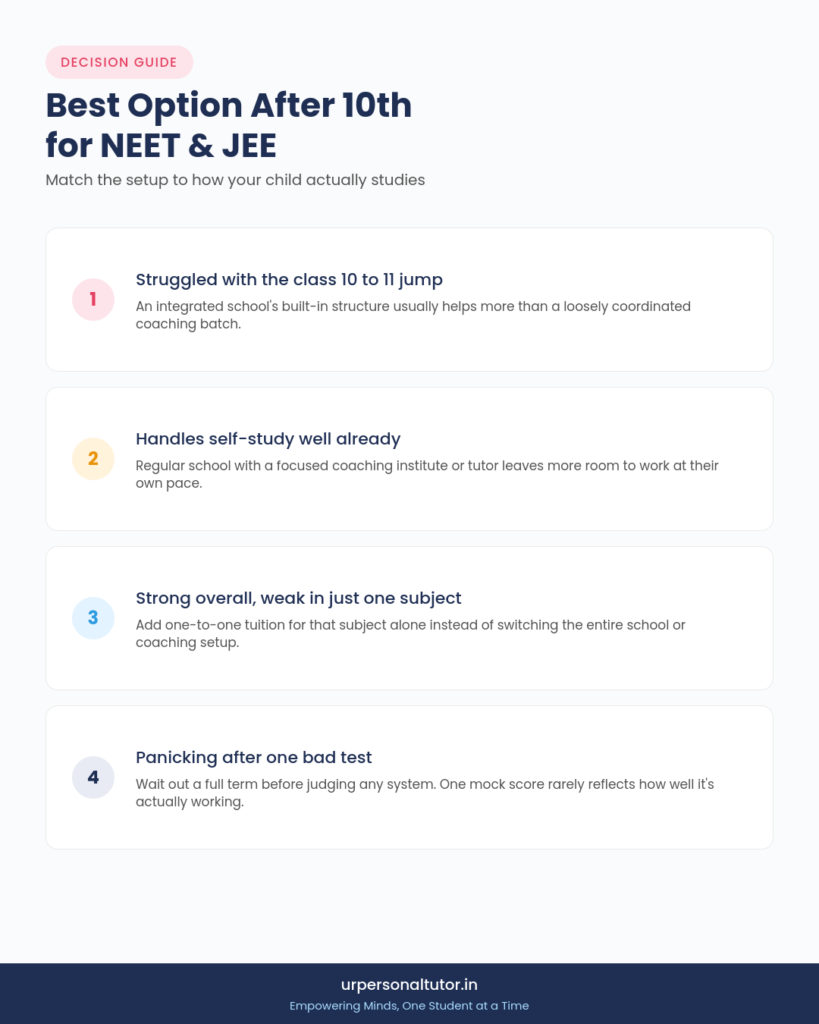
If your child struggled with the jump in difficulty and pace right after class 10, an integrated school’s tighter structure can help, since the coaching is baked into the day rather than something to squeeze in after school hours. If your child manages self-study well and just needs strong subject teaching, regular school with a focused coaching institute or tutor usually gives more room to breathe. Families often underestimate how much class 11 itself changes in difficulty regardless of which route they pick, and that adjustment period deserves as much attention as the institute’s brand name.
Where Private Tuition Fits In, Whichever Model You Choose
Tuition isn’t a fourth competing option so much as a support layer that works alongside either model. A student in an integrated school who’s falling behind in one subject doesn’t need to leave the school, just add focused tuition in that one area. A student in regular school without coaching at all can sometimes cover JEE or NEET-level physics through consistent one-to-one sessions rather than a full batch, particularly if their base concepts are already solid from school.
The mistake to avoid is stacking too many layers at once. School plus a large coaching batch plus private tuition in every subject usually leads to burnout rather than better scores, since the student ends up doing the same topic three times in three formats with no time left to actually practise problems independently.
Common Mistakes Families Make When Choosing
The most common error is choosing based on the previous year’s topper list rather than how the student actually studies. A school that produced one exceptional result doesn’t mean its system suits every learner who walks through the door.
The second mistake is switching mid-year out of panic after one bad test. Both integrated schools and coaching institutes need at least one full term before their approach can be judged fairly. A single mock test score, especially early in class 11, rarely reflects the system’s actual effectiveness.
The third is ignoring how many questions the student is actually solving per week versus how many hours they’re sitting in class. Attendance in coaching or an integrated programme isn’t the same as practice. Solving enough questions per chapter matters more to the final score than which building the lecture happened in.
Ready to figure out which setup actually fits your child? Book a consultation with Ur Personal Tutor and we’ll help you work out whether an integrated school, coaching, or focused one-to-one tuition makes the most sense for their pace and goals. Browse more preparation guides on the blog.
FAQs
Is an integrated course actually faster than regular school plus coaching?
Not faster in terms of syllabus content, since both cover the same board and entrance material eventually. It saves commuting time, which some students convert into extra study hours and others simply use to rest.
Can a student switch from an integrated school to regular school mid-course?
It’s possible but disruptive, since integrated schools often teach board topics in a different order or depth than a standalone board-affiliated school. A switch is easier before class 11 begins than partway through the two-year cycle.
Does private tuition replace the need for coaching entirely?
For some students, yes, particularly those with strong self-study habits who mainly need doubt-clearing and pace adjustment. For students who benefit from peer competition and a fixed test schedule, a batch environment usually still adds value tuition alone doesn’t replicate.
How do I know if my child needs an integrated school or more flexibility?
Look at how they handled the class 10 to 11 transition in the first two months. Students who adapted quickly to a faster pace often do well with an integrated structure. Students who needed more time to adjust usually benefit from the flexibility of a separate coaching or tuition arrangement they can modify as needed.
Is regular school with tuition enough for a top NEET or JEE rank?
Enough, yes, provided the tuition is consistent and the student is doing sufficient independent practice. Rank depends far more on hours of focused problem-solving than on which institutional model delivered the teaching.