
Start NEET Biology Preparation With NCERT, Not Reference Books
The right place to begin NEET biology preparation is the NCERT textbook, not a bulky reference guide picked up because a senior recommended it. Nearly 85 to 90 percent of NEET biology questions trace back directly to NCERT lines, diagrams, and examples. A beginner who starts with a thick reference book before NCERT usually ends up more confused, not less, because reference books add detail that NEET rarely tests at that depth.
That’s the direct answer. The rest of this guide walks through how to structure biology preparation for NEET from scratch, chapter by chapter, without wasting the first few months on the wrong material.
Why Biology Deserves Priority Early On
Biology carries the highest weightage of any subject in NEET, with 90 out of 200 questions coming from Botany and Zoology combined. That’s nearly half the exam. Yet a lot of beginners treat biology as the “easy, scoring” subject and push it to the side while focusing on physics and chemistry first. That’s backwards. Early NEET biology preparation should get real time on the calendar, not leftover hours after physics numericals are done.
Biology also rewards consistency more than intensity. A student who reads a chapter for thirty minutes daily for two months retains more than one who cram-reads the same chapter for six hours the weekend before a test.
Building Notes That Actually Help During Revision
Good biology notes for NEET preparation aren’t a copy of the textbook in smaller handwriting. They work best as a condensed, diagram-heavy summary that can be revised in under fifteen minutes per chapter closer to the exam. Three things make notes genuinely useful:
Write them chapter-wise, right after finishing that chapter in NCERT, while the concepts are still fresh. Draw diagrams yourself rather than pasting printed ones, since redrawing forces the brain to process structure instead of just recognising an image. Keep a separate page for numerical values, classifications, and exceptions, since these small details are exactly what beginners forget under exam pressure.
Skipping the note-making stage feels like it saves time early on, but it usually costs far more time later, when revision means rereading entire chapters instead of glancing at a condensed page.
How to Prepare for Biology for NEET Without Feeling Overwhelmed
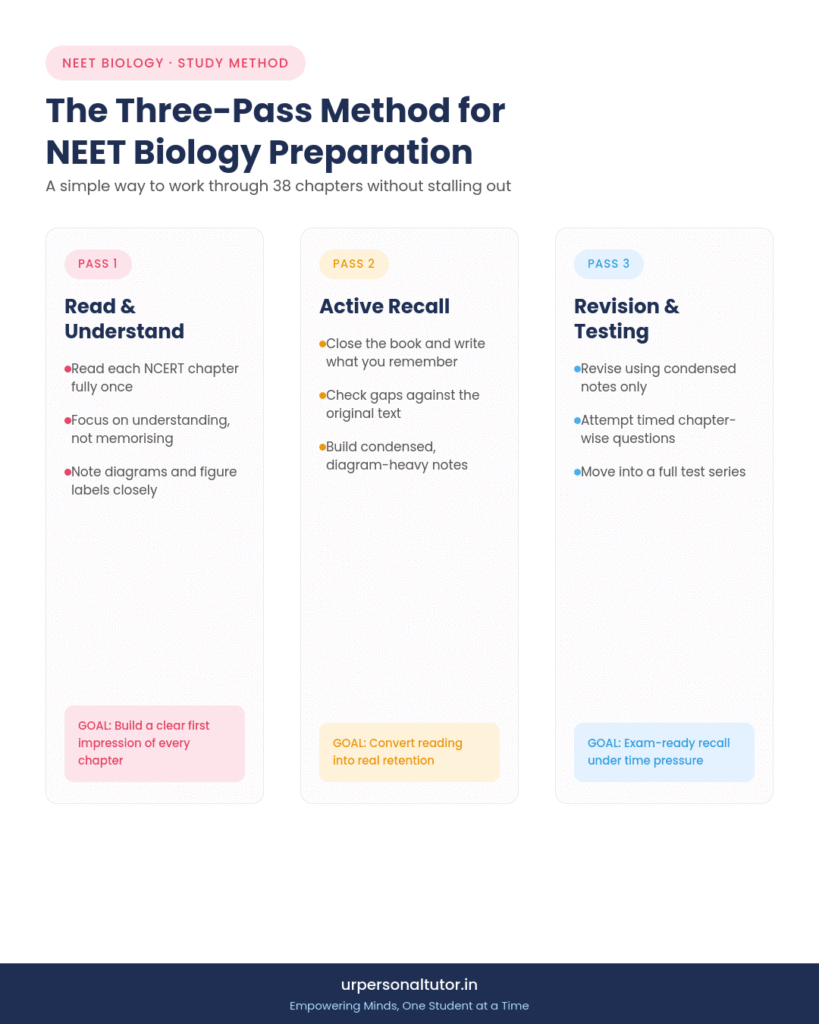
The syllabus looks massive at first glance, 38 chapters spread across Class 11 and Class 12. The way to prepare for biology for NEET without drowning in that volume is to split it into three passes rather than trying to master each chapter in one sitting.
The first pass is about reading and understanding, without worrying about retention. The second pass is active recall, where a student closes the book and tries to write down what they remember before checking against the text. The third pass, usually a few weeks later, is pure revision using the condensed notes built earlier. Beginners who try to perfect every chapter on the first read often stall out on early units and never reach the later ones before exams arrive.
NEET Preparation Tips for Biology: Which Chapters to Prioritise
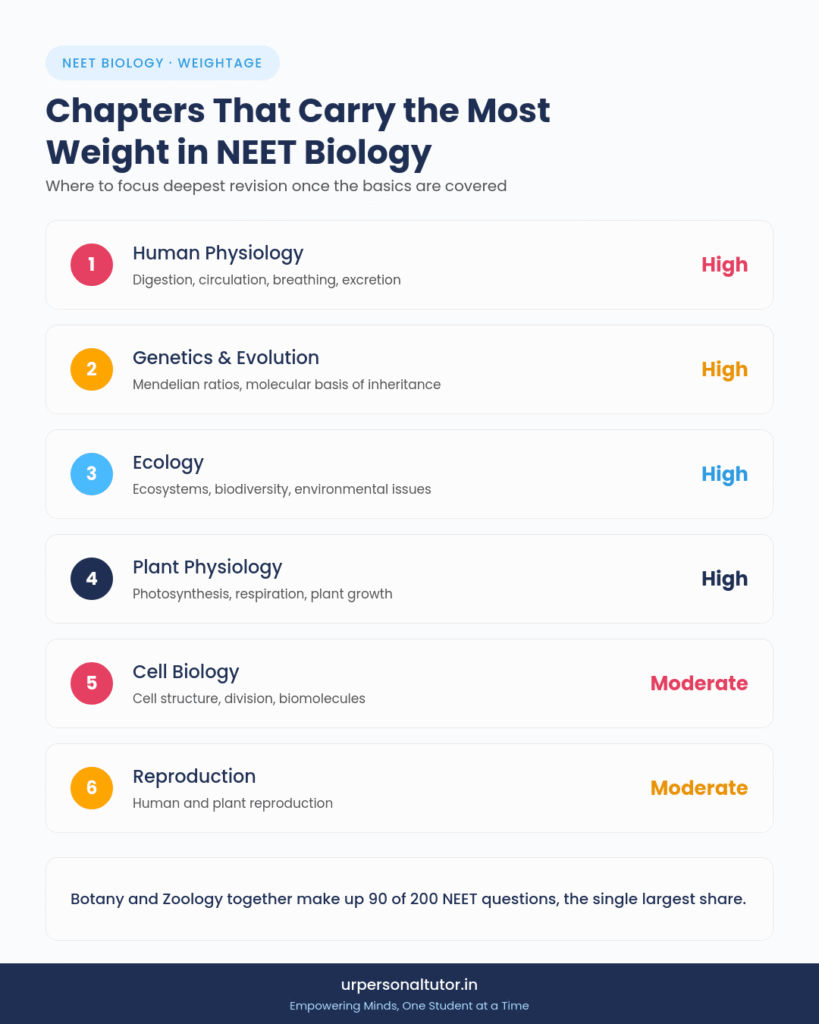
Not every chapter carries equal weight, and one of the most practical neet preparation tips for biology is to know that up front. Genetics and Evolution, Ecology, Human Physiology, and Plant Physiology together contribute a disproportionately large share of questions each year. Cell Biology and Biotechnology follow close behind.
That doesn’t mean other chapters can be skipped. Chapters like Reproduction and Human Health and Disease still show up reliably, just with slightly fewer questions attached. A beginner short on time should read every chapter at least once, but spend the deepest revision effort on the higher-weightage units first.
How to Prepare Biology Chapters for NEET, Unit by Unit
Botany Units
Plant Physiology and Plant Kingdom are the two chapters beginners underestimate the most. Both involve a lot of classification and process-based questions, which means diagrams and flowcharts help far more than plain text notes. Morphology of Flowering Plants is largely descriptive and rewards students who can visualise plant parts rather than just memorise terms.
Zoology Units
Human Physiology dominates this half of the syllabus. Digestion, Breathing and Exchange of Gases, and Body Fluids and Circulation are dense chapters, but they also repeat concepts across each other, so understanding one properly makes the next easier. Genetics and Evolution tends to intimidate beginners because of Mendelian ratios and molecular biology terminology, but it becomes manageable once broken into smaller sub-topics rather than tackled as one giant chapter.
Common Mistakes Beginners Make Early On
The most common mistake is jumping to solving previous year questions before finishing even one full read of NCERT. Question practice matters, but it works best once the foundation is in place, not as a substitute for it.
Another frequent mistake is ignoring diagrams and NCERT line-by-line details in favour of summarised online notes. NEET regularly picks questions directly from NCERT captions, footnotes, and figure labels, details that most third-party notes leave out entirely.
A third mistake is inconsistent daily time for biology. Physics and chemistry often get scheduled first because they feel harder, leaving biology squeezed into whatever time is left. Since biology carries the largest chunk of marks, it deserves a fixed daily slot, not the leftovers.
Turning Preparation Into a Weekly Routine
A simple weekly structure works better than an ambitious one that collapses after a few days. Four to five chapters get a first read each week, with thirty minutes set aside daily purely for revising notes from chapters already covered. Weekends work well for attempting timed questions on whatever was studied that week, since testing under a small time limit mimics exam conditions better than untimed practice does.
Once a few months of steady reading are behind you, working a proper test series for NEET into the routine becomes far more useful than it would have been at the very start, since there’s now enough covered syllabus to actually test.
Ready to Build a Proper Study Plan?
Starting biology the right way from day one saves months of relearning later. If figuring out a chapter-by-chapter schedule on your own feels like a lot to manage alongside physics and chemistry, one-to-one JEE and NEET tuition can help you build that plan properly
Frequently Asked Questions
How long does NEET biology preparation take for a complete beginner?
A realistic timeline for covering the full biology syllabus at a steady pace is 8 to 10 months, assuming daily study time and no major gaps. Compressing it into less time is possible but leaves little room for proper revision.
Is NCERT biology enough for NEET, or do I need extra books?
NCERT covers the vast majority of what NEET actually tests, and it should always be the base. Additional reference material can help clarify a difficult concept, but it should never replace NCERT as the primary source.
Should I study Botany or Zoology first?
There’s no fixed rule, but many beginners find Zoology’s Human Physiology chapters easier to stay motivated with early on, since the content connects to the human body and feels more tangible than plant classification.
How many hours a day should a beginner spend on biology?
Two to three focused hours daily is a reasonable starting point, split between reading new content and revising what was covered earlier in the week. Consistency matters more than stretching for longer sessions occasionally.
Can biology alone get me a good NEET rank if physics and chemistry are weak?
No single subject can carry the full result. Biology’s weightage makes it important, but NEET ranks depend on a balanced score across all three subjects, so physics and chemistry still need real, steady attention.