
Physics practicals are worth a significant chunk of your final score, and yet students treat them as an afterthought. They prepare for theory for months, then walk into the practical exam having done each experiment once. The result is lost marks that were almost free.
Practicals reward habits, not genius. Whether you are in CBSE, ICSE or IGCSE, the same core skills earn marks: accurate readings, clean tables, honest graphs and clear precautions. Here is how each board assesses practical Physics, and how to secure full marks.
How Each Board Assesses Practicals
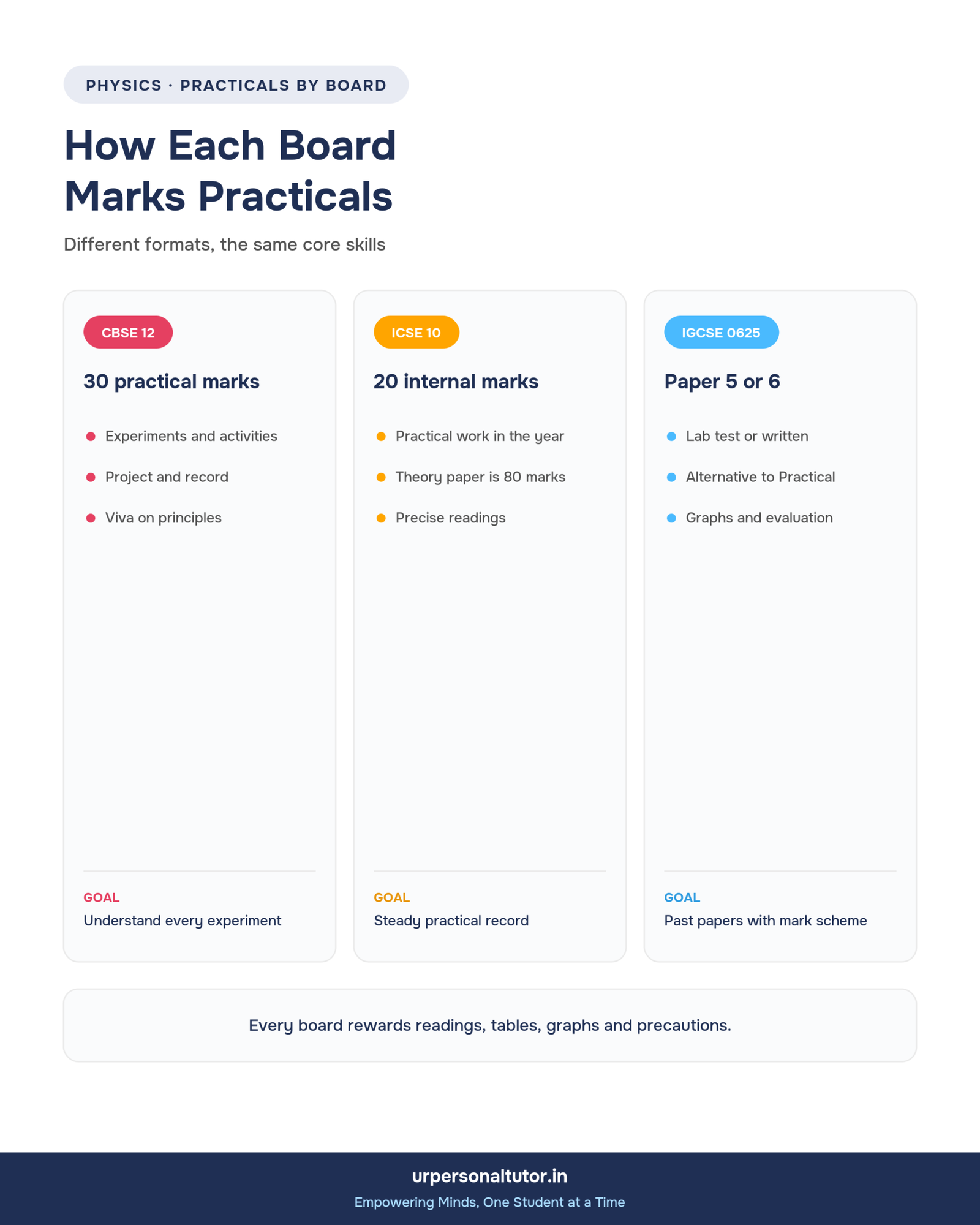
CBSE Class 12: Physics has 70 theory marks and 30 practical marks. The practical assessment includes experiments, activities, a project, the practical record and a viva. Class 10 Science includes internal assessment worth 20 marks.
ICSE Class 10: Physics theory is 80 marks, with 20 marks of internal assessment based on practical work through the year.
IGCSE Physics (0625): Students sit either Paper 5, a practical test in the lab, or Paper 6, the Alternative to Practical, a written paper testing practical skills. Both test the same skills: measuring, recording, graphing, concluding and evaluating.
The format differs, but the skills overlap almost completely.
Skill 1: Take Readings Properly
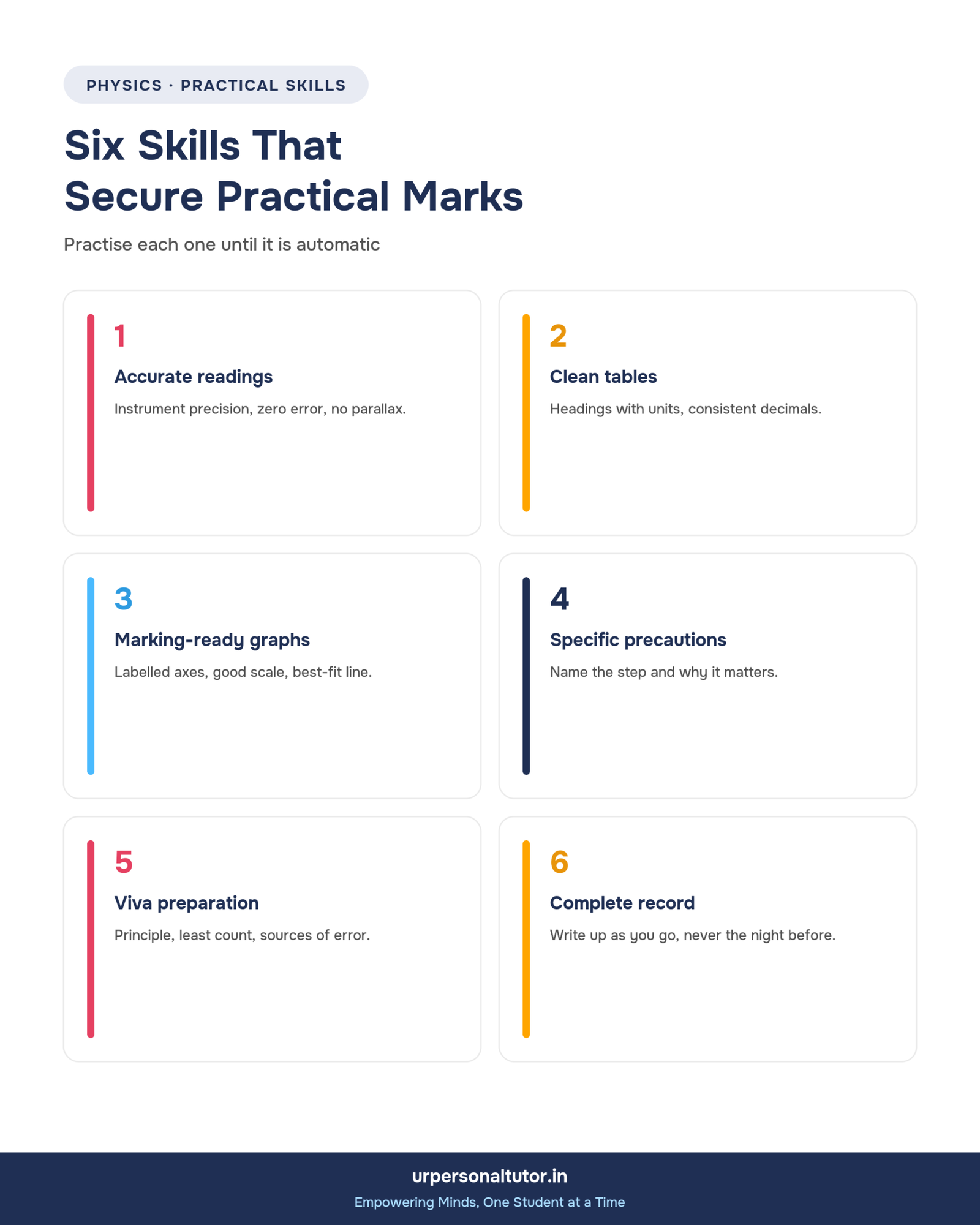
- Record every reading to the precision of the instrument. A metre rule reads to 0.1 cm, a vernier caliper to 0.01 cm, a screw gauge to 0.001 cm.
- Check and correct zero error before measuring.
- Avoid parallax by reading scales at eye level.
- Take repeat readings and calculate averages where appropriate.
Skill 2: Build a Clean Observation Table
Examiners look for tables with column headings that include units, for example “length / cm” or “time / s.” Keep decimal places consistent within each column. Never cross out and overwrite readings messily; draw a single line through an error and write the correct value beside it.
Skill 3: Draw Graphs That Earn Marks
Graph marks are some of the most reliable in any practical:
- Label axes with quantities and units
- Choose a scale that uses more than half the graph paper
- Plot points accurately with small crosses or dots in circles
- Draw a smooth line or best-fit straight line, not dot-to-dot
- Show the gradient triangle large, with values read clearly
Skill 4: State Precautions and Sources of Error
Generic precautions like “be careful” earn nothing. Specific ones earn marks: “The current was switched off between readings to prevent the resistance wire heating up.” Learn two or three specific precautions for each standard experiment.
Skill 5: Prepare for the Viva (CBSE)
The CBSE viva tests whether you understand the experiment you performed. Expect questions such as: What is the principle of this experiment? What is the least count of this instrument? What would happen if you changed this variable? Revise the theory behind each experiment, not just the procedure.
Skill 6: Keep a Complete Practical Record
For CBSE and ICSE, the practical file or record counts. Write up each experiment with aim, apparatus, diagram, theory, observation table, calculations, result and precautions. Complete it as you go, not the night before submission.
How to Practise
Do each standard experiment at least twice before the exam. For IGCSE Paper 6, solve past papers with the mark scheme, because the question styles repeat closely. Practise drawing graphs quickly, as time pressure is real in practical exams.
Frequently Asked Questions
How many marks are Physics practicals in CBSE Class 12?
CBSE Class 12 Physics has 30 practical marks covering experiments, activities, a project, the practical record and a viva, alongside 70 theory marks.
What is IGCSE Physics Paper 6?
Paper 6 is the Alternative to Practical, a written exam that tests practical skills such as reading instruments, recording data, plotting graphs and evaluating experiments, without lab work.
How do I avoid errors in Physics practicals?
Check zero error, avoid parallax, record readings to the instrument’s precision, take repeats, and keep decimal places consistent in your tables.
What questions are asked in a Physics viva?
Common viva questions cover the principle of the experiment, least count of instruments, sources of error, precautions, and how results would change if a variable were altered.
How do I draw a good graph in Physics practicals?
Label axes with units, use more than half the paper, plot points accurately, draw a best-fit line, and use a large triangle to calculate the gradient.
Practical marks should be secure marks. Ur Personal Tutor helps CBSE, ICSE and IGCSE students master practical skills alongside theory. Book a free first session.