
IGCSE generally demands more academic support than GCSE, mainly because of its wider syllabus, greater independent-study load, and heavier weighting on final exams rather than coursework. GCSE students still need help, particularly with exam technique and time management under the newer 9-1 grading system, but the sheer breadth of an IGCSE grading system and syllabus — especially in Maths, Sciences, and English — tends to catch families off guard. Below, we break down exactly where each curriculum puts pressure on students and where tutoring makes the biggest difference.
What Is the Real GCSE vs IGCSE Difference?
The GCSE (General Certificate of Secondary Education) is the standard qualification taken by students in England, Wales, and Northern Ireland, usually between Year 10 and Year 11. The IGCSE (International GCSE) is Cambridge International’s version of the same qualification, designed for schools outside the UK, including a large number in India, the UAE, and Southeast Asia.
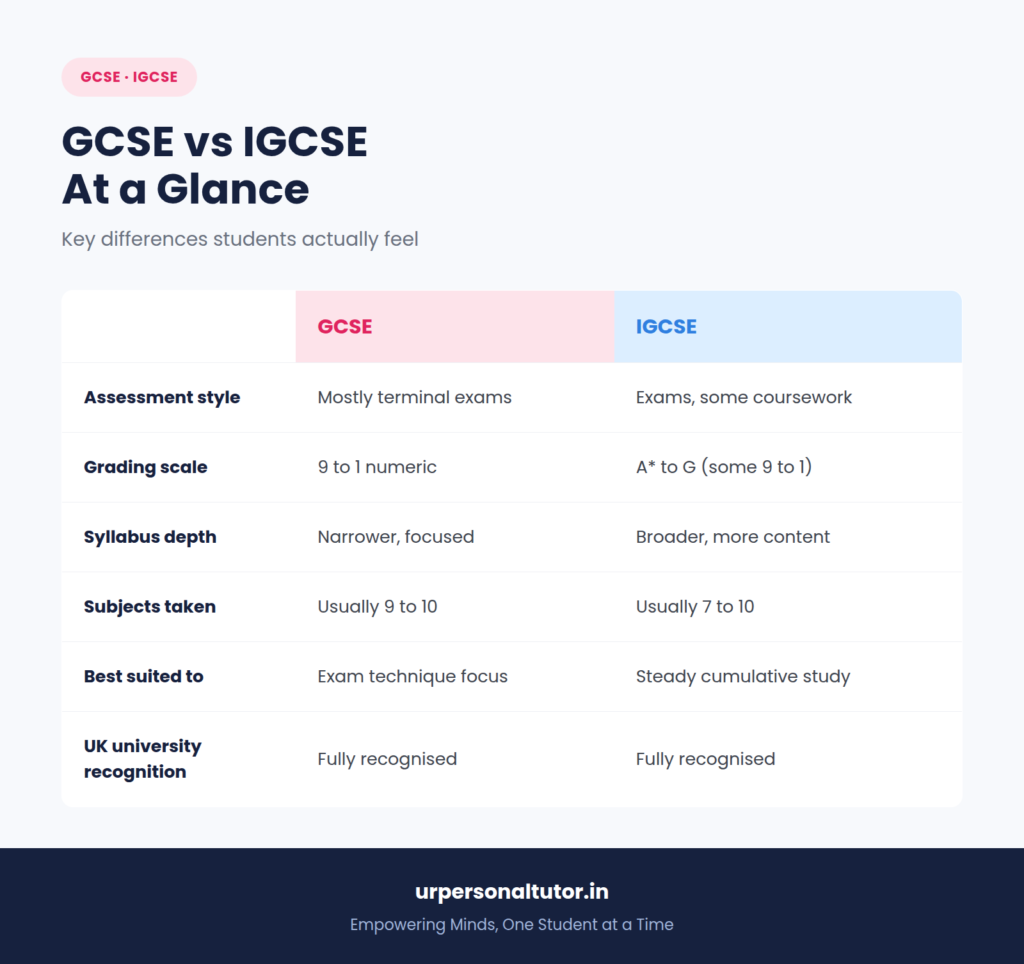
On paper, the two look similar. Both are typically taken at age 14 to 16. Both feed into A Levels, IB, or other pre-university programmes. The real GCSE vs IGCSE difference shows up in three places: syllabus content, assessment style, and coursework weighting.
GCSE has moved almost entirely toward terminal exams, meaning a student’s final grade in most subjects rests on exams sat at the end of Year 11. IGCSE, depending on the exam board and subject, still allows coursework or a mix of components in subjects like English and some sciences, though even here the trend has shifted toward exam-heavy assessment in recent years. This distinction matters more than most families realise when deciding where extra academic support should go.
GCSE vs IGCSE Difficulty: Which One Is Actually Harder?
There’s no single answer that applies to every subject, but IGCSE syllabuses are usually written with more content per subject, particularly in Maths, Physics, Chemistry, and Biology. A typical IGCSE Maths syllabus, for instance, includes topics like matrices, vectors, and set notation that don’t always appear at the same depth in GCSE Maths.
That said, GCSE’s grading system (9-1, with 9 being the highest) is often described by students as unforgiving. A single careless error in an exam can shift a grade band because so much weight sits on one sitting. So when people ask about igcse vs gcse difficulty, the honest answer is: IGCSE tends to be harder in terms of content volume, while GCSE can feel harder in terms of exam pressure and margin for error.
Where a student struggles usually depends on their learning style. A student who works well with steady, cumulative revision over two years often does fine with IGCSE’s breadth. A student who needs more structured, exam-focused preparation closer to test dates sometimes finds GCSE’s terminal-exam model more manageable, provided they get consistent support building up to it.
IGCSE Maths vs GCSE Maths: Where Students Struggle
IGCSE Maths vs GCSE Maths is one of the most searched comparisons, and for good reason. Parents moving a child from a CBSE or ICSE school into an international curriculum, or vice versa, often assume the maths content lines up neatly. It doesn’t always.
IGCSE Maths (particularly the Extended tier from Cambridge or Edexcel) covers a broader range of topics at a faster pace, and problems are frequently set in unfamiliar, applied contexts rather than the more predictable question formats seen in GCSE papers. Students accustomed to formulaic practice sometimes struggle with the wording and multi-step reasoning IGCSE questions demand.
GCSE Maths, by comparison, has a narrower syllabus but tests it more intensively, with a strong emphasis on problem-solving questions that combine two or three topics in a single question. A student weak in algebra, for example, will find that weakness exposed repeatedly across a GCSE Maths paper, since algebra threads through so many question types.
In our tutoring sessions, the most common gap we see isn’t a lack of raw ability. It’s a mismatch between how a student was taught to approach maths problems and how the specific exam board expects those problems to be answered. That gap closes quickly with targeted, board-specific practice.
IGCSE English vs GCSE English: Different Skills, Different Support Needs
The igcse english vs gcse english comparison brings its own quirks. GCSE English Language and Literature (in the UK system) lean heavily on close textual analysis of a fixed set of prescribed texts, often Shakespeare, a 19th-century novel, and a modern play or novel, alongside unseen poetry and prose comprehension.
IGCSE English, especially IGCSE First Language English for non-native or international students, places more emphasis on comprehension, summary writing, and directed writing tasks such as letters, articles, and speeches. Some IGCSE English syllabuses include a spoken language component that GCSE has largely dropped from formal assessment.
Students moving between the two systems sometimes lose marks simply because they’re applying the wrong exam technique. A student trained for GCSE-style literary analysis can over-analyse an IGCSE comprehension passage instead of answering the question directly. A student used to IGCSE’s more functional writing style can under-develop the literary commentary a GCSE examiner expects. This is one area where a tutor familiar with both syllabuses genuinely earns their keep, because the fix is almost always about technique rather than raw language ability.
Which Curriculum Needs More Academic Support: GCSE or IGCSE?
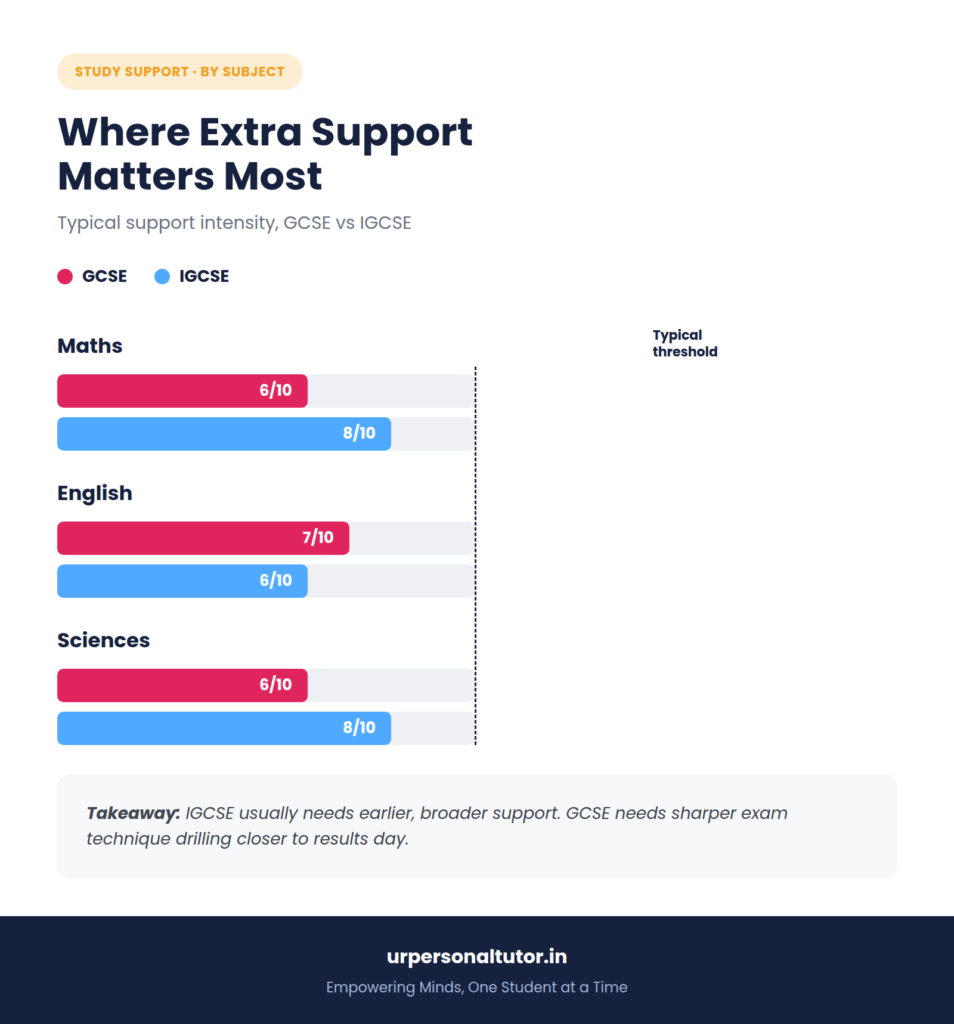
Pulling this together, IGCSE usually needs more sustained academic support across the two-year period, simply because there’s more content to cover and less room for a student to coast on strong exam technique alone. Families with children on an IGCSE track often benefit from starting structured support in Year 9, well before the exam years begin, to build the subject depth the syllabus demands.
GCSE students, meanwhile, benefit most from support that intensifies closer to exams, focused on past-paper practice, timing, and precision under the 9-1 grading system. Both approaches work. What doesn’t work is applying one strategy to the other curriculum. A GCSE-style cramming approach applied to IGCSE’s broader syllabus tends to leave gaps; an IGCSE-style slow-build approach applied to GCSE can leave a student under-drilled on exam technique when it matters most.
How Parents Can Identify Where Extra Support Is Needed
A few signs tend to show up early. A student who understands concepts in class but scores poorly on past papers is usually facing an exam-technique gap rather than a knowledge gap, common in GCSE. A student who finds homework manageable but panics at the sheer range of topics on a mock exam paper is often facing a breadth problem, more typical of IGCSE.
Mock exam results, marked against the actual grade boundaries for that exam board, tell you far more than end-of-term report cards. If a student’s mock score sits well below their coursework or classroom performance, that gap is worth investigating with a tutor who knows the specific board’s marking scheme, whether that’s Cambridge, Edexcel, AQA, or OCR.
Common Misconceptions About GCSE vs IGCSE
A lot of confusion around GCSE vs IGCSE comes from outdated or overly simplified claims. It’s worth clearing a few up directly.
“IGCSE isn’t recognised by UK universities.” This isn’t true. UK universities treat IGCSE and GCSE grades as equivalent for admissions purposes, and IGCSE is widely accepted precisely because it was designed with the same academic rigour in mind.
“GCSE is always easier.” As covered above, this depends heavily on the subject and the student. GCSE’s narrower syllabus can still be demanding, particularly under exam conditions where a single mistake carries more weight.
“A student who did well in CBSE or ICSE will automatically do well in IGCSE.” Subject knowledge transfers, but exam technique doesn’t transfer automatically. Without guidance on how each board expects answers to be structured, even a strong student can underperform relative to their ability.
Getting the Right Support for Either Curriculum
Whether a student is on a GCSE or IGCSE track, the support that actually moves grades is specific: board-aware, subject-aware, and built around where that individual student’s gaps actually sit, not generic revision advice. AtUr Personal Tutor sessions, our IGCSE tuition and GCSE-focused strategies in Physics, Chemistry, Maths, and Biology are built around exactly this kind of board-specific, one-on-one preparation, and we also support students transitioning into AS & A Level work once GCSE or IGCSE exams are behind them.
If you’re trying to work out where your child needs support,get in touch for a personal tutor and we’ll help map out a plan based on their actual mock results and syllabus, not guesswork.
Frequently Asked Questions
Can a student switch from GCSE to IGCSE partway through their studies?
It’s possible but not ideal after Year 10, since syllabus content and assessment structure differ enough that a mid-course switch usually requires catch-up work in at least one or two subjects, most often Maths and Sciences.
Do UK universities treat GCSE and IGCSE grades differently?
No. UK universities generally treat IGCSE grades as equivalent to GCSE grades for admissions purposes, since both are recognised, externally assessed qualifications.
Which grading scale does each curriculum use?
GCSE in England uses the 9-1 numerical scale. IGCSE typically uses the A*-G scale, though some exam boards now also offer 9-1 grading for IGCSE in select subjects, so it’s worth checking with the specific board.
Is IGCSE a good option for students moving from CBSE or ICSE schools?
Yes, IGCSE is a common pathway for students transferring from Indian curricula into international or UK-bound education, though most benefit from a term or two of targeted support to adjust to the exam board’s question style and marking expectations.
How many subjects do students usually take at GCSE versus IGCSE?
Most GCSE students take 9 to 10 subjects, while IGCSE students commonly take between 7 and 10, depending on the school. The core academic load in Maths, English, and Sciences is broadly similar across both.