

Is Physics Hard? The Honest Answer for JEE and NEET Aspirants
No, physics is not inherently hard. It is dense, cumulative, and unforgiving of gaps, which feels the same as “hard” when you’re the one stuck on a rotational dynamics problem at 11 pm. But the subject itself is built on a small set of ideas, applied over and over. Students who struggle usually aren’t facing a harder subject than their classmates. They’re facing the same subject with a weaker foundation, less practice volume, or a teaching style that never connected the formula to the physical picture behind it.
That distinction matters more than it sounds. If physics were genuinely hard in some fixed, unchangeable sense, coaching, tutoring, and revision plans wouldn’t move the needle. They do, consistently, which tells you the difficulty is mostly a function of how the subject is approached, not some ceiling baked into the topic.
Why Does Physics Feel Difficult in the First Place?
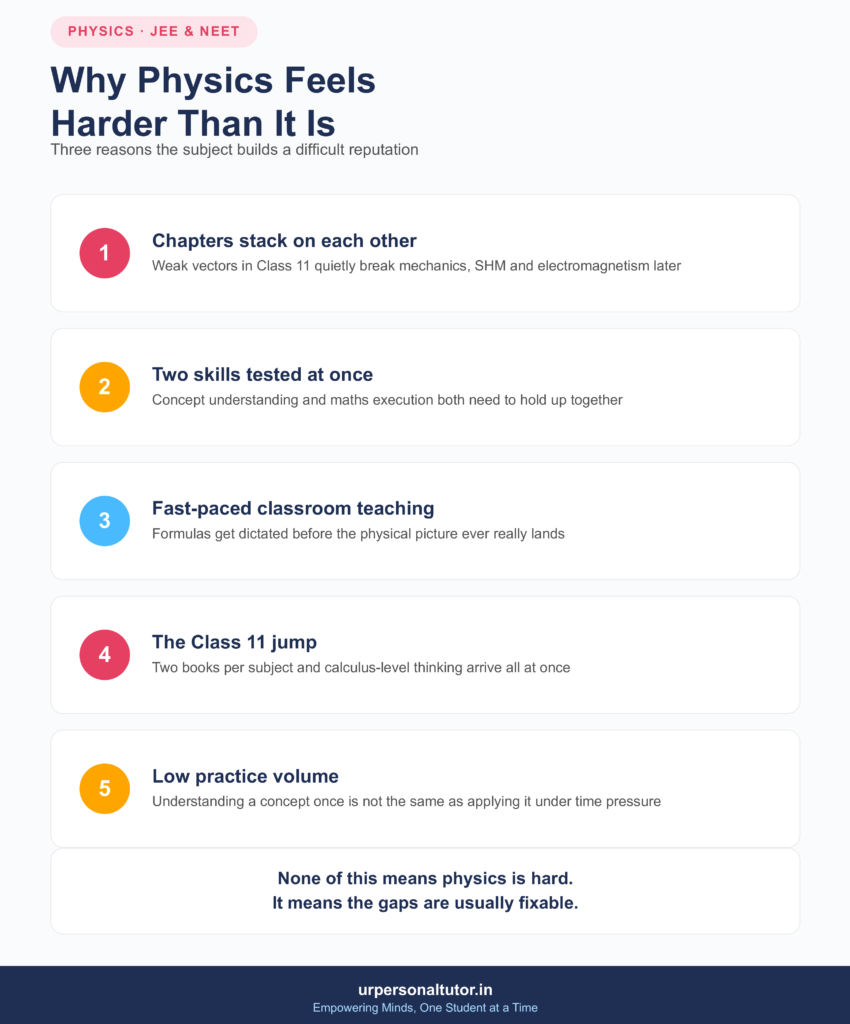
Three things make physics feel harder than it is.
First, it stacks. Miss the vector basics in Class 11 and every mechanics chapter after it wobbles. Unlike history or even chemistry, where a weak chapter can be somewhat isolated, physics chapters lean on each other. A shaky grip on Newton’s laws will quietly sabotage rotational motion, SHM, and even parts of electromagnetism months later.
Second, it demands two skills at once: conceptual understanding and mathematical execution. A student can genuinely understand why a pendulum’s period depends on length and still lose marks because their calculus or trigonometry slipped. Parents and students often diagnose this as “I’m bad at physics” when the real gap is applied maths.
Third, most classroom teaching moves too fast to build intuition. Formulas get dictated, students copy them down, and the underlying physical picture never fully lands. That’s a teaching and pacing problem, not proof that the subject is genuinely difficult.
Is Physics a Difficult Subject, or Is It Taught Wrong?
This is worth separating clearly. Is physics a difficult subject in some absolute sense, or is it difficult the way any subject becomes difficult when it’s rushed? Ask any student who’s had one good teacher explain torque with a spanner and a bolt, versus one who wrote the formula on a board and moved on. Same syllabus, wildly different experience of difficulty.
This is also why Class 11 feels so difficult after 10th catches so many toppers off guard. Two books per subject, faster pacing, and physics suddenly demanding calculus-level thinking, all at once. Students who were fine in Class 10 physics can feel like the subject “got hard” overnight. It didn’t get harder. The expectations changed faster than their study habits did.
Why Is Physics Difficult for JEE Aspirants Specifically
For JEE, is physics hard depends heavily on which physics you mean. Class 11 and 12 board-level physics and JEE-level physics are not the same animal. JEE physics demands multi-concept problems, tight time limits, and problems designed to punish rote formula plugging. A student who memorised without understanding will hit a wall the moment a question combines kinematics with energy conservation in a way they haven’t seen before.
The good news: JEE physics rewards depth over memorisation more than JEE chemistry does. Once a student has gone through a proper foundation course for JEE and NEET, they can solve variations of a concept they’ve never practiced. That’s not true of, say, organic chemistry reaction memorisation. So while JEE physics has a steeper initial climb, it plateaus into something more manageable once the fundamentals are locked in.
How Difficult Is Getting Physics UG-Level Marks in JEE?
How difficult is getting physics UG in JEE, meaning scoring at the level that gets you into a good undergraduate seat, comes down to volume and error correction more than raw talent. JEE Advanced-level physics concept typically test two or three concepts stitched together, and most students lose marks not from ignorance but from small errors under time pressure: a sign flip, a missed constraint, an unchecked unit.
Physics vs Chemistry in JEE: Which One Is Actually Harder?
Is chemistry of JEE difficult as compared to physics is one of the most common questions students ask before Class 11 even starts. The honest answer: it depends on the type of intelligence you’re relying on.
Physical and inorganic chemistry lean heavily on memorisation. Organic chemistry rewards pattern recognition once you’ve internalised reaction mechanisms. Physics rewards conceptual depth and mathematical comfort. A student with a strong memory but weaker maths instincts often finds chemistry more approachable early on, then hits a ceiling in physics later. A student who’s comfortable with equations but has a weaker memory for reagent lists tends to find the opposite.
Neither is objectively harder. What’s true is that chemistry has more low-hanging fruit for quick score gains through memorisation, while physics has a higher ceiling once the concepts click, and a slower start while they don’t.
Is NEET-UG Physics Harder Than IIT-JEE Physics?
Is NEET-UG physics difficult than IIT-JEE physics is a question every NEET aspirant eventually asks, usually while comparing notes with a JEE friend. NEET physics questions are generally less multi-layered than JEE Advanced questions. They test the same syllabus but expect faster, more direct application rather than combining three concepts into one problem.
That said, NEET physics is not “easy” by comparison. It’s a different kind of demand: speed and accuracy over 45 questions in limited time, with negative marking that punishes guesswork. Many NEET aspirants underestimate physics because biology dominates their study hours, and the truth is NEET physics preparation is difficult to ignore when it comes to where marks actually get lost.
5 Habits That Actually Make Physics Easier
None of these are shortcuts. They’re just what consistently separates students who stop asking “is physics hard” and start treating it as manageable.
Draw the diagram before touching the formula. A free body diagram or a labelled sketch forces you to understand the setup before you calculate anything.
Derive, don’t just memorise. Deriving a formula once, even roughly, builds recall that pure memorisation never does.
Solve problems you’ll get wrong. Practising only questions you already know how to do feels productive and teaches almost nothing.
Track your error type, not just your score. “Silly mistake” and “didn’t understand the concept” require completely different fixes.
Revisit old chapters on a rolling basis. Physics punishes forgetting more than most subjects, because later chapters assume earlier ones are still solid.
Book a Physics Consultation
If physics has been feeling harder than it should, the fastest fix usually isn’t more hours, it’s identifying exactly where the gap is: concept, calculation, or exam strategy. Book a consultation with UrPersonalTutor and we’ll map out a plan built around where you’re actually losing marks, not a generic revision calendar.
Frequently Asked Questions
Is physics difficult in JEE or NEET?
Neither is objectively harder; they test physics differently. JEE physics demands combining multiple concepts into one problem, while NEET physics tests the same syllabus faster and more directly, with less tolerance for calculation slips under time pressure.
Can an average student score well in physics?
Yes. Physics rewards consistent problem-solving practice more than raw aptitude. Students who are methodical about tracking their mistakes and revisiting weak chapters routinely outscore naturally “gifted” students who skip practice volume.
Is physics harder than maths for JEE aspirants?
They test different things. Maths is closer to pure technique and speed, while physics requires connecting that technique to a physical situation first. Students strong in pure calculation but weak in visualising a setup often find physics harder than maths, even with similar maths ability.
How many hours a day should I study physics for NEET?
There’s no universal number, but consistency matters more than a fixed hour count. A focused 90 minutes daily with active problem-solving, rather than passive reading, outperforms sporadic 4-hour sessions before a test.