
Most parents signing up for an integrated program pay twice for the same subject without realizing it. That’s the double fee trap: school tuition and coaching tuition both claim to teach physics, chemistry, and biology from scratch, and both charge full price for it, even though only one of them can actually go deep enough for JEE or NEET.
If you’re comparing integrated course fees for JEE NEET right now, the number on the brochure is rarely the number you end up paying. Add registration charges, study material, test series fees, and a second or third year of “foundation” batches, and the real total often runs 30-40% higher than the headline figure.
What Is the “Double Fee Trap” in Integrated Coaching?
An integrated school promises one seamless track: board exams and JEE/NEET preparation under one roof, one fee, one timetable. In practice, most integrated setups still run two separate systems side by side. The school covers the CBSE or state board syllabus at a pace built for board exams. The “coaching” wing, often a different faculty team entirely, covers the same chapters again at competitive-exam depth and speed.
You are paying integrated course fees for JEE NEET on the assumption that this overlap has been engineered away. Often it hasn’t. A student sits through Newton’s Laws in a 9 AM school period, then sits through Newton’s Laws again in a 4 PM coaching period, taught by someone who has never seen the school’s lesson plan. Two fee structures, one topic, half the depth either one would have delivered alone.
How Much Are Integrated Course Fees for JEE NEET, Really?
Sticker prices for integrated schools in India typically range from ₹1.5 lakh to ₹4 lakh per year, depending on the city and the brand name attached to the coaching partner. That figure usually covers tuition and a basic test series. It rarely covers:
- Admission and registration charges, often ₹15,000-₹40,000 as a one-time cost
- Printed study material beyond the first set, especially if a student needs a repeat batch
- Hostel or transport, if the integrated campus isn’t local
- Additional test series for a second exam (a student targeting both JEE and NEET often needs separate mock series for each)
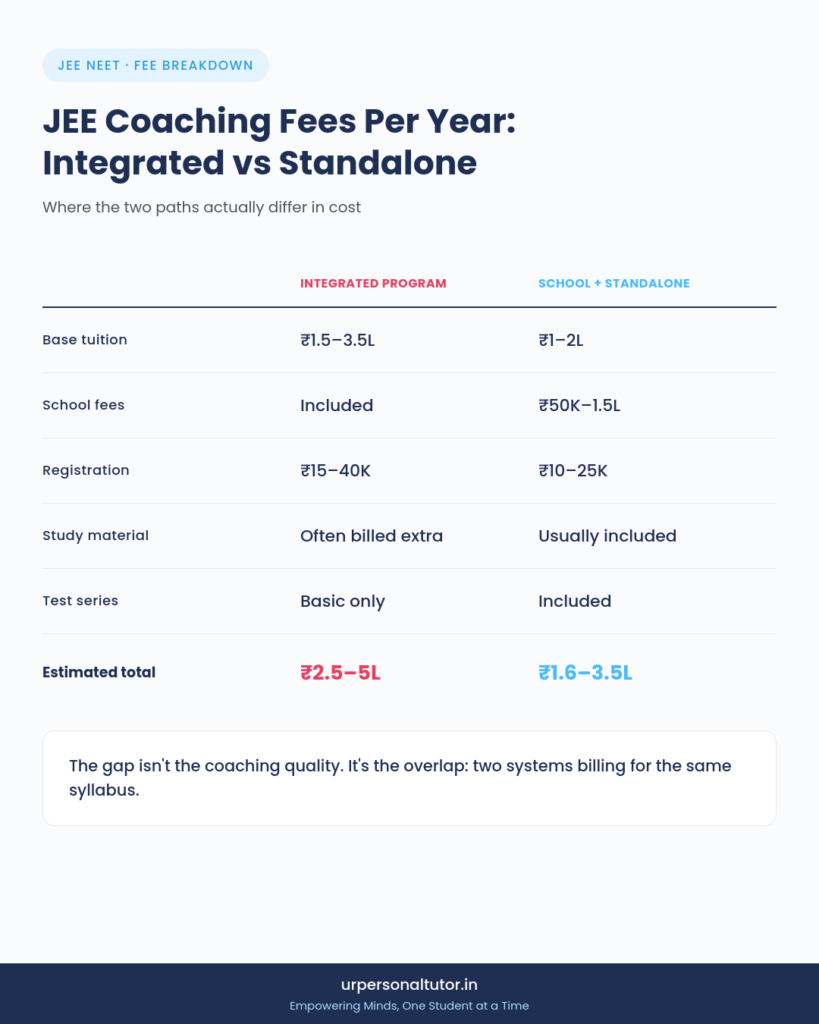
Once these are added, JEE coaching fees per year inside an integrated setup can land closer to ₹2.5-5 lakh, and NEET coaching fees in India follow a similar curve, sometimes higher because NEET test series and biology-specific material are billed separately from the physics-chemistry package.
Is Integrated Course Worth It? What You’re Actually Paying For
Here’s the honest answer: it depends on what the school does with the overlap, not on the brand name on the gate. Is integrated course worth it if the two timetables genuinely sync, so board topics and competitive-exam topics are taught once, in the right depth, at the right pace? Yes, in that case the fee buys real time savings.
Is it worth it if the “integration” is really just two unrelated schedules stapled together under one invoice? No. In that case a student ends up more exhausted and no better prepared than if the two pieces had been bought separately, at lower combined cost.
Many integrated brochures lean hard on the promise of foundation classes from class 8, as though starting early guarantees strong results later. It doesn’t automatically, and the fee premium attached to that promise deserves the same scrutiny as any other line item.
JEE Coaching Fees Per Year vs Standalone Coaching — Where the Math Actually Changes
Compare the two paths side by side and the picture gets clearer. Standalone JEE coaching, bought separately from a regular school, usually runs ₹1-2 lakh per year for a well-regarded institute. Add a regular school’s fees, typically ₹50,000-₹1.5 lakh depending on the board and city, and the combined total often comes in at or below what an integrated campus charges for the “convenience” of doing both under one roof.
The convenience is real when the coaching faculty and school faculty are the same people, or at least coordinate closely on pacing. It’s an illusion when they don’t. A faculty team that actually teaches you to solve IIT JEE physics problems at the pace a given student needs matters more than the brand name printed on the fee receipt. Before comparing JEE coaching fees per year across integrated versus standalone options, ask the admissions team a direct question: do the school teachers and coaching teachers share a syllabus map, or do they operate independently?
NEET Coaching Fees India: A Line Item Parents Often Miss
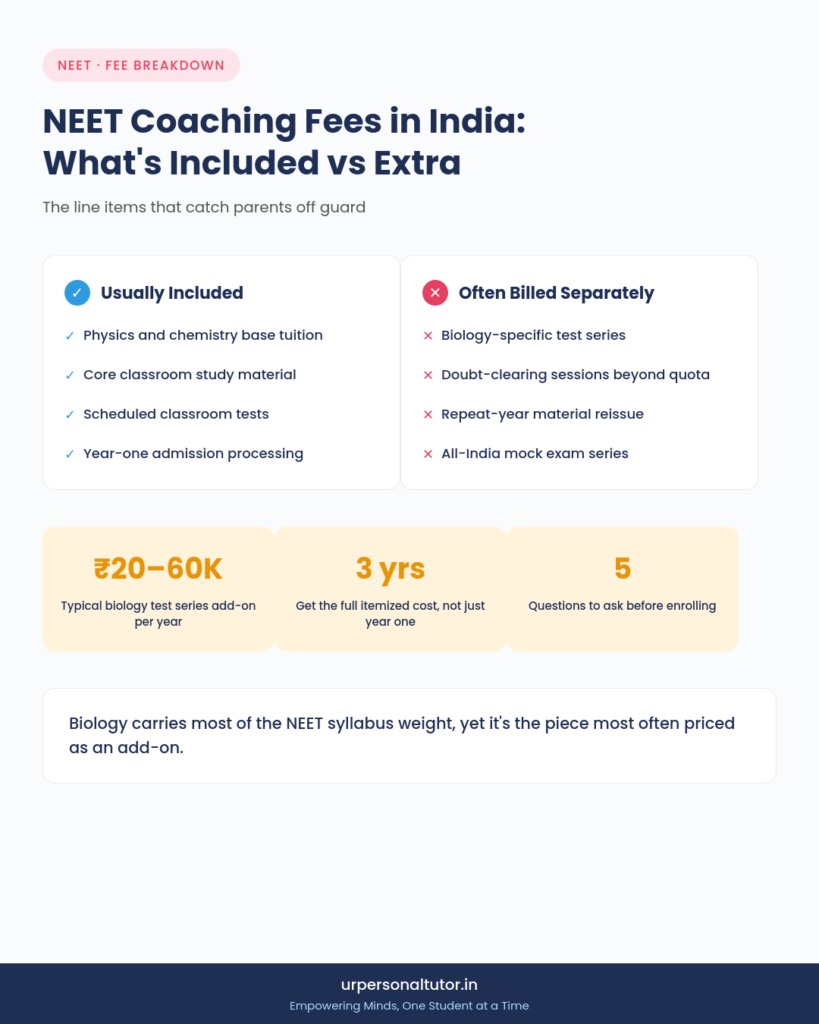
NEET-specific costs deserve their own scrutiny because biology carries most of the NEET syllabus weight, and biology-heavy test series are frequently priced as an add-on rather than bundled into the base integrated fee. A family budgeting purely off physics and chemistry coaching costs can be caught off guard when the biology test series invoice arrives separately in year two.
Biology tends to dominate the conversation, but a rushed or disconnected NEET physics preparation schedule can quietly cost just as much in extra tuition or repeat test series. Ask for a full itemized breakdown covering all three years before signing, not just the year-one number quoted at admission.
Myth: A Higher Fee Always Means Better Results
This is the myth worth busting directly, because it drives a lot of bad decisions. A higher integrated course fee does not reliably predict a higher rank or a better board score. What predicts results is practice volume, how quickly doubts get resolved, and whether the pace matches the student rather than the average of a 60-person batch.
A well-run ₹1.5 lakh program with tight faculty coordination and small batch sizes can outperform a ₹4 lakh program running two disconnected timetables. What fees genuinely buy: structured pacing, access to experienced faculty, and a built-in test series. What fees cannot buy: a student’s actual understanding of a concept, which still depends on practice volume and how quickly gaps get caught and fixed. No amount of tuition replaces that groundwork.
What to Ask Before Signing Up for an Integrated Program
Before committing to integrated course fees for JEE NEET, get straight answers to these questions from the admissions office:
- Do school and coaching faculty share a common syllabus calendar, or run independently?
- Is the NEET biology test series included in the base fee, or billed separately?
- What is the total three-year cost, itemized, not just the year-one figure?
- What is the average batch size in the coaching wing specifically, not the school-wide average?
- Is there a refund or adjustment policy if a student switches from the JEE track to the NEET track (or drops one) partway through?
A program that answers all five clearly, in writing, is usually one that has actually built an integrated system. A program that hedges on two or more of these is likely charging integrated fees for a setup that isn’t meaningfully integrated at all.
FAQs
Is integrated coaching cheaper than paying for school and coaching separately?
Not always. Once registration charges, repeat-batch material, and separate test series are added, many integrated programs cost the same or more than a standalone school plus a standalone coaching institute bought individually.
Do integrated schools guarantee better JEE or NEET results?
No school or coaching brand can guarantee a rank. Results track more closely with practice volume, doubt-resolution speed, and batch size than with the fee slab a family pays.
Can a student switch from an integrated JEE track to NEET mid-year?
Some programs allow this with an additional fee for the missing subject material (typically biology); others require a fresh admission cycle. This should be confirmed in writing before enrollment, not assumed.
Are integrated course fees for JEE NEET negotiable?
Base tuition is rarely negotiable, but material costs, transport, and hostel fees sometimes have flexibility, especially for early enrollment or sibling discounts. It’s worth asking directly rather than assuming the quoted figure is fixed.