
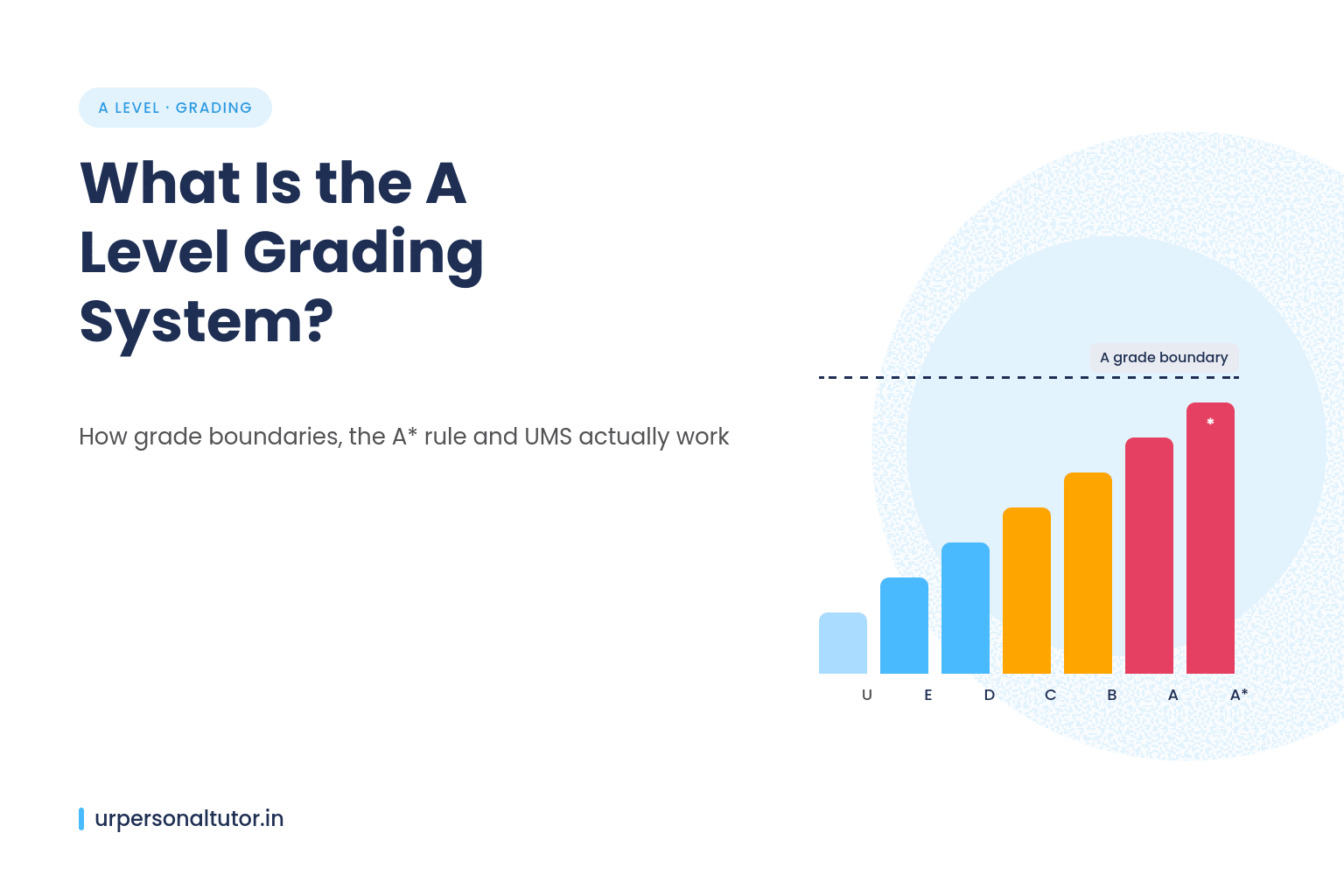
The A Level grading system awards letter grades from A* to E based on a student’s total marks across all exam papers in a subject, converted into a percentage band based on grade boundaries set by exam boards after each series. There’s no fixed percentage for an A or a B. Grade boundaries shift every year depending on how difficult that year’s papers turned out to be, which is exactly why two students who sit different years can score the same grade off different raw marks.
If you’re trying to make sense of a UCAS offer, a school report, or your own exam result slip, this guide breaks down exactly how the a level grading system works, who sets the boundaries, and what each grade actually means for your next step.
How A Level Grading System works?
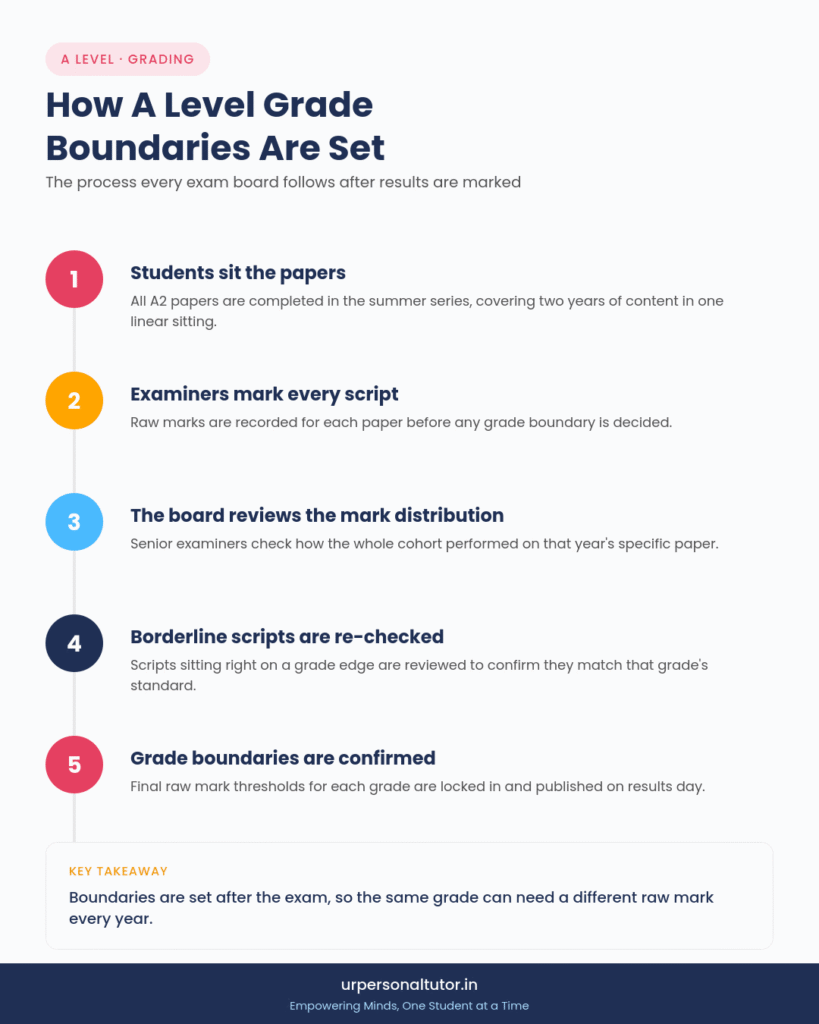
Each A Level subject is marked out of a total number of raw marks, usually somewhere between 200 and 300 depending on the exam board and how many papers make up the qualification. Once every student’s script has been marked, the exam board looks at the overall distribution of marks that year and decides where each grade boundary falls.
This process is called grade boundary setting, and it happens after the exams, not before. A senior examiner reviews scripts sitting right on the border between two grades, checking whether the work genuinely matches the standard expected for the higher grade. Only then are the final boundaries confirmed and published, usually alongside results day in August.
Six grades are possible at A Level: A*, A, B, C, D and E. Below E, a student receives a U, meaning unclassified, which does not count as a pass. The A* grade sits apart from the rest of the a level grading system, since it isn’t decided purely on the raw mark total.
The A* Grade Explained
To be awarded an A*, a student must first achieve an A grade overall, then also score 90% or above on the combined marks from their A2 papers specifically, which are the papers sat in the second year of the course. AS marks from the first year don’t count toward the A* calculation at all.
This two-part condition exists because Ofqual introduced the A* in 2010 to help universities distinguish between top performers when so many students were achieving straight As. A student can score 85% overall across the full course and still miss the A* if their second-year performance dips below that 90% threshold, even with a strong first year behind them.
Cambridge Grading System A Level vs UK Boards
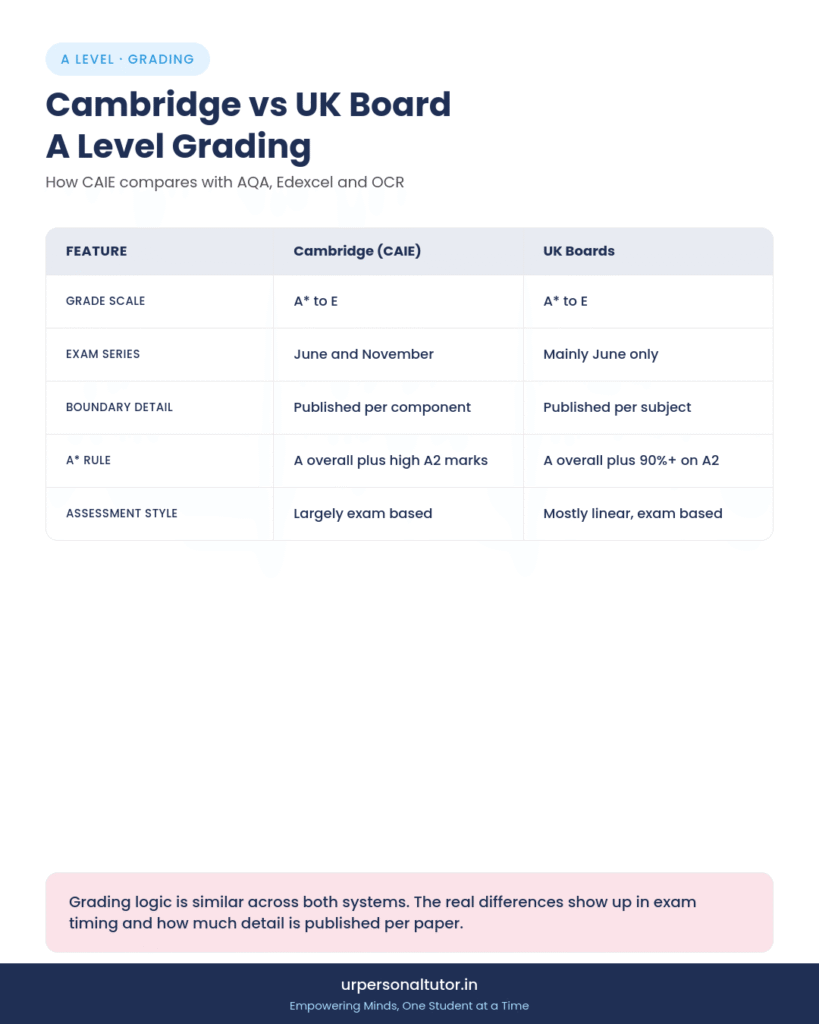
Students sitting Cambridge International A Levels (CAIE) follow a broadly similar structure to UK exam boards like AQA, Edexcel and OCR, but with a few real differences worth knowing. The cambridge grading system a level uses the same A* to E scale, yet Cambridge publishes indicative grade thresholds for each component alongside the overall subject grade, giving students a clearer sense of how marks in individual papers contributed to the final result.
Cambridge also runs two exam series a year, in June and November, compared to the single June series most UK boards rely on for the majority of entries. Students often land in this system straight after choosing between GCSE vs IGCSE at the earlier stage, and the two qualifications diverge more in structure and pacing than in the underlying grading philosophy.
How Grading Plays Out Differently Across Subjects
The a level grading system uses one shared scale, but what costs a student marks looks completely different depending on the subject. In English Literature or History, most marks sit in extended essay responses, and grade boundaries often hinge on how consistently a student can build an argument under time pressure across three or four essays in one sitting, rather than on any single fact recalled correctly.
In Mathematics and Further Maths, marks are awarded method by method within a working, which means a student can lose a final answer but still bank most of the marks if the working shown is correct up to the error. Chemistry and Biology sit somewhere in between: multiple-choice and short-answer sections reward precision and command words like “explain” versus “describe,” while longer application questions test whether a student can transfer a concept to an unfamiliar context rather than just recite it.
Physics tends to sit at the stricter end of this range, since a large share of the paper is calculation-based and a single sign error or missing unit can cost a mark that a similarly-sized slip in an essay subject wouldn’t. That’s part of why so many marks lost by otherwise strong physics students trace back to technique rather than a gap in understanding, the kind of avoidable error covered under common mistakes in A Level Physics that examiner reports flag every year.
AS Level vs A2: How the Two Years Combine
Since the 2015 curriculum reforms in England, AS and A2 have been decoupled. AS Level is now a standalone qualification worth half the UCAS points of a full A Level, and in most subjects it no longer counts toward the final A Level grade at all. Scotland, Wales and international Cambridge entries handle this differently, so the rules depend heavily on where a student is studying.
For students in England sitting linear A Levels, that means the final grade rests entirely on exams taken at the end of the second year, covering the full two years of content in one sitting. A student who coasted through year 12 content can’t rely on banked AS marks to soften a rough final exam season, whatever the subject, whether that means two years of vocabulary and grammar resurfacing at once in a language paper or two years of formulae and derivations all being fair game in a single sitting for sciences and maths.
What Each Grade Actually Means
A U grade means a student’s marks fell below the threshold for an E, and the qualification is not awarded. An E is the minimum pass grade, often accepted by less competitive university courses or as evidence of subject knowledge for apprenticeships and other routes. C and D grades sit in the middle of the range and remain widely accepted by many universities, particularly for courses where the specific subject isn’t a core entry requirement.
B and A grades are where most competitive offers are pitched, across subjects from economics to biology to modern languages. The a level grading system reserves A* almost exclusively for the most selective courses, things like medicine, law, or engineering at top-tier institutions, where an AAA or AA*A offer isn’t unusual.
Why Grade Boundaries Change Every Year
A level grading system boundaries move because exam difficulty isn’t perfectly consistent from year to year, even with careful question design. If a particular paper turns out harder than intended, the boundary for an A might drop from 75% to 68% raw marks, so that the proportion of students achieving each grade stays roughly stable across years and across subjects. This process, sometimes called comparable outcomes, is meant to protect students from being penalised simply for sitting exams in a tougher year.
It’s a common misconception that boundaries are fixed percentages decided in advance. They’re not. A student aiming for a B in Chemistry one year might need 62% raw marks, while a friend the following year needs 58% for the same grade in the same subject, purely because that year’s paper behaved differently in practice. The same happens in Economics, History and every other subject independently, since each subject’s boundaries are set on its own cohort’s performance.
Common Myths About A Level Grading
Myth: Every board grades to the same percentage. Different exam boards, AQA, Edexcel, OCR, WJEC, set their own boundaries independently, and a 75% in one board’s paper won’t necessarily land the same grade as 75% in another’s for the same subject.
Myth: Coursework and controlled assessment still count in every subject. Most A Level subjects moved to 100% exam assessment under the linear reforms, with only a small number, like art and design, drama, or certain sciences with a practical endorsement, retaining non-exam elements. Where a science practical endorsement does apply, it’s reported separately as pass or not classified and doesn’t affect the overall subject grade at all.
Myth: Resits average with your original grade. They don’t. If a student resits a unit or full qualification, the new result typically replaces the old one entirely, it isn’t blended or averaged, so a resit is a genuine second attempt rather than a top-up.
Turning a Grade Boundary Into a Target
Because boundaries can’t be predicted in advance, the safest strategy across any subject is aiming well above the minimum a grade has historically required, not just scraping the edge of it. In essay-based subjects that margin usually comes from timed practice under real exam conditions, while in calculation-heavy subjects like Maths and Physics it tends to come from drilling the specific question types that repeatedly trip students up, which is why a focused last 30 days A-Level physics revision plan built around past-paper patterns tends to close more of that gap than generic revision in the final stretch.
Book a Consultation
Understanding the a level grading system is only half the picture. Turning that understanding into a grade that matches your target offer takes consistent, subject-specific practice, whatever that subject is, and many students find that gap closes fastest with one-to-one a-level tuition or subject-specific support built around their exam board’s actual grade boundaries rather than a generic revision guide. Get in touch to book a consultation and put together a plan for the year ahead.
Frequently Asked Questions
Is an A* harder to get than an A in A Level?
Yes, meaningfully so. An A requires an overall raw mark total in the top band for that subject, while an A* additionally requires 90% or above specifically on the second-year papers, meaning a strong first year can’t compensate for a weaker final year performance.
Do universities accept a C grade at A Level?
Many do, particularly for courses where the specific subject isn’t a strict requirement, though competitive courses at research-intensive universities generally expect grades from B upward, and highly selective subjects like medicine often require close to straight A*s.
Can grade boundaries be different for the same subject across exam boards?
Yes. AQA, Edexcel, OCR and WJEC each set their own boundaries independently after every exam series, so a raw mark that earns a B on one board’s paper might land a different grade on another board’s equivalent paper that year.
Do all A Level subjects use the same grading scale?
Yes, every A Level subject uses the same A* to E scale, though the raw marks required to reach each grade vary by subject and by year, since each subject’s papers are graded against their own boundary set rather than a shared numerical target.
What happens if I get a U grade at A Level?
A U means the qualification isn’t awarded for that subject, and it won’t appear on a certificate as a pass. Students can usually resit the full A Level or, in some cases, specific units, depending on the exam board’s current resit policy.