
A working JEE Advanced preparation strategy rests on three things: pushing past JEE Main level accuracy into multi-concept problem solving, restructuring revision around your weakest chapters instead of your favourite ones, and building a practice routine that mirrors the exam’s actual question style months before you sit it. Most students skip straight to solving Advanced-level papers without doing any of that first, and the results usually show it.
A lot of JEE Advanced preparation still gets treated as an extension of JEE Main prep, just with a few harder books added in. That approach runs out of road fast. The exams test overlapping syllabus content, but the way JEE Advanced questions are framed, scored, and structured demands a different kind of practice altogether. This piece breaks down what an actual JEE Advanced preparation strategy needs to include, and where most students lose time chasing the wrong things.
What JEE Advanced Preparation Actually Requires Beyond JEE Main
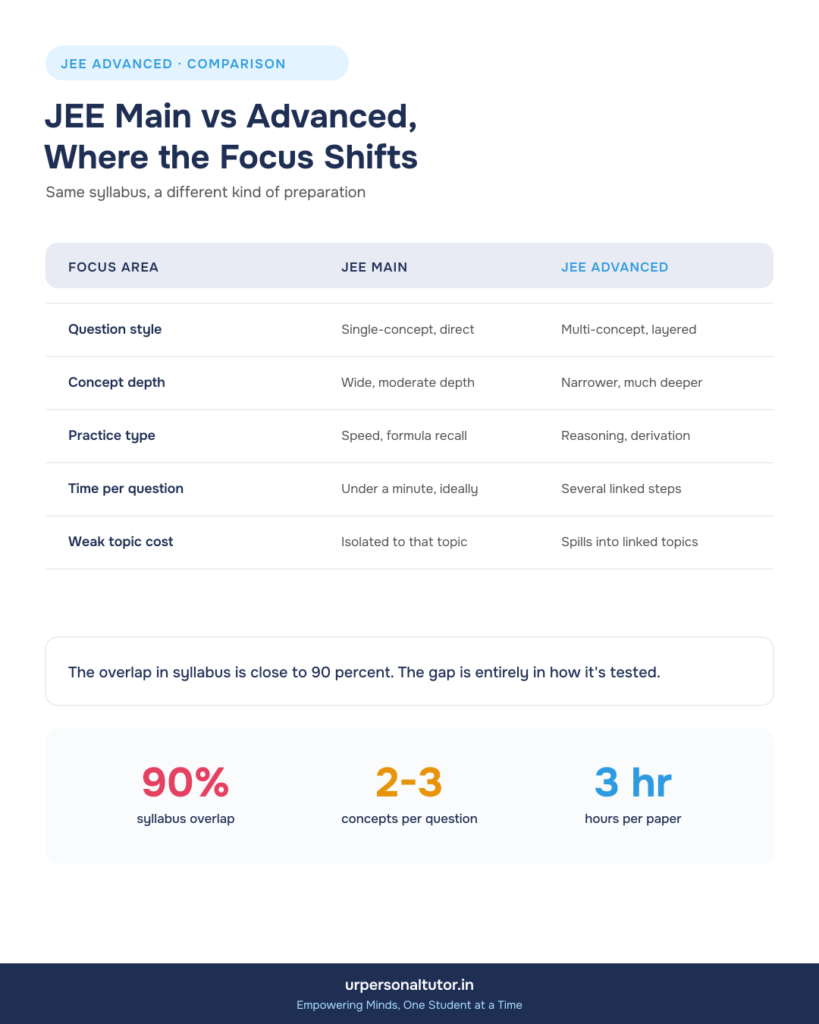
JEE Main rewards speed and formula recall across a wide but shallow syllabus. JEE Advanced rewards depth. A single question often pulls concepts from two or three chapters at once, expects you to justify intermediate steps, and penalises guesswork heavily through its negative marking pattern. Students who cleared Main comfortably sometimes find Advanced-level questions unfamiliar in structure even when the underlying topic is one they know well.
That gap is the entire reason JEE Advanced preparation needs its own plan rather than a continuation of Main-level revision. Comprehension-type and multi-correct questions, common in Advanced papers, punish memorised shortcuts and reward students who can reconstruct a concept from first principles under time pressure.
Building a JEE Advanced Preparation Strategy Around the Syllabus
The syllabus overlap between JEE Main and JEE Advanced sits close to 90%, so a JEE Advanced preparation strategy isn’t really about learning new topics. It’s about redistributing your time toward chapters that carry disproportionate weight in Advanced papers specifically. Mechanics, electrostatics, and organic chemistry reaction mechanisms consistently pull more marks in Advanced than their JEE Main weightage would suggest, while a handful of high-frequency Main topics barely feature.
This is where a lot of students misallocate their final months. They keep revising chapters they’re already strong in because it feels productive, while chapters like coordination chemistry or rotational dynamics, both notorious for Advanced-style twists, get pushed aside simply because they’re harder to revise.
How Much Practice a Realistic JEE Advanced Preparation Schedule Needs
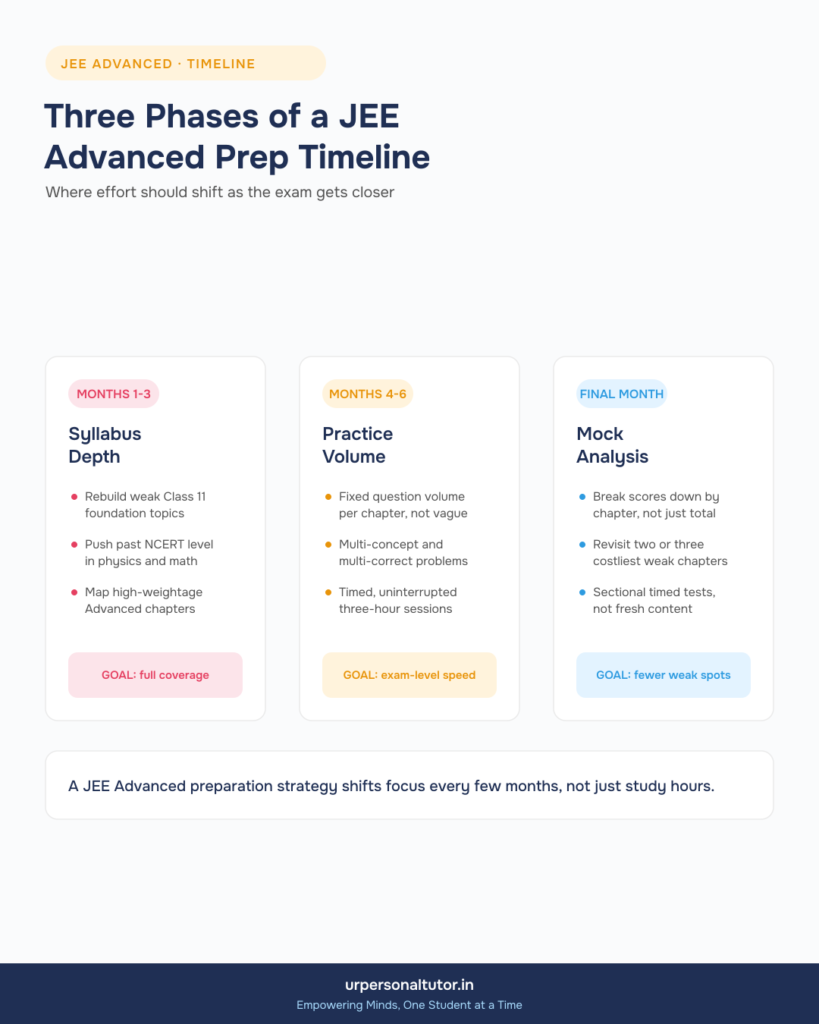
Vague daily targets like “solve more problems” rarely translate into real progress. A more useful benchmark is chapter-level: working through a defined volume of mixed-difficulty questions per topic before moving on, rather than jumping between chapters after a handful of easy problems each. Our breakdown on how many questions to solve per chapter for JEE sets out practical ranges that hold up well even at the Advanced level, since the core issue it addresses, low mock scores despite decent chapter knowledge, shows up just as often in Advanced prep as it does in Main.
Practice volume matters, but sequencing matters just as much. Advanced-style preparation works best when easier problems are used to confirm a concept is solid, and harder, layered problems are used to actually test it. Skipping straight to the hardest problem sets in a chapter usually just wastes time relearning basics mid-solution.
Solving Problems the JEE Advanced Way
The biggest shift in JEE Advanced preparation isn’t content, it’s method. Advanced questions are built to be solved through a chain of smaller deductions rather than a single formula application, and students who haven’t practiced that specific skill tend to freeze on questions they’d otherwise be capable of answering. A structured approach to solving IIT JEE physics problems may help, particularly the habit of writing down what’s actually being asked before reaching for an equation, since misreading a multi-part Advanced question costs far more than misreading a Main one.
Timed practice under exam-like conditions matters more here than it does for Main prep. Three hours of uninterrupted problem solving, without breaks or reference material, exposes gaps that shorter practice sessions hide completely.
Why Foundation Gaps From Class 11 Resurface in JEE Advanced
A surprising number of Advanced-level struggles trace back to Class 11, not Class 12. Concepts introduced early, like vectors, basic thermodynamics, or mole concept, get treated as settled once a student moves past them, but Advanced questions frequently combine those early topics with more advanced Class 12 material. If the Class 11 base was shaky to begin with, that combination question becomes the point of failure.
This is one reason class 11 foundation gaps show up so often among students who otherwise look well prepared on paper. A JEE Advanced preparation strategy that only looks forward from where a student currently stands, without checking whether the early foundation actually holds, tends to leave these gaps untouched until they surface in a mock test at the worst possible time.
Common Mistakes in JEE Advanced Preparation
The most common mistake is treating mock test scores as a pass or fail signal rather than a diagnostic tool. A mediocre score on an Advanced-pattern mock is far more useful when it’s broken down by question type and chapter than when it’s just logged as a number to improve next time.
Another recurring issue is over-reliance on a single source of practice material. Advanced papers vary in style year to year, and students who only work through one coaching institute’s question bank often find real exam questions phrased in ways they haven’t encountered before.
A third mistake sits in revision timing. Students frequently push full syllabus revision into the final month, leaving almost no room for the kind of slow, connected problem solving that Advanced-level questions actually demand. By that point, there’s time to review formulas, but not enough time to rebuild the deeper understanding a difficult multi-concept question requires.
How to Prepare for JEE Advanced in the Final Six Months
Six months out is usually the point where a JEE Advanced preparation strategy needs to shift from content coverage to targeted correction. Full syllabus revision should already be close to complete by this stage, which frees up time for chapter-wise mock analysis, timed sectional tests, and deliberately revisiting the two or three chapters that keep costing the most marks. Students who spend this window purely on fresh content rather than correcting known weak spots tend to plateau earlier than they expect.
FAQs
How is JEE Advanced preparation different from JEE Main preparation?
JEE Advanced questions test the same syllabus in greater depth, often combining multiple concepts in a single question and applying stricter negative marking, which means preparation needs to prioritise multi-step problem solving over quick recall.
How many hours a day does JEE Advanced preparation actually need?
There’s no fixed number that works for everyone, but consistency across fewer, focused hours generally outperforms long, unfocused study blocks, especially once revision shifts toward mock analysis.
Should JEE Advanced preparation include NCERT revision?
Yes for chemistry, where NCERT-level facts still appear directly in questions, but physics and math require moving well beyond NCERT depth fairly early in the preparation timeline.
Is coaching material enough for a full JEE Advanced preparation strategy?
It covers most of what’s needed, but supplementing with varied question sources helps students avoid being caught off guard by unfamiliar phrasing or question formats on exam day.
When should mock tests start in a JEE Advanced preparation plan?
Once core topics are reasonably covered, usually a few months before the exam, since starting too early means the diagnostic value of a mock is wasted on gaps that are still expected at that stage.