
An IB physics tutor gives a student something a classroom of twenty rarely can: full attention on exactly where their understanding breaks down. The IB Physics syllabus, at both HL and SL, moves through concepts fast and expects students to apply them in unfamiliar contexts during Paper 2 and Paper 3. When a student falls one step behind in class, that gap tends to widen rather than close on its own.
That’s the short answer. Here’s what actually changes when a student moves from group teaching to working with an IB physics tutor.
Why the IB Physics Syllabus Rewards One-to-One Teaching
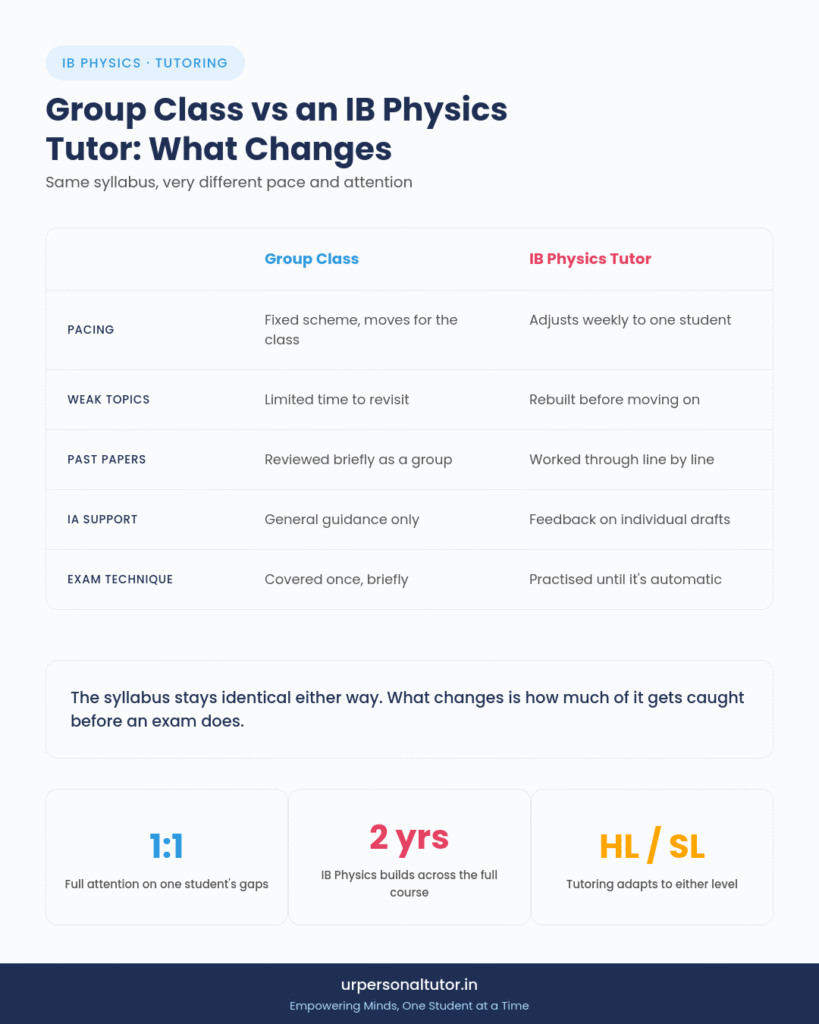
IB Physics isn’t structured like most school-leaving exams. Command terms like “derive,” “discuss,” and “evaluate” ask for reasoning, not recall, and Paper 3 in particular tests how a student handles data they’ve never seen before. A classroom teacher covering thirty students simply cannot pause on every misunderstanding without losing the rest of the group.
An ib physics tutor works the opposite way. Every session adjusts to what one student actually needs that week, whether that’s rebuilding a shaky grasp of simple harmonic motion or working through past-paper data analysis line by line. The pacing follows the student, not a fixed scheme of work.
What an IB Physics HL Tutor Focuses On
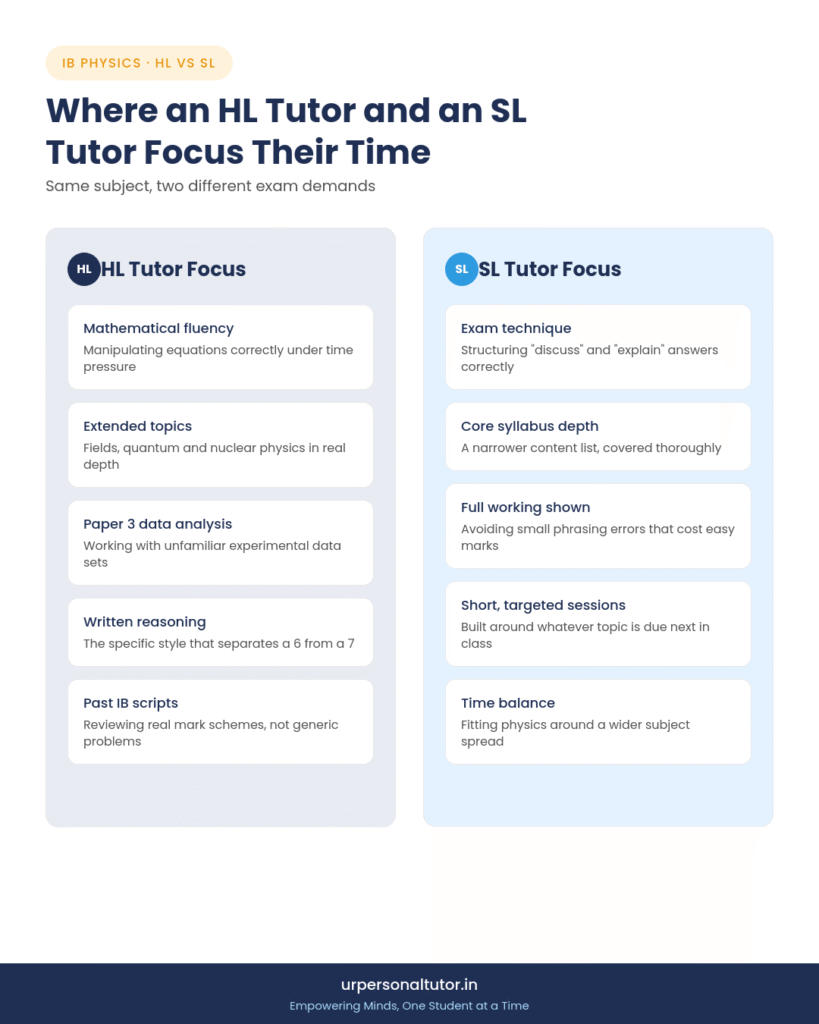
Higher Level physics adds real depth in areas like fields, quantum and nuclear physics, and the more demanding end of mechanics. An ib physics hl tutor typically spends more time on mathematical fluency, since HL problems often hinge on manipulating equations correctly under exam pressure rather than just knowing the right formula.
Sessions with an HL tutor usually work through past IB-style questions rather than generic textbook problems, since the internal assessment and exam style reward a very specific kind of written reasoning. A tutor who has marked or reviewed IB scripts before knows exactly what separates a 6 from a 7, and that insight is difficult to get from self-study alone.
What an IB Physics SL Tutor Focuses On
Standard Level physics covers a narrower slice of content but still demands the same command-term precision in exam answers. An ib physics sl tutor often spends more time on exam technique: structuring a “discuss” answer correctly, showing full working for calculation questions, and avoiding the small phrasing mistakes that cost easy marks.
Because SL students often juggle a wider spread of subjects, an SL-focused tutor tends to work in shorter, more targeted sessions built around whatever topic is due next in class, rather than a long-term deep rebuild of foundational concepts.
How an IB Physics Online Tutor Compares to In-Person Sessions
An ib physics online tutor can cover exactly the same syllabus depth as an in-person tutor, and for many students the format works just as well or better. Screen-sharing makes it easy to annotate past papers together in real time, and recorded sessions give students something to revisit before exams.
The main difference is logistics rather than teaching quality. Online sessions remove commute time entirely, which matters during the final months before exams when every hour counts. Students juggling IB alongside other commitments often find that flexible scheduling, something a good one-to-one tuition setup should offer regardless of format, makes it far easier to stay consistent through the two-year course.
Signs a Student Would Benefit From an IB Physics Tutor
A student doesn’t need to be failing to benefit from tutoring. Some common signals show up well before grades slip: consistently running out of time on Paper 2, understanding a concept in class but freezing on it in a past paper, or getting stuck on the same topic across multiple attempts at internal assessment drafts.
Physics also compounds. A weak grasp of vectors in the first term makes fields and circular motion harder a year later. An ib physics tutor who spots that pattern early can rebuild the missing piece before it affects three or four other topics down the line.
Building an IB Physics Study Plan Around Tutoring
Tutoring works best when it fits into a wider study rhythm rather than replacing one. Most students see the biggest gains when weekly sessions are paired with a clear sense of what’s coming up on the IB calendar, from internal assessment deadlines to mock exams.
Getting this timing right matters more in the IB than in most other systems, since coursework, exams and university application deadlines often overlap. A student mapping out their final months of IB revision alongside tutoring sessions tends to walk into exams with far less last-minute scrambling than one relying on tutoring alone to catch everything up.
What Realistic Progress With an IB Physics Tutor Looks Like
Progress with an ib physics tutor rarely shows up as a sudden jump. It’s more often a steady climb across a term: fewer careless errors on calculation questions, faster recognition of which formula a question is actually asking for, and gradually more confident answers to “explain” and “evaluate” style questions.
Students aiming for the very top grades sometimes ask what separates a 6 from a 7 in the final result. A closer look at what it actually takes to score a 7 in IB Physics usually comes down to exam technique and depth of understanding built up over many months, not a single trick applied in the final weeks.
Frequently Asked Questions
How many hours a week should I spend with an IB physics tutor?
This depends heavily on where a student stands relative to the syllabus. One to two hours a week is typical for a student keeping pace with class, while students rebuilding a specific weak area sometimes benefit from a short, more intensive block instead of spreading sessions thin.
Is an IB physics tutor useful for internal assessment, or just exam prep?
Internal assessment often benefits more from tutoring than final exam prep does, since IA marking criteria are specific and a tutor who understands them can catch structural issues in a draft long before a deadline.
Can a tutor help with both HL and SL physics, or should I look for a specialist?
Many tutors teach across both levels comfortably, since the core syllabus overlaps significantly. The bigger factor is whether the tutor has genuine familiarity with IB-specific command terms and mark schemes, not just physics knowledge in general.
Does switching from group classes to one-to-one tutoring mean dropping group classes entirely?
Not necessarily. Many students keep their school classes for structure and pace, and add one-to-one sessions specifically to fill gaps or prepare for assessments the group pace doesn’t allow time for.
When in the two-year IB course should tutoring start?
Earlier is generally better, since physics concepts build on each other across the two years. That said, targeted tutoring in the final six months before exams can still meaningfully impr